MeetingMiner – Project Story
Inspiration
Meetings are where decisions are made, but execution often breaks afterward.
In most teams, someone records the call, another person writes notes, tasks are scattered across chats, and ownership becomes unclear. Important commitments are forgotten, deadlines slip, and accountability disappears.
Existing AI note-takers generate summaries, but summaries are not execution systems.
We asked:
What if the meeting could end and the work could already be organized?
What if AI could listen, understand intent, detect commitments, resolve ambiguity, and prepare follow-through automatically?
That idea became MeetingMiner.
What it does
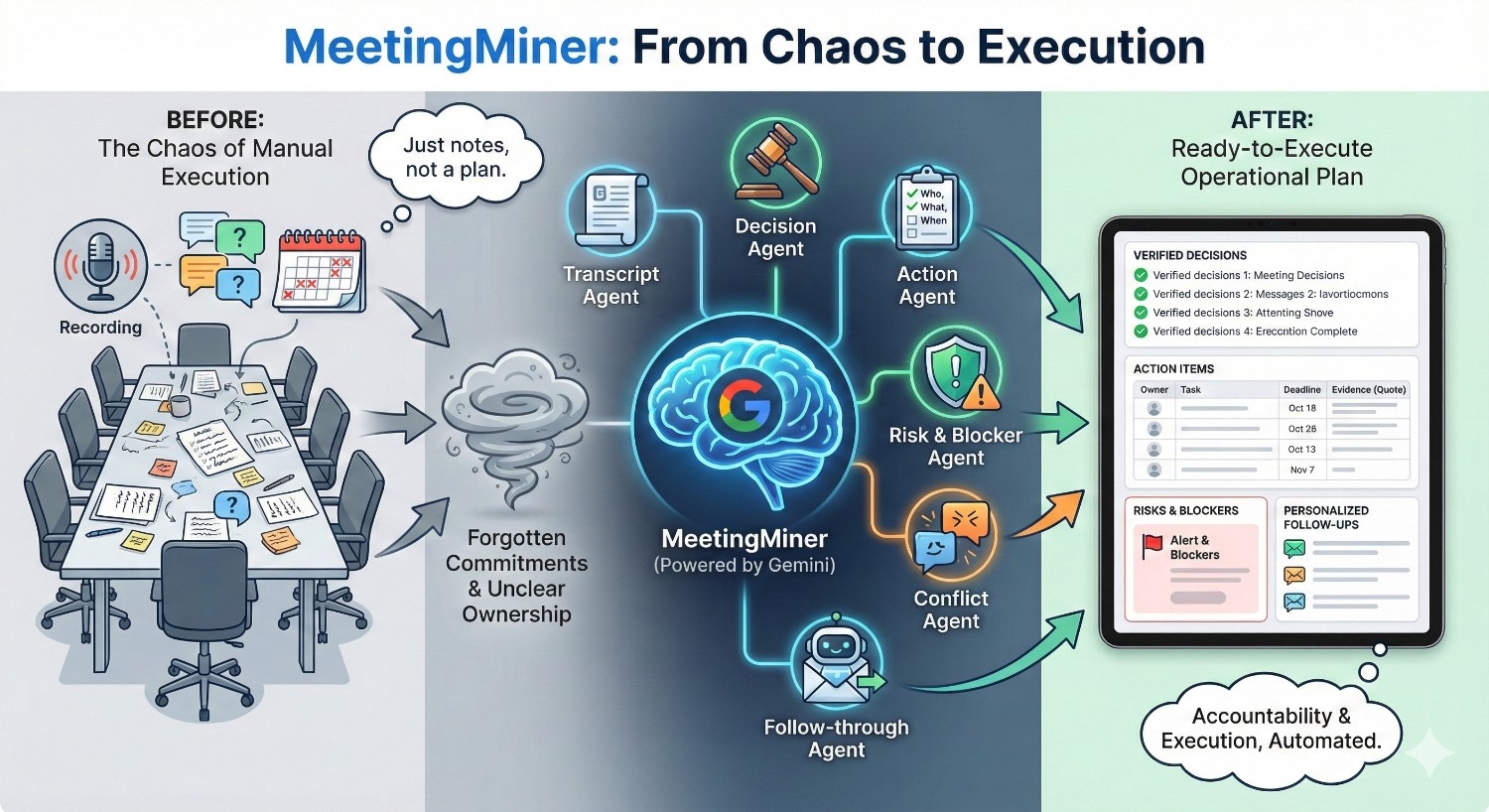
MeetingMiner transforms a meeting recording into:
- Verified decisions
- Action items with owners
- Deadlines
- Dependencies & blockers
- Unresolved conflicts
- Personalized follow-up messages
Instead of “notes”, teams receive a ready-to-execute operational plan.
How it works
We built a multi-agent system powered by Gemini.
Each agent has a specialized responsibility:
🎧 Transcript & Speaker Agent
Creates structured conversation with timestamps and attribution.
Decision Agent
Distinguishes firm decisions from brainstorming or speculation.
Action Agent
Extracts commitments in the form:
who → will do → what → by when
Risk & Blocker Agent
Finds statements like
“we can’t ship until legal approves”.
Conflict Agent
Detects disagreements or unresolved debates.
Follow-through Agent
Generates personalized summaries and ready-to-send follow-ups for each participant.
What makes this different from existing tools
Most products stop at summarization.
MeetingMiner focuses on accountability & execution.
Every extracted action item includes:
- timestamp
- speaker
- original quote (evidence)
So teams can verify why something exists.
We also surface what is missing: no owner, no deadline, or vague commitments.
Why Gemini made this possible
Gemini’s strengths allow us to:
- handle long, messy conversations
- reason across multiple speakers
- understand intent vs suggestion
- connect statements across time
- produce structured outputs for downstream automation
Without strong reasoning, these signals are impossible to extract reliably.
Challenges we faced
Ambiguity.
Humans rarely speak in structured task formats.
Example: “Yeah I’ll try to send it sometime next week.”
Is that a commitment?
Who owns it?
What is “next week”?
We built validation agents that:
- flag uncertainty
- request clarification
- or assign confidence levels
What we learned
Execution intelligence is harder than summarization.
To move from words → responsibility, AI must reason about intent, context, and consequences.
But when it works, the productivity gain is enormous.
Impact
The average professional spends hours each week writing follow-ups and tracking decisions.
MeetingMiner reduces this to minutes.
When meetings end, teams already know:
✔ what was decided
✔ who is responsible
✔ what happens next
What’s next
We want to integrate with calendars, task managers, and communication tools to create a fully autonomous post-meeting workflow engine.
Meetings shouldn’t produce documents.
They should produce momentum.


Log in or sign up for Devpost to join the conversation.