-
-
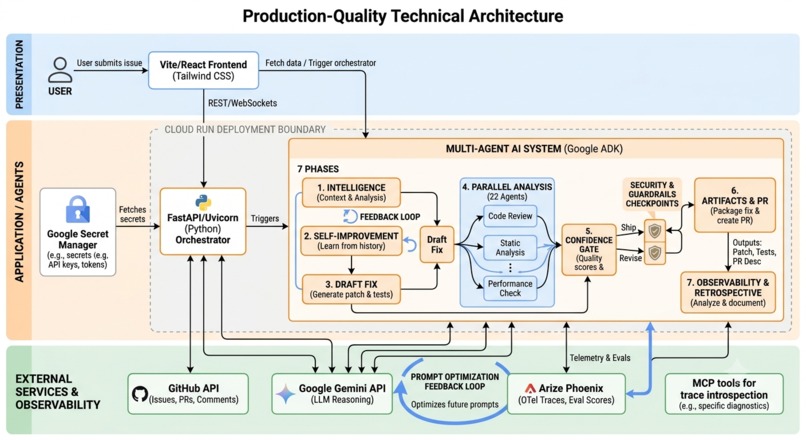
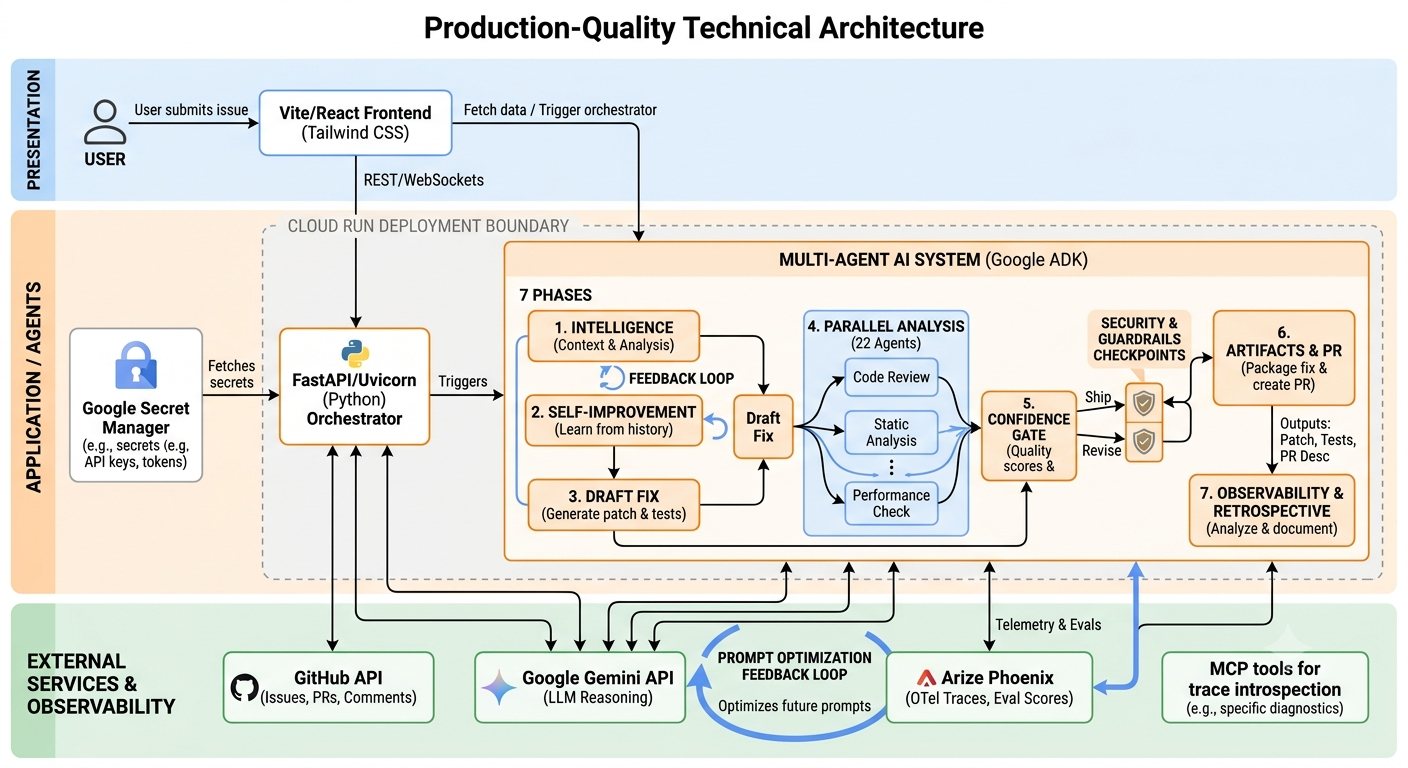
Architecture Diagram
Inspiration
Software teams lose huge time moving from bug report to safe code change, and we wanted to compress that cycle. We were inspired by the idea of treating AI agents like a real engineering squad with specialized roles. The goal was to make delivery faster without sacrificing review quality, security, or traceability.
What it does
Dev Velocity Optimizer converts a GitHub issue into a quality-gated pull request using a multi-agent pipeline. It triages the problem, drafts a fix, runs parallel risk and quality checks, and decides whether to ship, revise, or escalate. Every step is traced in Phoenix so teams can audit decisions and improve over time.
How we built it
We built the backend with FastAPI and Google ADK, with an orchestrator coordinating 22 specialized agents across 7 phases. Gemini powers generation and review tasks, while GitHub tools handle issue/PR workflows and Phoenix captures observability and eval signals. The frontend is a React dashboard for simulation, live runs, traces, and status visibility.
Challenges we ran into
The biggest challenge was Phoenix key behavior: trace ingestion worked while direct read endpoints returned auth errors for our key scope. We solved this with graceful fallbacks and health reporting based on active tracing, so the system stayed reliable for demos and judging. We also tightened config validation so missing GitHub settings fail clearly instead of causing confusing generic errors.
Accomplishments that we're proud of
We delivered an end-to-end autonomous workflow that is both practical and demo-ready. We implemented safety layers like confidence gating, redaction checks, and escalation paths rather than shipping raw LLM output.
What we learned
We learned that orchestration quality matters as much as model quality in real engineering automation. Strong observability and explicit guardrails make agent systems trustworthy for real workflows. We also learned to design for degraded modes early, because reliability under imperfect credentials and APIs is a competitive advantage.
What's next for Dev Velocity Optimizer
Next we plan deeper GitHub automation, including branch creation and safer patch application in isolated execution. We will add stronger eval datasets and trend analytics to quantify long-term improvement and regression risk. We also plan production hardening on Cloud Run with managed identity, persistent storage, and team-level policy controls.


Log in or sign up for Devpost to join the conversation.