Inspiration
- AI coding agents are a normal part of engineering workflows; a new kind of founder — the solopreneur — runs a startup with AI doing much of the heavy lifting.
- We asked: what if you could see those agents at work, treat them like real employees, and run the team yourself?
- Goal: a game where each engineer has personality, preferences, and quirks — people you hire, manage, and sometimes fire.
What it does
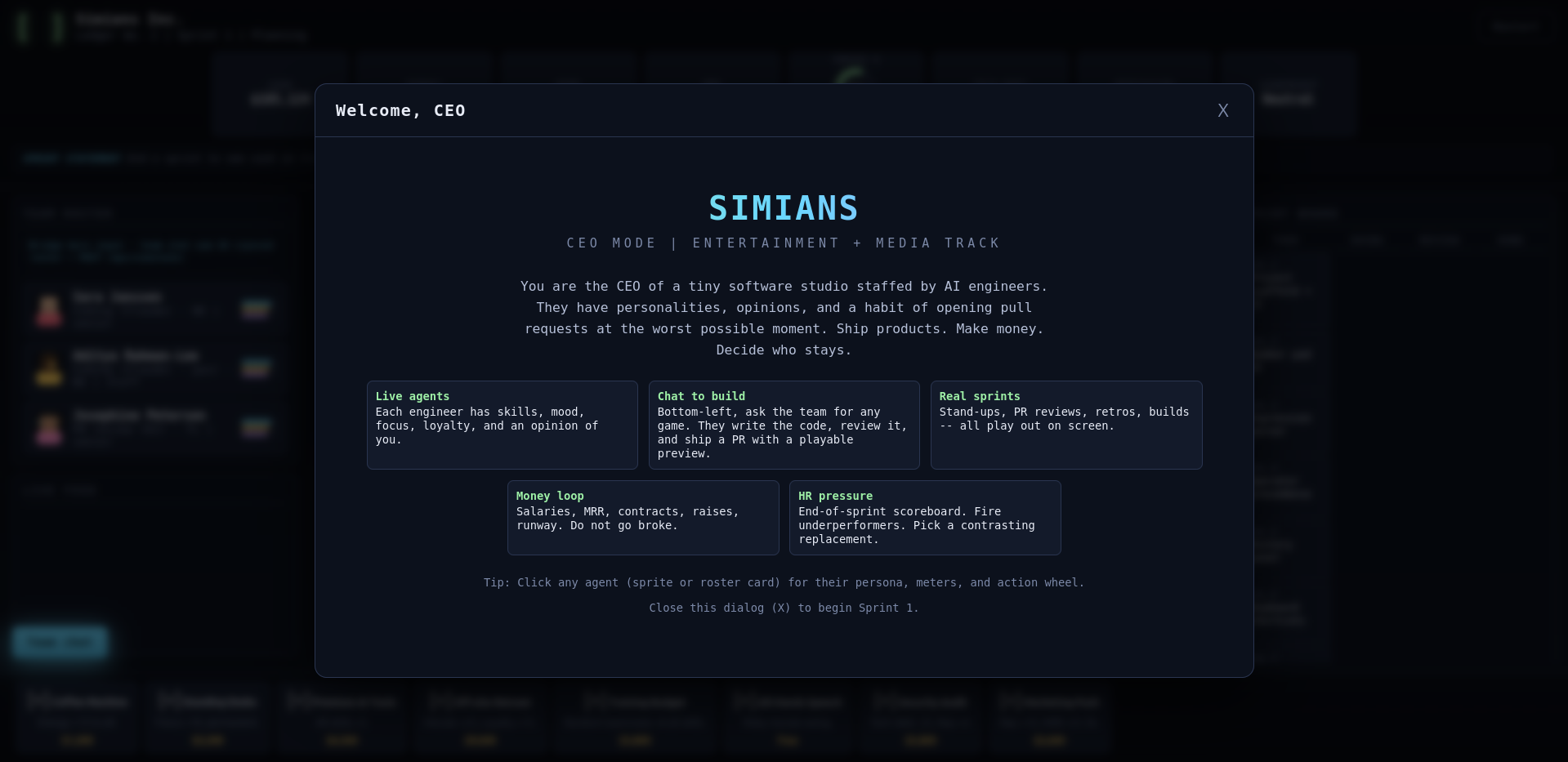
- Simians wraps a live multi-agent build in a retro pixel CEO view: you play the CEO, not the IDE.
- Agents run stand-ups, pick up work, open PRs, review each other, and ship sprint by sprint.
- End of sprint: performance scores, coaching / fire decisions, and replacement candidates chosen for contrast to shake up team dynamics.
How we built it
- Frontend: Vite + vanilla JS + Canvas 2D for the studio sim HUD (see
frontend/).
- Orchestration: Python
dev_sim_bridge — planning (optional), Claude coding agent, K2 PR review (optional fast-path skip), real GitHub PRs under agent identities so history looks like a real team.
- Local dev: Vite app under
frontend/, bridge via python -m dev_sim_bridge from the repo root (details in README).
- Real remotes: the coding agent pushes the working branch to
origin so GitHub can open a real PR. In src/dev_sim/coding_agent.py, after optional origin rewrite with the GitHub token, the push is a plain subprocess wrapper around git:
push = _run_git_subprocess(repo, ["push", "-u", "origin", br])
- A planner decomposes the CEO’s product idea into sprint-sized work before coding agents take over.
Challenges we ran into
- PR workflow: everyone had a slightly different mental model of task → commit → PR; prose wasn’t enough — several discussions and whiteboard passes before the flow converged.
- One-shotting: agents initially dumped whole projects in a single commit on one branch — technically fine, but not how real teams work.
- Fix: a dedicated planning step and explicit definitions of what a “task” / “feature” is before anything reaches the coding agent.
Accomplishments that we're proud of
- A multi-agent pipeline that builds on itself: real repo, real PRs, review loop, runnable output.
- Shipping something this unusual in the time we had.
What we learned
- Multi-agent setups burn credits fast — budget top-ups happened more than once over two days.
- Decomposition quality upstream dominates outcomes: good planning saves a lot of wasted token spend downstream.
What's next for Simians
- Deeper personas — more roles and quirks that change how agents work, not only how they talk.
- Broader specs — any product brief, not only small seed apps, built end to end.
- Richer studio sim — budgets, morale, tech debt, CEO “initiatives” mid-sprint.
- Longer term: a sandbox to study how team composition affects what actually ships.


Log in or sign up for Devpost to join the conversation.