-
-
Welcome to Dev Archeotype Tree
-
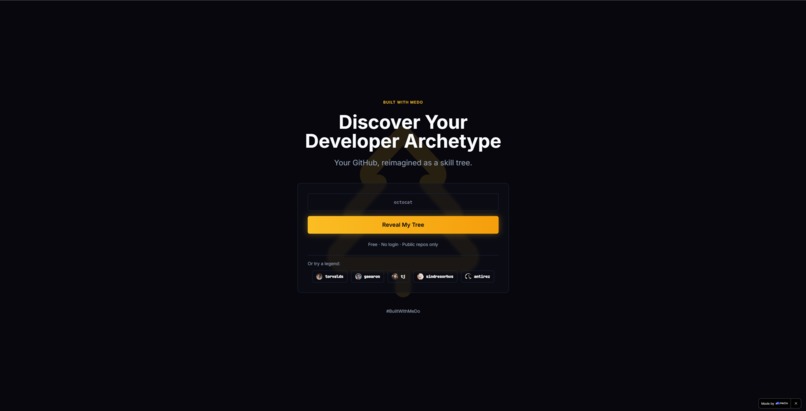
Ready to innovate your Archetype?
-
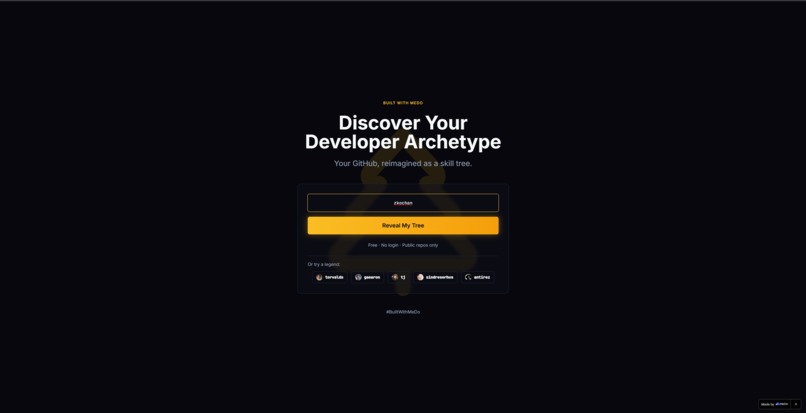
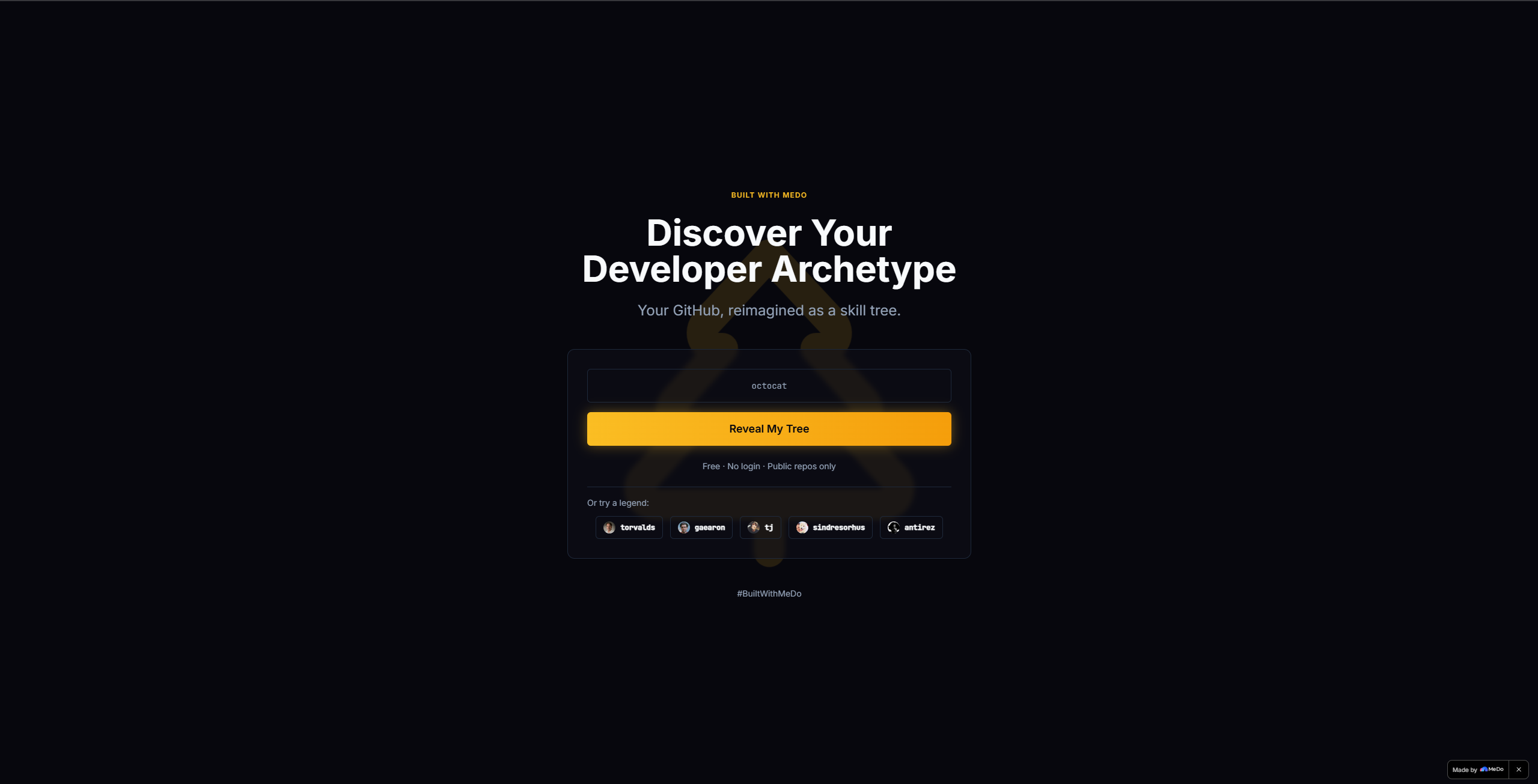
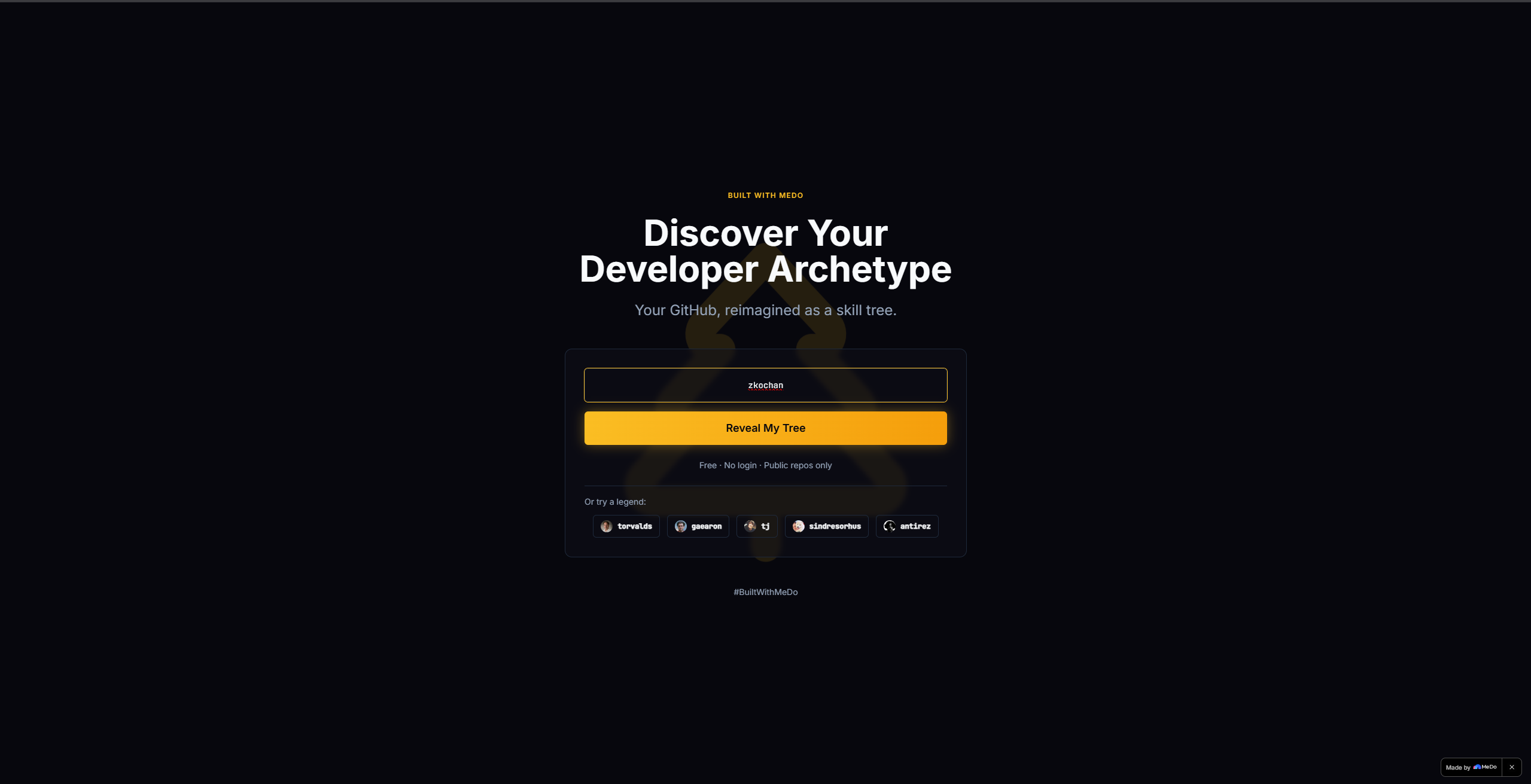
Just Put your github nickname.
-
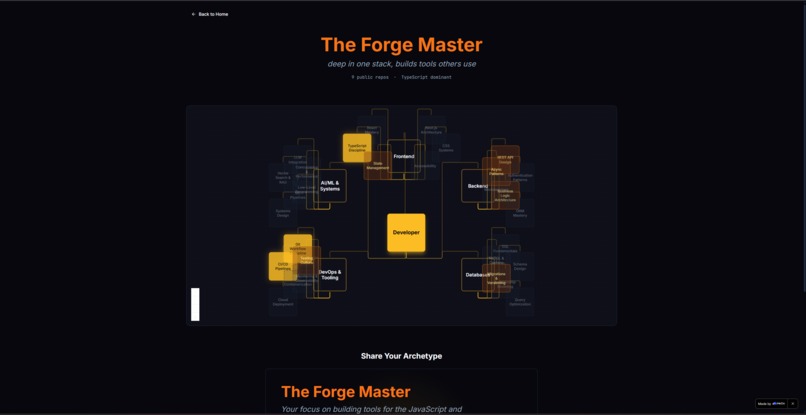
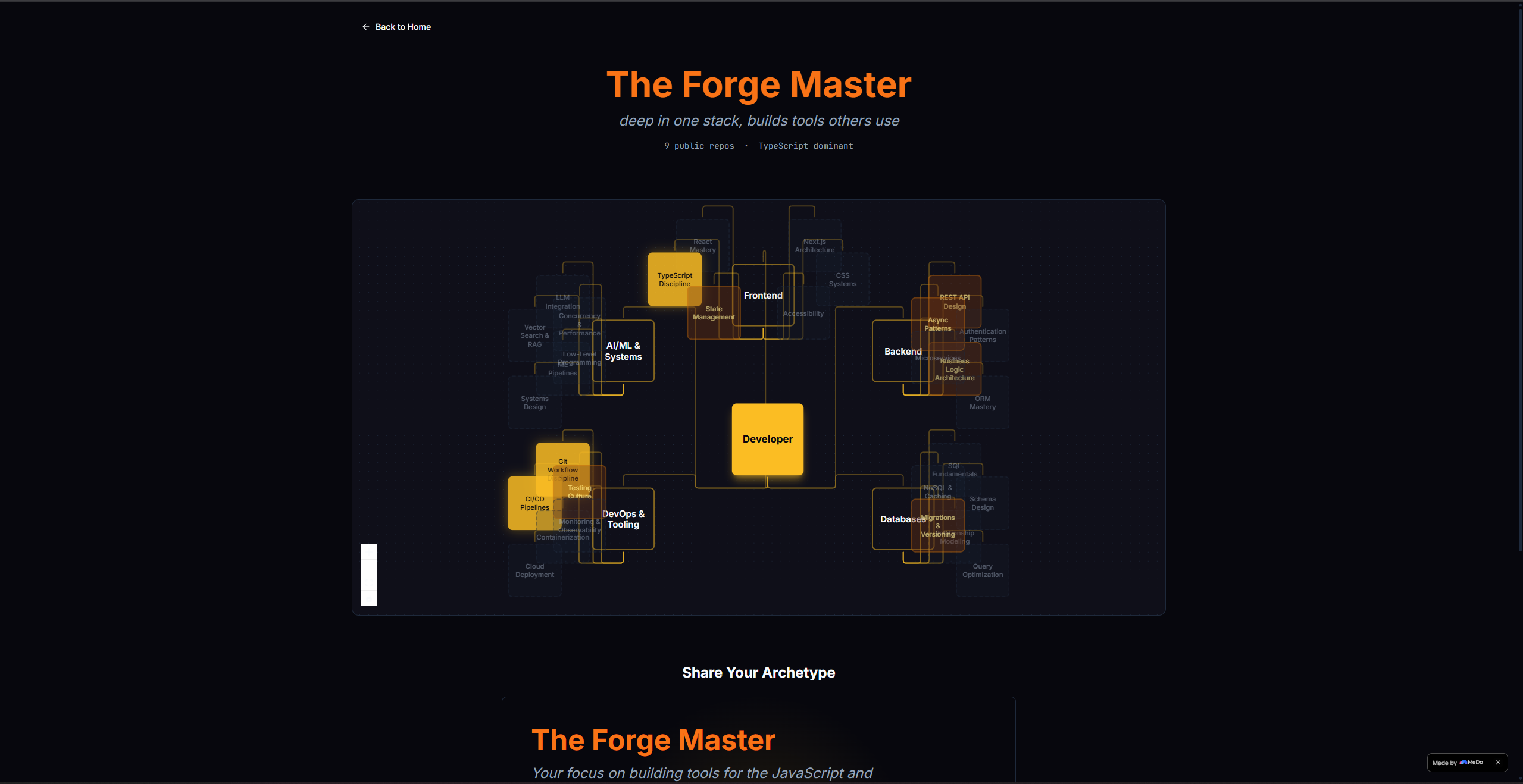
Get your archetype tree effortlessly
-
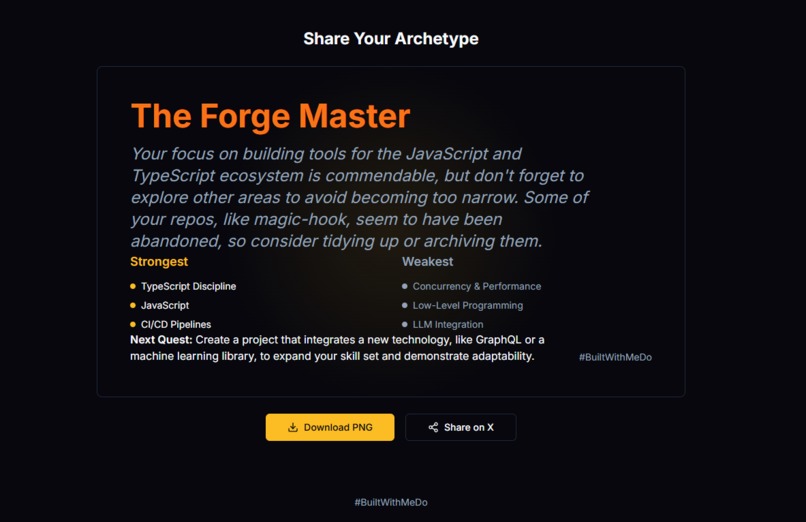
And a summary of your archetype , which is shartable and downloadable.

Dev Archetype Tree
Inspiration
Every developer has a GitHub. Most of us also have a quiet question: what does it actually say about me?
Hundreds of commits, dozens of repos, years of work — and all anyone sees is a green contribution graph.
Meanwhile, the internet loves turning identity into shareable artifacts:
- Stack Overflow ranks
- Spotify Wrapped
- RPG character builds
So we asked the obvious question no one had asked:
What if your GitHub became an RPG skill tree?
Not a dashboard. Not a chart. An actual tree, with glowing nodes for what you’ve earned, locked branches for what you haven’t, and an archetype that names the kind of builder you really are.
What it does
Dev Archetype Tree turns any GitHub profile into a personalized RPG skill tree in seconds.
You paste a username, and the app:
- Pulls every public repo through the GitHub API
- Sends your developer profile to an LLM for deep analysis
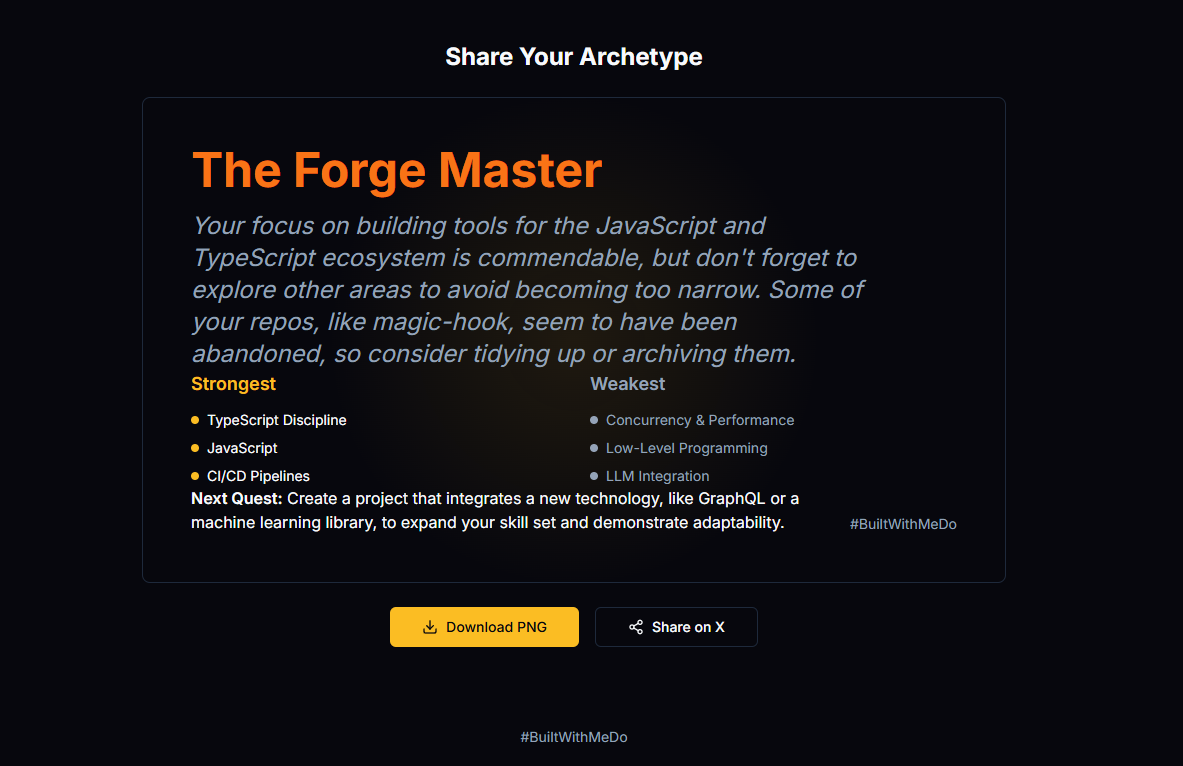
Classifies you into 1 of 10 hand-crafted archetypes:
- The Cathedral Builder
- The Sniper
- The Magpie
- The Forge Master
- and more
Renders a 30-node interactive skill tree across 5 domains:
- Frontend
- Backend
- Databases
- DevOps
- AI/ML
Marks each skill as:
- unlocked
- partial
- locked
Uses real repo evidence for every node
Gives actionable quests for missing skills
Generates a witty, shareable roast card users can export as PNG
It’s a mirror, a game, and a roadmap — all at once.
How we built it
The stack is intentionally lean. AI handled the heavy lifting. Humans guided the chaos.
Frontend
- React
- Vite
- TypeScript
- Tailwind CSS
- Shadcn UI
- Framer Motion
- React Flow
- TanStack Query
AI Pipeline
- GitHub REST API for repo/profile aggregation
- Groq + Llama 3.3 70B for analysis
- Zod validation for schema safety and retry logic
Rendering & Sharing
- React Flow for handcrafted node layouts
- html-to-image for downloadable PNG cards
Design Philosophy
The aesthetic was:
“Hades meets Linear.”
Dark navy backgrounds. Gold accents. Subtle glow. Premium feel.
Challenges we ran into
1. LLM reliability
Free-tier LLMs love malformed JSON.
We had to:
- Lock prompts with explicit schemas
- Add Zod validation
- Build retry logic
- Create fallback archetypes
This became the single biggest engineering investment.
2. The 5-second comprehension problem
Early versions tried explaining too much:
- stats
- percentages
- graphs
- breakdowns
None of it landed.
So we stripped everything down to:
- archetype
- skill tree
- roast
The product instantly became understandable.
3. Tree visualization complexity
React Flow can become a black hole if you rely on auto-layout.
We avoided that entirely.
All 30 nodes were manually positioned in configuration files.
The result:
- cleaner layout
- intentional spacing
- more game-like presentation
- no algorithmic mess
4. Cold-start demo latency
Hackathon judges hate waiting.
A few seconds feels massive during demos.
We optimized by:
- switching from Claude to Groq
- reducing response time to ~1–2 seconds
- pre-caching famous developer profiles
That dramatically improved first impressions.
5. Roast tone balancing
The roast system took multiple iterations.
Too soft:
- feels fake
Too harsh:
- feels mean
Final tone:
“Senior engineer reviewing your pull request.”
Honest. Funny. Never punching down.
Accomplishments we’re proud of
A pitch people instantly understand
“Your GitHub as an RPG skill tree.”
That clarity matters. Most hackathon projects fail right there.
Evidence-based AI
Every unlocked node maps to real repositories.
Every missing node generates a meaningful quest.
No random hallucinations.
Strong visual identity
The product genuinely feels polished:
- gold-on-navy palette
- glowing nodes
- animated transitions
- premium UI feel
Not just another AI dashboard.
Fully shipped product during hackathon time
The team completed:
- landing page
- AI analysis pipeline
- skill tree system
- share card export
- edge-case handling
- caching
- deployment
All live. All functional.
Curiosity loop
The biggest signal:
“I want to try mine too.”
That reaction is incredibly hard to engineer.
What we learned
AI-native development is real
This wasn’t “vibe coding.”
AI accelerated scaffolding.
But quality still depended on:
- architecture decisions
- prompt engineering
- schema validation
- UX judgment
- knowing when to override AI
The leverage came from direction, not blind generation.
Prompt engineering is product engineering
The most important file in the entire project was the LLM prompt.
Changing prompt structure changed the product more than many UI iterations.
That’s a major shift in modern software engineering.
Identity beats utility
People rarely share dashboards.
They share identity.
Every feature was filtered through one question:
“Would someone screenshot this?”
That became the product compass.
Constraints create better products
Reducing scope was harder than expanding it.
But focus is exactly what made the project demo-able and memorable.
What’s next for Dev Archetype Tree
Comparison Mode
Paste two GitHub usernames. Compare density, strengths, and archetypes.
Built-in viral mechanic.
Tree DNA
Every user gets:
- unique color signatures
- unique branch shapes
- personalized visual identity
No two trees feel identical.
Timeline Mode
Watch your tree evolve across years of GitHub history.
Visualize growth over time.
Boss Fight Nodes
Major milestones unlock entire branches.
Examples:
- Shipped a production SaaS
- Maintained OSS with 100+ stars
- Led a large open-source contribution
Team Trees
Analyze entire engineering teams.
Useful for:
- hiring
- mentorship
- skill-gap analysis
- team balancing
Expanded domains
Future specializations:
- Mobile
- Security
- Embedded
- Data Engineering
- ML Research
Long-Term Vision
GitHub shows what you’ve built.
Dev Archetype Tree shows where you’re going.
The goal is to make developer growth:
- visible
- personal
- gamified
- motivating
- shareable
Not just tracked. Experienced.
Built With
- groq
- llama
- medo
- react
- typescript
- vite
- zod

Log in or sign up for Devpost to join the conversation.