Inspiration
The Detkin Lab is the heart and soul of the Electrical Engineering Department at Penn. We are both Lab Staff at Detkin and we find ourselves constantly looking for components through endless drawers and compartments. This is a daily struggle for staff and students alike. We have decided to find a solution for this problem.
What it does
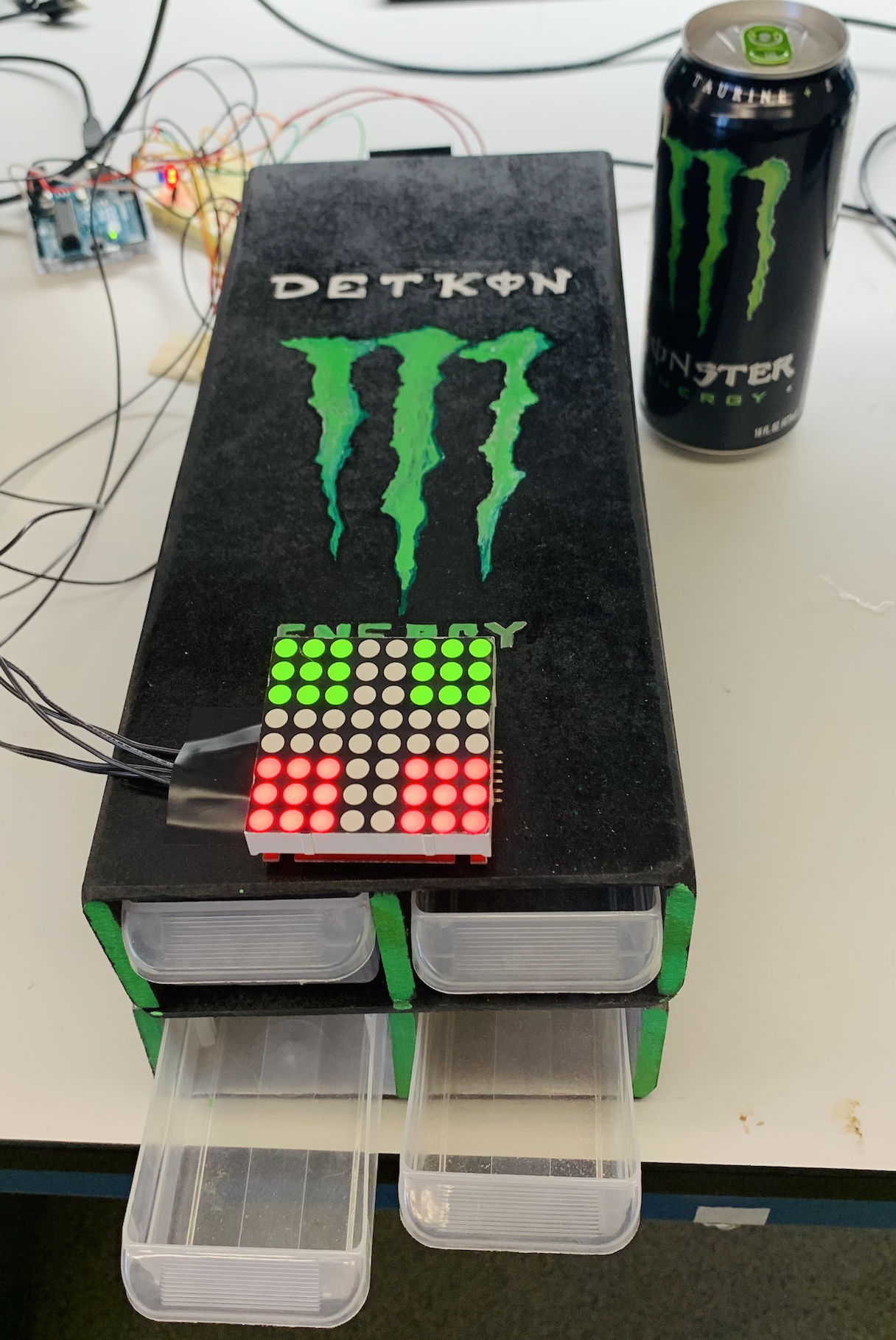
Our final project is an organizational device tailored towards Detkin lab. Using the Blynk platform we created a user interface where a user is are able to search up components such as resistors and capacitors and directly connect to their storage location. The system then activates a linear actuator that opens the component cubby and the user is free to collect the components. Simultaneously, an RG-Dot-Matrix display shows which cubbies are open, and which cubbies are closed. The benefit of our design is that it is modular, and multiple such cubby modules can be stacked together to create a complete component dispenser, increasing the variety of electrical and mechanical components available for Penn students.
How we built it
Softare
We started by creating the user interface using the Blynk platform and an ESP32 and an Arduino Uno. When the user selects components on the Blynk UI, the backend sends a signal to the ESP32, which in turn activates a demultiplexer that sends an interrupt signal to the Arduino, signaling the opening of a specific component cubby. Upon receiving the interrupt signal, the Arduino sends a signal via the SPI bus and activates the LEDs on the RG-Dot-Matrix that corresponds to the selected component cubby. At the same time, the Arduino uses a PWM signal to activate the linear actuator attached to each of the cubbies and opens the selected cubby. Once the user has collected the desired components, they press the manual button on the UI to close the cubbies and reset the display.
Hardware
The cubbies are manufactured using laser-cutting MDF. The linear actuators were 3D-printed and mounted onto servo motors that are then attached to the Arduino Uno. The hardware design is modular, such that numerous cubbies can be manufactured and stacked. Electronically, more modules can be integrated since the demultiplexer increases the number of GPIO pins that can be used.
Challenges we ran into
Originally, we wanted to use the Arduino IoT Cloud interface, but it did not have good support for the ESP32. We also ran into challenges with the RG-Dot-Matrix display, which required us to write our own SPI library. We also wanted to make the design modular, but we had a limited amount of GPIO pins, so we had to use a demultiplexer to increase the number of pins.
Accomplishments that we're proud of
Implementing a custom SPI library and manufacturing our own linear actuators were the highlights of the project. From a system design perspective, the modularity was a creative implementation.
What we learned
This project was a good learning experience in splitting up work, experimenting with different designs and implementations, integrating software and hardware, and creating a modular system.
What's next for Detkin Energy
The next steps for the cubbies:
- Adding a power management system that supports multiple cubby modules at once
- Upgrade the demux to a modular serial protocol such as RS232 or Modbus-RTU
- Upgrade the user interface such that a user can upload a component list and all the corresponding cubbies automatically open
- Automizing the closing of cubbies such that the cubbies the previous cubby closes when it detects that the user has moved on to the next cubby

Log in or sign up for Devpost to join the conversation.