-
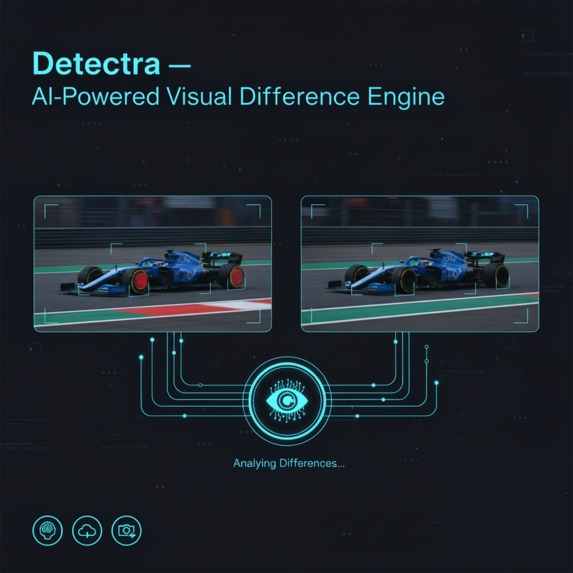
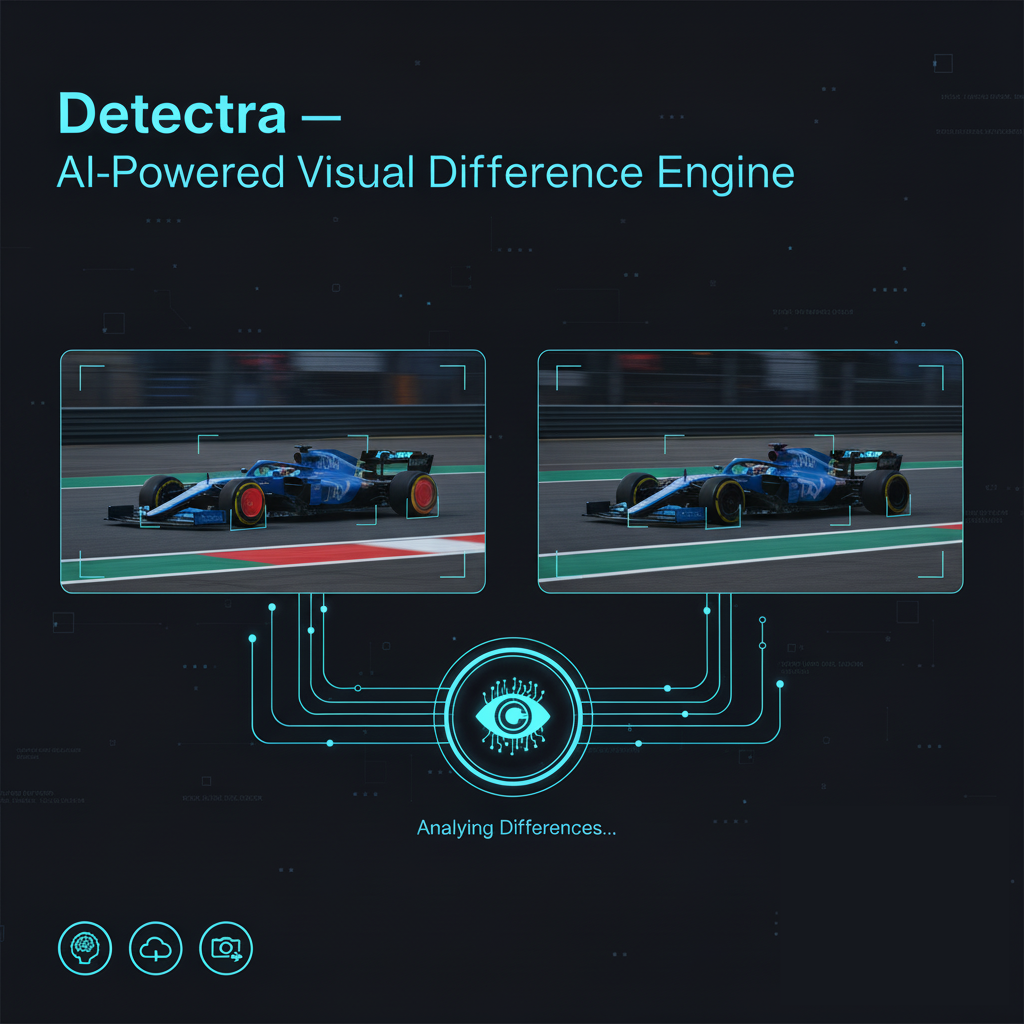
Demo Image
Inspiration
In industries like manufacturing, infrastructure, and compliance audits, visual inspections are often manual, time-consuming, and prone to human error. We were inspired by the idea of creating a system that could see changes the human eye might miss - from micro surface defects on machines to gradual wear and tear in infrastructure.
Watching how Formula 1 teams use real-time telemetry to detect performance shifts sparked the thought:
“What if images could tell their own change story - automatically and intelligently?”
That idea became Detectra - an AI-powered multi-spectral visual difference engine that detects, classifies, and predicts visual change across time-series images using RGB, thermal, infrared, and drone-based imagery.
What It Does
Detectra takes two or more images of the same scene over time from different camera types -RGB, thermal, infrared, and drone - and uses deep vision algorithms to:
- Detect and localize visual differences (tiny or large)
- Classify them by type - damage, defect, or anomaly
- Quantify the severity of change
- Predict future degradation trends using temporal analysis
Applications span manufacturing inspections, brand compliance, infrastructure monitoring, aerospace, and environmental analysis.
How We Built It
- Data Processing: Used OpenCV and Pillow to preprocess image sets (alignment, noise reduction, contrast normalization).
- Change Detection Engine: Implemented a hybrid model using Structural Similarity Index (SSIM) and Deep Siamese Networks for precise difference localization.
- Classification Layer: Fine-tuned a lightweight CNN (MobileNetV3) to identify the nature of the change.
- Visualization Dashboard: Built an interactive dashboard using Streamlit for visual overlays and temporal tracking.
- Predictive Analytics: Integrated Prophet (Meta’s time-series model) to predict the rate of visual change over time.
Challenges We Ran Into
- Aligning time-series images with varying lighting, angles, and resolutions.
- Reducing false positives in texture-heavy or reflective surfaces.
- Balancing accuracy vs. real-time performance for edge deployment.
- Designing a general-purpose model adaptable across industries.
Accomplishments That We're Proud Of
- Built a working prototype capable of detecting minute differences in high-resolution image pairs.
- Achieved over 92% accuracy in defect detection during internal testing.
- Developed an intuitive dashboard for visualization and predictive insights.
- Created a modular pipeline that can adapt to different domains like automotive, packaging, and infrastructure.
What We Learned
- Even minor visual variations can hold major predictive value when analyzed temporally.
- The synergy between classical CV methods (SSIM, edge maps) and AI-driven embeddings can drastically improve accuracy.
- How to optimize AI models for real-world noise and unstable lighting conditions.
- Importance of UI/UX in presenting AI results clearly to non-technical users.
What's Next for Detectra - AI-Powered Visual Difference Engine
- Deploy Detectra as an Edge AI module for offline use in remote inspection sites.
- Add multi-spectral image support (thermal, IR) for broader industrial use.
- Integrate AR-based real-time overlays to guide human inspectors visually.
- Launch Detectra Cloud, allowing users to upload time-series images and receive detailed visual analytics reports automatically.
Built With
- amazon-web-services
- firebase
- github
- google-cloud-vision-api
- keras
- matplotlib
- opencv
- plotly
- python
- pytorch
- scikit-learn
- sqlite
- streamlit
- tensorflow

Log in or sign up for Devpost to join the conversation.