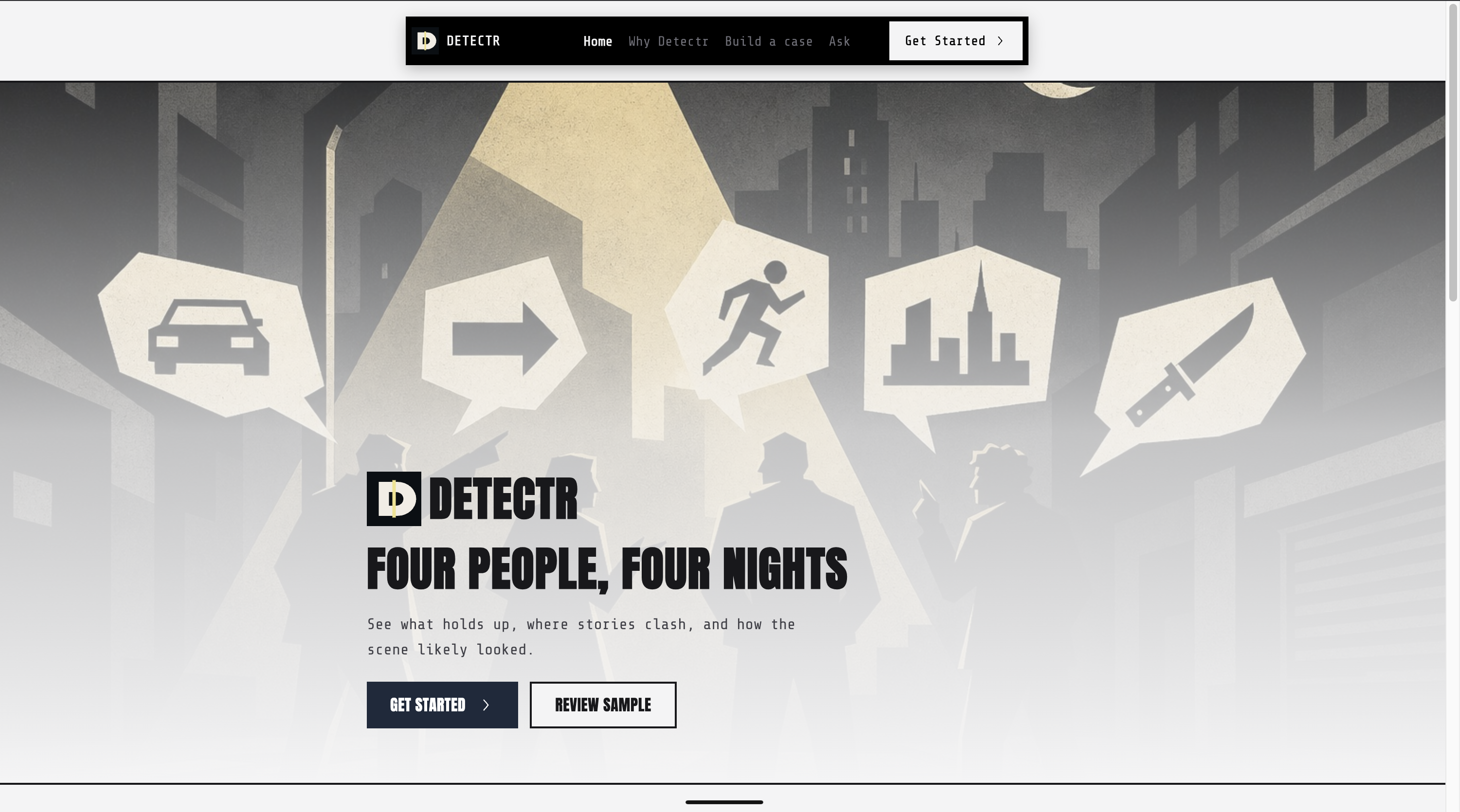
Inspiration Witnesses to the same night rarely tell the same story. Investigators, juries, and even AI chatbots usually get a single flattened narrative — and miss the quiet physics that make a claim impossible (a facial scar “seen” from fifty feet in dim light, a limp that doesn’t match the distance and time).
We were inspired by forensic workflow tools and multi-agent debate: what if specialized agents argued over testimony the way a physics expert and a detective would, then showed the scene so everyone can see what holds up?
That became Detectr — an Agent Society on Qwen Cloud for witness testimony.
What it does Detectr turns a case file and multiple witness statements into a structured forensic review:
Claim extraction — breaks each statement into atomic claims with sensory tags Physics validation — scores claims POSSIBLE / UNCERTAIN / UNLIKELY against vision and acoustics limits Cross-reference — finds agreements, contradictions, and unique details across witnesses Agent debate — Physics vs Detective when science conflicts with multi-witness consensus Scene reconstruction — optional Wan / HappyHorse clips of key beats Detective report + Ask — narrative findings and grounded Q&A on the finished case Baseline comparison — multi-agent society vs a single monolithic Qwen pass (Track 3 measurable delta) Try it: open the live app → Review sample (Oak Street Incident). Pause / Stop keep you in the case shell; rate limits protect the API from abuse.
How we built it Frontend: Next.js App Router, TypeScript, HeroUI Pro patterns, Brutalism theme, original logo + hero art Orchestration: LangGraph StateGraph Agent Society (src/agents/orchestrator.ts) LLM: LangChain ChatOpenAI → Qwen Cloud (DashScope / Token Plan OpenAI-compatible API) Video: DashScope async Wan / HappyHorse T2V (src/agents/visualizer.ts) Storage: serverless-safe case store + optional Alibaba Cloud OSS for MP4s (src/lib/alibaba.ts) Ops: per-IP rate limits, abortable analyze (Pause / Stop all), public MIT repo Proof of Alibaba Cloud usage for judges: https://github.com/fozagtx/detectr/blob/main/src/lib/alibaba.ts
Architecture: https://github.com/fozagtx/detectr/blob/main/docs/architecture.svg
Challenges we ran into No mocks allowed — every step must be live Qwen; timeouts and quota failures show up immediately in the demo path Vercel + long agent graphs — full runs with thinking + video hit platform limits; we disabled thinking by default, made videos optional, and tightened the sample path Serverless filesystem — writing to .data failed on Vercel; moved to memory + /tmp and pass case context into detective chat Billing / plan wiring — free-tier keys, Token Plan keys (sk-sp-…), and base URLs are not interchangeable; wrong combo looks like “quota exhausted” or AccessDenied.Unpurchased even when you subscribed UX honesty — dual sidebars, pause dumping users back to landing, and old detectr-five URLs 404ing on browser back — all had to be fixed under live demo pressure Accomplishments that we're proud of A real LangGraph Agent Society with specialist roles, debate, and a single-agent baseline — not a single mega-prompt Physics-aware claim scoring that surfaces weak testimony instead of rubber-stamping stories End-to-end product: landing → case shell → checks → report → grounded Ask, with Pause / Stop and rate limits Open-source MIT repo with architecture diagram, Alibaba proof file, and judge-ready docs What we learned Multi-agent pipelines win when roles are sharp and state is shared — Extractor / Physics / CrossRef / Detective each do one job Cloud “plans” are product surfaces: Token Plan endpoint + seat assignment is different from DashScope free/pay-as-you-go; keys and base URLs must match Demo reliability beats feature sprawl: optional video, no thinking tax, clear errors, and a sticky app shell matter as much as the graph What's next for Detectr Seat-aware model routing and clearer billing errors when a Token Plan seat can’t access a model Stream agent progress live in the UI (not just a working card) Stronger persistence (DB) for cases across serverless isolates Jury-mode presentation: side-by-side claim timeline + scene clips Optional multimodal inputs (photos / CCTV stills) via Qwen vision into the same society
Built With
- langchain
- nextjs


Log in or sign up for Devpost to join the conversation.