-
-
DIAGNOSTIC PROCEDURE OF ANONYMOUS COVID-19
-
PROJECT SUMMARY
What inspired>
Given the current situation of confinement, in which we are inundated with news about positive cases and deaths due to this recently appeared virus, COVID-19. And the numerous complaints by health personnel of the absence of material and tests that confirm cases of contagion. After various talks between our engineers, experts in the processing of voice data and vocal biometrics, we set out in search of a cheap and accessible technique that allows mass detection in the population. This detection will be essential, especially if we can have a high predictive value, whether positive or negative.
That makes. >
The objective of this research project is to develop an application that, through the latest technological innovations, allows reporting with a high degree of precision the rate of Covid-19 contagion in the population.
How is Artificial Intelligence applied to Covid-19 detection?
Biometric Vox's team of engineers / researchers have experience in the measurement, study and analysis of more than 100 voice morphological and phonetic parameters that are used by their vocal biometrics tool, CheckVox. Using previous knowledge and experience, the team of researchers considers that by performing an in-depth analysis of all these characteristics using some machine learning tools, it is possible to establish / detect if there have been changes in the speaker's speech system as a consequence of this viral infection, etc. For this, collaboration agreements are being established with different medical institutions to take samples of voices from patients with Covid-19.
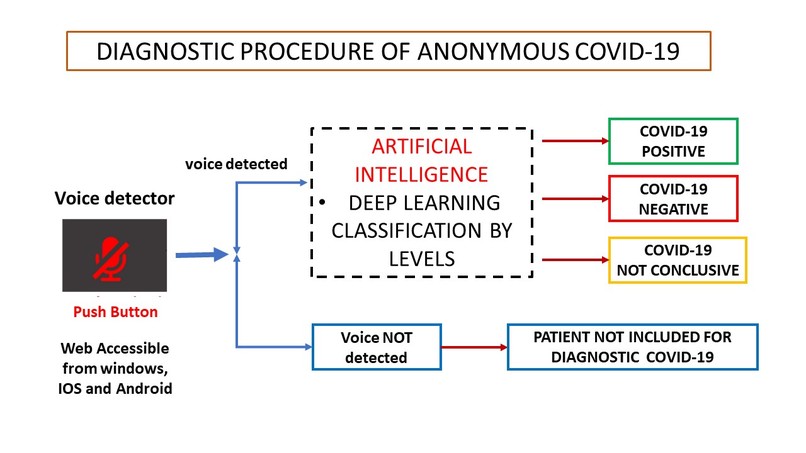
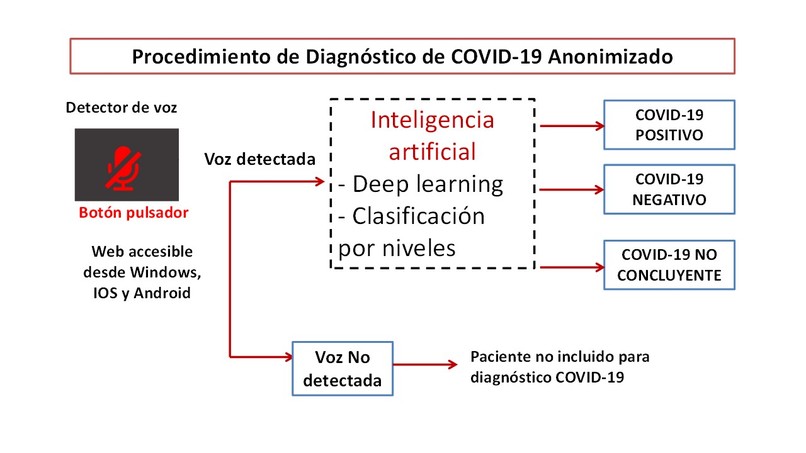
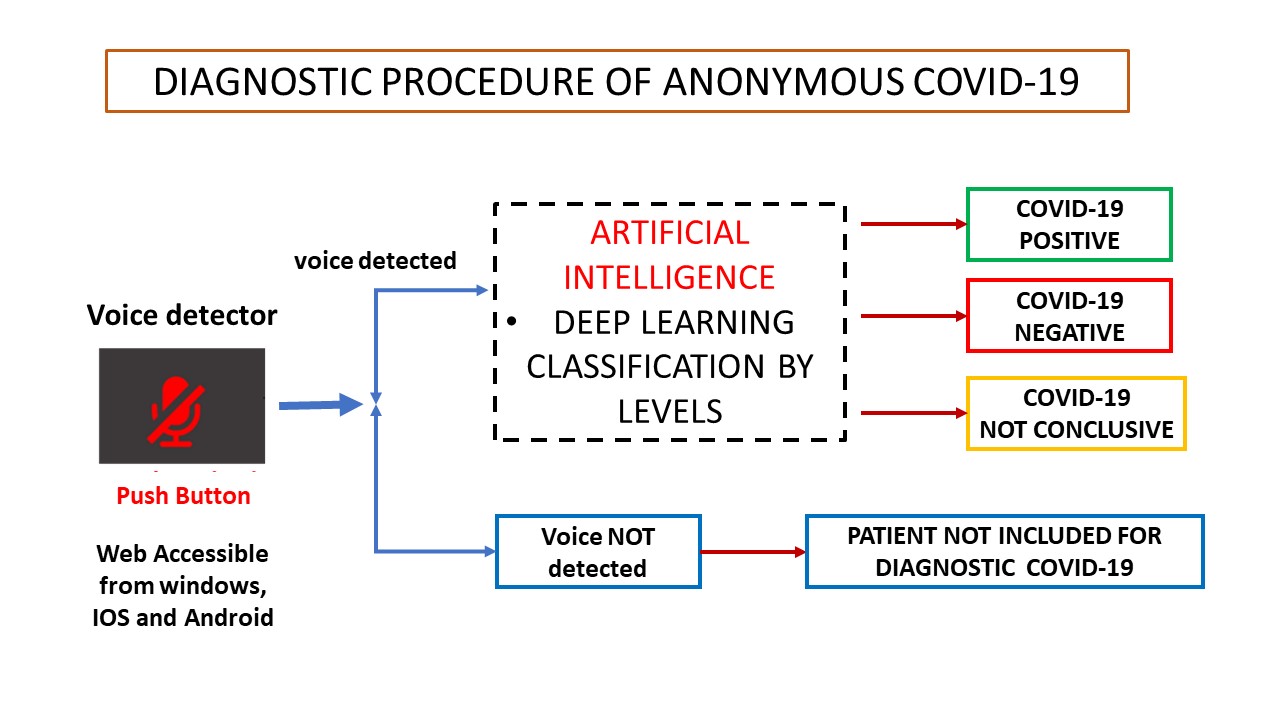
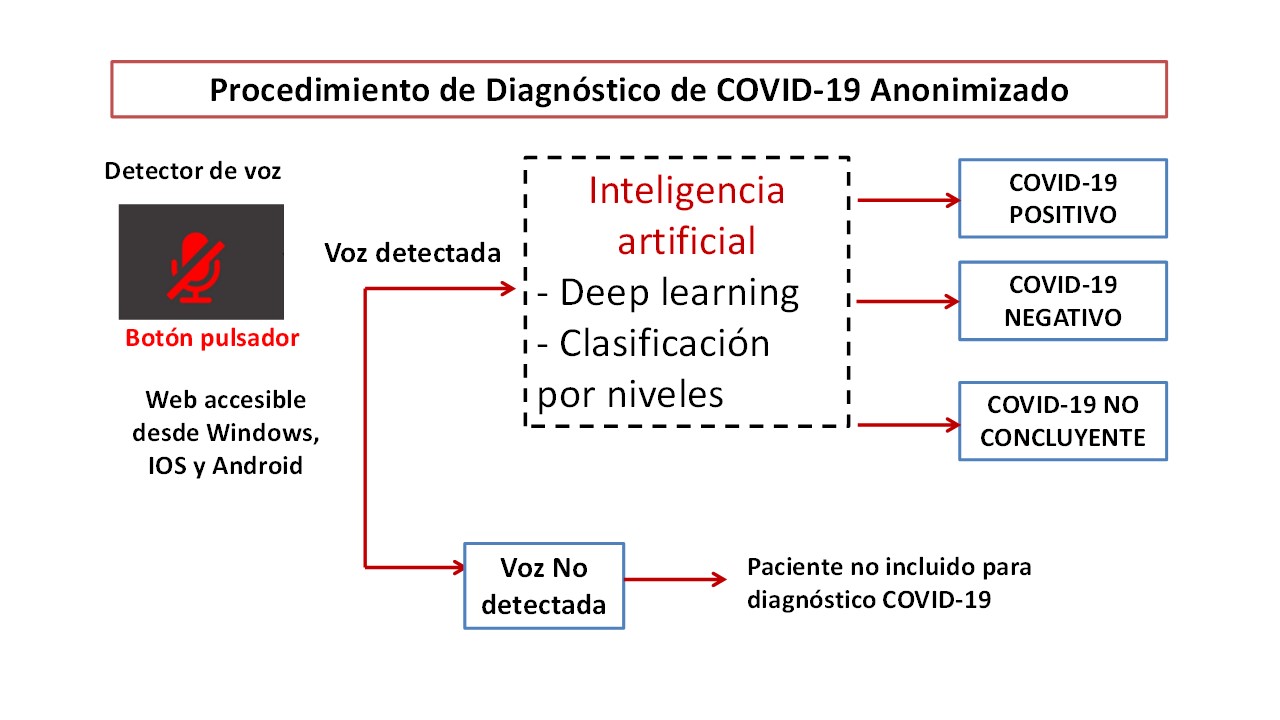
The final objective of the research and the TESTVOX-CV19 project is the development of an application for mass use and accessible to the entire population, where users register a voice sample and the system launches in response a degree of possibility of containing the virus.
How we build it. >
First, it is necessary to compile a database that contains audio samples from different groups, symptomatic infected people, asymptomatic infected people, people without infection but presenting similar symptoms due to other conditions, or people without infection and without symptoms. For this we have prepared a web page for hospital use, which we are finishing adjusting, which will be accessible from any electronic device with Windows, iOS or Android, with a push button and a set text for the patient to make his diction. Additionally, a Covid-19 questionnaire will be completed according to medical criteria.
Subsequently, all the information is collected and, according to medical criteria, vocal samples are grouped n in sets according to specific symptoms. Thanks to this, an algorithmic study can be started by applying artificial intelligence technology to the voices, which allows differentiating conclusive patterns in each of them.
Then , when the researchers have worked with the algorithms and have been able to develop a system that has a high predictive value, whether positive or negative, it will be shared with the health community of the Basque Country and will be evaluated in one of the hospitals in reference of those who support the project.
Finally, once it has been validated by the health community, an application will be created (still to be determined, whether a mobile application , web page or both ) accessible to the entire health system, where each doctor will be able to take a patient's voice patient and to be compared with the developed algorithm thus obtaining a prediction about the contagion.
This concludes a system test fast, accessible to both hospitals and health centers, streamlining Medical attention to and responding to the viral outbreak COVID-19.
Challenges we encounter. >
At a medical level, we already have positive experiences in detecting voice abnormalities in patients with heart problems, such as decompensated heart failure or heart attack, making it a viable option.
We know that COVID-19 disease affects the upper airways from the beginning, so this technology could be especially important in the detection of asymptomatic initial cases, where rapid tests and PCR lose utility and applicability. Furthermore, research is done quickly at the population level, and the results would be readily available. On a medical level, it is undoubtedly an opportunity”, says Domingo Andrés Pascual Figal, Head of Service and Professor at the Virgen de la Arrixaca Hospital and Faculty of Medicine, as well as a CNIC Researcher.
The main challenge that our researchers will face is to achieve an algorithm with a high predictive capacity from the collected data.
Achievements of which we are proud. >
Biometric Vox is a startup dedicated to the research and development of solutions based on voice biometrics. Created in 2015, Biometric Vox allows users to increase the security of their records and operations thanks to unequivocal identification based on voice biometrics.
What we learned>
Among the main symptoms of Covid-19 is dyspnea or shortness of breath, which obviously affects the generation of the voice. "The human vocal system is divided into 3 parts: respiratory apparatus, phonation apparatus and resonator apparatus. Thanks to the possibility of using algorithms based on artificial intelligence, we can correlate the physiological effects of the virus on the respiratory and voice systems with voice alteration patterns In other words, this vocal technology would help detect cases of contagion at a distance and in real time, protecting health personnel by eliminating potential risks from physical contact
What follows for the AI TECHNIQUES CV19 DETECTION TEST applied to the VOICE.>
We need to collect voice samples from the different patients, according to the inclusion criteria: (minimum 50 per classification) Adult patients (≥ 18 years) with the SARS-CoV-2 PCR test (reaction of polymerase chain) carried out and with the following Classification:
• Healthy patients with negative PCR to COVID-19.
• Patients with respiratory processes not related to COVID-19 and negative PCR.
• Patients with respiratory symptoms associated with COVID-19 and positive PCR.
• Patients with otorhinolaryngological clinic associated with COVID-19 and positive PCR.
• Patients without otorhinolaryngological or respiratory symptoms associated with COVID-19 and positive PCR.
Built With
- ai
- neural-networks





Log in or sign up for Devpost to join the conversation.