-

Training accuracy of ~95%
-
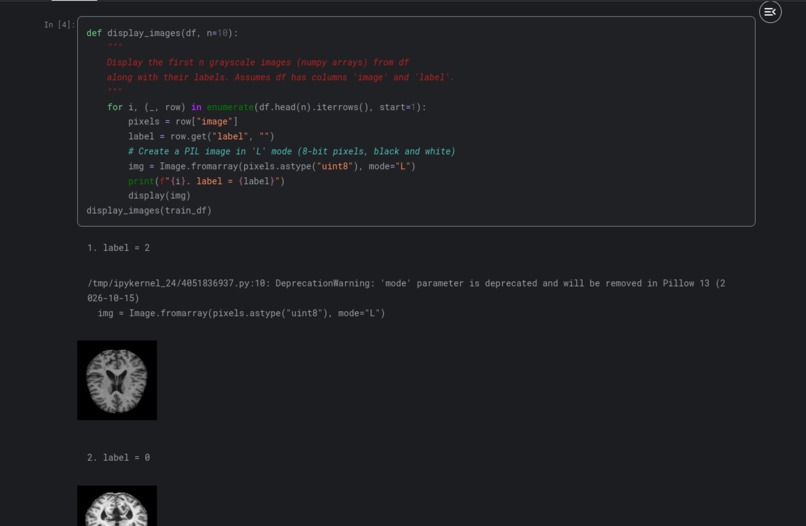
Images from the dataset


Inspiration
Alzheimer’s is usually detected late, after irreversible damage. The motivation was to see whether patterns in brain MRIs can be picked up earlier using learning systems instead of waiting for severe symptoms.
What it does
The model analyzes brain MRI scans and classifies them into Alzheimer’s-related stages by learning spatial patterns associated with neurodegeneration, helping flag risk early.
How we built it
We decoded MRI images from Parquet files, standardized them, and trained a convolutional neural network on grayscale scans. The CNN learns hierarchical spatial features and outputs class probabilities using softmax.
Challenges we ran into
The data was stored as raw image bytes, not ready-to-use tensors. Handling decoding, normalization, and consistent image sizing was critical. Preventing overfitting on a limited medical dataset was another constraint.
Accomplishments that we're proud of
We built a fully reproducible CNN pipeline from raw medical data and achieved decent test accuracy while maintaining proper train, validation, and test separation.
What we learned
What's next for Detecting Alzheimer's with CNNs
Built With
- datasets
- machine-learning
- neural-networks
- numpy
- pandas
- python
- scikit-learn
- tensorflow

Log in or sign up for Devpost to join the conversation.