-
-
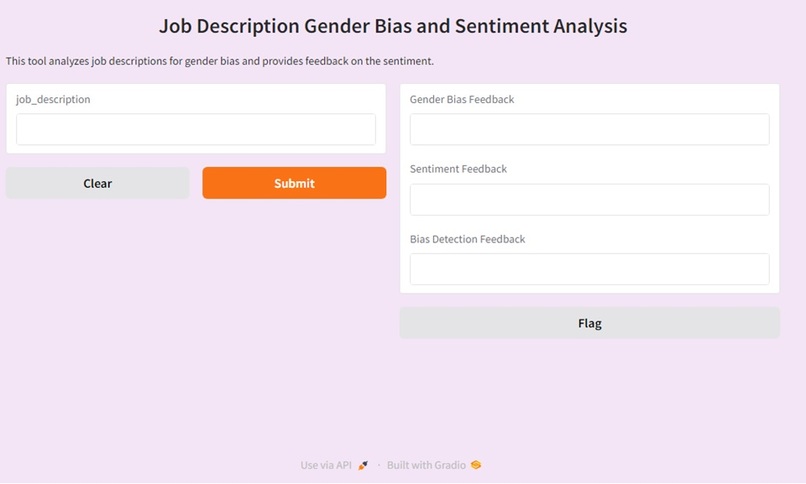
Check job descriptions for masculine or feminine language,assign a sentiment score and assign a score indicating the strength of the bias.
-
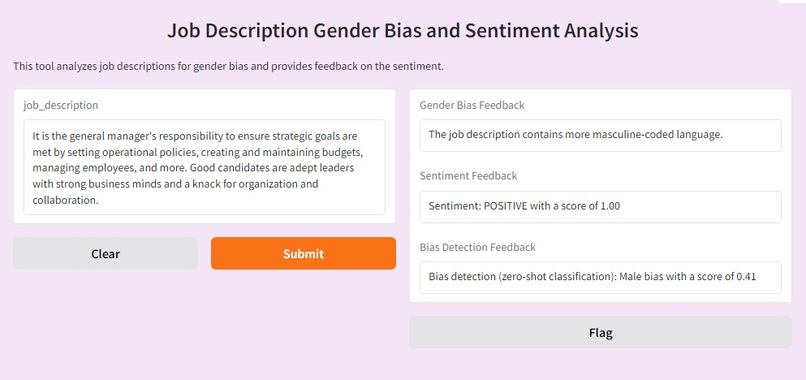
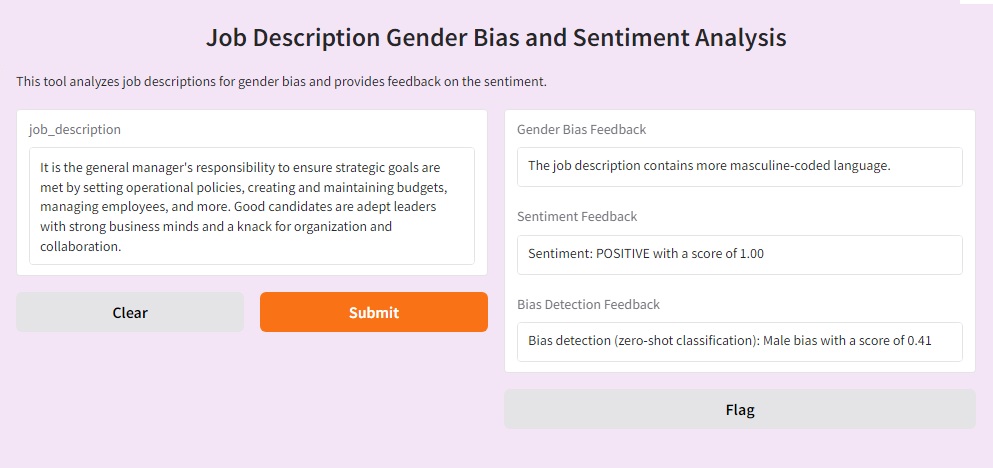
Output
Inspiration
Mostly Job descriptions contained the unconsciously or intentionally gender biased language and that is difficult to identify, it controls the gender equity like mostly jobs descriptions hidden mentioned tasks that are male dominant.Job descriptions frequently include substantial, clues from language that may effect the broad range of people seeking for the position. These cues might establish gender bias. So there is a need to develop an AI powered solution to address gender equity challenges around the world, as outlined in UN Sustainable Development Goal 5.
What it does
I selected the problem from “Gender equality” to address the gender equity.
How we built it
The following essential elements are used in the code: Hugging Face Transformers Library: Hugging Face's pipeline function is used to load the zero-shot classification (facebook/bart-large-MNLI) and sentiment analysis (sentiment-analysis) models. Since Hugging Face's infrastructure hosts these models. Natural Language Toolkit, or NLTK: The code pre-processes the input text using nltk.tokenize.word_tokenize. Unlike the 'punkt' tokenizer, NLTK does not require an API key in order to download its datasets. Gradio: An intuitive interface for working with your model is made possible by the Gradio library. Gender-specific words: I used Gender-specific words(such as masculine and feminine words) which are commonly in use to detect bias.
Challenges we ran into
Accomplishments that we're proud of
The project is providing an automated tool to detect gender bias in job descriptions, which is an important step in promoting inclusive and fairness in the hiring process. Here's how the program addresses gender equality:
- Detecting Gendered Language • The program analyzes job descriptions for gender-specific words that are often associated with traditional masculine or feminine traits. o Masculine Words: The tool identifies words like "strong," "decisive," and "dominant" that are often coded as masculine traits. o Feminine Words: Similarly, words like "nurturing," "caring," and "empathic" are recognized as feminine-coded. • By identifying these words, the tool highlights whether a job description leans more towards masculine or feminine language, which could unintentionally favor one gender over another. For example, job descriptions with overly masculine language may discourage women from applying, while overly feminine language may deter men.
- Bias Feedback • The tool generates feedback regarding the gender bias in the job description by providing an analysis of the relative frequency of masculine vs. feminine-coded words. • It also includes a more sophisticated zero-shot classification model that assesses whether the description leans towards a "male," "female," or "neutral" bias, offering an additional layer of insight into potential gender bias. • By flagging biased language, this tool can help employers create more neutral, inclusive job descriptions that appeal to a broader range of candidates, ensuring equal opportunities for all genders.
- Sentiment Analysis • The sentiment analysis function provides feedback on the overall tone of the job description—whether it's positive, negative, or neutral. • A positive or neutral tone can foster a welcoming environment, while overly aggressive or harsh language (often coded as masculine) may unintentionally alienate candidates who identify with other genders, especially women or non-binary individuals. • With sentiment feedback, users can adjust the tone of their job descriptions to be more inclusive and inviting.
- Promoting Fairness in Recruitment • By detecting and addressing bias, the tool helps organizations reduce the potential for gender-based discrimination during the recruitment process. • For instance, job descriptions that inadvertently emphasize masculine traits may unintentionally deter female candidates, even if those traits aren’t actually required for the job. Identifying this bias and adjusting the language can ensure that the job posting appeals to a diverse range of applicants, improving gender equality in the hiring process.
What we learned
This tool can eventually contribute to the creation of more diverse and inclusive workplaces,by encouraging companies to utilize gender-neutral language and remove stereotypes from job descriptions, . This might eventually help to lessen gender-based differences in hiring procedures, which would improve the representation of both sexes in a range of fields and positions. This project is aligned with gender equality, such as: • Equal Opportunity: By flagging biased language, the program supports equal opportunities for all genders, especially in environments where job descriptions have traditionally favored one gender over others. • Challenging Stereotypes: It challenges common gender stereotypes (e.g., men are "strong" or "competitive," women are "nurturing" or "supportive") by making bias more visible, helping to break down harmful gender expectations. • Supporting neutral: The tool encourages neutral in recruitment by making it easier for employers to ensure their job descriptions are not unintentionally biased toward a specific gender.
What's next for Detect Gender Biased Job Description
A lot of things that can be implemented like with the help of dataset the models can be trained and use to detect gender discrimination
Built With
- google-colab
- gradio
- machine-learning
- nli
- nltk
- pre-trained
- python

Log in or sign up for Devpost to join the conversation.