-

OpenFOAM simulation of out custom elliptical airfoild
-
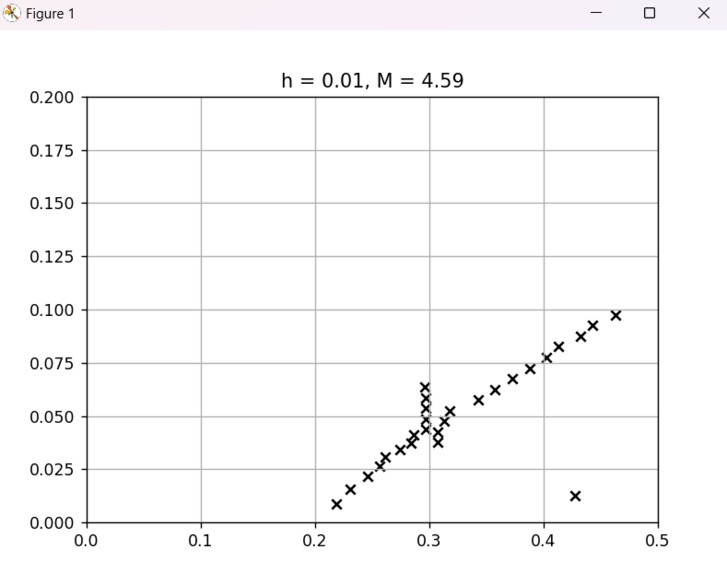
Detached Shock for h=0.01 M = 4.59
Inspiration
Motivated by the lack of detached shock wave data for elliptical airfoils, we initiated a project to bridge this gap and provide a valuable resource for future aerodynamic computations in both industry and research. Recognizing the significance of elliptical airfoils in various applications, we aimed to contribute to the advancement of aerodynamic simulations by creating a specialized data set. Our project addresses a critical need, offering insights that can enhance the accuracy of computational models and facilitate innovation in industries such as aviation and renewable energy.
How we built it
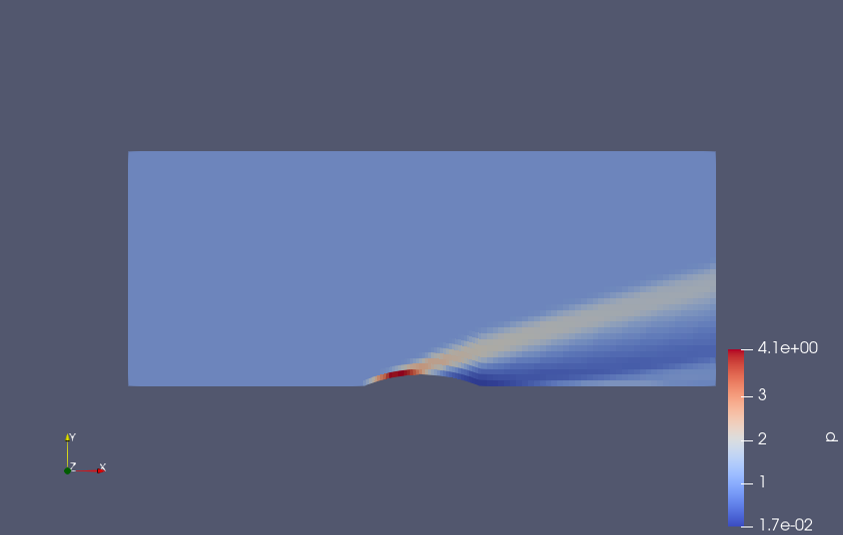
To construct the detached shock wave dataset for elliptical airfoils, we employed OpenFOAM for Computational Fluid Dynamics (CFD) analysis to obtain pressure distributions. Utilizing Python, we automated the entire process for 1000 different configurations. The pressure distributions derived from OpenFOAM were then leveraged to pinpoint the locations of shock waves. This automated methodology not only streamlined the data collection process but also ensured a comprehensive and diverse dataset, laying the foundation for improved aerodynamic computations and analysis in the realm of elliptical airfoils.
Challenges we ran into
We faced several challenges during the project. Firstly, understanding and setting up the CFD software, particularly OpenFOAM, proved to be a complex task that required a learning curve. Next, adapting the mesh generation process to fit the elliptical geometry posed practical difficulties, necessitating iterative adjustments. Additionally, we encountered instances of the CFD simulations hanging, which presented challenges in optimizing the process. Addressing these issues required a methodical approach, collaborative problem-solving, and ongoing refinement to ensure the effective automation of data collection for various elliptical airfoil configurations.
Accomplishments that we're proud of
We're proud of two key accomplishments in our project. First, successfully configuring the CFD simulations to work seamlessly with our given geometry and free stream velocity was a significant achievement. It required a deep understanding of the software and the specific challenges posed by our project. Second, the automation of the entire process was another source of pride. This not only made the data collection more efficient but also highlighted our ability to tackle a complex task systematically and effectively.
What we learned
Through this project, we gained practical insights into CFD, data analysis, and high-speed aerodynamics. Working hands-on with CFD simulations deepened our understanding of their intricacies, while the data analysis aspect honed our skills in handling and interpreting large datasets. Focusing on high-speed aerodynamics provided a practical understanding of the unique challenges associated with airflow at elevated speeds. In essence, the project was a practical learning experience, broadening our expertise in these key areas.
What's next for Detached Shock Data for Elliptical Airfoils
Moving forward, our next steps involve expanding the versatility of our project. We aim to incorporate the capability to include custom airfoil geometries beyond ellipses, broadening the applicability of our dataset. Additionally, we recognize the need to enhance mesh fidelity without compromising performance. Striking a balance between increased mesh detail and computational efficiency will be a priority to ensure more accurate and comprehensive aerodynamic simulations for a wider range of airfoil shapes. These advancements will contribute to the ongoing refinement and applicability of our project in diverse aerodynamic scenarios.
Built With
- jupyter
- openfoam
- python

Log in or sign up for Devpost to join the conversation.