-
-
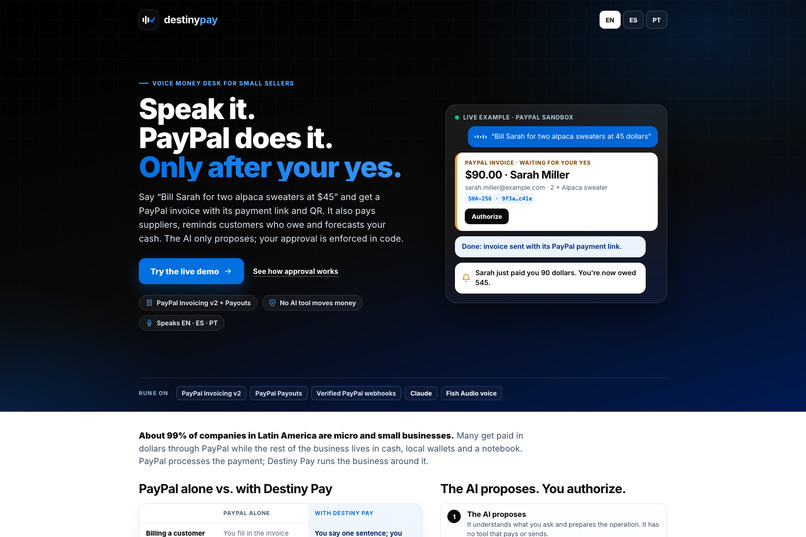
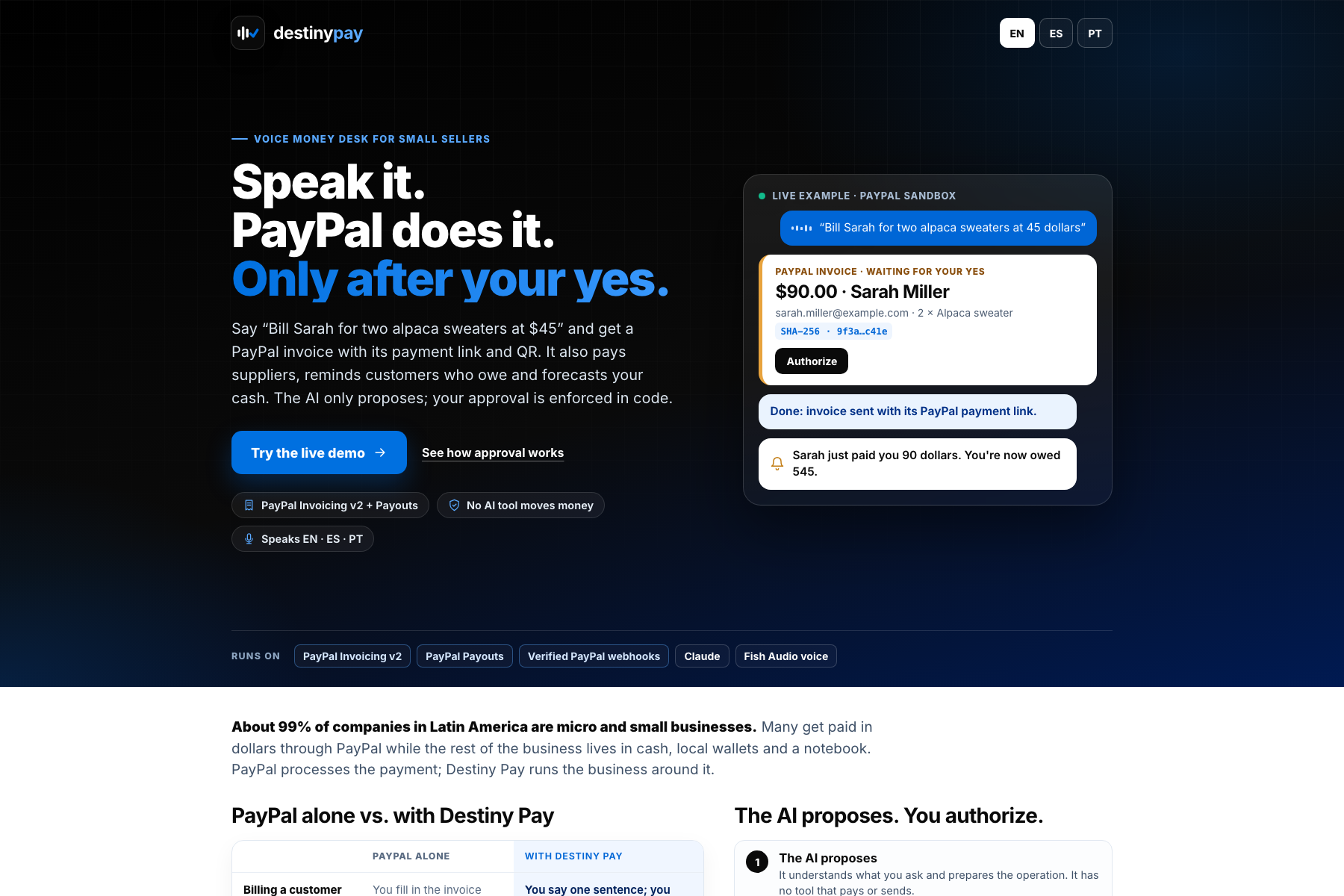
Speak it, PayPal does it, only after your yes: a voice money desk for small sellers paid through PayPal.
-
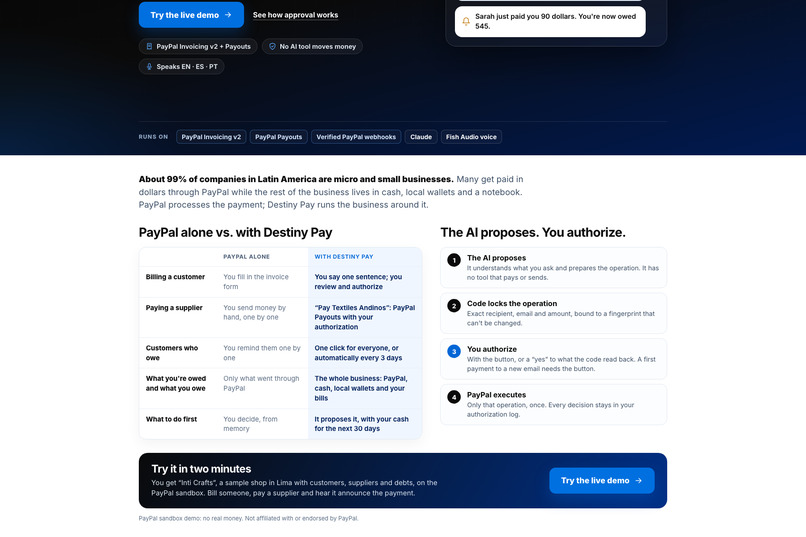
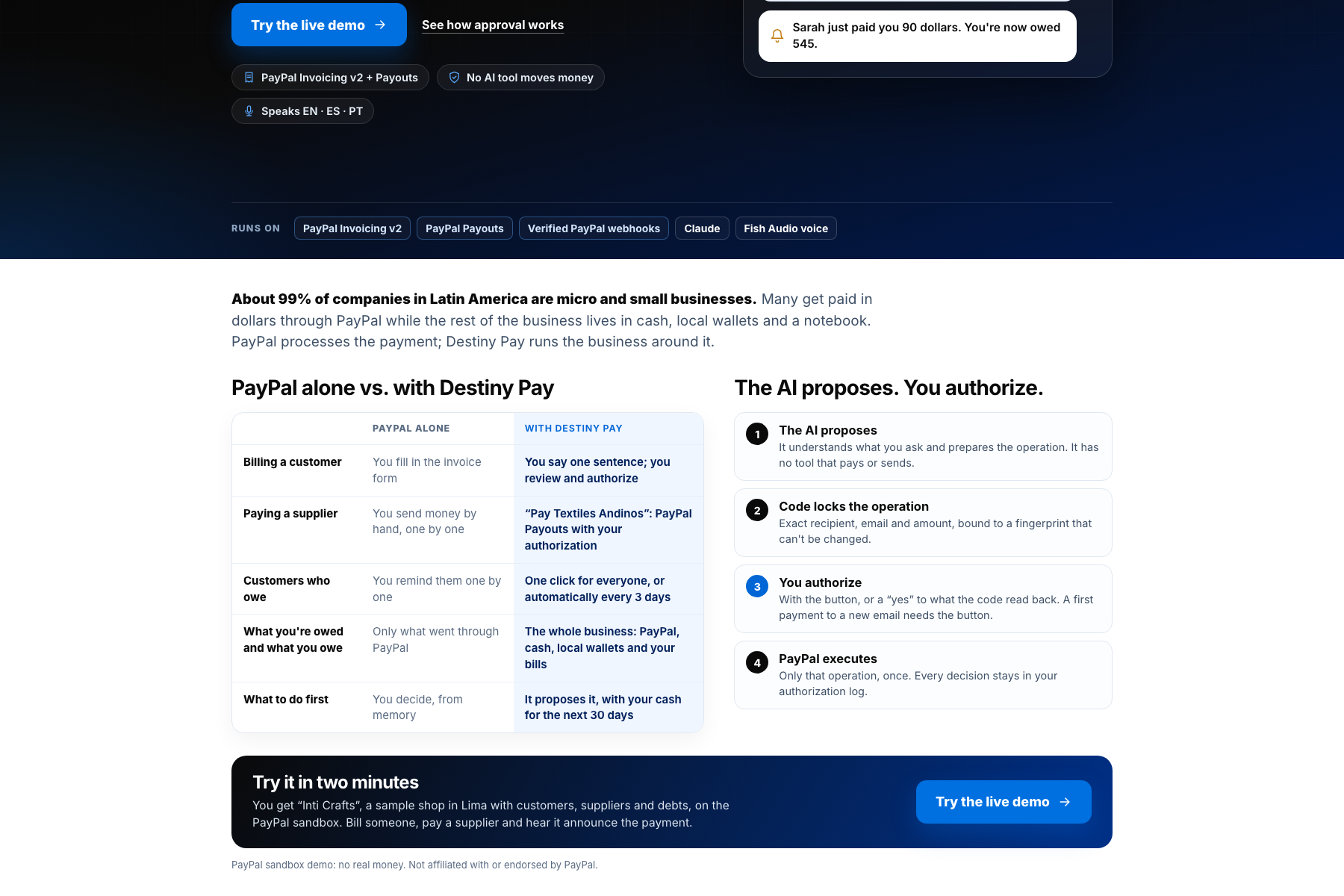
PayPal processes the payment; Destiny Pay runs the business around it. The AI proposes, the owner authorizes.
-
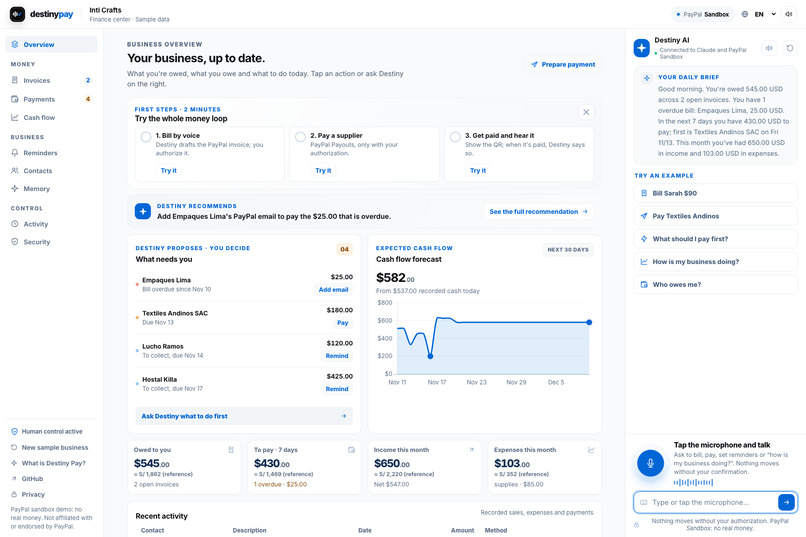
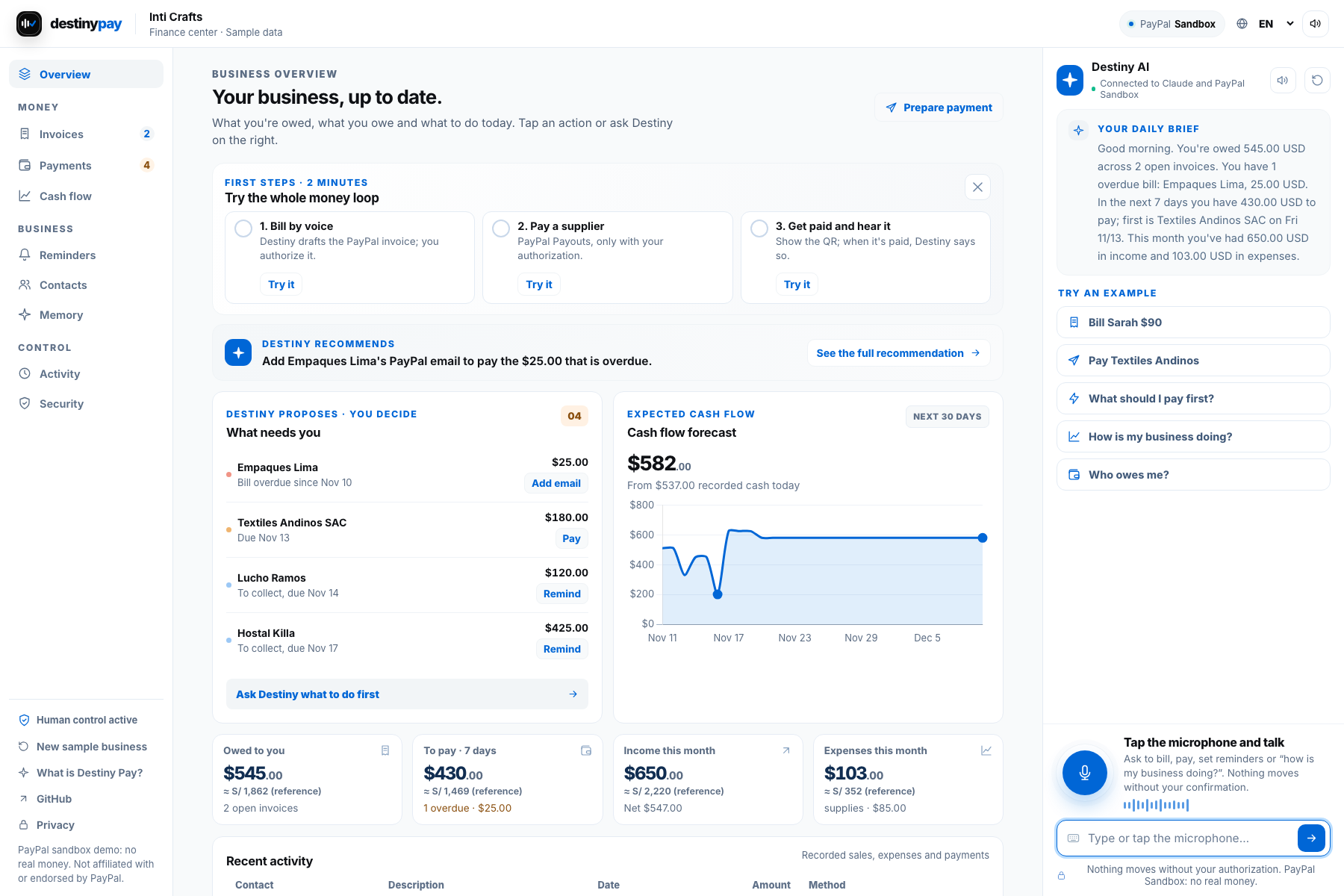
One screen: what you're owed, what you owe, a 30-day cash forecast and what to do first.
-
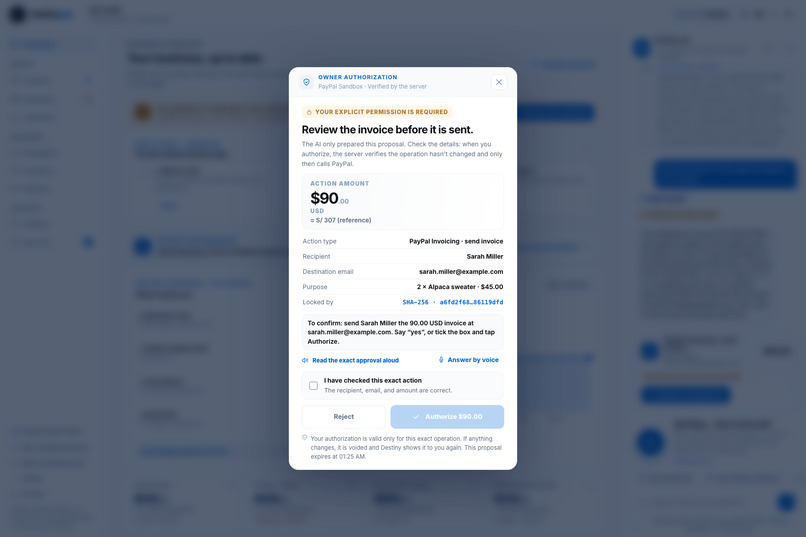
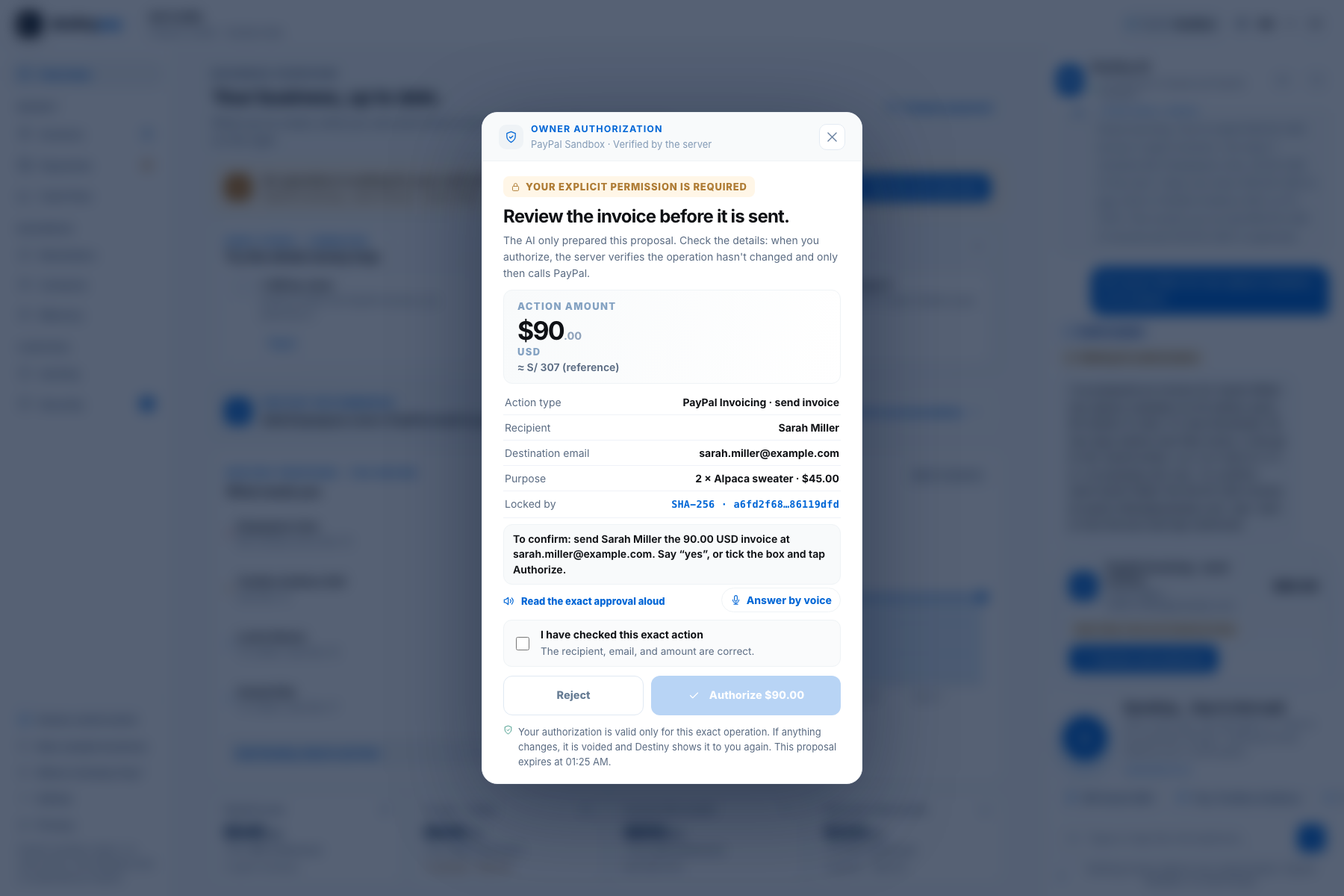
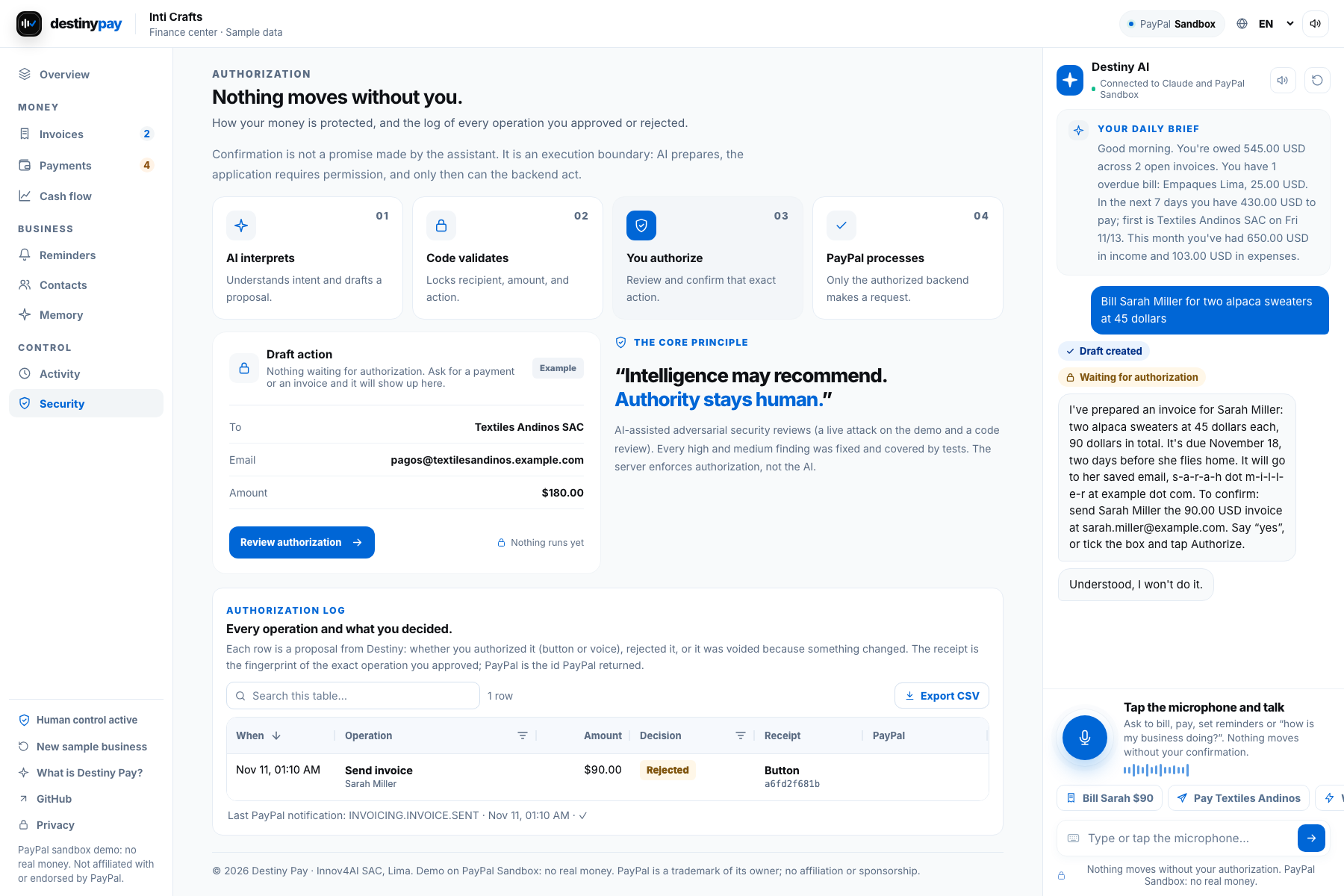
Authorization dialog written by code: exact amount, email and items locked by a SHA-256 fingerprint.
-
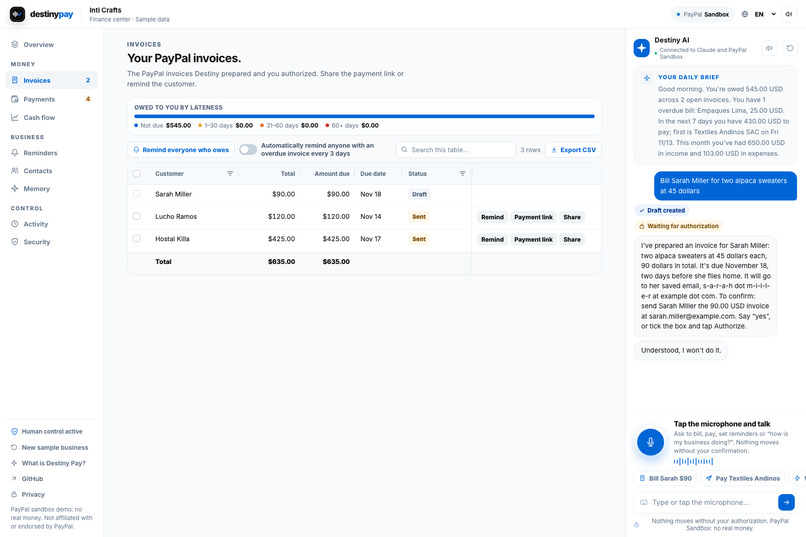
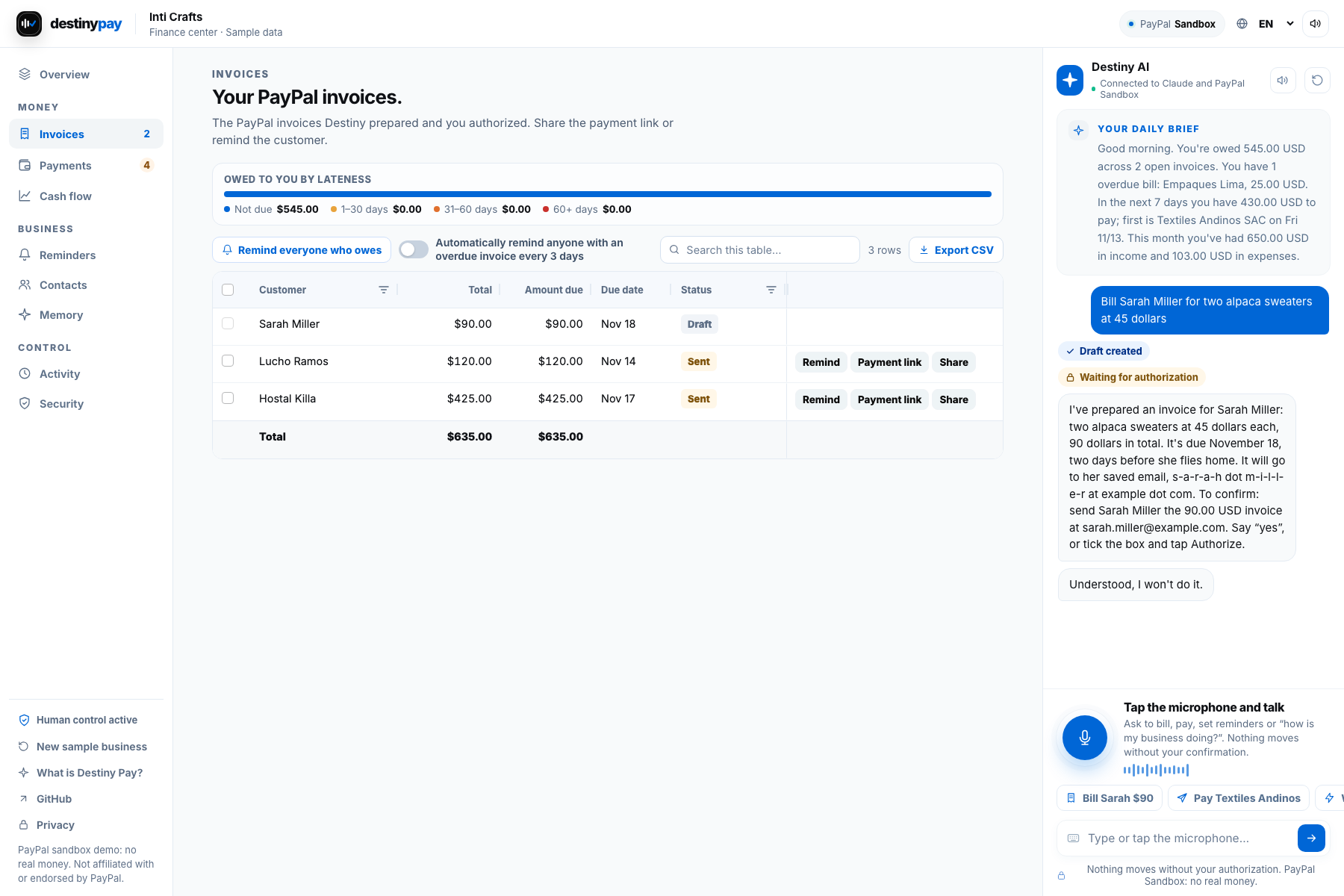
Real PayPal invoices (Invoicing v2): remind everyone who owes with one click, or automatically every 3 days.
-
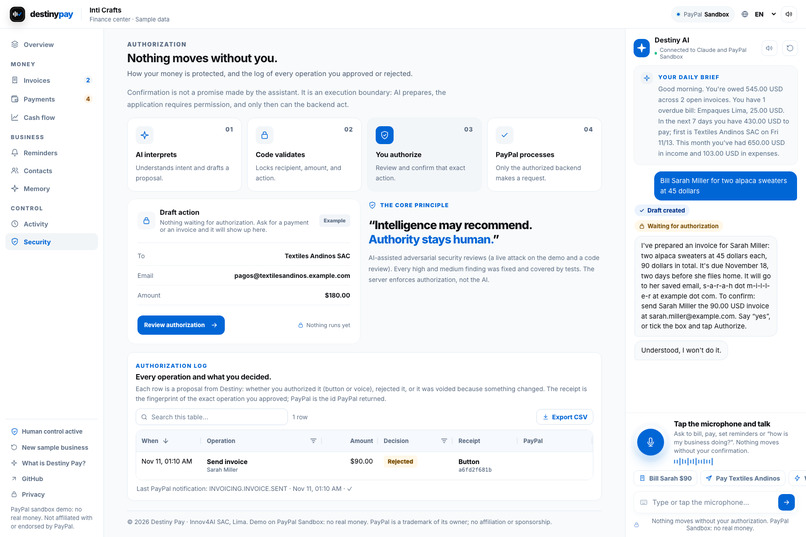
Security: every decision, by button or voice, is logged with its receipt and PayPal's reference.
-
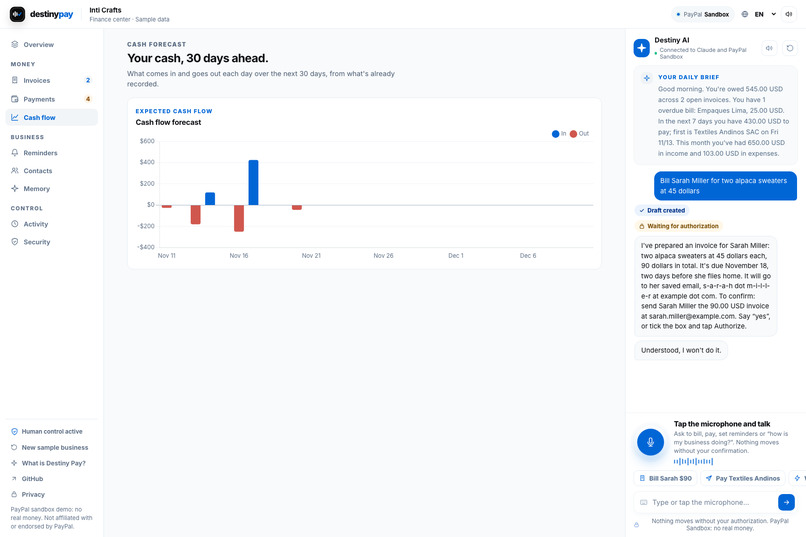
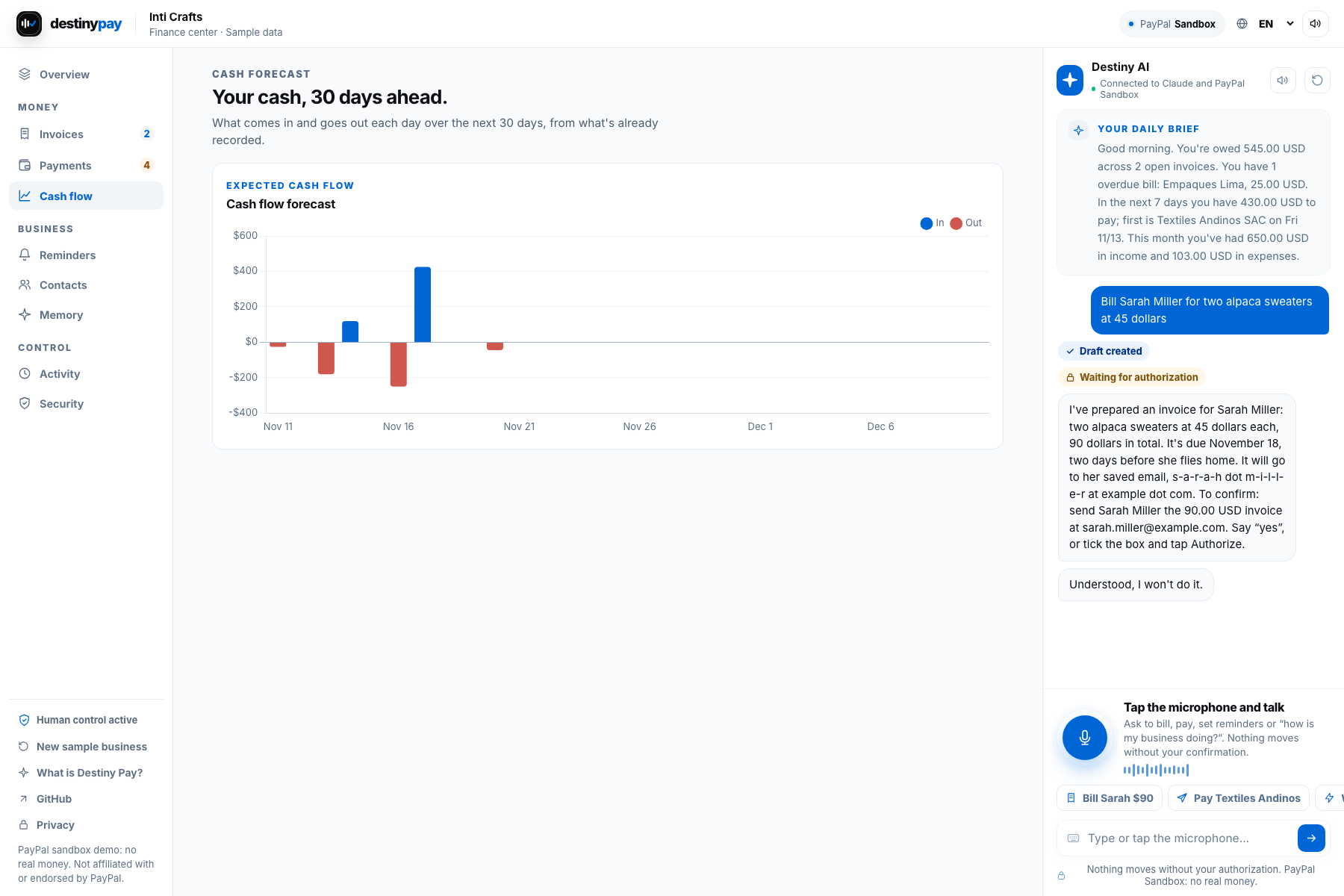
Cash forecast for the next 30 days from what is already recorded: money in and money out per day.
-
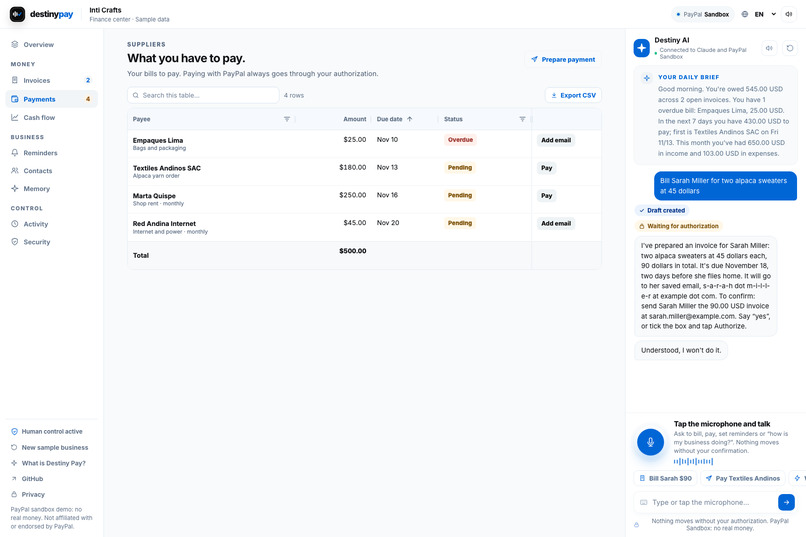
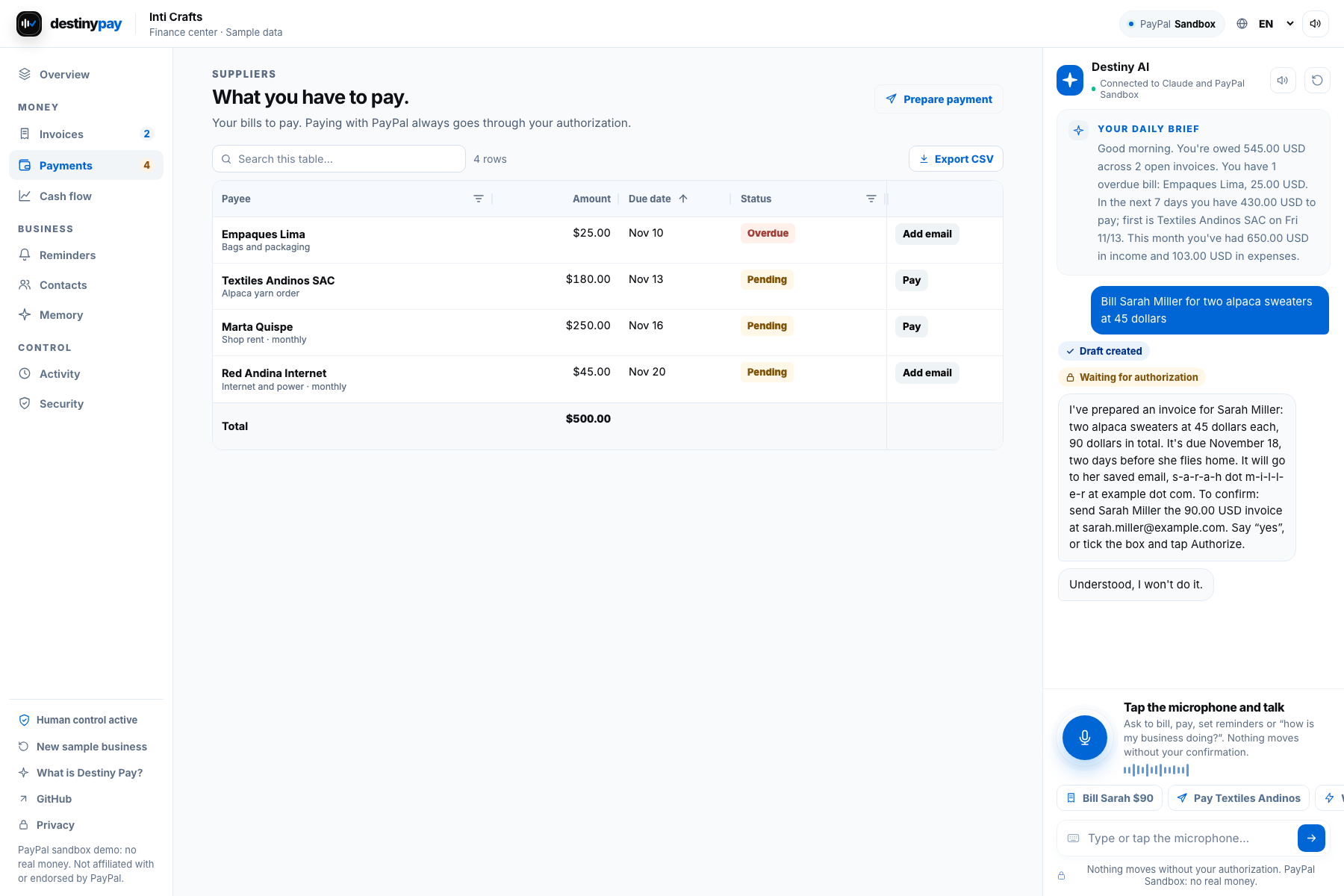
Suppliers to pay through PayPal Payouts; a first payment to a new email can only be authorized with the button.
Inspiration
I'm Iván, from Lima, Peru. At Innov4AI I build AI products for small businesses, and I keep seeing the same picture. A craft shop sells to a tourist and gets paid in dollars through PayPal. The next customer pays in cash, another one with Yape, and what the shop owes its suppliers is written in a notebook. PayPal handles each payment very well, but it only sees its own part. It doesn't know the rent is due on the 5th, that a customer paid half in cash, or whether there will be enough money at the end of the month.
And every invoice means stopping to fill in a form while someone is waiting at the counter.
This is not a small group. About 99% of companies in Latin America are micro or small businesses (CEPAL), and Peru alone has 2.34 million formal ones (PRODUCE). I wanted to give them what is missing around the payment: one place where the whole business is clear, that you run by talking, and where an AI can help with money but can never move it on its own.
What it does
Destiny Pay is a money desk you talk to. It runs in the browser, in Spanish, English or Portuguese, each with its own native voice.
You say "Bill Sarah for two alpaca sweaters at 45 dollars." It remembers Sarah's email, prepares a PayPal invoice, reads the items and the total back to you, and sends it with a payment link only after you say yes. The QR code shows up on screen, and when Sarah pays, Destiny Pay tells you out loud.
You say "Rent is 300 on the 5th, every month" or "Pay Textiles Andinos with PayPal." It keeps track of your bills, warns you the day before they're due, and pays suppliers with PayPal Payouts once you confirm.
It also:
- remembers customers, suppliers, debts and notes from one day to the next, with a full activity log;
- sends PayPal's own reminders to customers who owe you: one invoice, everyone at once, or automatically every 3 days for overdue invoices;
- answers "How am I doing?" with income, expenses, what's overdue, a 30-day cash projection and one or two careful suggestions;
- gives you a short briefing when you open it: what you're owed, what's late and what to pay this week;
- shows what needs you today, each item with one action (pay this bill, remind this customer, cancel a payout nobody claimed, add a missing email), and every money action opens the same authorization dialog;
- records cash and Yape payments on the PayPal invoice ("Lucho paid me 50 by Yape") after you authorize it;
- shows a soles reference next to dollar amounts, shares PayPal's payment link through WhatsApp, and installs on the phone like an app.
I also built it around problems PayPal sellers really complain about. Customers who pay late: debts are grouped by how late they are, with scheduled reminders. Fake PayPal invoices: every invoice tells the customer to check it by logging in to PayPal directly. Supplier payouts nobody claims: after three days Destiny Pay tells you to check the email, before PayPal returns the money at 30 days. A sudden big invoice: it reminds you that PayPal may review unusual activity and suggests keeping proof of delivery. It never promises to prevent a hold.
Why you can trust it with money
This is the part I cared about most. An AI that can touch your money has to be safe by design, not because the prompt asks it nicely.
The model can't send an invoice, pay anyone, cancel anything or record a payment. It can only ask. When it asks, the server rebuilds the operation from its own records (who, which email, how much in cents, the items, the status) and locks it with a SHA-256 fingerprint. Then the owner sees a dialog with the amount, the recipient, the email and the reason. Money moves only when the owner ticks "I have checked this exact action" and presses Authorize, or says "yes" to a read-back that the code wrote, not the AI. Inside that dialog the server decides what a spoken answer means, not the model. If anything changed, or it no longer matches PayPal's own copy of the invoice, the authorization is cancelled.
A few more rules:
- The first payout to a new email can only be approved with the button, never by voice. If someone slips in a different supplier email, a quick "yes" won't pay it.
- A click and a spoken yes can't both go through, and only one operation per invoice or bill runs at a time.
- Every PayPal call carries a PayPal-Request-Id and every payout a fixed sender_batch_id, so a retry after a timeout never pays twice. If PayPal recorded a payment but the answer got lost, it's matched once against PayPal's own list of payments.
- Every decision leaves a receipt in the Security view: what was authorized, by button or by voice, its fingerprint and PayPal's reference.
- Each business is isolated, text from outside is treated as data and never as an order, and the public demo has rate limits and daily budgets.
The full threat model, with the test behind each defense, is in SECURITY.md.
How I built it
- AI: Claude (
claude-opus-5-5) runs the agent with 22 tools, strict schemas on every tool that touches money, prompt caching and a fallback model on the server. Each conversation starts with what it remembers and the local time, and the recognizer's alternatives help it get names and numbers right. - PayPal: Invoicing v2 (create, send, QR, remind, cancel, record and reconcile payments, track refunds), Payouts (including the "unclaimed" status and cancelling an unclaimed payout) and webhooks with signature verification on the raw body, plus a status refresh every 30 seconds as a safety net. Everything runs in the sandbox.
- Voice: Fish Audio gives each language its own natural voice and is the backup for transcription. The browser's Web Speech API handles live dictation. I picked the voices by measuring how clearly real transcriptions came back. Destiny always speaks with its own voice, and a check renders a real phrase every 10 minutes to make sure the voice is healthy.
- Backend: Python, FastAPI and SQLite on Railway, with a scheduler for reminders and alerts.
- Design: a two-screen welcome that explains what it is, the problem, an honest comparison with PayPal alone and how it protects you. Then one screen: navigation on the left, your numbers in the middle and the assistant on the right, so you see the numbers change while you talk. AG Grid tables for invoices, bills and contacts (search, filters, totals and CSV export), Chart.js charts with money on the axes, and large type with checked contrast (WCAG AA). On the phone, the microphone sits in the middle of the bottom bar.
- Testing: 209 automated tests (money safety, isolation between businesses, authorizations, the agent loop, voice). I also ran several AI-assisted attack reviews on the code and on the live demo, and fixed every high and medium finding with a test for it. Invoices, payouts and both voice engines run against the real PayPal sandbox and Fish Audio.
Destiny Pay was built entirely during the hackathon, in November 2026.
Challenges I ran into
- Trusting an AI with money. A prompt is not a lock. I moved the confirmation out of the model and into the code, with a closed list of what counts as "yes", tested case by case.
- Voice at a busy counter. Spelled-out emails, misheard numbers, echo. I added read-backs, remembered contacts, the option to interrupt it, and a transcription backup on the server. Once, in the middle of a demo, the app switched to the browser's robotic voice. Now it retries its own voice and never switches.
- Never paying twice. Retries, double clicks and a webhook arriving at the same moment as a refresh can all cause a double payment. Each authorization can be used only once, and every PayPal call has its own key, so the second attempt does nothing.
- Soles. PayPal invoices don't support Peruvian soles yet, so I focused on sellers who charge foreign customers in dollars, and left the engine ready for local payment rails.
Accomplishments that I'm proud of
The whole money loop works by voice, collecting and paying, with memory and advice, in three languages. And anyone can check the authorization design in the code: request_confirmation and resolve_confirmation in app/business.py.
What I learned
Good agents are careful by construction: few tools, strict schemas, and a person deciding exactly at the moment that matters. With voice, the small details decide everything: knowing when it's listening, reading things back, and never talking over yourself.
How it's different from using PayPal directly
PayPal already has invoices, payment links, QR codes and reminders, and Destiny Pay uses them. What I added is everything around the payment: billing with one sentence instead of a form, paying suppliers from a conversation, seeing the whole business (PayPal, cash, Yape and bills) and not only what went through PayPal, and a clear answer to "what do I pay first?" based on a 30-day forecast. General AI assistants can connect to PayPal now too. Destiny Pay is made for a seller standing at a counter, it speaks Spanish, English and Portuguese, and the authorization lives in the code, not in a prompt.
What's next for Destiny Pay
- Each seller connects their own PayPal account. That also lets me safely add PayPal's official MCP server for read-only questions about transactions and disputes. I left it out of the demo on purpose: all sample businesses share one sandbox merchant, so those reads would mix businesses.
- A WhatsApp channel, because that's where small sellers already work.
- Local payment rails behind the same engine: soles through Peruvian providers, electronic receipts for SUNAT, and bank connections as open finance arrives in Peru.
- A pilot with 10 tourism businesses in Lima and Cusco.
Built With
- ag-grid
- anthropic
- claude
- fastapi
- fish-audio
- javascript
- paypal
- paypal-payouts
- paypal-webhooks
- python
- railway
- sqlite
- web-speech-api
