Inspiration
Learning a new skill often means relying on tutorials and figuring things out as you go. But when you get stuck, you usually have to stop what you're doing, take a screenshot, explain the context to an AI, and ask it what went wrong. Then you go back to learning and repeat the process the next time you get stuck.
A human 1:1 tutor can make this much easier by seeing what you're doing and helping you in the moment, but that kind of personalized instruction is expensive. In the US, for example, private tutoring commonly costs around $40 to $80 per hour. You also usually need to schedule a session in advance, so help isn't necessarily available when you need it.
We built DeskProf to close that gap.
What it does
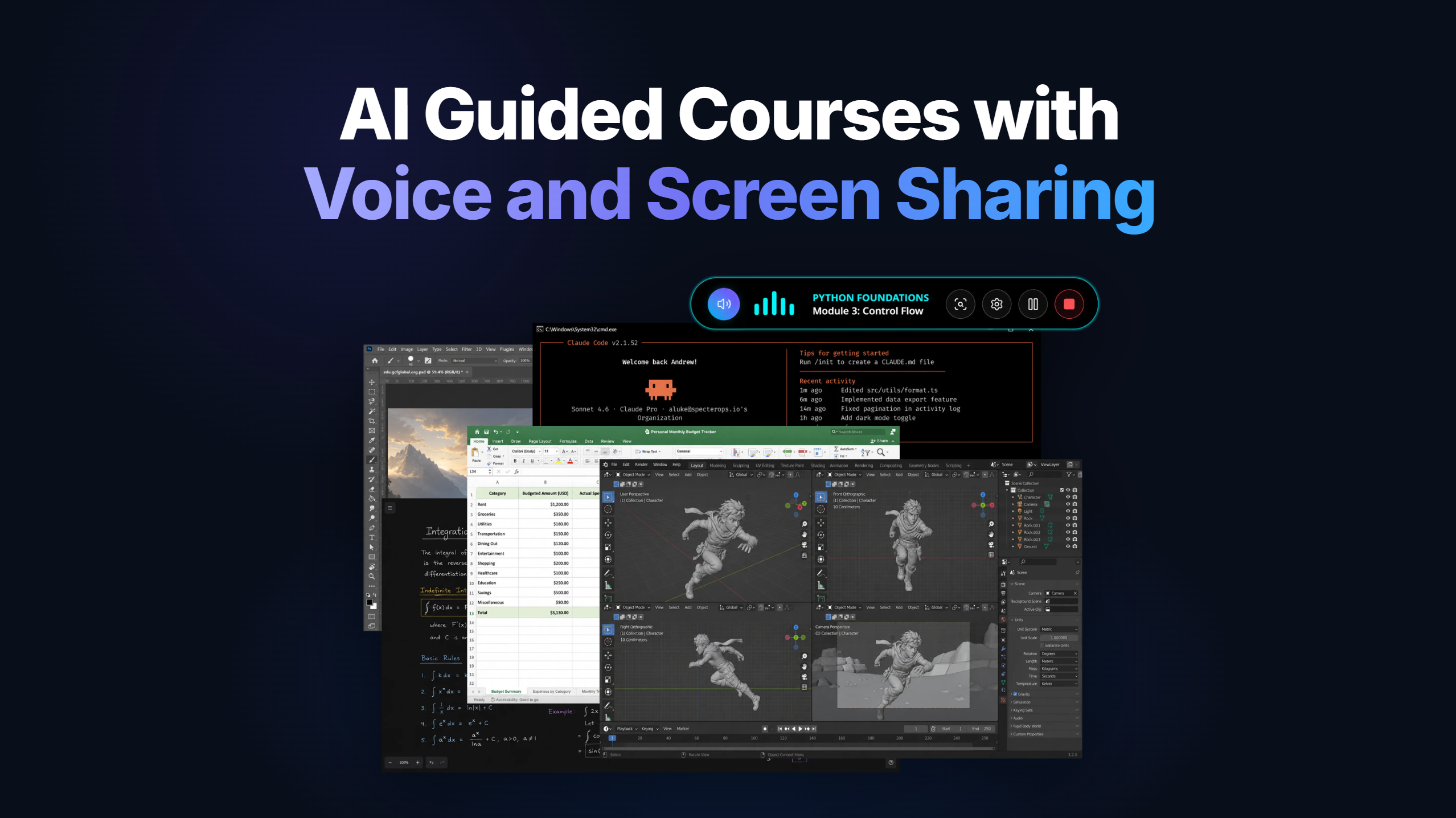
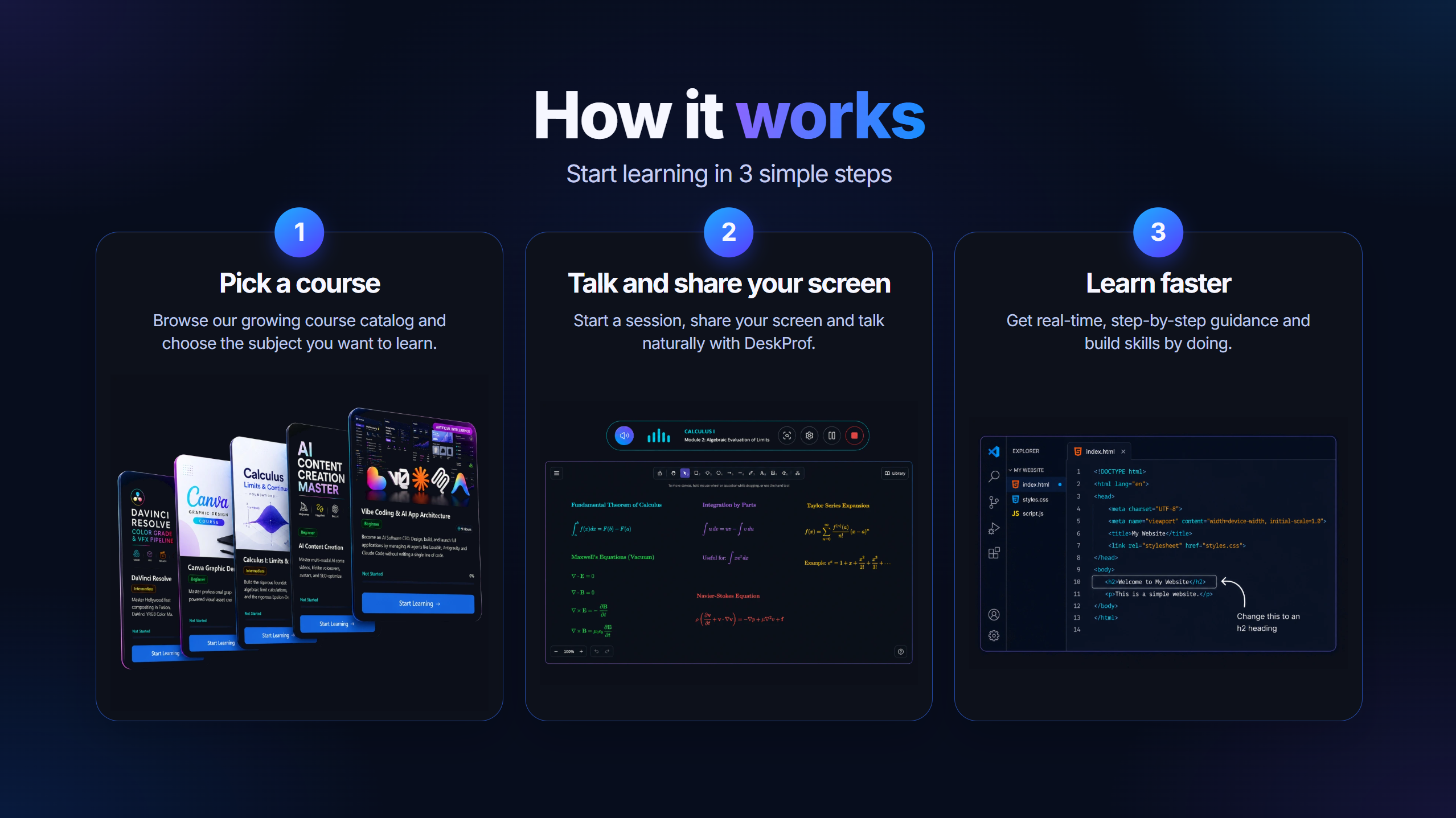
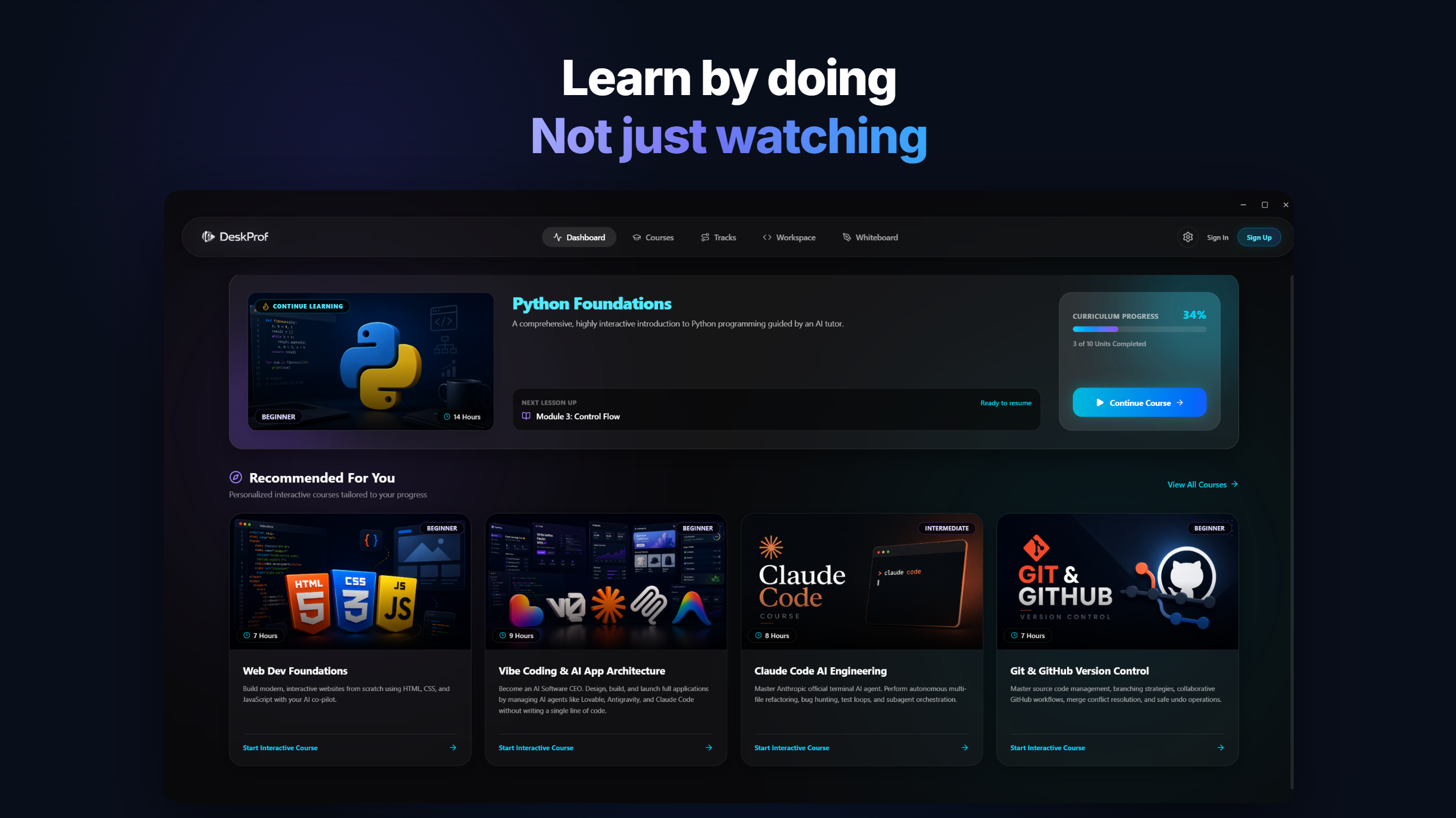
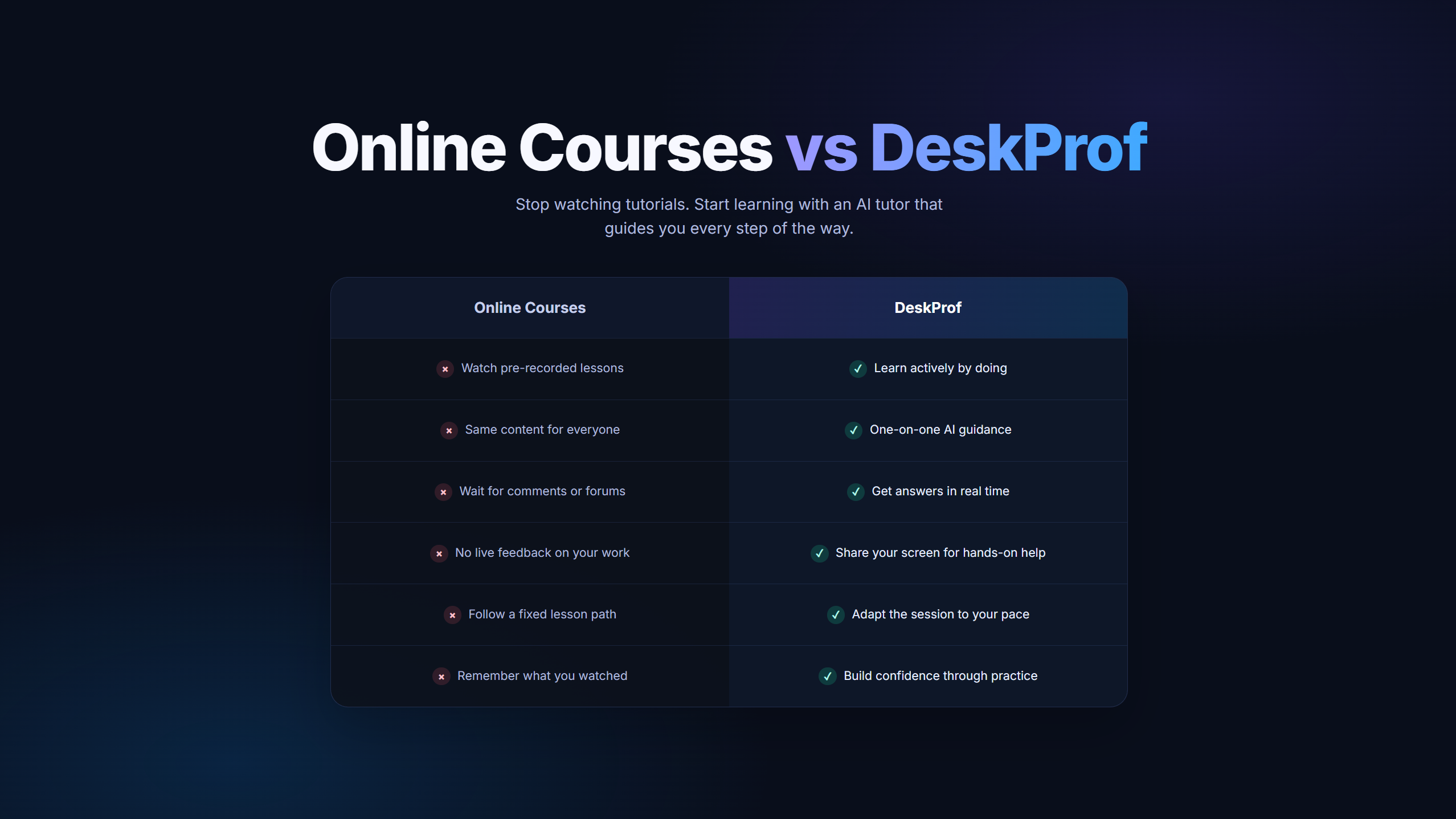
DeskProf is an AI tutor that sees the learner's screen, listens to what they say, and guides them through a structured curriculum in real time.
Instead of stopping to explain what is happening through a screenshot, learners can simply ask for help while they work. They can interrupt the tutor at any time and ask questions by voice, or use Circle to Ask to point out exactly where they need help. The AI understands what is happening on screen and can guide them from there.
The AI follows the curriculum and guides the learner through each step. It can react to what is happening on screen and, when needed, use tools such as screen highlighting, pointers, and a whiteboard to explain concepts visually.
The goal is to learn by doing, not just by watching.
How we built it
AI is not simply a feature inside DeskProf. It delivers the core service. Every tutoring session is conducted by Gemini, which makes decisions about what the learner needs based on the curriculum, their conversation, and what it can see on their screen.
We use Gemini through both Vertex AI and the Gemini API. Vertex AI powers the live tutoring experience, while the Gemini API handles business-operations automation such as classifying support and feedback submissions and proposing curriculum improvements.
DeskProf is currently operated by a single founder, so we use AI throughout the business. Google Antigravity and Claude Code were used for feature development, debugging production issues, and building internal tooling.
AI also helps maintain the curriculum. When learners submit course feedback, AI identifies the relevant course and module and proposes a targeted improvement. A human reviews and approves the change before it is applied.
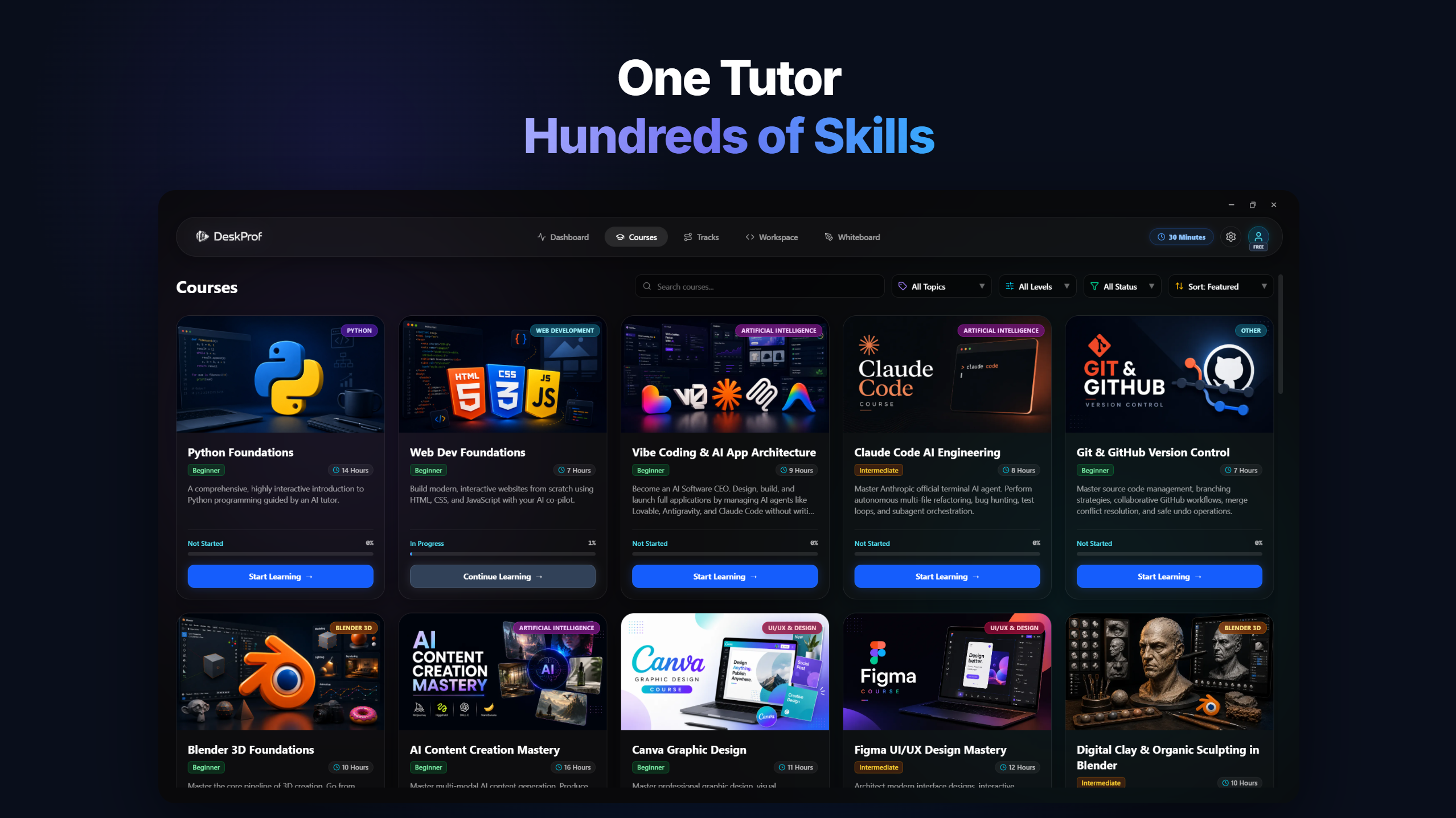
We also used AI to generate the initial curriculum content and course imagery, allowing us to build a broad catalog without first needing a large curriculum or design team.
Jobs and economic opportunity created
DeskProf is designed not only to help individuals learn, but also to create opportunities beyond the founding team.
As DeskProf grows, we expect to need curriculum designers, subject-matter experts, learning experience reviewers, support staff, and operations roles. AI can handle much of the drafting and automation, while human experts focus on validation, pedagogy, quality, and specialized knowledge.
DeskProf can also make skill acquisition significantly more affordable and accessible. Learners who cannot afford regular private tutoring can gain job-relevant skills in areas such as programming, design, data analysis, and productivity tools. This can expand access to higher-skilled jobs and career paths that would otherwise be harder to reach.
Challenges we ran into
The hardest part was making an AI tutor that could reliably understand both what a learner was saying and what was happening on their screen. A normal chatbot can answer a question, but a tutor needs to understand context, follow a curriculum, remember what has happened, and respond to changes on screen.
Another major challenge was working with real-time AI models. We found that low-latency conversational models were not always strong enough at interpreting complex screen context. To solve this, we built a custom pipeline around the latest Gemini models. This slightly increases latency, but significantly improves reasoning accuracy and reliability.
We also had to balance context quality with inference cost. Long sessions generate substantial conversational and visual context, so we built memory compression and context-management systems to preserve important information without continuously sending the entire history.
Accomplishments that we're proud of
We're proud that DeskProf is already operating as an AI-native product rather than a prototype with AI added on top.
The AI delivers the actual tutoring sessions, makes real-time decisions during lessons, evaluates sessions, handles the first pass on support and feedback, and helps improve the curriculum.
We are also proud that a single founder has been able to build and operate the product across engineering, tutoring, support, and curriculum development with AI handling much of the repeatable workload.
What we learned
We learned that building an AI-native company is different from simply adding AI features to a traditional product. The biggest opportunity is redesigning workflows around what AI can do.
We also learned that human oversight remains important. AI is excellent at handling volume and producing first drafts, but humans still need to set direction, validate important decisions, and maintain quality. The best system for us has been AI handling the first pass while humans focus on judgment.
What's next for DeskProf
Our next step is to improve the reliability and quality of the tutoring experience, expand the course catalog, and continue improving the AI's ability to understand learners and their work.
As the business grows, we want to bring subject-matter experts, curriculum designers, and reviewers into the process. AI can handle drafting and repetitive maintenance, while experts focus on accuracy, learning design, and specialized knowledge.
Long term, we want DeskProf to make high-quality, personalized learning accessible without requiring a human tutor to be available every time someone gets stuck.
Built With
- cloud-run
- creem
- docker
- electron
- excalidraw
- express.js
- firebase
- firebase-auth
- firestore
- gemini
- gemini-api
- google-cloud
- google-cloud-text-to-speech
- katex
- microsoft-store
- monaco-editor
- node.js
- pyodide
- react
- tailwindcss
- typescript
- vertex-ai
- vite
- web-audio-api


Log in or sign up for Devpost to join the conversation.