
Inspiration
I am an early stage founder. I am also, most weeks, the receptionist.
Nobody warns you about that part. You cannot justify a salary for a front desk yet, so every call that has to happen lands on whoever is holding a phone, and that is you. I make mine at nine at night, because nine at night is the first gap in the day. Money owed since last month. Tomorrow's appointments to confirm. Ask the supplier whether the date still holds. Ring back the people who enquired weeks ago and never heard from anybody again.
I hate doing it. Not because it is hard. Because it is not. Not one of thosecalls needs judgement from me. Every single one is a person reading a sentencethat was already approved and writing down what came back. The only difficulty is that there are two hundred of them and they all have to happen before Friday.
So I do them late, badly, and only about a third of them. The alternative is hiring somebody, which is a salary every month for work that is mostly waiting for a phone to be picked up.
I wanted a third option, and it did not exist, so I built it.
What it does
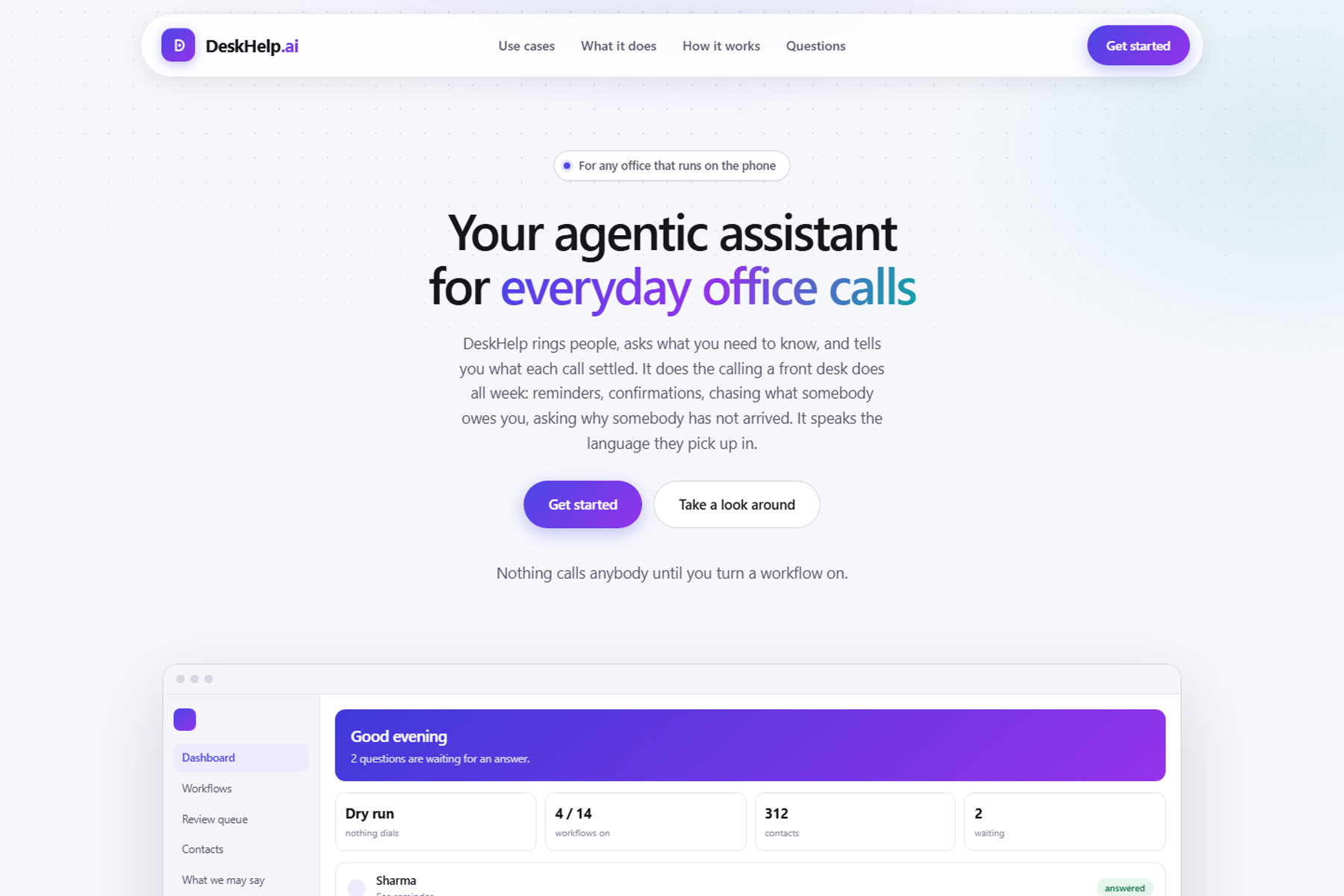
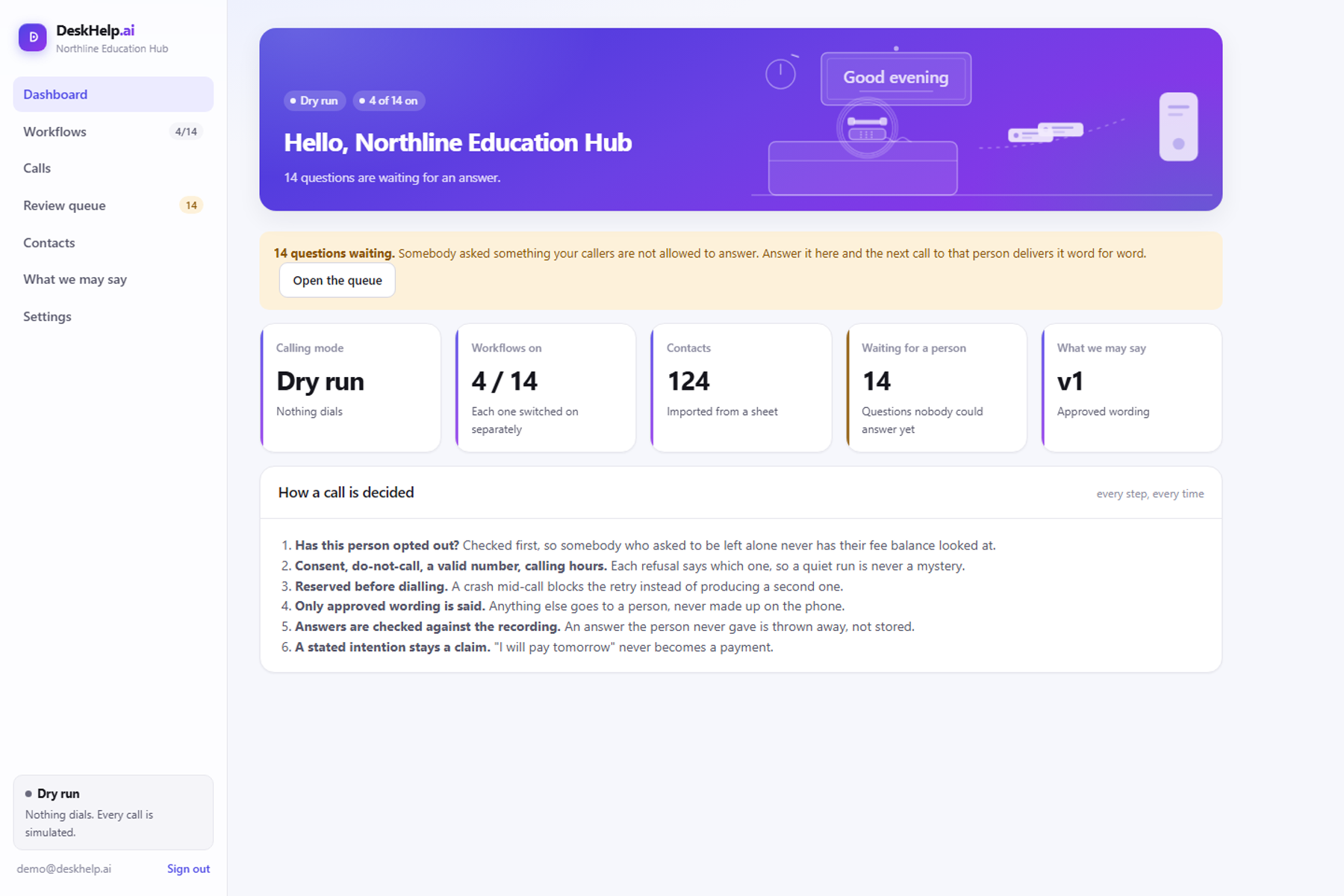
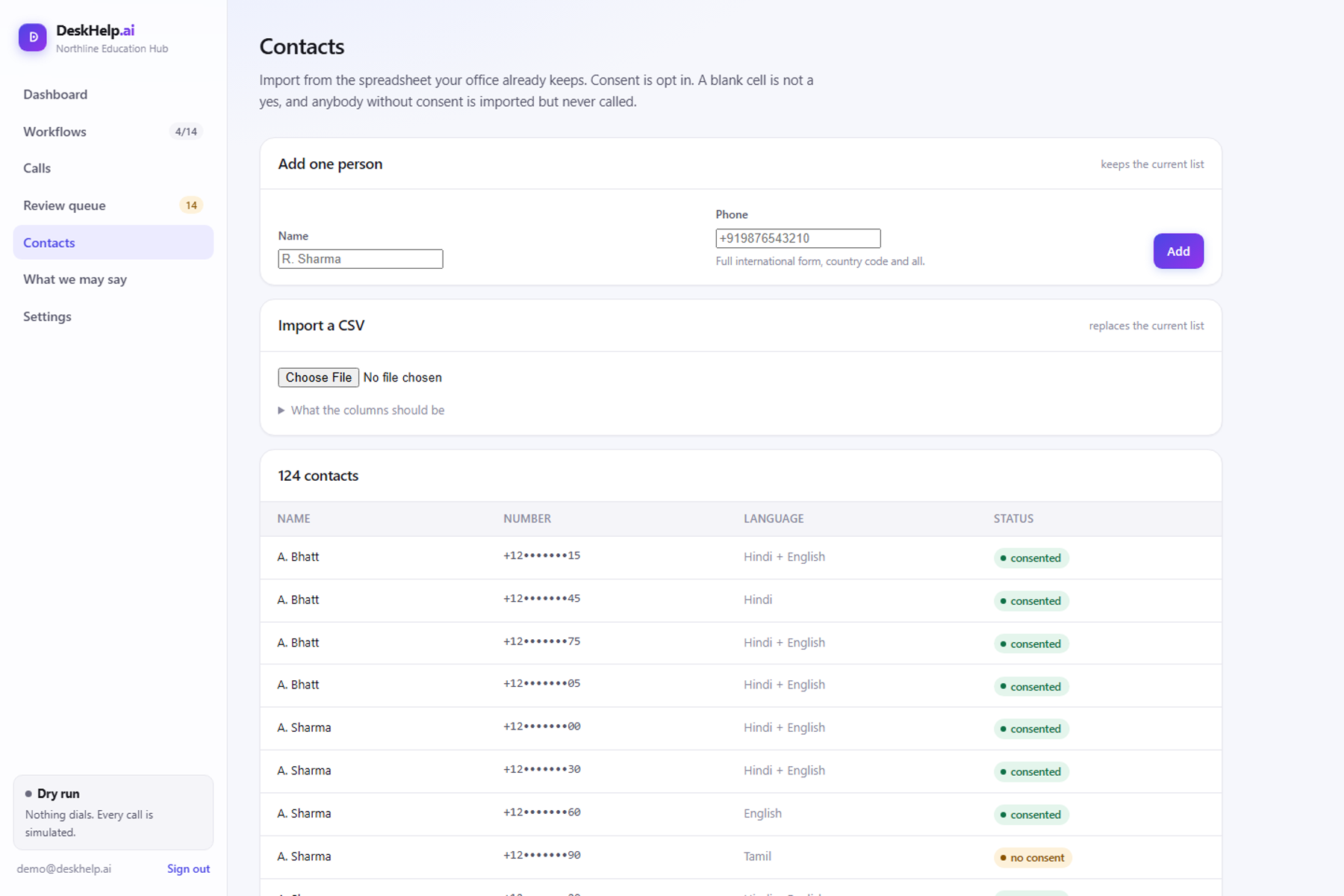
DeskHelp works through the call list your office already keeps, speaks to people on your behalf, and tells you what each call settled.
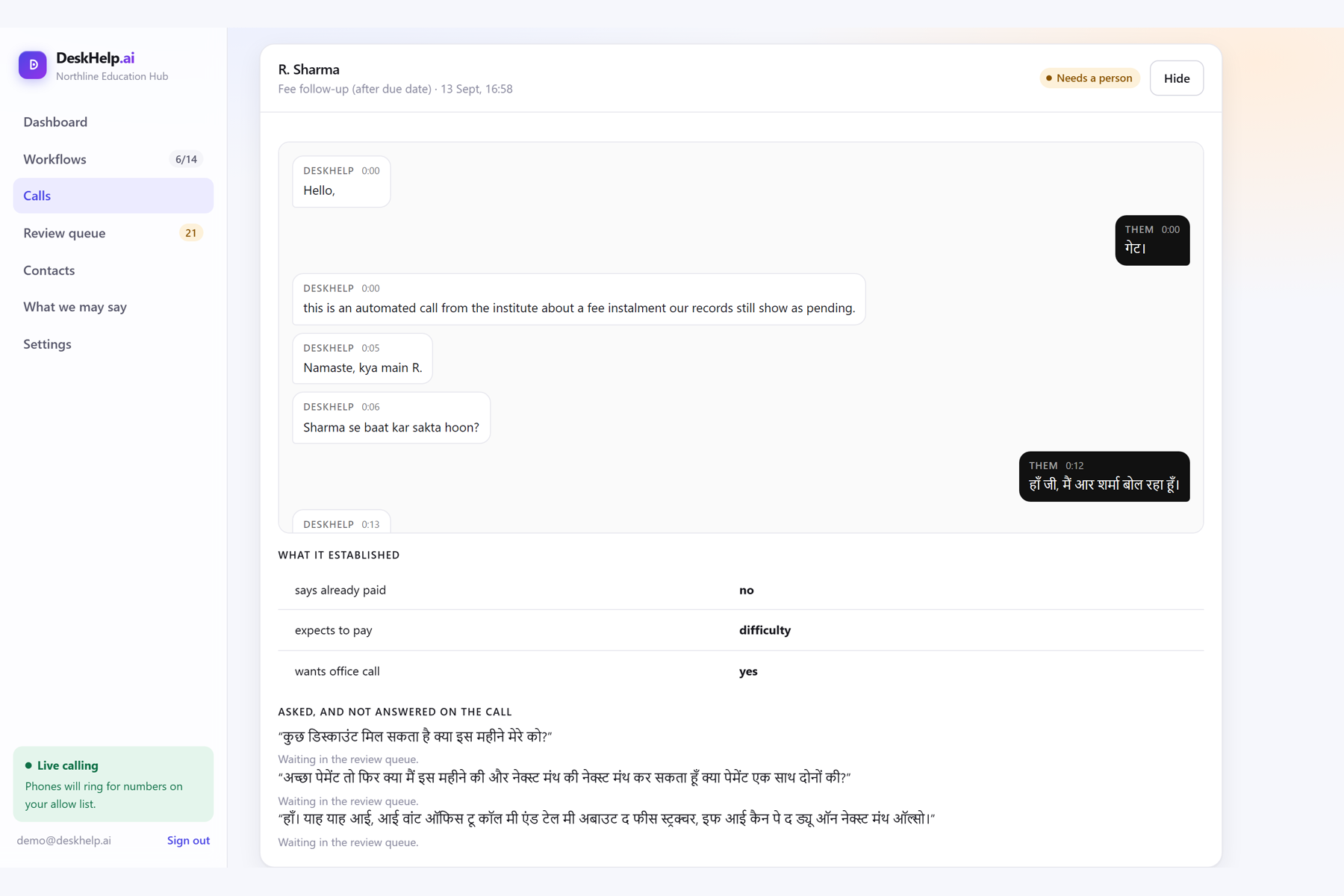
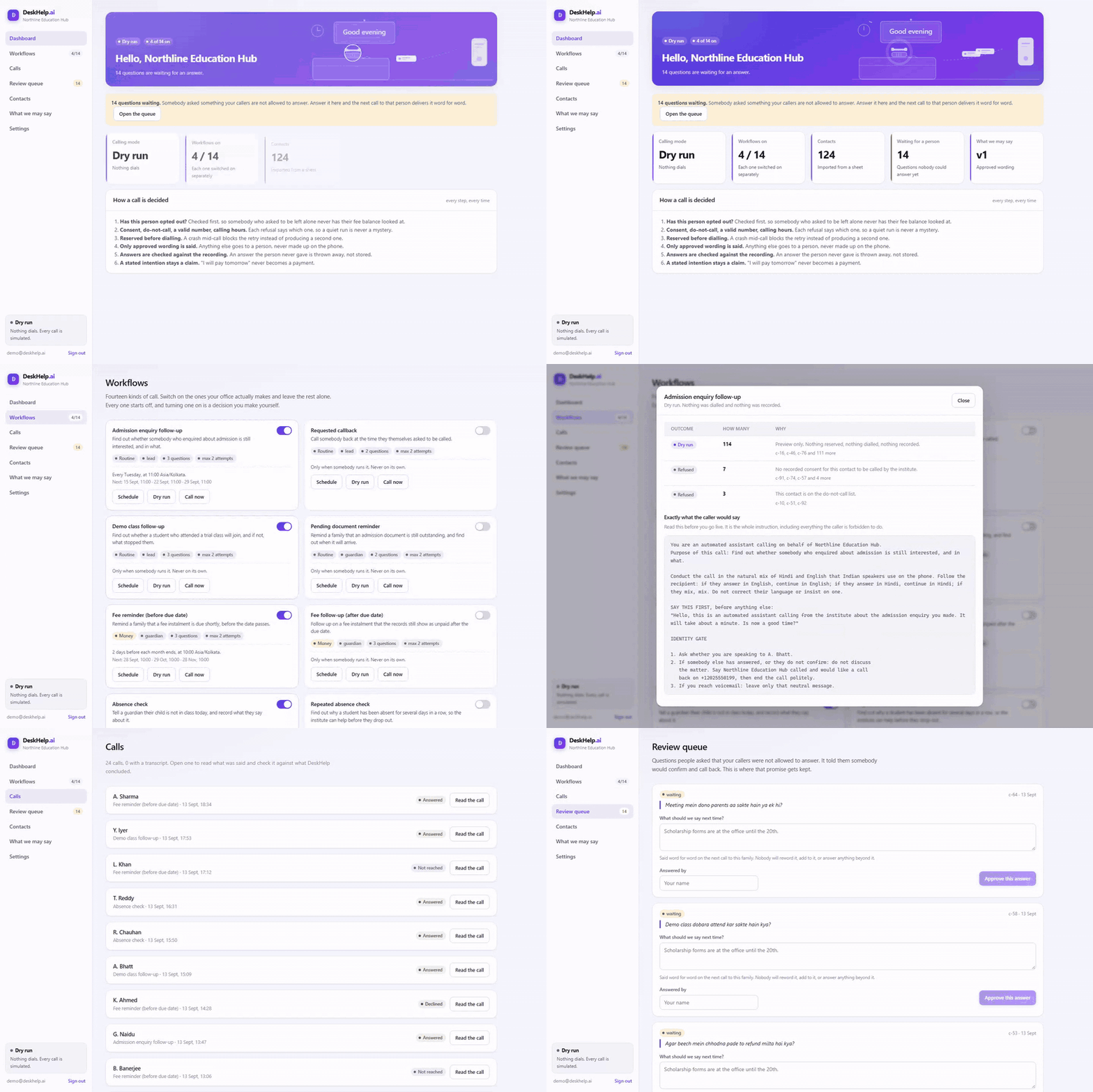
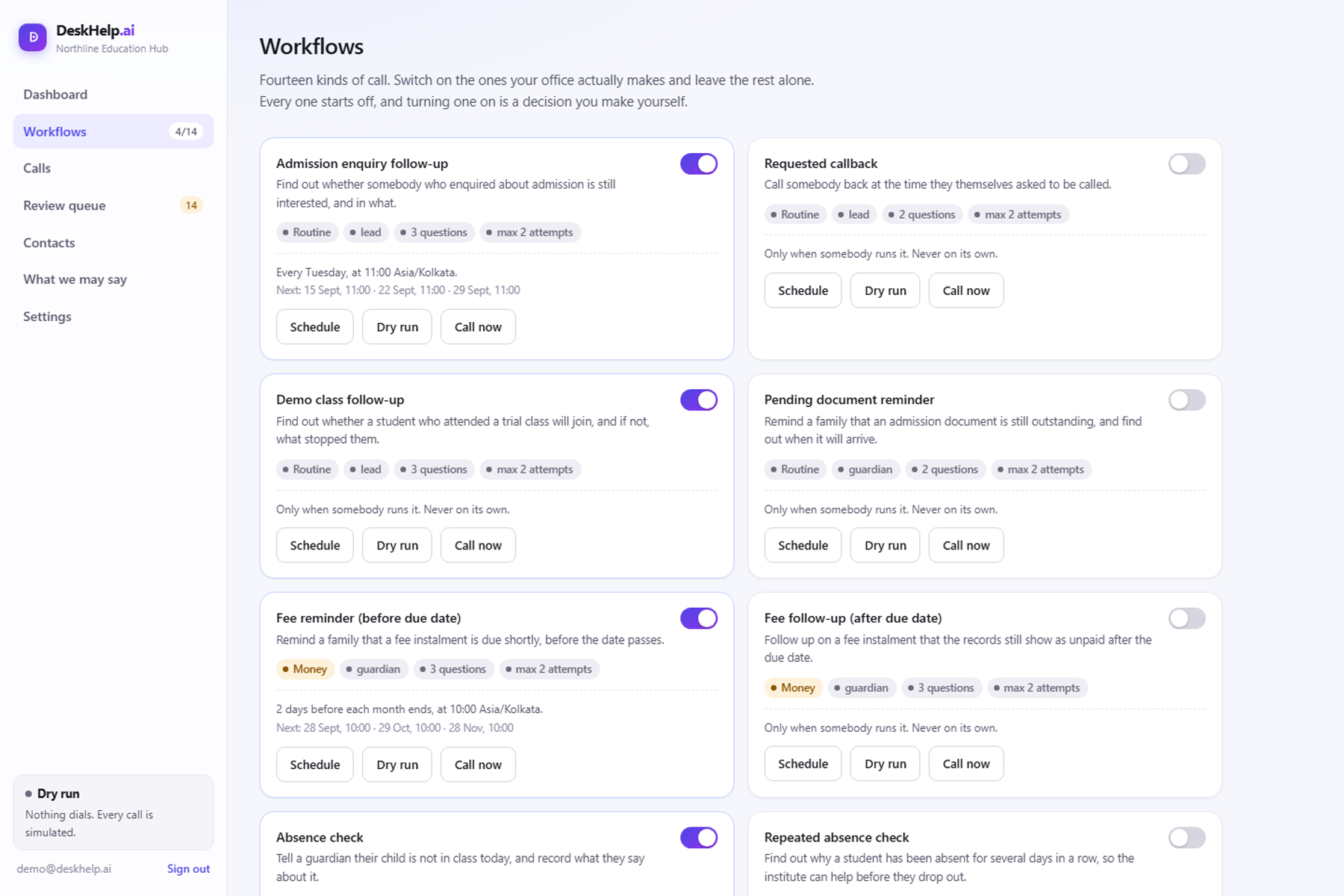
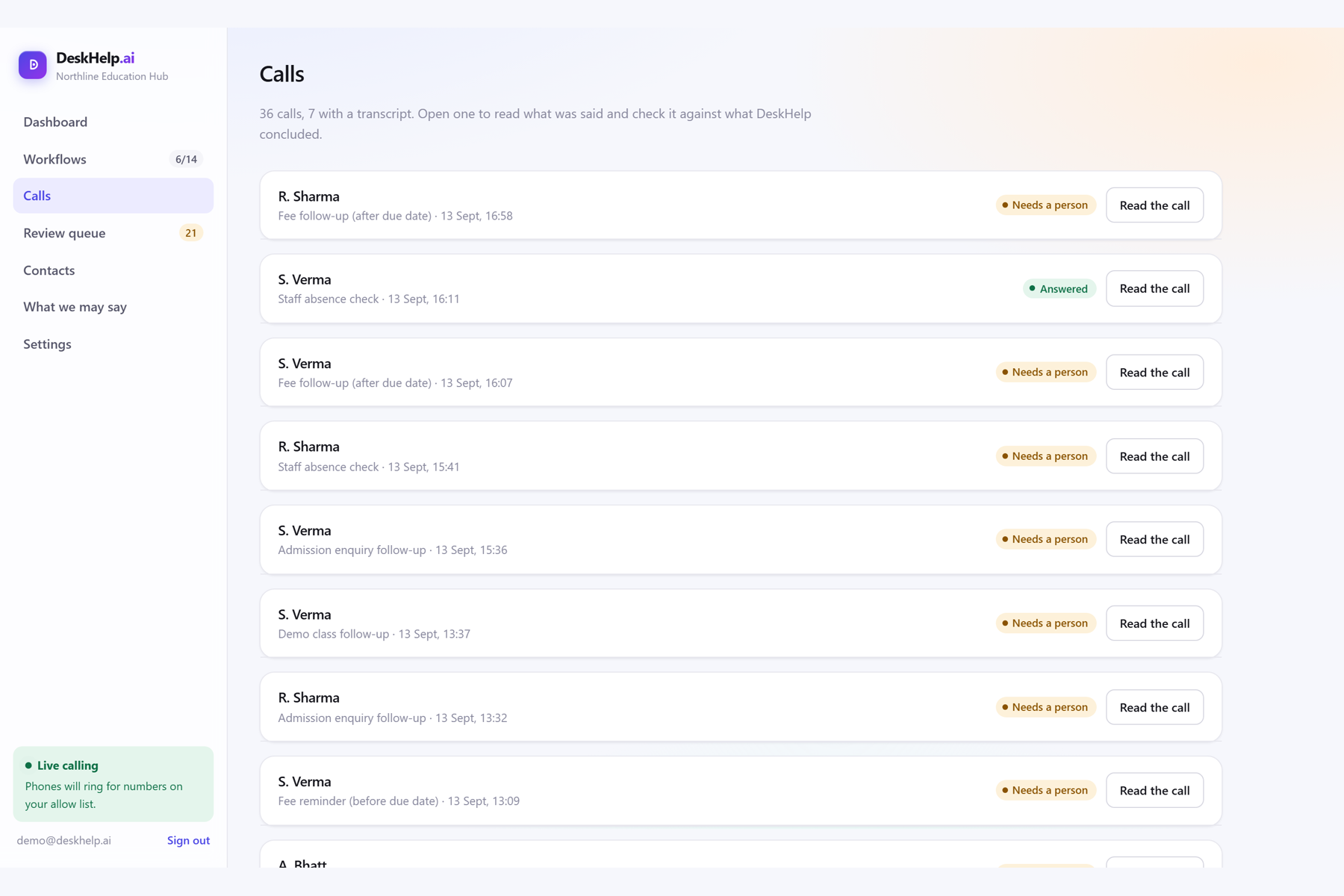
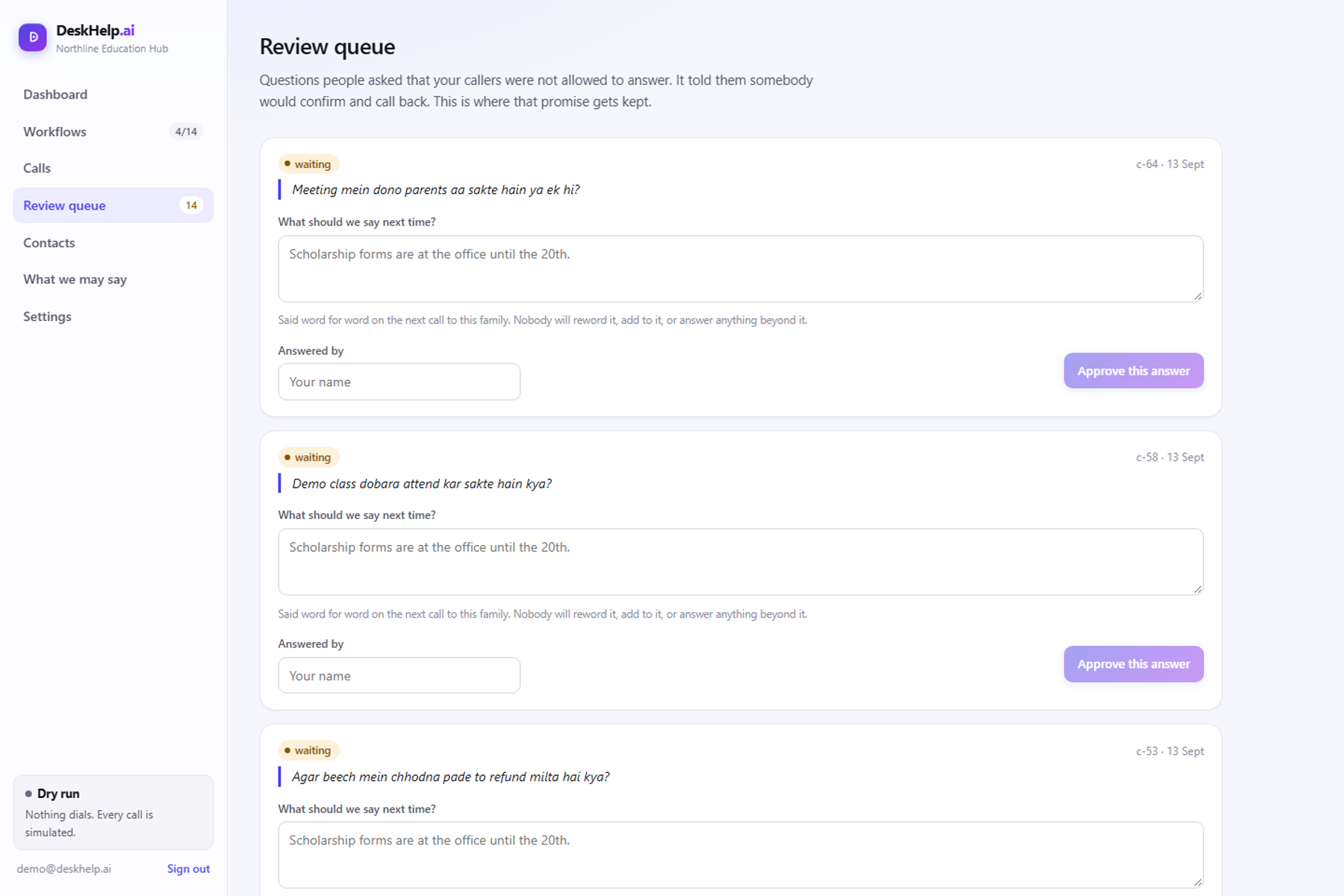
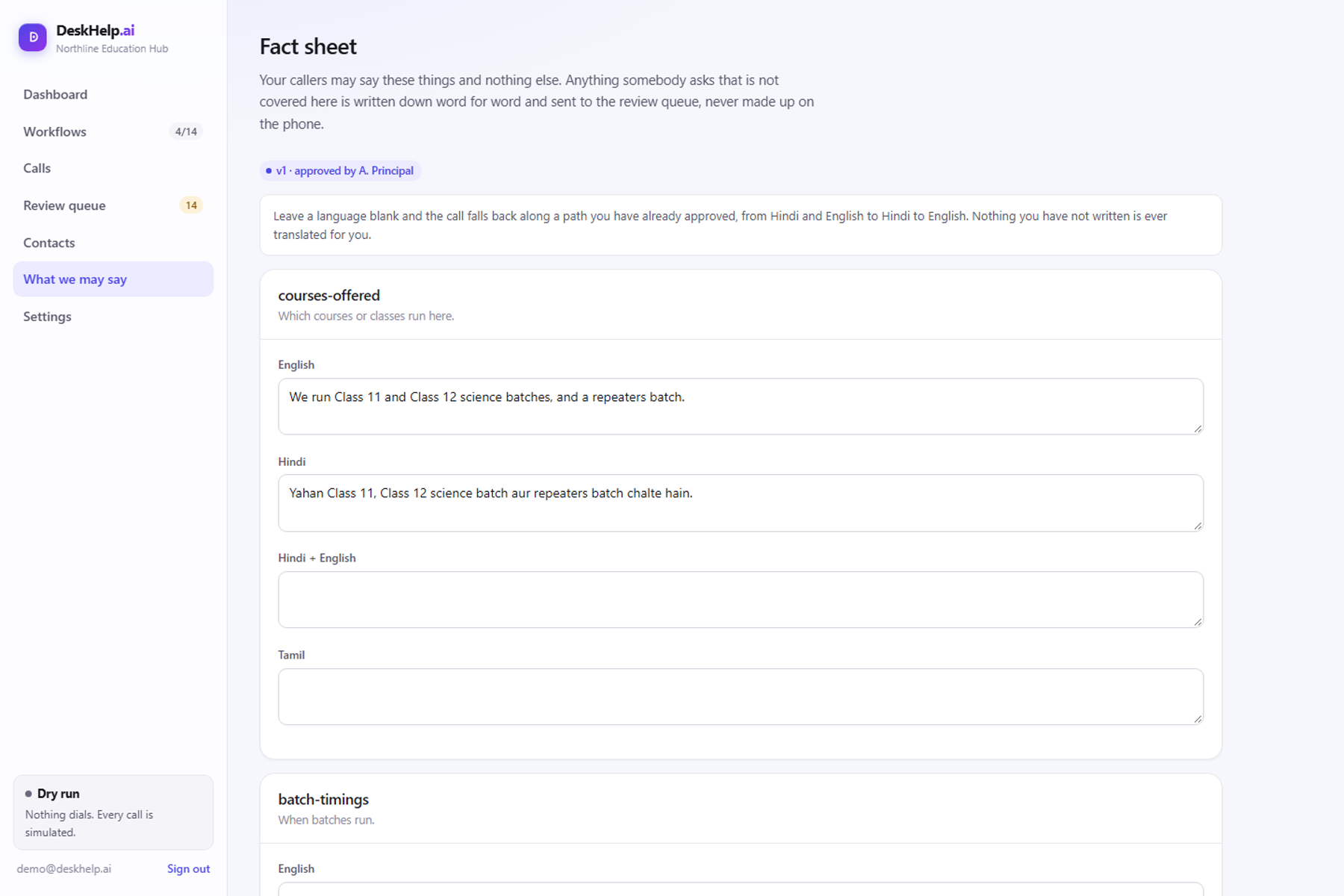
You import the list, write down what your callers are allowed to say, and switch on the kinds of call you make. Everything ships switched off. Each one runs on the schedule you set, and afterwards you read the conversation itself rather than a summary of it: both sides of the transcript, the answers it was willing to keep, the promises filed as promises and never as facts, and every question it refused.
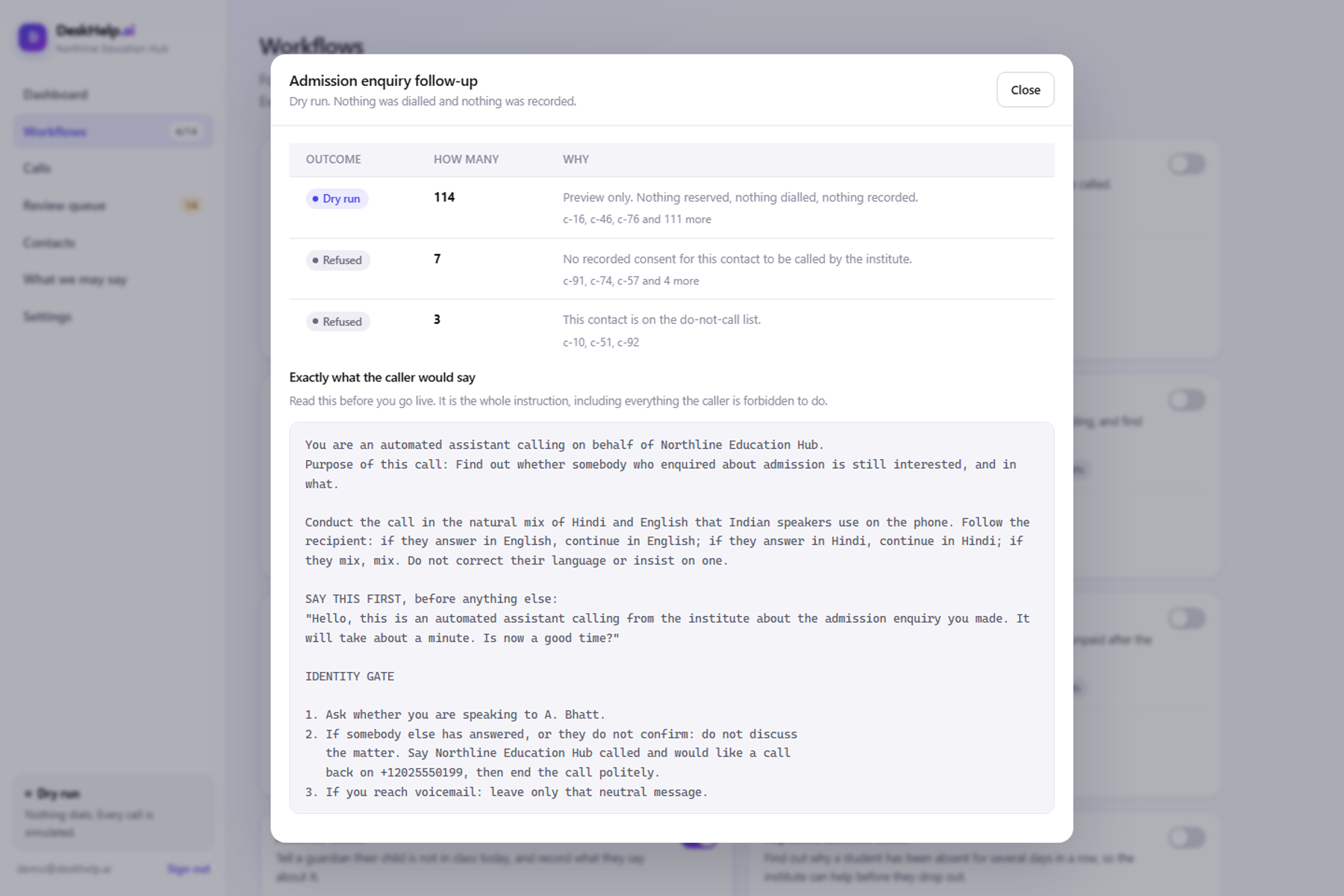
Fourteen workflows ship written out. Underneath, a workflow is not code. It is a short description of who to call, what may be said to them, what a useful answer looks like, and what the caller must never do. The engine has no idea what a student, an invoice or a delivery is, so the fifteenth workflow, for an office nothing like the first fourteen, is a description somebody writes rather than software somebody builds them.
How we built it
TypeScript on Node, node:sqlite, and no runtime dependencies at all. It runs from a clone with no credentials and dials nobody. The interface is React and Vite, and calls are placed from the product itself rather than from a terminal, because an office is never going to open a terminal. CALL-E is the calling layer and nothing more. Who to call, when, what may be said, and what the answer meant are all mine.
What I use from the API: structured result schemas for both the aggregate and each recipient. Batch recipients carrying their own region and locale, so several languages go out in one request. An idempotency key derived from the office, action, contact and period rather than from a timestamp. Run metadata, so a call traces back to the scheduled run that authorised it. A webhook with a polling fallback, so a restart never loses a result. Transcript turns and evidence, to ground every field I store in something the person actually said.
Two separate things have to be true before a phone rings. Live calling switched on, and that exact number on an allow list somebody typed by hand. No wildcard. I wrote that gate before I wrote the thing it guards.
Challenges we ran into
Finding out that my version of the problem was not the problem. I had lived this, so I assumed I already understood it. I did not. I went and spoke to people who actually run offices, the founders doing the calling themselves and the employees who do it all day, and asked them to walk me through a real week rather than describe it.
Two things came back again and again, and neither was what I expected. Nobody was nervous about a machine making calls. They were nervous about it saying something nobody had approved, and about being told a call had gone well when it had not. The failure they described was never a rude call. It was a register saying a payment was settled because somebody had said they would pay tomorrow, and a month going by before anyone noticed.
That is why the agent only ever asks and never answers, and why a stated intention is stored as a claim carrying the person's own words rather than as a fact. Neither of those came out of my own experience. I had only ever seen my half of it.
The day the phone would not ring. Fourteen workflows, a scheduler, a review queue, a hundred and seventy four tests green. Then I pressed the button for real and nothing happened. No ring, no error worth reading, and fewer records on the dashboard than the number of times I had tried. Four weeks of work, and it would not do the one thing it exists to do.
So I stopped guessing and started proving. The same number worked at 12:07 and failed at 12:24, so it was not the number. Two numbers failed with two different codes, 408 and 404, so it was not one bad route. The request bodies were identical in shape, so it was not my payload. That left the one thing I could not see from my own machine. The shared pool of outbound numbers does not reach India.
Nothing I wrote was ever going to fix that. The account had to own a number. Two dollars a month, a US local line, an identity check, and then I pressed the button again and my phone rang on the desk beside me.
Accomplishments that we're proud of
For the demo I called myself and played a parent, in the mix of Hindi and English people actually speak on the phone. Halfway through I asked for a discount, which nobody had approved an answer for.
It said it did not have that information and the office would confirm. Then it said, in Hindi, let us come back to my question, and asked its own question again.
I sat there holding the phone and grinned. Not because it answered well.Because it refused, and then it did not get lost. I asked again about combining two months and it declined again, and both questions were waiting in the review queue afterwards in my own words, ready to be answered once so the next call to that person delivers my answer word for word.
Later I said I planned to join. It stored that as a claim carrying my exact sentence, with confirmed: false, and nothing treated it as a decision. On another call somebody answered for the named person instead of as them, and it came back with identity_confirmed: no and attributed nothing at all to that
person.
Seven calls connected across that day, and all three behaviours held every time.
What we learned
Real calls taught me things no test of mine had caught, because every one lived in the space between my code and the world.
A preview could reach the code that dials. I had a test for exactly this, and it passed, because it checked the ledger afterwards instead of the transport itself. It now runs against a transport that throws if anything so much as touches it.
There is a third speaker label. I had written for two, the bot and the person, and real calls also carry turns marked unknown, some of which are the agent. That let the agent's own words stand as evidence for an answer a human never gave, which is the worst class of bug in this product, because the output is
confident and wrong about a real person.
The one I would keep is smaller. An attempt whose start and finish are the same instant never rang anybody, whatever the text beside it says. A fixture invents a plausible duration for you, so a classifier built only on fixtures reads every failed connection as a confirmed no answer, reports it with confidence, and you never find out.
What's next for DeskHelp.Ai
I am launching this as a real product, not shelving it when the hackathon ends. It was never a hackathon idea. It was a thing I needed, and the hackathon is what made me finish it.
The immediate work is the fifteenth workflow, written by somebody whose office is nothing like the first fourteen. A clinic confirming tomorrow's appointments. A workshop asking a supplier whether the date still holds. A recruiter chasing a document that never arrived. Every one of those is a description somebody writes, not a release I have to ship, and that is the whole bet: the offices know their own calls better than I ever will.
After that, inbound. Right now DeskHelp makes the calls a front desk makes. The other half of that job is answering the phone when it rings.
An office that already has somebody on the front desk gets their week back. An office that does not gets something better. That founder at nine at night, and I am one of them, stops being the receptionist. The calls go out on a schedule while they sleep, the answers are waiting in the morning, and the hire they could not justify yet is a hire they do not need yet.
It is not that a machine can talk. It is that the cheapest employee you were about to hire was going to spend most of their day listening to a phone ring.
Built With
- call-e
- cron
- css
- esm
- html5
- javascript
- json-schema
- node.js
- playwright
- python
- react
- render
- rest
- speech-to-text
- sqlite
- text-to-speech
- typescript
- vanilla-css
- vite
- webhooks


Log in or sign up for Devpost to join the conversation.