-
-
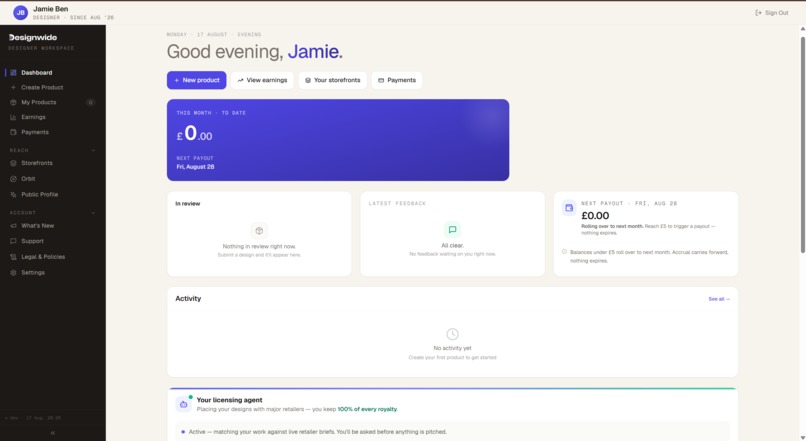
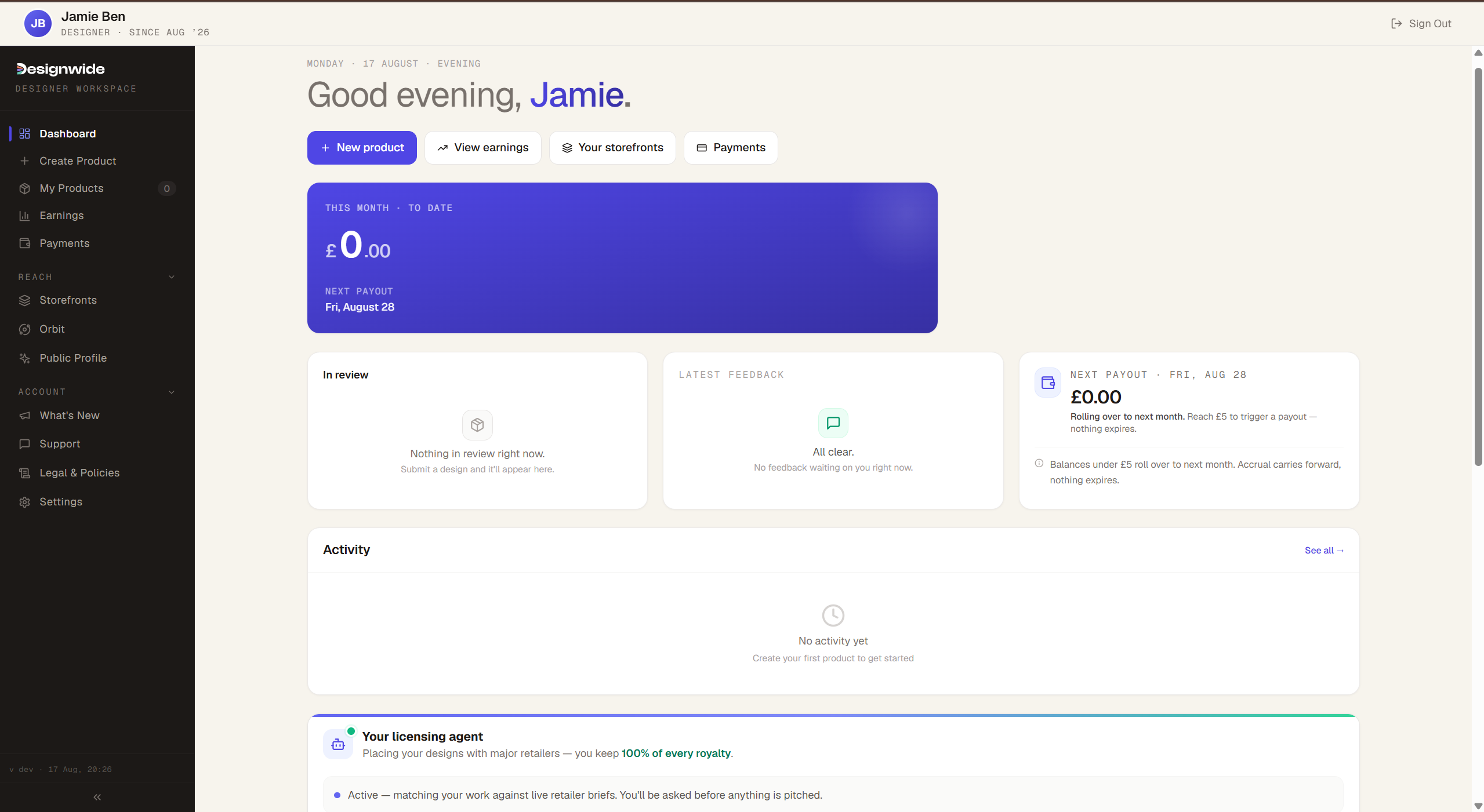
Platform - Designer side
Inspiration
Talent is everywhere. The commercial infrastructure that turns talent into income is not.
As a designer, I have seen how difficult it is for an independent creator to reach major retailers. The problem is rarely a shortage of ideas. Retailers need reliable suppliers, suitable products, clear pricing, production capability and ongoing account support. Most creators cannot provide all of that alone, and large retailers cannot manage thousands of individual relationships.
Traditional licensing agencies help bridge this gap, but their capacity is limited. We asked a more fundamental question: what if every creator could access the commercial team normally available only to established companies?
That became Designwide—a Gemini-powered licensing business designed to turn independent creativity into viable enterprise.
What it does
Designwide gives creators a Gemini-powered licensing team that turns their work into products sold by retailers—helping them build businesses, keep ownership and earn from every sale.
Licensing simply means that a creator gives permission for selected work to appear on a product. The creator retains ownership of the original work and receives an agreed payment when products sell.
Gemini helps run the commercial operation behind that process. It researches market opportunities, reads retailer requirements, searches creator catalogues for suitable work, develops product proposals, studies comparable products, prepares pricing and sales materials, and supports the deal pipeline.
Designwide becomes the dependable supplier. Retailers gain access to varied independent creativity through one commercial relationship, while creators can participate without having to build an agency, employ a sales team or already know the right buyers.
The creator supplies the talent. Designwide provides the infrastructure. Gemini operates the workforce.
How we built it
Designwide’s competition project is the new Gemini-operated layer built around our experience and commerce foundations.
At its centre is a dispatcher powered by Gemini 3.6 Flash and deployed on Google Cloud. The dispatcher reads the live state of the business—such as retailer opportunities without proposals, products needing improvement, creators awaiting contact, open support cases and pending commercial work—and selects the most valuable next tasks.
Specialist Gemini agents then carry out different business functions. The licensing agent reads a retailer’s exact requirements, exclusions and price expectations before examining creator catalogues and proposing genuine matches. The merchandising agent uses comparable products to prepare titles, descriptions, tags and evidence-based pricing. The deals agent researches buyers, maintains the sales pipeline, assembles product presentations and drafts commercial messages. Other agents support opportunity research, product development, procurement, customer service and growth.
Every decision is recorded through task, run and proposal logs, creating an auditable history of what Gemini saw, decided and produced.
We designed clear boundaries between AI and people. Gemini researches, prioritises, evaluates and proposes. People approve consequential actions such as contacting a buyer, publishing a product, signing an agreement or making a payment. Royalty, stock and financial calculations remain deterministic rather than being generated by an AI model.
Challenges we ran into
The hardest challenge was making Gemini operationally useful without allowing it to invent commercial reality.
A plausible but unsupported product match can waste a buyer’s time. An invented market signal can lead to the wrong product. An unjustified price can destroy margin, while inaccurate statements about ownership can create legal risk.
We therefore grounded agents in live business information and gave them narrow responsibilities. Pricing must be supported by comparable products. Growth recommendations must reflect actual sales data. Retailer proposals must follow the retailer’s stated requirements. Outreach remains in draft until a person approves it. A separate reviewer checks proposals for unsupported claims, unsafe content, intellectual-property concerns and weak pricing evidence.
Another challenge was turning a complex industry into something creators and judges could understand. We learned to describe Designwide not as software that automates licensing, but as infrastructure that gives an individual access to the capabilities of a commercial organisation.
Accomplishments that we're proud of
During the competition, Designwide signed a contract with Walmart. We see this as evidence that independent creativity can reach major retail when it is supported by dependable commercial infrastructure—not as the limit of the opportunity.
Our wider licensing work has paid more than £24,492 in royalties to independent designers, demonstrating that creative ownership can produce real economic value.
We are also proud that Gemini is not included as a superficial feature. It reads genuine operating data, identifies unfinished commercial work, makes prioritisation and matching decisions, and produces proposals that move the business forward. The result is a working model for an AI-native organisation with responsible human control.
What we learned
We learned that many aspiring entrepreneurs do not simply need another tool. They need access to the functions of a company: research, product development, merchandising, sales, administration and customer support.
Gemini changes the minimum viable size of that company. Capabilities that previously required several employees or a traditional agency can become shared infrastructure serving many independent creators.
We also learned that job creation begins with enterprise creation. Before a creator can hire other people, they need a realistic way to reach customers and generate income. By reducing the commercial barriers between talent and demand, Designwide can help more people establish sustainable creative businesses, regardless of their location or existing industry connections.
What's next for Designwide
Our immediate focus is expanding to more retailers and proving that the model can repeatedly convert creator-owned work into products customers want to buy.
We will improve how Gemini identifies opportunities, matches creators to retailer demand, develops product ranges and measures the economic results for each creator. We also plan to make it easier for creators across geographical boundaries to participate without relocating or building their own commercial teams.
Over time, one Gemini-powered operating layer could coordinate opportunities for thousands of independent creators while giving retailers a manageable and reliable way to work with them.
Retail is our first proving ground. The larger ambition is to build infrastructure that connects distributed creative talent with commercial demand wherever it exists - making entrepreneurship possible for people who previously had the ability to create, but not the tools needed to compete.
Built With
- agentic
- express.js
- gemini
- node.js
- puppeteer
- python
- react
- supabase
- typescript
- vercel
- vite


Log in or sign up for Devpost to join the conversation.