-
-
AI Powered system design builder
Inspiration
As your project grows over the years, the architecture becomes harder to understand. Team members leave, new engineers join, and knowledge is scattered across docs, code, and KT sessions.
With Design2App, your system design becomes the single source of truth. Everything is visual, connected, and stored in graph memory, so both developers and AI coding agents can instantly understand how the system works without relying on tribal knowledge.
AI coding agents are incredibly good at writing code, but they all suffer from the same limitation: they only understand what fits inside their context window.
As applications grow from a few files to hundreds of services and thousands of components, AI agents lose the architectural context that human engineers naturally build over time. They begin making incorrect assumptions, duplicate existing functionality, violate architectural boundaries, and generate inconsistent implementations.
We realized that the problem wasn't the AI's coding ability—it was the lack of a structured understanding of the system.
Instead of forcing AI to reverse-engineer architecture from code, we asked a simple question:
What if AI could directly understand the system design?
That idea became Design2App.
What it does
Design2App is an abstraction layer that transforms visual system design into executable context for AI coding agents.
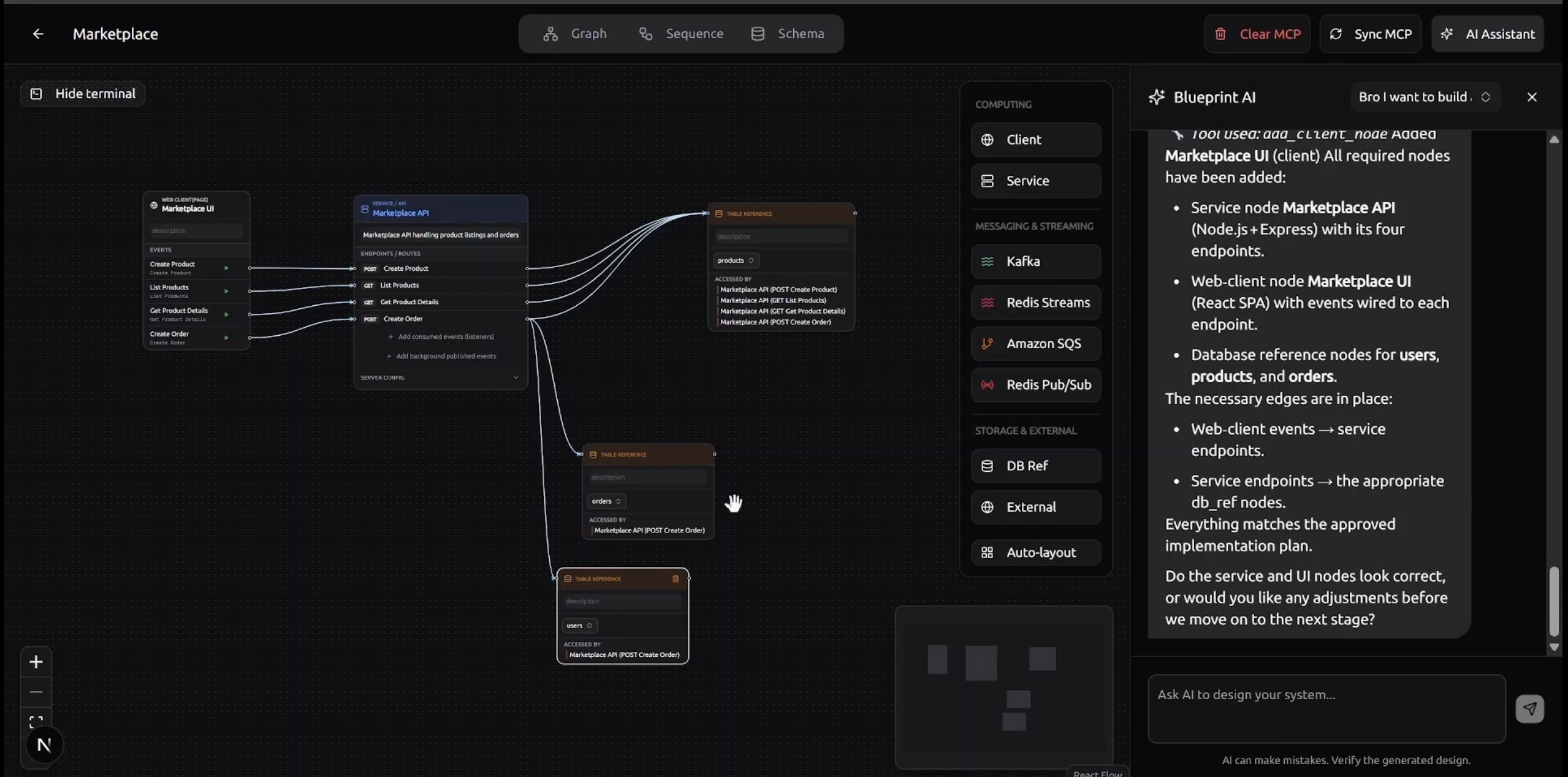
Developers model their application visually—services, APIs, databases, events, queues, relationships, business rules, and dependencies.
The platform converts this architecture into structured knowledge that AI agents can retrieve through an MCP server. Instead of relying on huge prompts or scanning an entire repository, agents query the architecture and instantly understand:
- System boundaries
- APIs and contracts
- Data ownership
- Event flows
- Dependencies
- Business logic
- Relationships between services
Every AI agent references the same Single Source of Truth (SOT), allowing multiple agents to work in parallel while remaining synchronized.
How we built it
The project consists of several core components:
- A visual system design editor for modelling software architecture
- A knowledge generation pipeline that converts diagrams into executable context
- An MCP server exposing architectural context to coding agents
- A semantic memory layer for fast retrieval
- Real-time synchronization so architectural changes immediately become available to AI agents
The result is an architecture-aware workflow where AI no longer guesses how the system is organized—it retrieves the information directly from the design.
Challenges we ran into
The biggest challenge was deciding how architecture should be represented so that AI agents could consume it efficiently.
A diagram by itself is useful for humans but difficult for LLMs to reason about. We had to transform visual nodes and edges into structured semantic knowledge while preserving relationships, dependencies, ownership, and context.
Another challenge was ensuring that parallel AI agents stayed synchronized. Every agent needs consistent architectural knowledge without introducing conflicts or stale context.
We also spent significant effort designing a retrieval format that minimizes tokens while maximizing architectural understanding.
What we learned
Building Design2App reinforced an important idea:
Code is not the best source of architectural truth.
Architecture exists at a higher level of abstraction than implementation. By giving AI access to that abstraction instead of forcing it to infer architecture from code, coding agents become significantly more reliable, consistent, and scalable.
We also learned that context engineering may become just as important as prompt engineering as AI-native software development evolves.
What's next
Our hackathon submission focuses on solving the architectural context problem.
The long-term vision is much bigger:
- Autonomous cloud based multi-agent software development
- Architecture-aware planning and implementation
- Continuous synchronization between design and code
- AI-driven system evolution
- Cloud-native orchestration of specialized coding agents
We believe software development will increasingly shift from manually writing code to designing systems, while AI handles implementation using architecture as its primary source of truth.

Log in or sign up for Devpost to join the conversation.