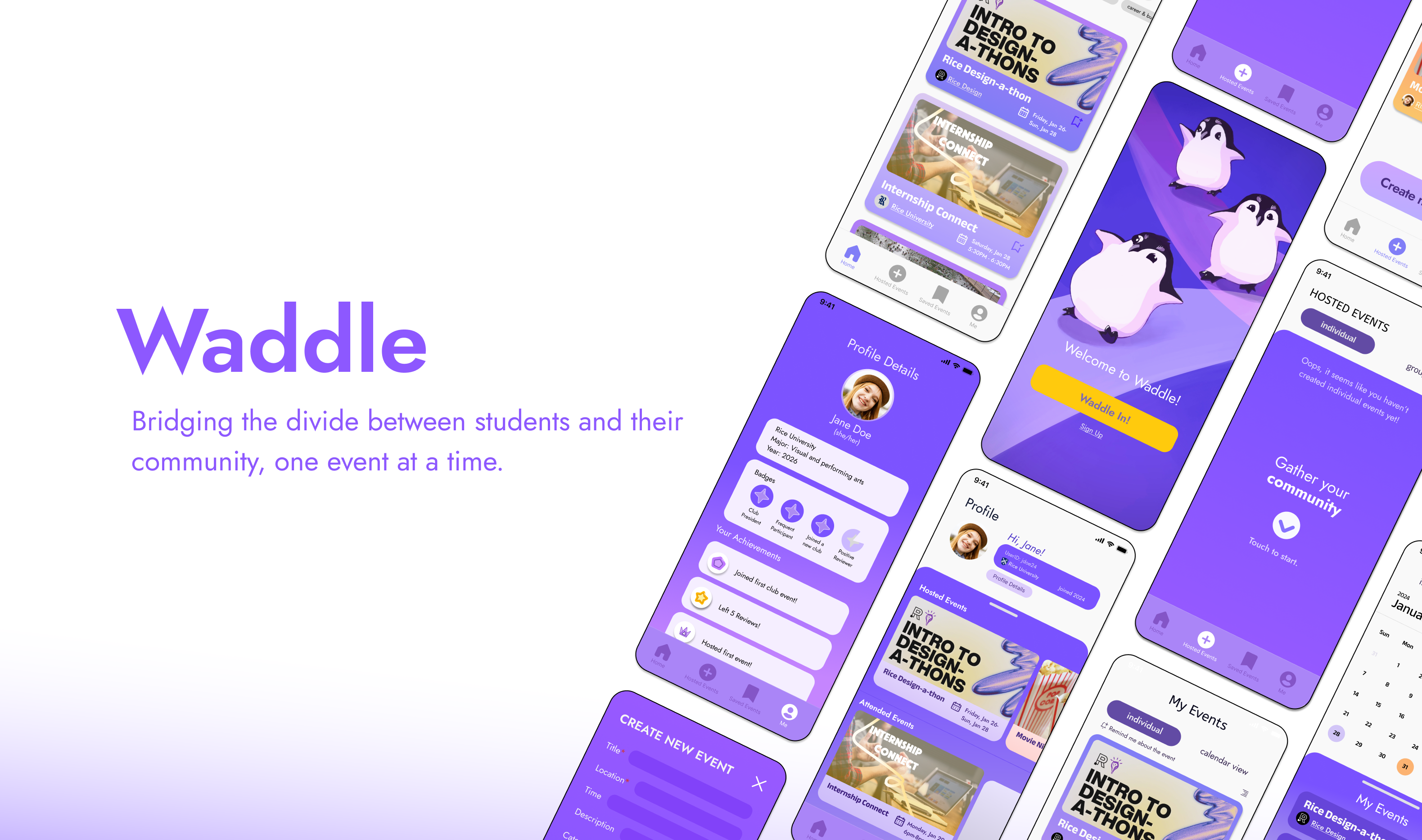
Describe your project Our app, Waddle, aims to bridge the divide between on-campus undergrad students and the vibrant events on and around their campuses by condensing resources for community and educational engagement onto one accessible and dynamic platform. Although Waddle is a virtual platform that aims to solve a social challenge, it encourages students to step outside of their normal schedules and habits to not only experience, but to actively gather new communities that trigger new conversations through in-person interactions. From career fairs to school clubs to personal hobbies, events that may help a student’s personal growth and connection with their campus and local communities will be right within reach. Each event they attend will be their source of learning, and each event they create will be their source of courage. So Waddle in!
Describe your research process and findings. If you conducted any surveys or interviews, please include the survey form and/or interview questions here. If you conducted secondary research by pulling from online sources, please include a link to your sources.
We conducted our initial user research through distributing surveys for quantitative data and conducting interviews for qualitative insights. After a brainstorming session with brief secondary research ([https://medium.com/@sarenks/addressing-mental-health-in-students-loneliness-isolation-and-suicide-prevention-7ee334053100, https://www.aacu.org/research/the-effects-of-community-based-engagement-in-higher-education), we decided that the resources currently dedicated to encouraging active participation in events hosted within the campus community is limited. We hypothesize that a platform dedicated for undergraduate’s social challenges would be helpful, which was why we first distributed a survey to verify our hypothesis. Here is a link to our survey: [https://docs.google.com/forms/d/e/1FAIpQLSe1Cs-voBdY93YAGg3lxw5dM1kzevuDiUpZTZc6eUaUL1ab5A/viewform?usp=sf_link]. The survey link was distributed through Discord servers and Slack channels of current undergraduate students attending US universities. A total of 46 survey responses were collected, and here are our main findings: 1) Most (around 75% of students) find it hard to find community events in the area where their campuses are located (choosing less than 5 on Question 2) 2) Most (around 63% of students) don’t feel that they are maximizing the resources around them (choosing less than 5 on Question 1) 3) Topic/theme of the event and time and date of the location are the main factors that play in deciding to attend an off campus event
With our initial hypothesis backed up by our survey findings, we conducted 5 user interviews to dive deeper into the how and why of our target user’s challenges. All interviews were conducted according to the following interview questions: [https://docs.google.com/document/d/1NjXfaKgoXItaCUkaPmSJxBLj0x8hUDNzkxW21ZW6v6Q/edit?usp=sharing]. All interview participants are currently enrolling as full-time undergraduate students at an U.S. university campus, as they will be the target audience of our design. After a careful analysis of our interview results, here are some of the key takeaways: 1) Students find it difficult to find time for community events because of the lack of planning The top reason for why students weren’t attending events that they would like to go to is being ill-informed about the schedule of the event, many notice an event they like only a couple days before, usually through posters that they pass by 2) Students find information on campus events very sporadic, they usually have to look from multiple sources to find events that they would like to attend
After constructing our prototype, we also did usability testing with 5 undergraduate students and gathered feedback and suggestions on their interactive experience with our app. No major alterations happened after the usability testing, but we did improve our interfaces with various minor considerations. For example, how lists of information should be better arranged (horizontal scrolls vs vertical scrolls) and making text colors contrast more with the background to improve legibility.
- Describe your most important design decisions. What research findings and/or user testing results led you to make these decisions?
Based on both our quantitative and qualitative data, we have decided to create an app that addresses undergraduate students’ struggle to find a sense of community and encourage students to actively engage in on-campus activities and meet new people.
A. Whether a student should be able to both host events and participate events in one account, whether that freedom should be given to everyone
- We decided that students who host club or school events may want to choose to have their own communities, and that both their academic lives and personal lives do not belong in separate communities
- Our research shows that students have strong interests in organizing and hosting events that welcome attendance from other students, which is why we decided to give everyone the opportunity to start meaningful gatherings and form in-person connections.
B. Brand name, logo, color, and typography choices
- Brand name Waddle & Penguin as a mascot: Penguins are a naturally social group of animals with strong networks and support systems, which is a core design inspiration that we kept in mind as we progressed
- Purple: trust-worthy color, vibrant & youthful, nice middle ground between a lively red color and calm blue color
C. Whether to include a social aspect of the app
- We decided not to include too many social functions for the app, but instead encourage our users to focus on enjoying offline experiences and staying present
- We also vetoed our initial thought of including a reward system for attending events, and ended up creating a private badge system for personal reference
- Place emphasis on being present and enjoying the experience itself, instead of competing against each other virtually merely for points
- We also didn’t provide options to see who’s going to a certain event, which encourage people to step outside of their comfort zone of interacting within a fixed friend group and meet new people offline
D. Besides the major decisions mentioned above, we also made various small tweaks to our interfaces after our user testing sessions.
- Some examples of the changes we made are, a bigger navigation bar to increase accessibility, including more obvious signifiers to indicate the scrollability of some of our horizontal cards.
E. What type of activities to include in the app
- Based on our survey and interview results, we realize that students value both academic and social events on campus, which was why we decided to include both professional development and entertainment events on the platform. We value diversity and inclusivity, and would love all students to find their place on our app regardless of their goals and interests.
Built With
- figma
- procreate


Log in or sign up for Devpost to join the conversation.