-
-
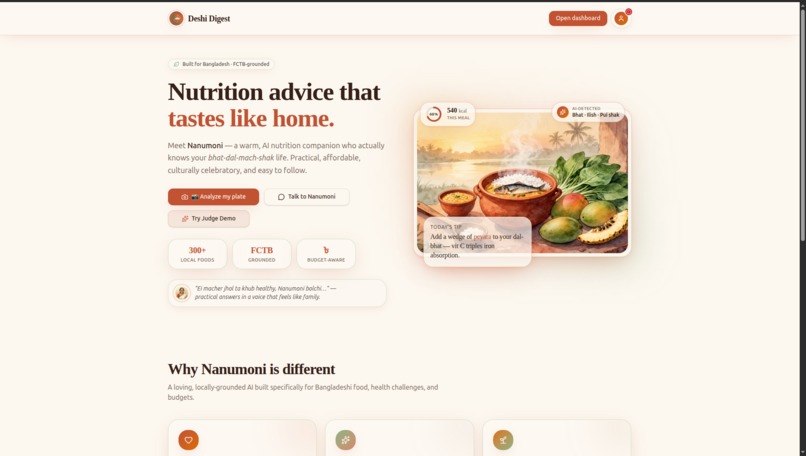
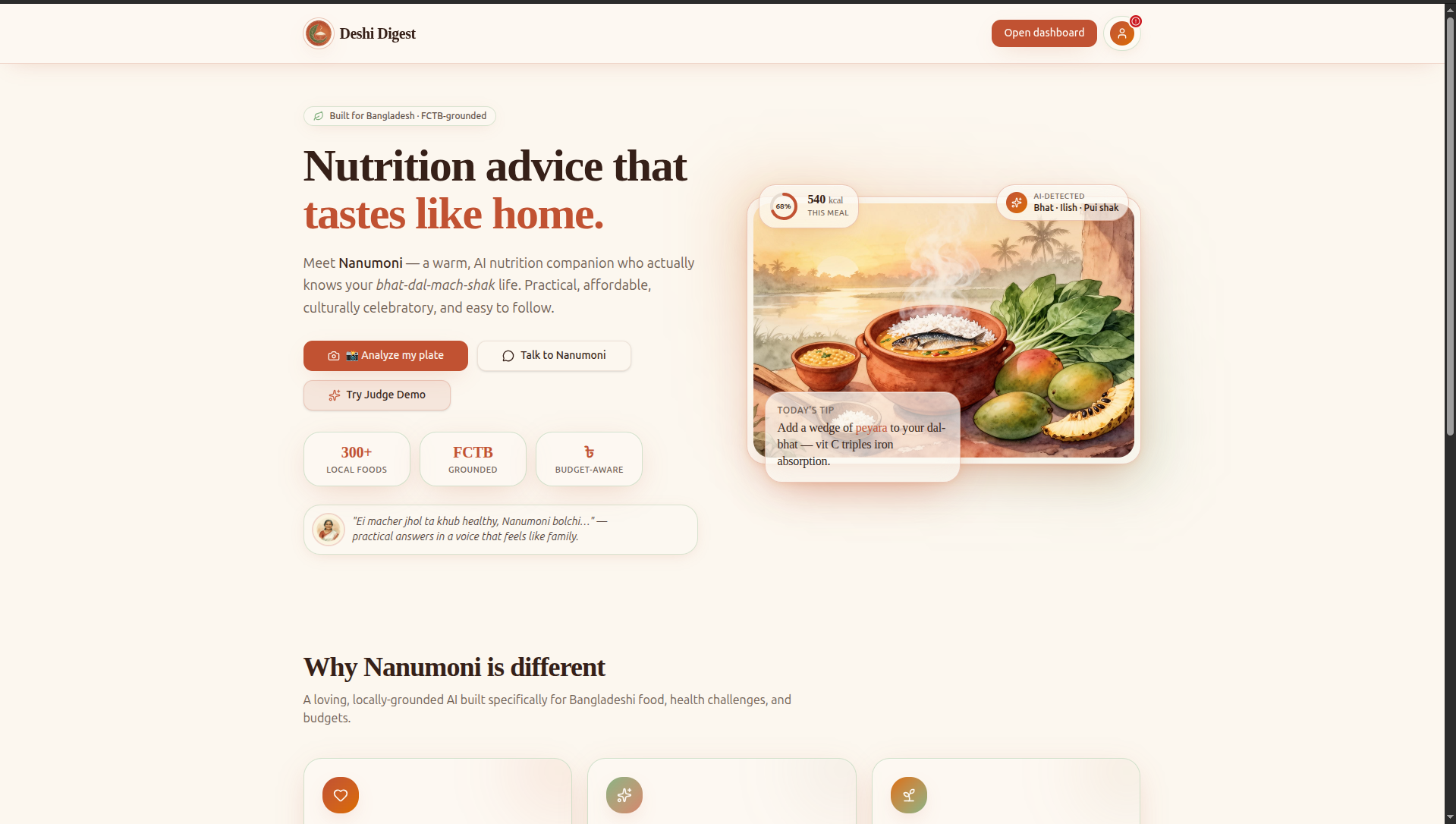
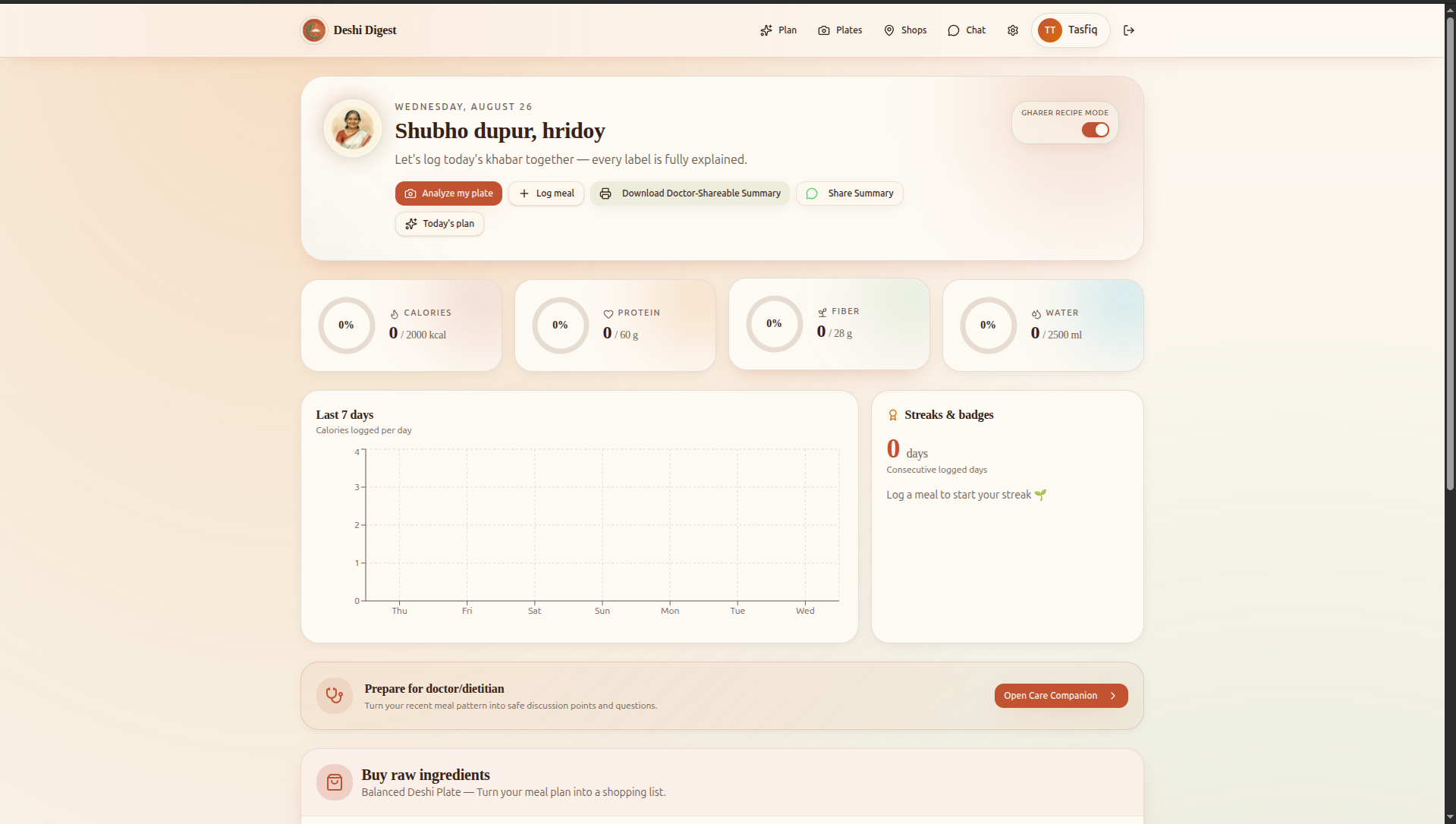
landing page
-
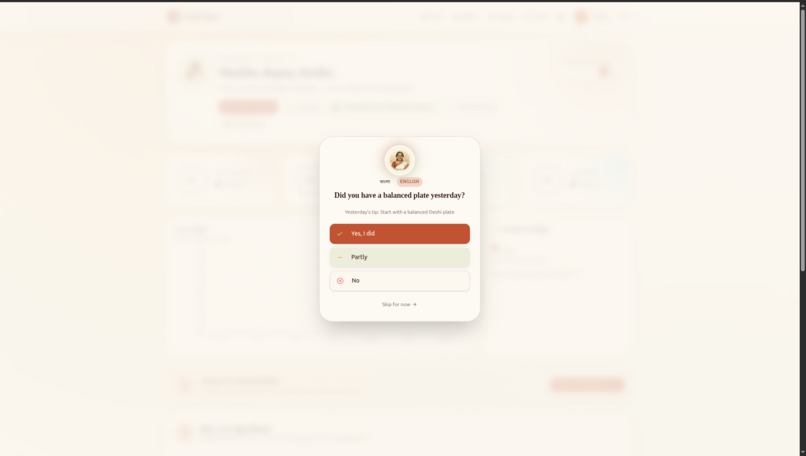
-
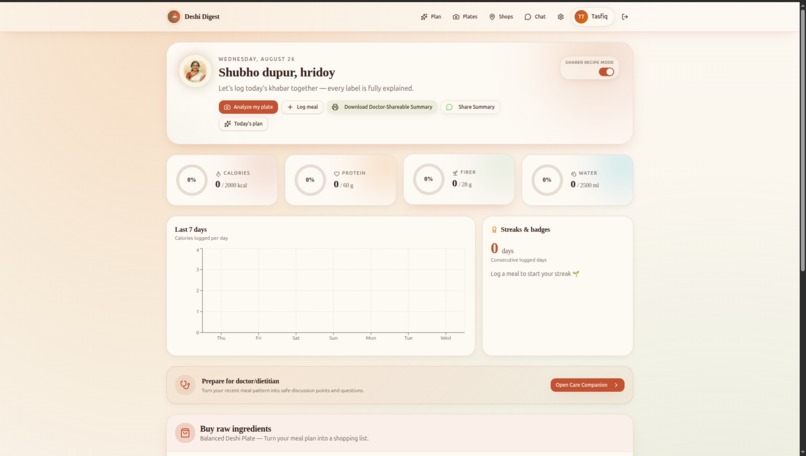
front page
-
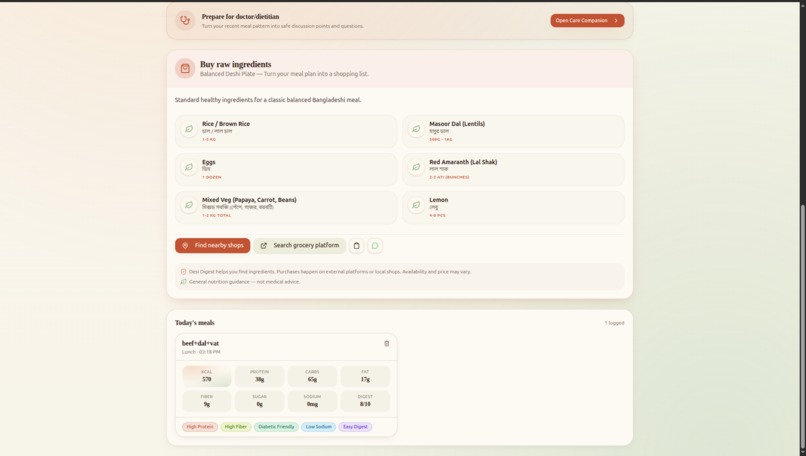
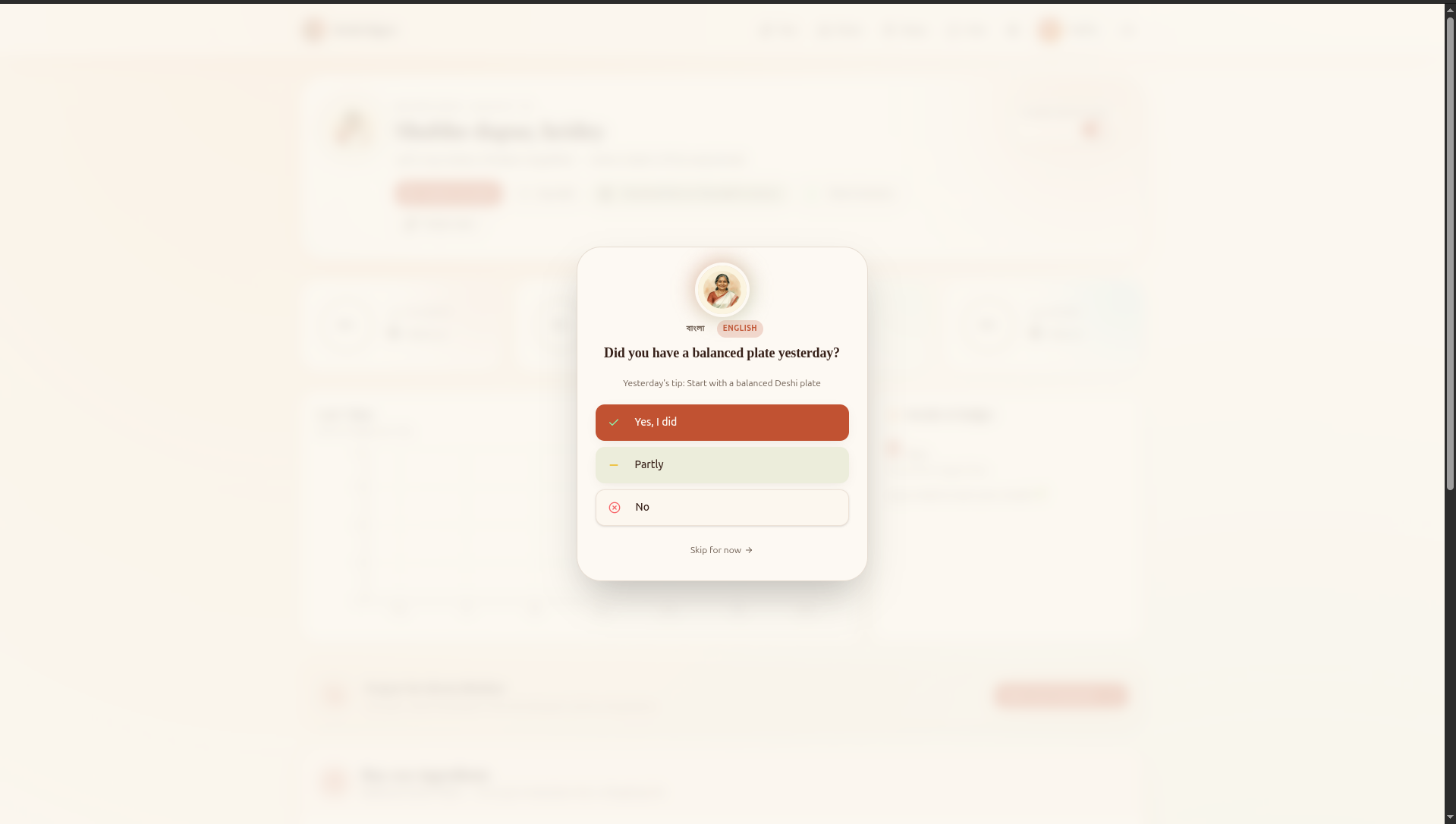
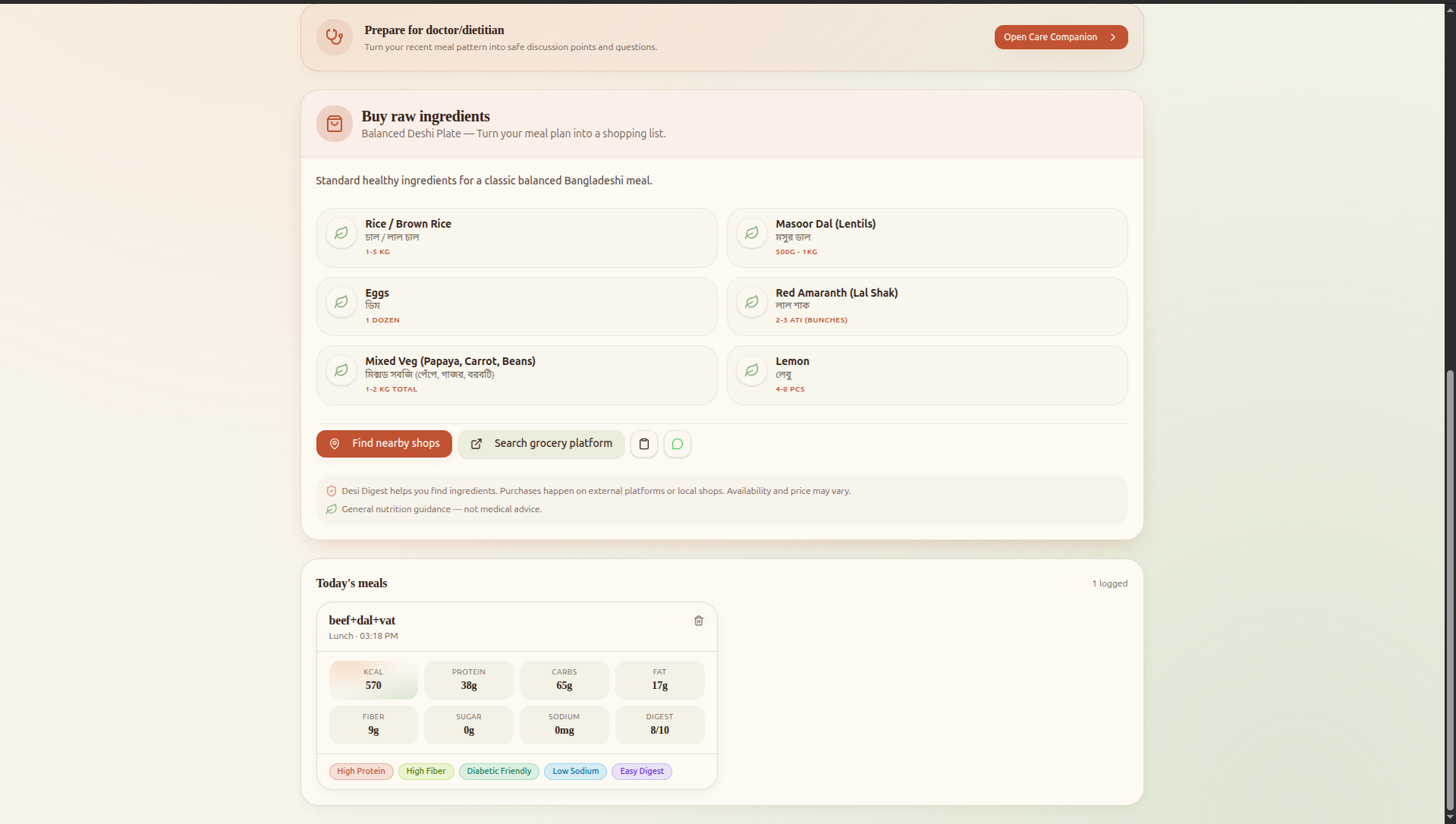
log meal
-
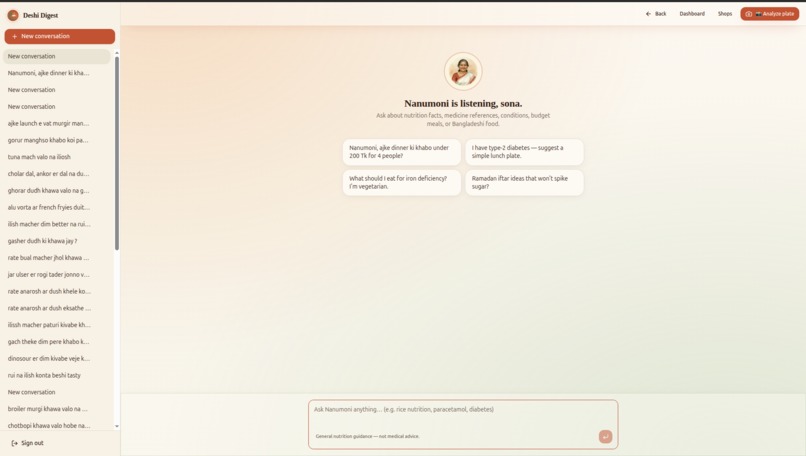
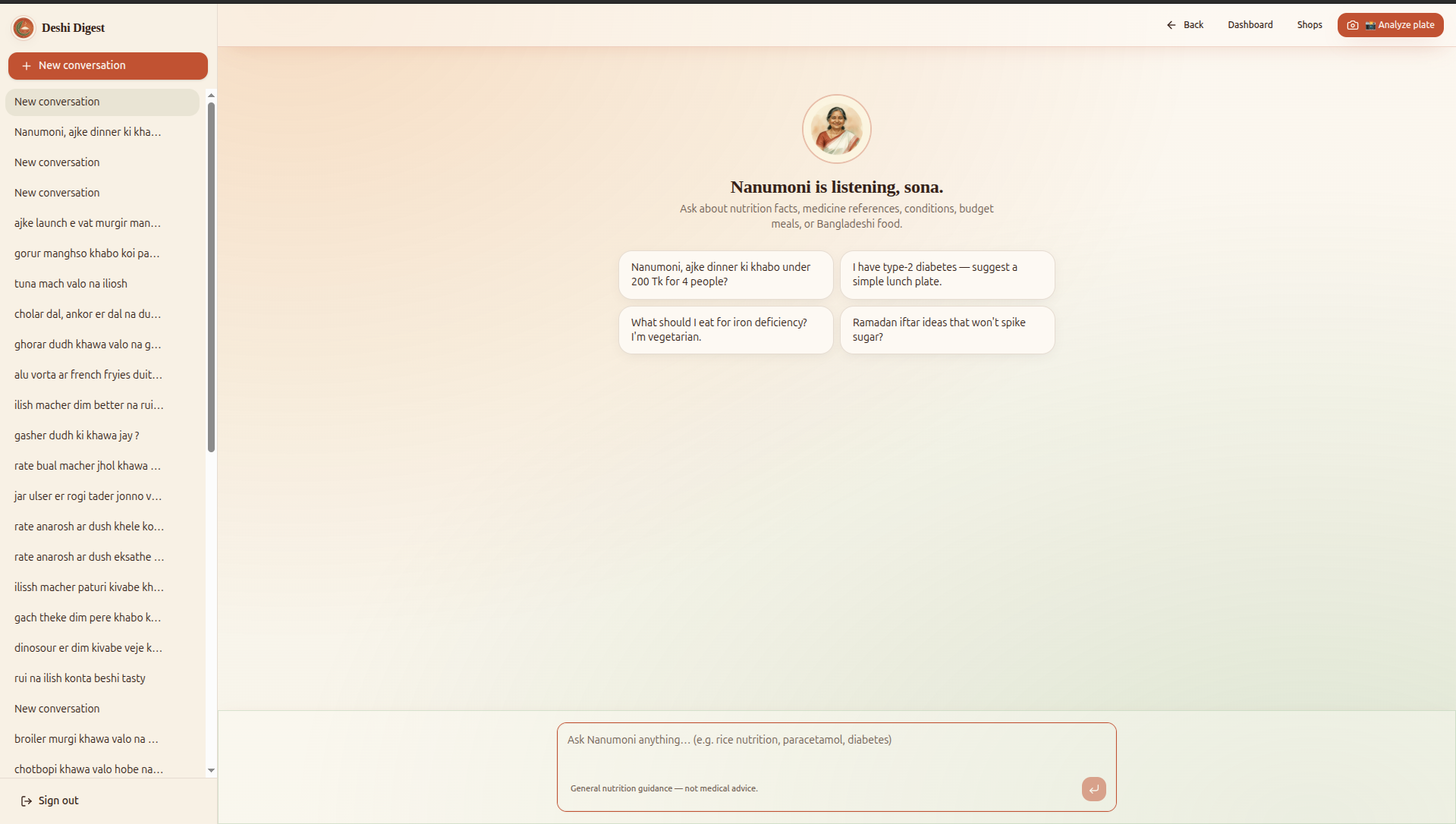
chat bot
-
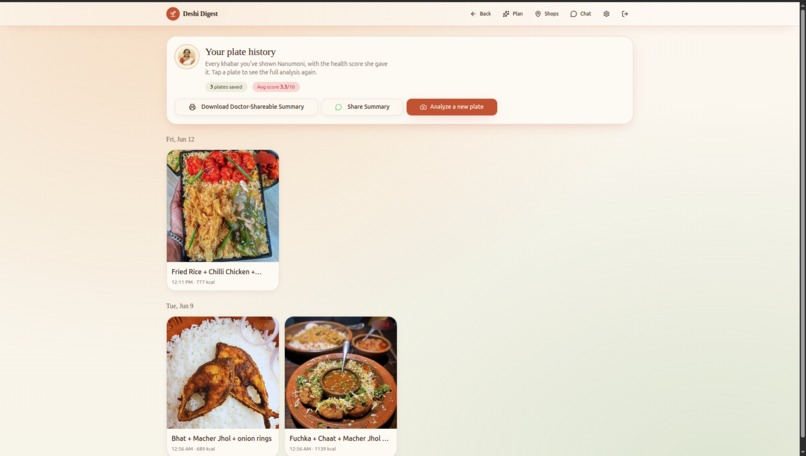
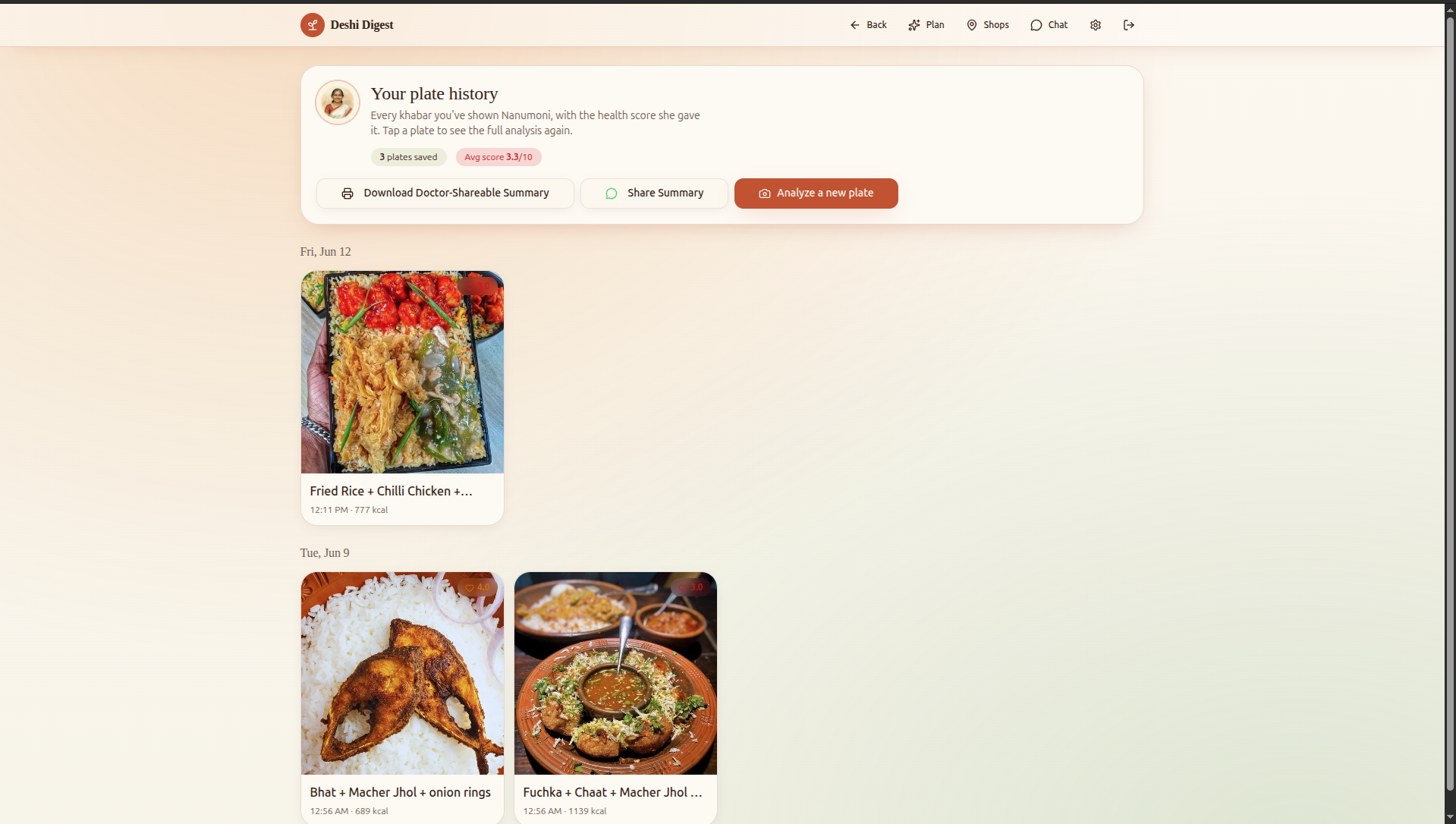
plate analyzer
Inspiration
Deshi Digest started from a problem in my own life.
Over time, I gained much more weight than I was comfortable with. I wanted to control my eating habits and understand what I was actually consuming every day.
So naturally, I tried looking for nutrition apps.
But I noticed a problem.
Most of them understood foods like pizza, pasta, cereal, sandwiches, or packaged Western products very well, but they were much less useful when my plate contained things like rice, dal, bhorta, khichuri, kacchi biryani, fish curry, paratha, pitha, or several Bangladeshi dishes together.
And even when I could find nutritional information, the experience still felt generic.
I did not just want an app that told me:
"You ate 700 calories."
I wanted something that actually understood me, my food, my habits, my goals, and the way people around me eat.
That was the beginning of Deshi Digest.
My initial thought was simple:
What if I could create a personalized AI food companion built around Bangladeshi food?
But as I continued building it, that idea became much bigger.
What Deshi Digest does
Deshi Digest is an AI-powered personalized food, nutrition, and lifestyle companion centered around Bangladeshi cuisine.
It is designed to follow the complete journey around food:
Understand what you eat → track it → get personalized guidance → decide what to cook → find the ingredients → and actually get the food.
Personalized food and nutrition
Deshi Digest helps users understand Bangladeshi meals instead of forcing them into a food database designed for another culture.
The system can help users explore foods, analyze meals, understand nutrition, track their food-related activity, and receive recommendations based on their own situation.
I have also been working on fine-tuning AI around Bangladeshi food, so the intelligence behind Deshi Digest can better understand local dishes, ingredients, terminology, and eating habits.
AI is therefore not simply a chatbot added on top of the website.
It is intended to become the intelligence connecting the entire experience.
Care Companion
Food is only one part of taking care of yourself.
That led me to build the Care Companion concept into Deshi Digest.
Instead of only showing numbers, the Care Companion is designed to stay alongside the user and help them understand their daily food decisions in a more personal and conversational way.
For example, instead of simply warning:
"You consumed too many calories today."
the companion should understand the context and help the user decide what to do next.
A user might say:
"I already had kacchi for lunch. What should I eat tonight?"
The Care Companion can help adjust the rest of the day's choices rather than treating one meal as a failure.
The goal is to make Deshi Digest feel less like a calculator and more like a personal food companion that understands your journey over time.
Built for students and bachelors too
While working on the project, I realized another everyday problem.
Students and bachelors often see amazing food online or at restaurants but think:
"I can't cook that."
or:
"That will cost too much."
But good-looking and enjoyable food does not always need expensive ingredients.
Deshi Digest is designed to help someone say:
"I have eggs, potatoes, rice, onions and 200 taka. What can I make?"
and receive practical ideas based on what they already have and what they can afford.
It can help turn ordinary ingredients into attractive meals while keeping the recipe realistic for someone living alone or on a limited budget.
So Deshi Digest is not just about telling people to eat less.
It should also help people enjoy food more intelligently.
From recipe to grocery
Then I thought about another problem.
Suppose Deshi Digest recommends a meal.
The user still has to:
- figure out the ingredients,
- find a grocery shop,
- determine where it is,
- travel there,
- and then buy everything.
Why should the experience stop at the recipe?
That led to the grocery discovery and route experience.
Deshi Digest can help users discover grocery options and find a suitable route to get the ingredients they need.
The vision is that after choosing a meal, the experience can continue naturally:
Choose meal → see required ingredients → find grocery options → get the route → buy the food or ingredients.
And where purchasing is available through the platform, users can continue from discovery directly toward buying what they need.
This makes the platform useful not only for deciding what to eat, but also for answering:
"How do I actually get it?"
A complete food journey
This is the experience I want Deshi Digest to create.
Imagine saying:
"I want to cook something special tonight, but I only have 300 taka."
Deshi Digest could help:
- understand your preferences
- consider your recent meals
- suggest suitable Bangladeshi dishes
- show affordable alternatives
- generate a practical recipe
- identify missing ingredients
- help locate grocery options
- guide you to the shop
- and help you obtain what you need
Or you could say:
"I already ate biryani for lunch. I still want something tasty tonight."
Your Care Companion could understand the context and help balance the rest of your day without simply telling you not to eat.
For me, this is what personalization should actually mean.
Why WebMCP?
While building all of these capabilities, I realized something else.
Why should Deshi Digest only work when someone manually opens the website and clicks through every feature?
An AI agent should also be able to understand what Deshi Digest can do.
That is why WebMCP fits naturally into the project.
With WebMCP, Deshi Digest can expose its useful capabilities directly to AI agents in a structured way.
Instead of an agent trying to visually understand buttons and pages, Deshi Digest can effectively tell the agent:
"These are the things I can help you with."
An agent could potentially use Deshi Digest to:
- search Bangladeshi foods
- understand local dishes
- retrieve food and nutrition information
- compare meals
- analyze someone's food choices
- work with the Care Companion
- generate practical meal ideas
- plan meals around a user's budget
- find required ingredients
- discover grocery options
- help find routes to grocery shops
- and assist with the journey from deciding what to eat to actually obtaining the food
Human + AI Agent + Deshi Digest
This creates an experience I find especially exciting.
Instead of:
Human → Website → Click → Click → Search → Result
we can move toward:
Human → AI Agent → WebMCP → Deshi Digest
For example, someone could simply tell their AI agent:
"Use Deshi Digest. I ate kacchi today, I don't want to spend more than 250 taka tonight, and I want something easy to cook. Find something suitable and tell me where I can get the ingredients."
The agent could use Deshi Digest's specialized capabilities to help complete that entire task.
The user does not need to know which page contains which feature.
They simply express an intention.
That is what makes WebMCP particularly interesting to me.
Challenges
One of the biggest challenges has been understanding Bangladeshi food itself.
Our food is incredibly diverse.
The same dish can have very different nutritional values depending on:
- ingredients
- portion sizes
- cooking oil
- preparation method
- restaurant
- household
- and region
A Bangladeshi plate may also contain rice, meat, dal, vegetables, bhorta, curry, and several other items together.
Teaching AI to understand that is much more difficult than identifying a standardized packaged food.
Another challenge has been connecting different parts of the food experience.
Food recognition, nutrition, personalization, recipes, affordability, Care Companion, grocery discovery, routing, and AI interaction are all useful individually.
The harder and more interesting challenge is making them feel like one continuous experience.
WebMCP introduces another challenge:
deciding which of these capabilities should become tools for AI agents and designing those tools so that they are useful, reliable, and understandable.
What I learned
Deshi Digest started because I wanted to solve a problem for myself.
I had gained weight and wanted something that could genuinely help me understand and improve the way I eat.
But while building it, I realized the problem was much larger.
It affects students trying to eat better.
Bachelors trying to cook with whatever is available.
People trying to lose or manage weight without abandoning the food they grew up eating.
People wondering what they can cook within a limited budget.
And people who simply want technology that understands their culture instead of asking them to adapt to someone else's food database.
That changed how I think about Deshi Digest.
It is no longer just a nutrition tracker.
My goal is for it to become a personalized AI food companion for the complete journey around food:
Understand it. Track it. Plan it. Cook it. Find it. Buy it. And make better choices over time.
With WebMCP, that intelligence can also become available directly to AI agents.
Deshi Digest began with one personal question:
"How can I take better control of what I eat?"
Now I am trying to build something that can help answer that question for many more people.
Built With
- bitsandbytes
- cuda
- fastapi
- gemini
- hugging
- kaggle
- learning
- lora
- ms-swift
- nvidia
- openrouter
- postgresql
- python
- pytorch
- qwen3-vl
- react
- supabase
- t4
- tanstack
- transformers
- typescript
- vercel
- vision
- webmcp
- zod

Log in or sign up for Devpost to join the conversation.