-
-
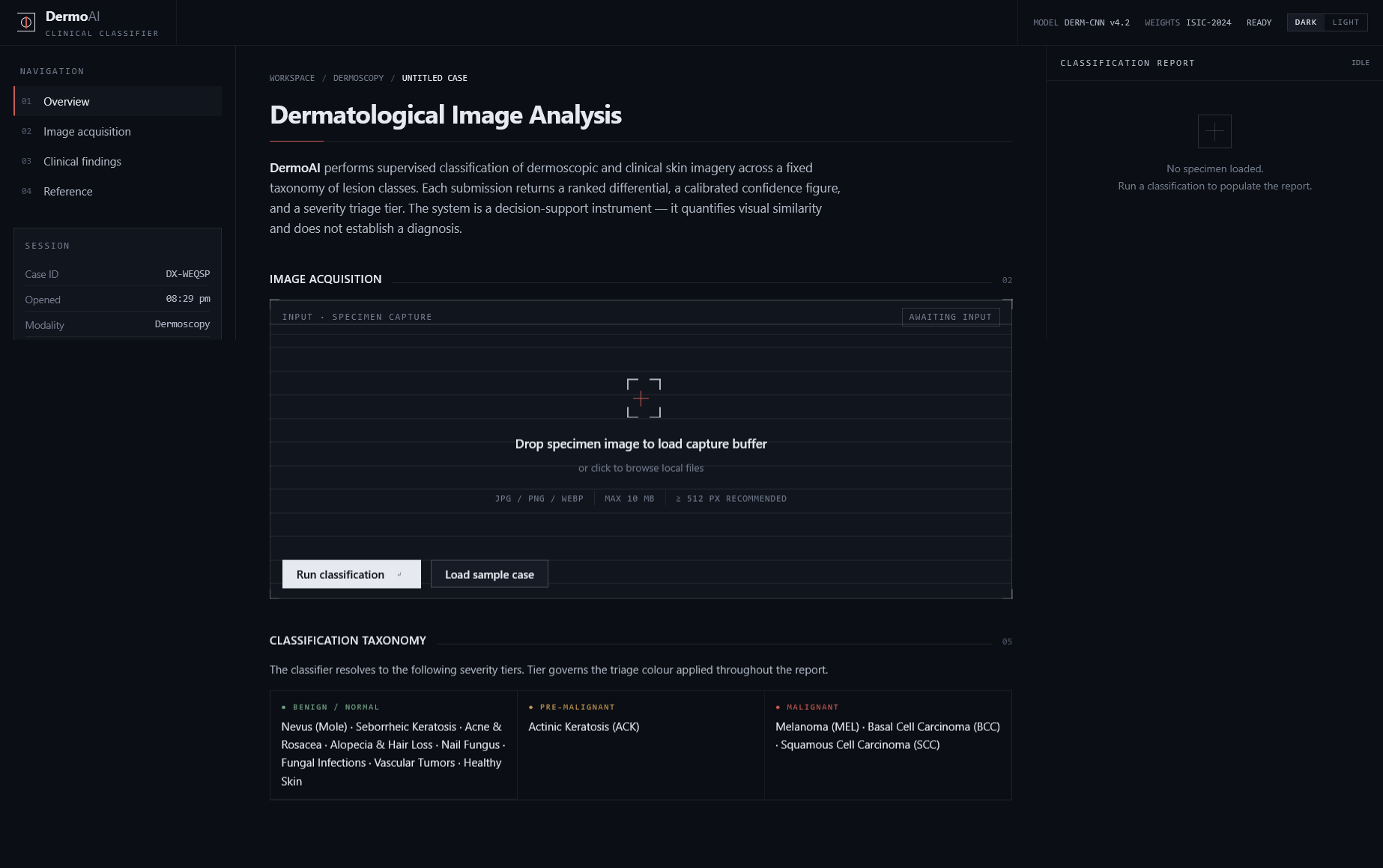
DermoAI
-
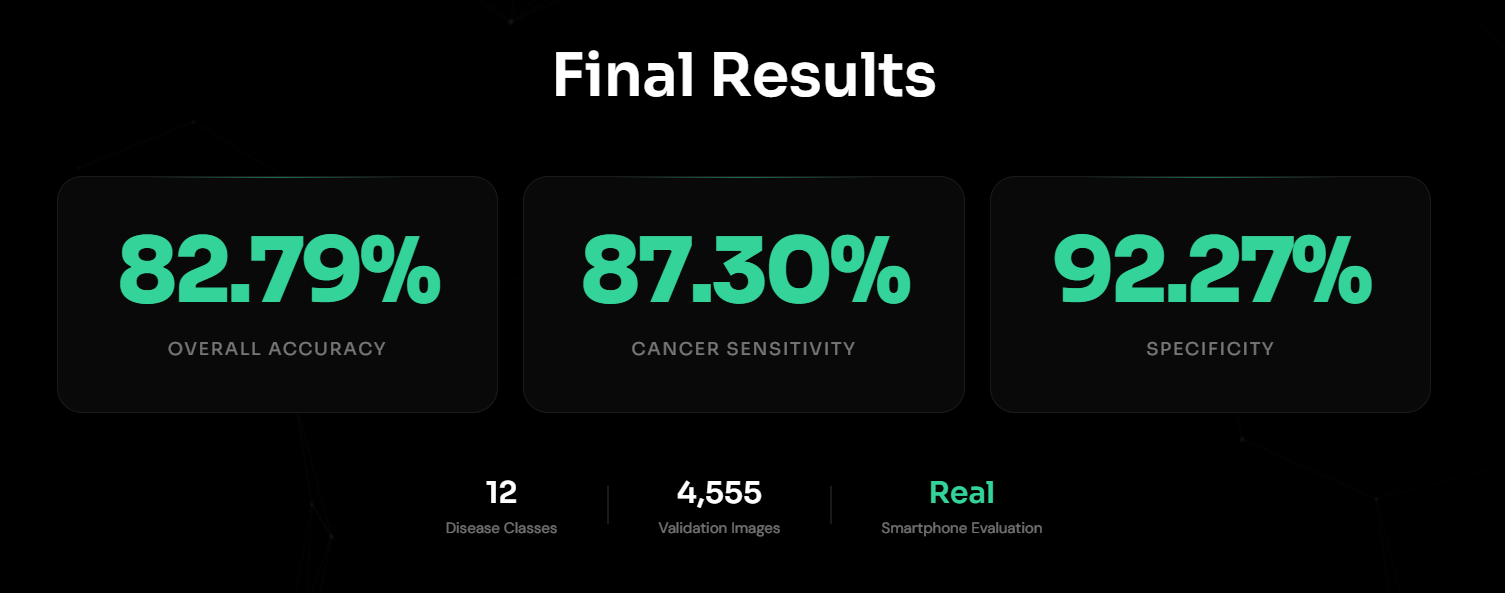
Final Results
-
Main Area
-
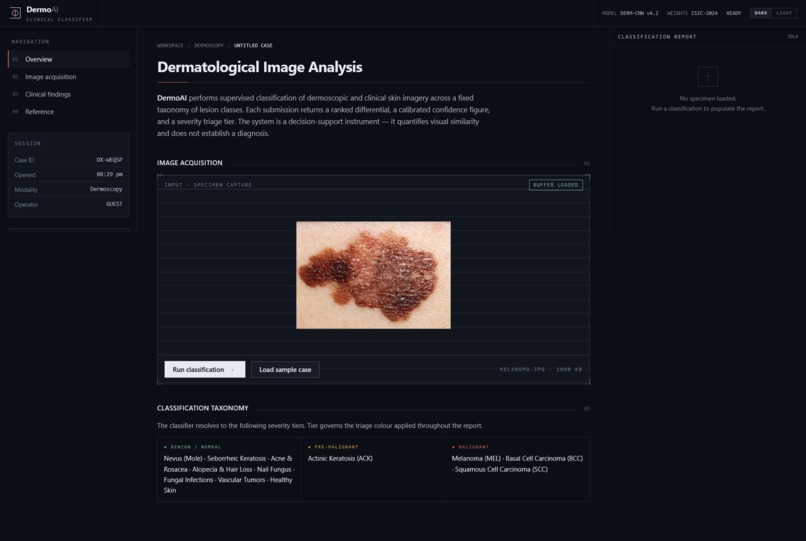
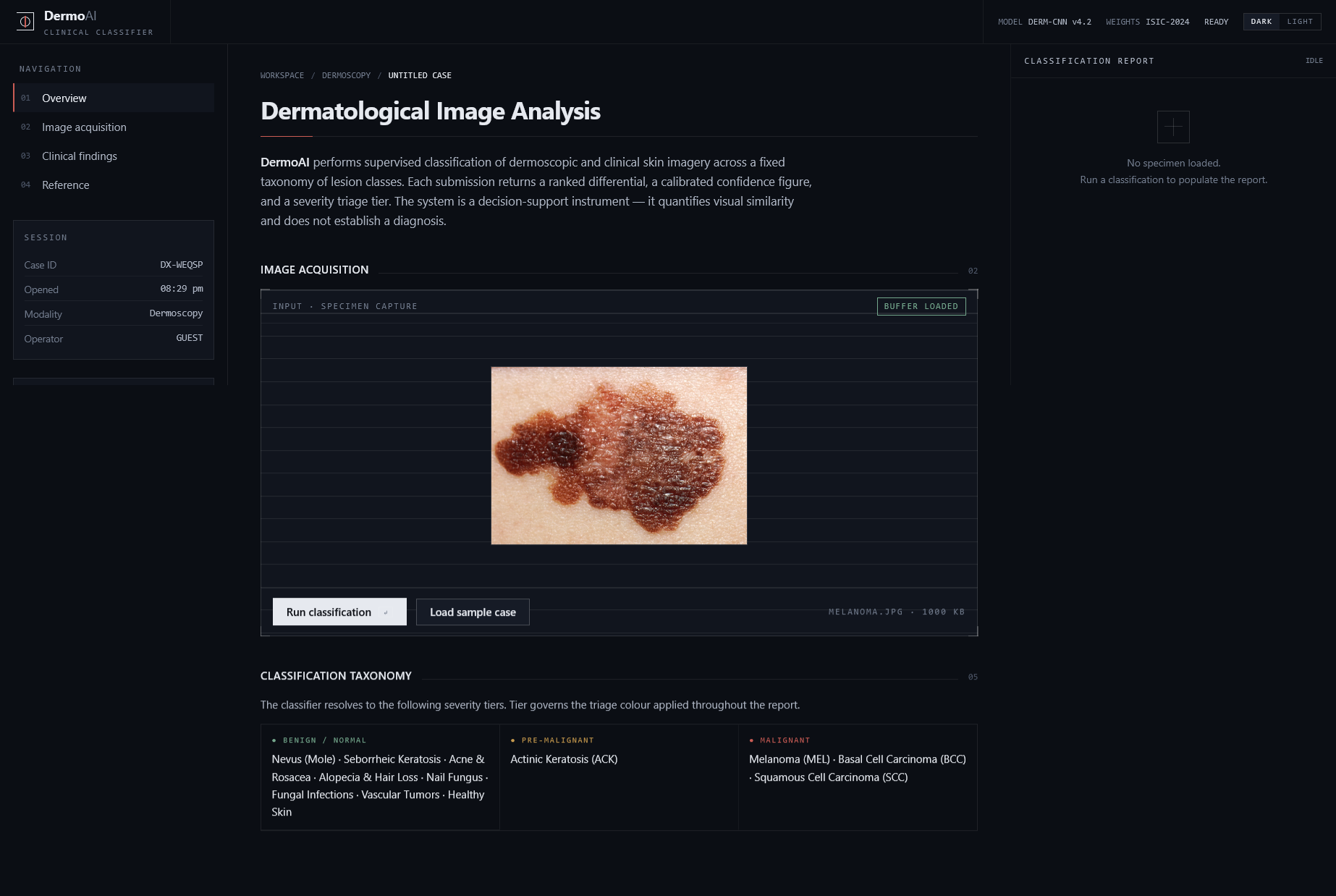
Image Uploaded
-
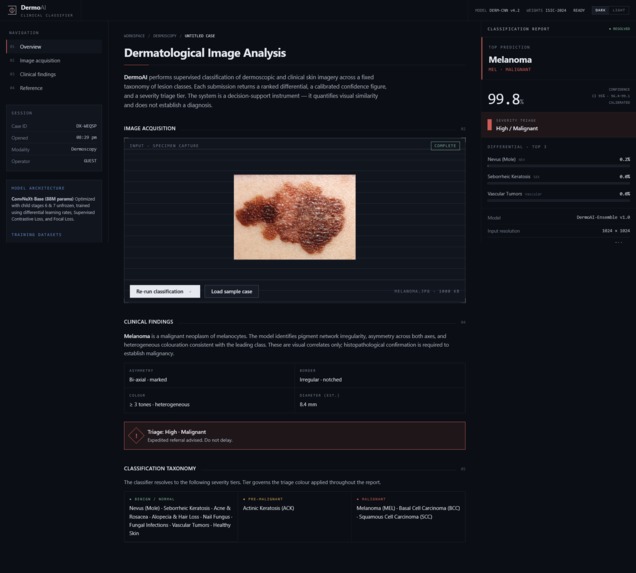
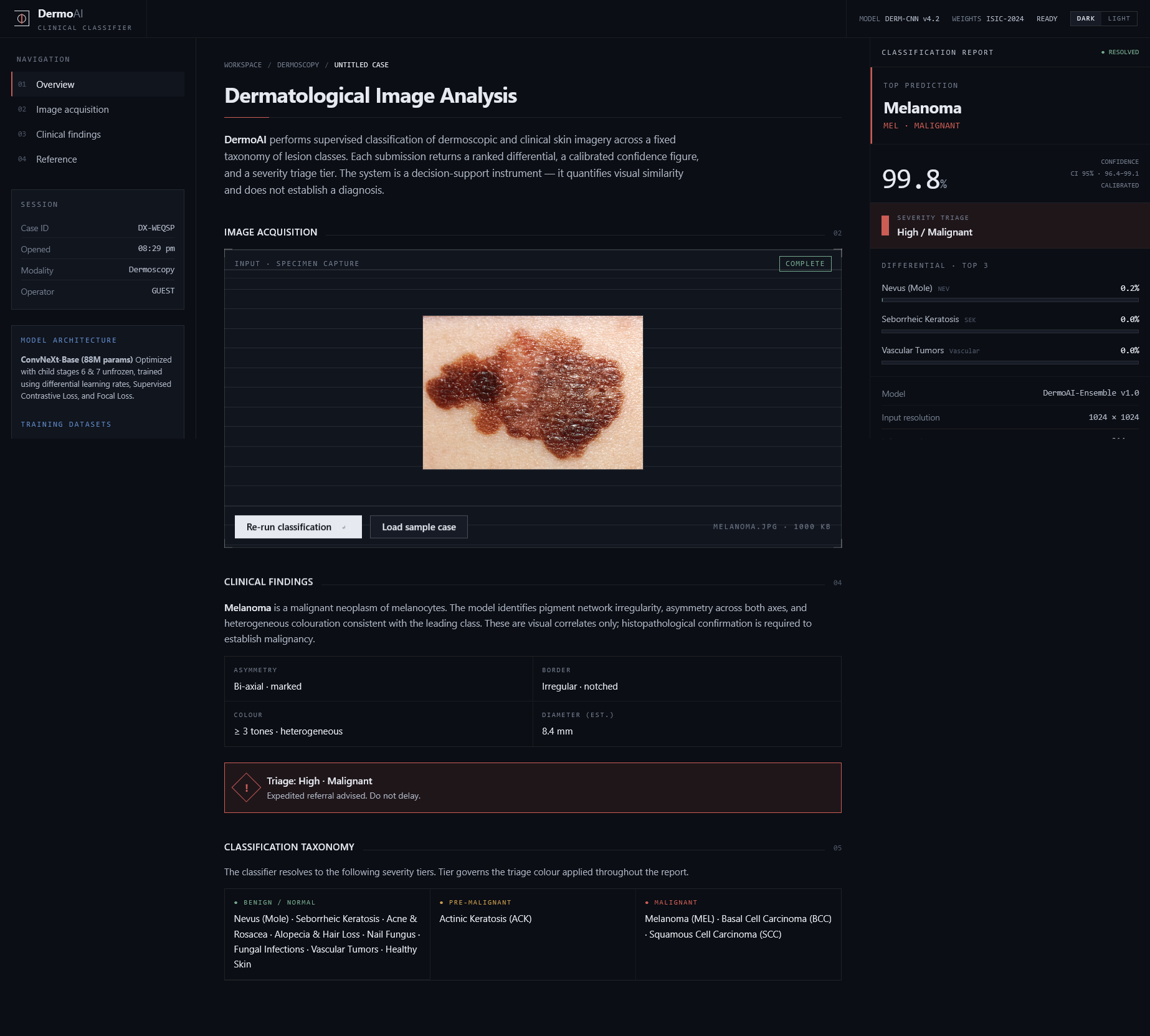
Image Analyzed
-
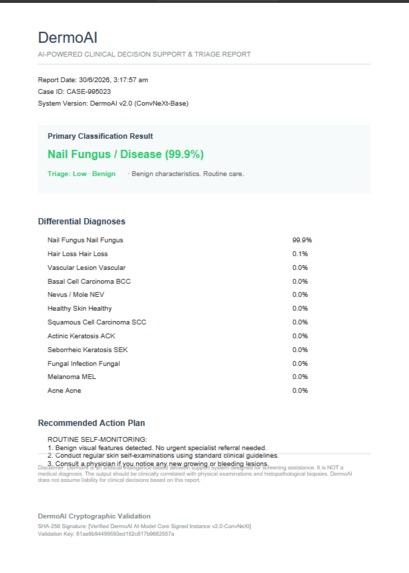
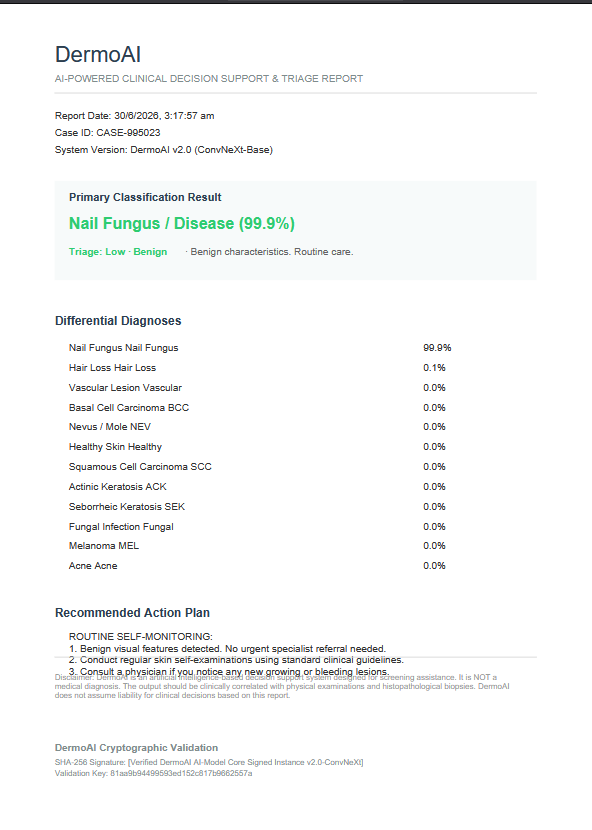
Report
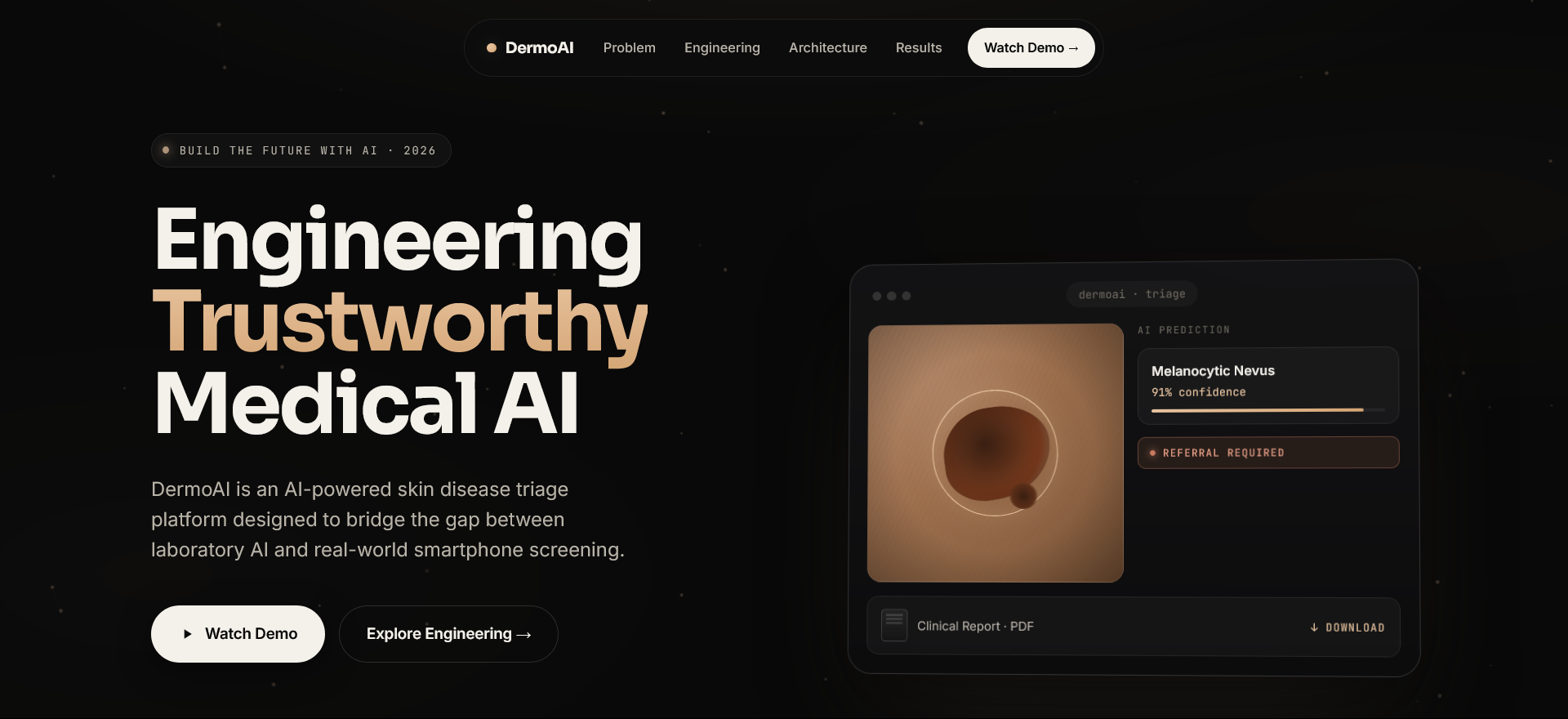
Inspiration
Skin diseases affect billions of people worldwide, yet access to dermatologists remains limited—particularly in rural and underserved communities. While recent advances in AI have demonstrated remarkable performance on curated clinical datasets, we found that many state-of-the-art models struggle when presented with everyday smartphone photos taken under uncontrolled conditions.
This gap between research benchmarks and real-world usability inspired us to build DermoAI. Rather than creating another image classifier, we focused on developing a practical AI-powered skin disease triage platform that prioritizes robustness, reliability, and early risk assessment using images captured in realistic environments.
What it does
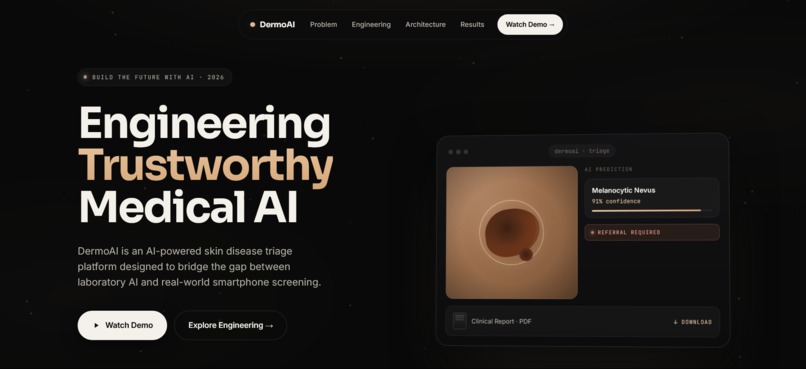
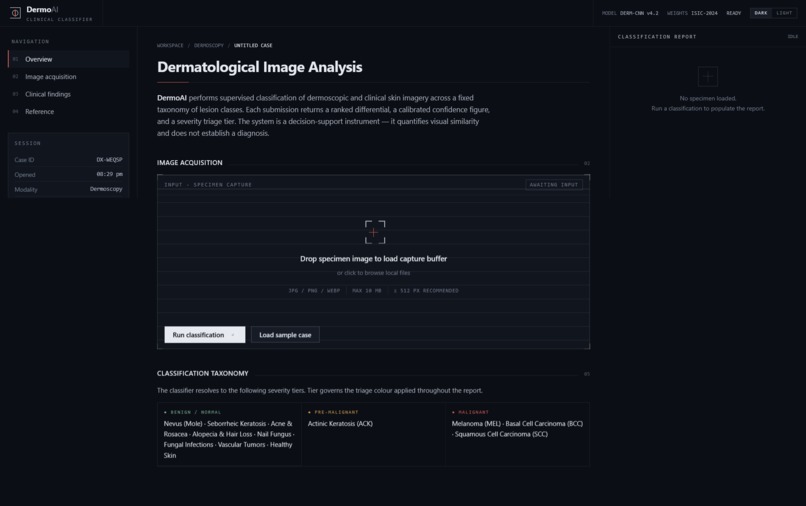
DermoAI is an AI-assisted skin disease triage platform that analyzes smartphone images to identify 12 common skin conditions while assessing potential skin cancer risk.
After an image is uploaded, the platform:
- Classifies the most likely skin condition.
- Provides prediction confidence scores.
- Evaluates potential malignancy risk.
- Generates a structured clinical report.
- Recommends whether professional dermatological evaluation should be considered.
DermoAI is designed as a decision-support and screening tool to assist with early detection—not as a replacement for medical professionals.
How we built it
Development was highly iterative and research-driven.
We began with a ResNet-50 baseline before transitioning to a ConvNeXt-Base architecture implemented in PyTorch. During experimentation, we discovered patient-level data leakage that artificially inflated validation performance. To ensure trustworthy evaluation, we rebuilt the entire validation pipeline using patient-level dataset splitting.
To improve real-world performance, we expanded our training data with smartphone images and introduced domain-specific augmentations that simulate practical imaging conditions, including motion blur, lighting variation, perspective distortion, compression artifacts, and image noise.
To further improve robustness, we incorporated:
- Supervised Contrastive Learning
- Focal Loss
- Weighted Sampling
- Test-Time Augmentation (TTA)
- Ensemble inference
The deployment pipeline was built with FastAPI, providing image upload, AI inference, cancer triage, and automated PDF clinical report generation.
Challenges we ran into
Our biggest challenge was closing the gap between laboratory performance and real-world deployment.
While our ConvNeXt model achieved approximately 77% accuracy on clinical datasets, performance initially dropped to 27.59% when evaluated on real smartphone photographs due to variations in lighting, blur, shadows, camera quality, and compression artifacts.
Another major obstacle was identifying patient-level data leakage, which required redesigning our validation strategy from the ground up to obtain reliable performance estimates.
Additional engineering challenges included:
- Severe class imbalance between benign and malignant lesions.
- Maximizing cancer sensitivity while minimizing false positives.
- GPU memory limitations during large-scale training.
- Iteratively refining the model until it generalized effectively to uncontrolled smartphone images.
Accomplishments that we're proud of
- Built an end-to-end AI-powered skin disease triage platform from research to deployment.
- Identified and eliminated patient-level data leakage by redesigning the validation pipeline.
- Significantly improved robustness to real-world smartphone images through domain adaptation and targeted augmentation strategies.
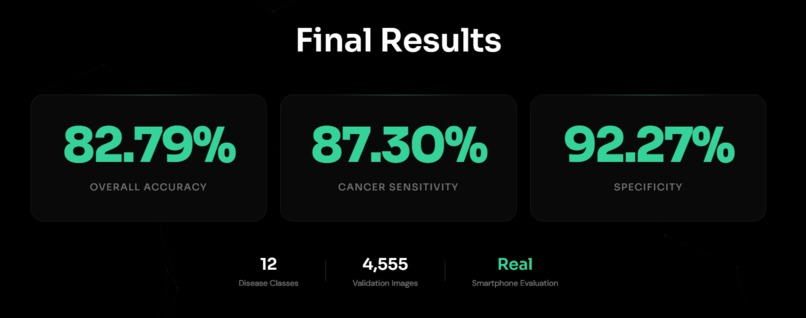
- Achieved 82.79% overall validation accuracy, 87.30% cancer sensitivity, and 92.27% specificity.
- Developed a FastAPI-based application capable of generating structured clinical reports and referral recommendations suitable for real-world screening workflows.
What we learned
This project reinforced that building trustworthy medical AI extends far beyond selecting a powerful neural network architecture.
Reliable validation, high-quality datasets, domain adaptation, and rigorous experimentation ultimately contributed far more to real-world performance than increasing model complexity alone.
Throughout the project, we gained hands-on experience in deep learning, computer vision, medical dataset engineering, model optimization, deployment, and translating academic research into a practical application capable of assisting real users.
What's next for DermoAI
Our next objective is to improve real-world generalization by expanding the dataset with more diverse smartphone images captured across different devices, lighting conditions, geographic regions, and skin tones.
We also plan to:
- Integrate Grad-CAM explainability for transparent AI predictions.
- Optimize inference using ONNX and TensorRT for mobile deployment.
- Explore larger Vision Transformer architectures.
- Collaborate with dermatologists to conduct prospective clinical validation.
Our long-term vision is to transform DermoAI into a trustworthy AI-assisted screening platform that improves access to early dermatological care for people worldwide.


Log in or sign up for Devpost to join the conversation.