
Inspiration
Extreme heat and humidity are changing the environments in which people live and work. Clothing is one of the first interfaces between the human body and the environment, yet understanding what happens at the skin–textile interface is still highly dependent on physical testing.
We were inspired by a simple scientific question:
Can physics-informed machine learning help us understand and simulate how heat and moisture move through textiles under extreme climatic conditions?
Instead of building another AI system that simply labels one material as "good" and another as "bad", we wanted to understand why materials behave differently under specific physical conditions.
Dermatherm combines our interest in physics, mathematics, AI, environmental challenges, and material science into one research-oriented platform.
What it does
Dermatherm is a physics-based virtual material laboratory for climate-adaptive textile research.
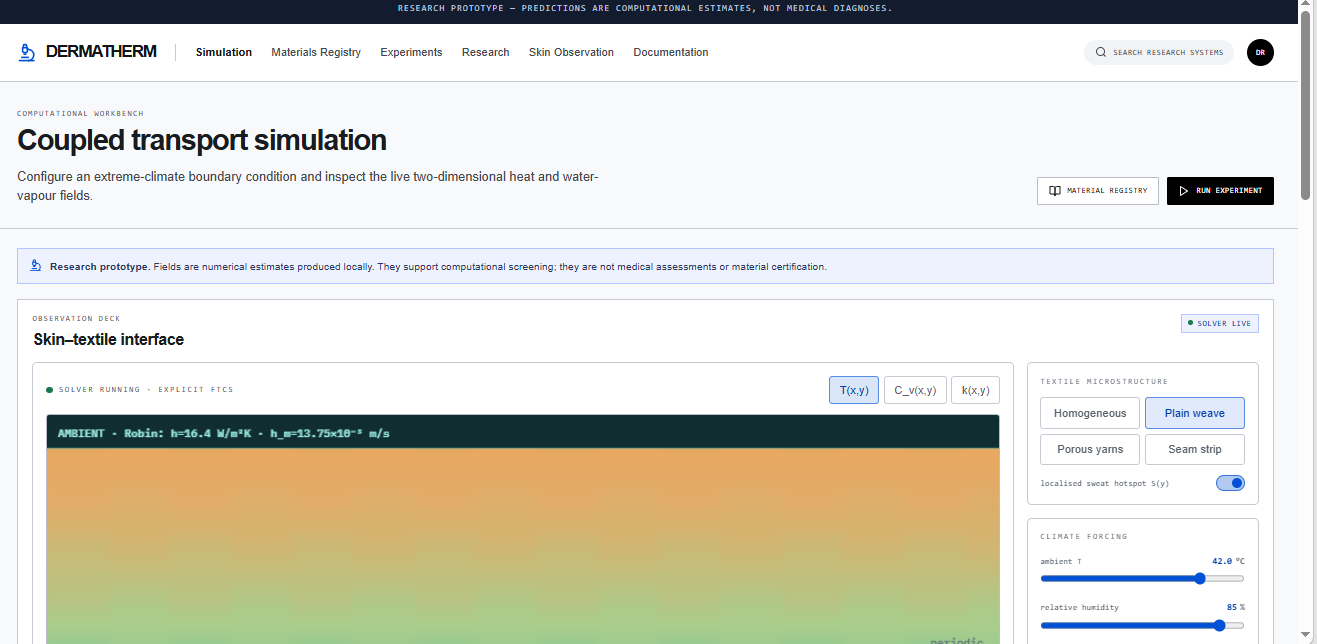
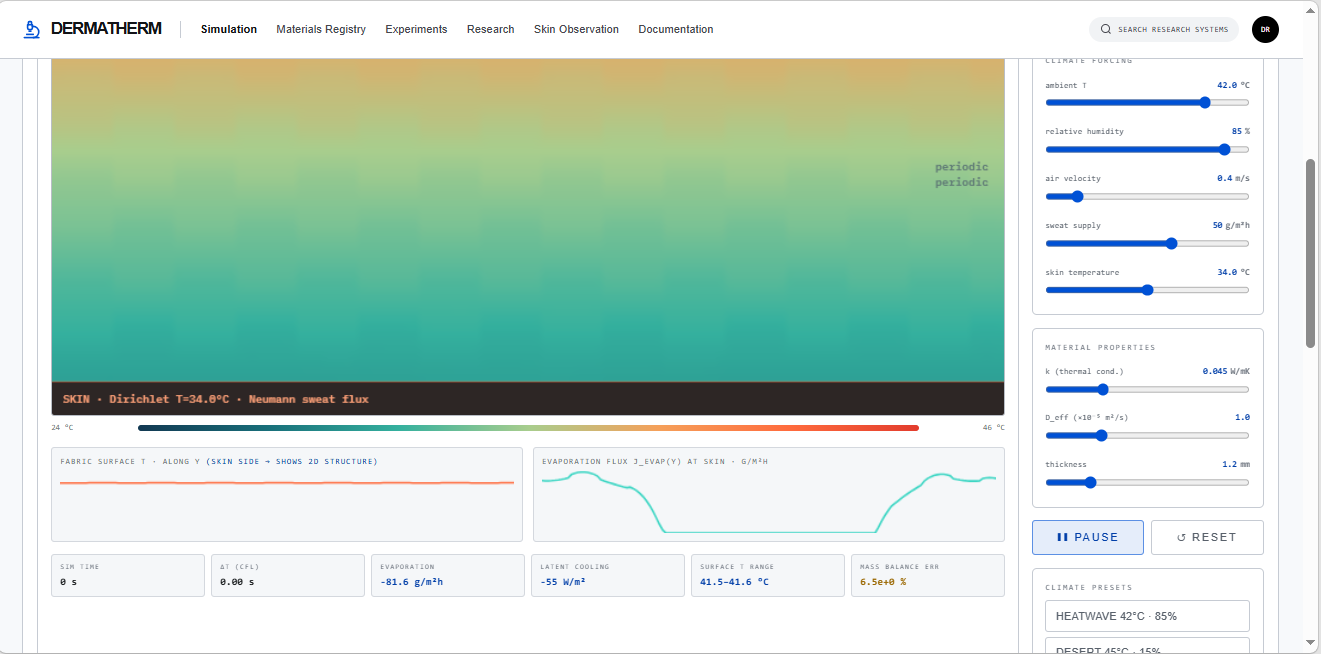
The platform allows users to define environmental conditions and textile properties, then simulate coupled heat and moisture transport through the textile.
The prototype provides:
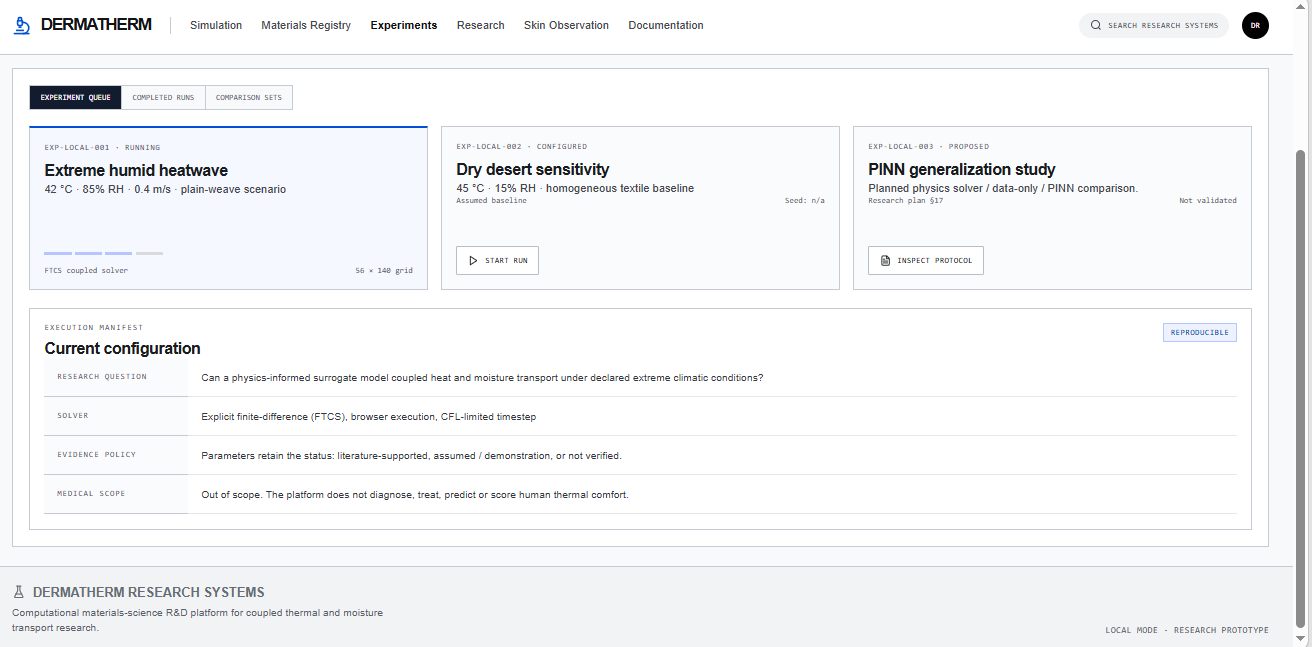
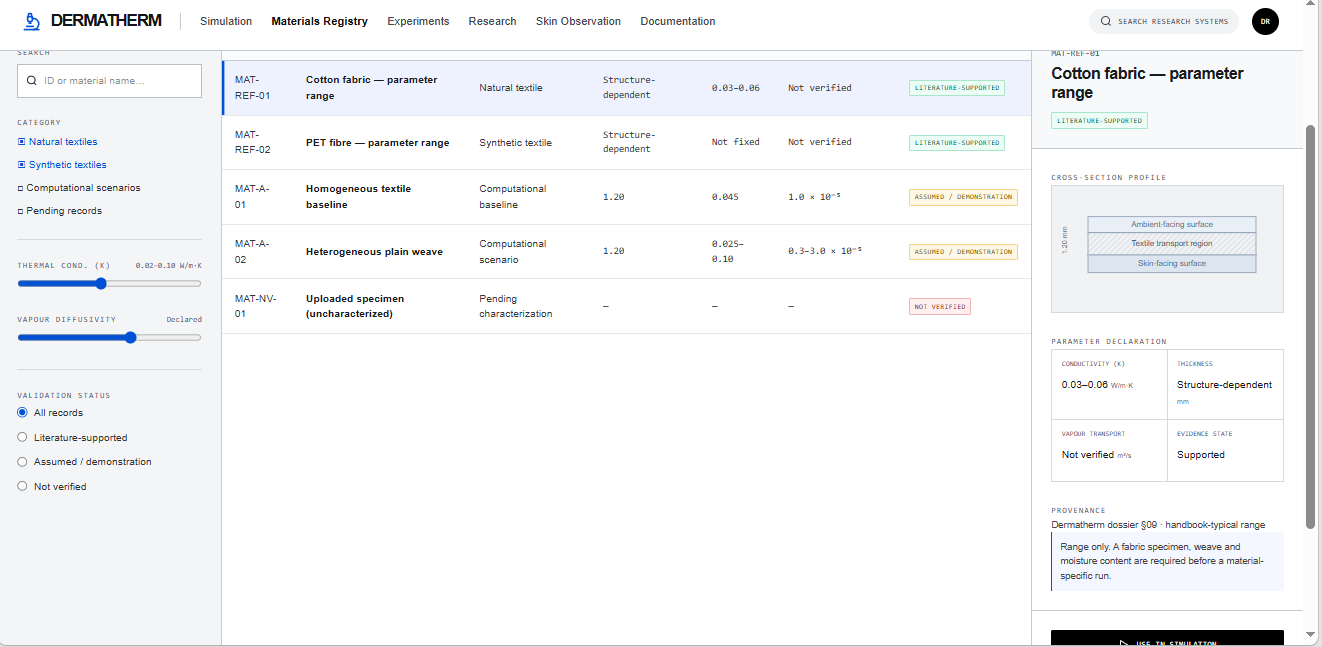
Environmental condition configuration Material property configuration Physics-based heat and moisture modeling 2D temperature fields 2D moisture fields Material comparison Physics-informed machine learning as a future acceleration layer An interactive visualization interface
The goal is to help textile R&D teams explore material behavior computationally before moving to physical prototyping.
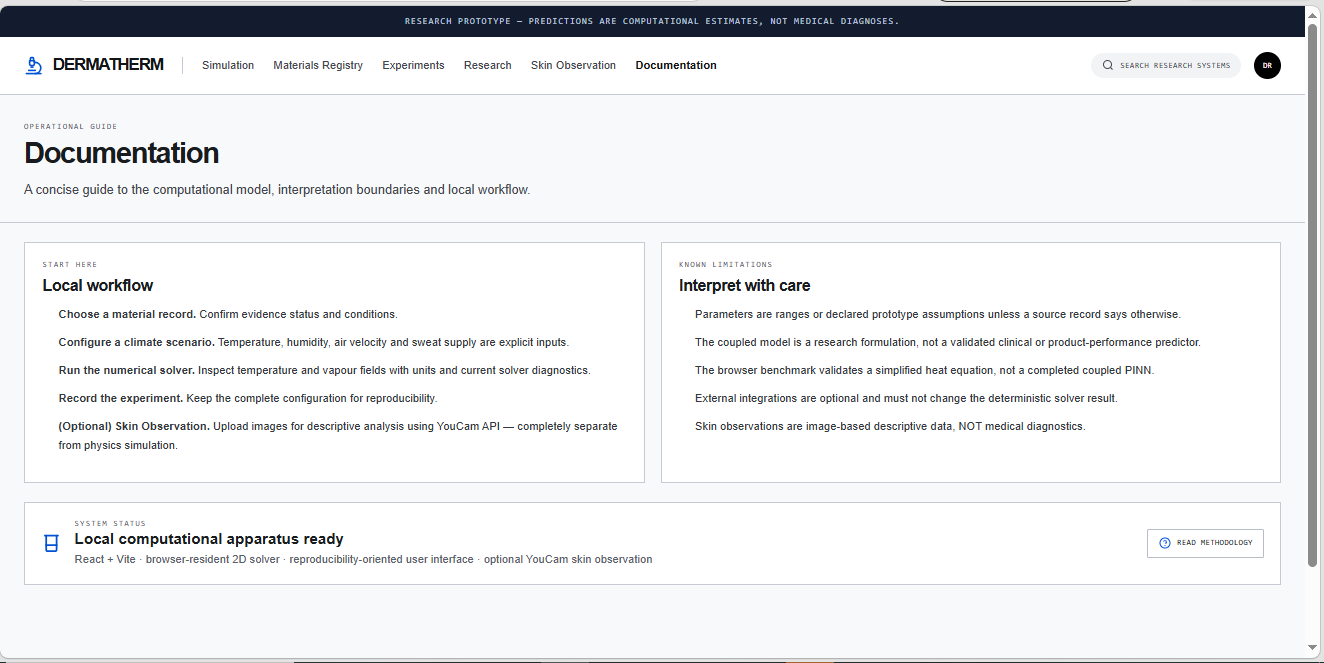
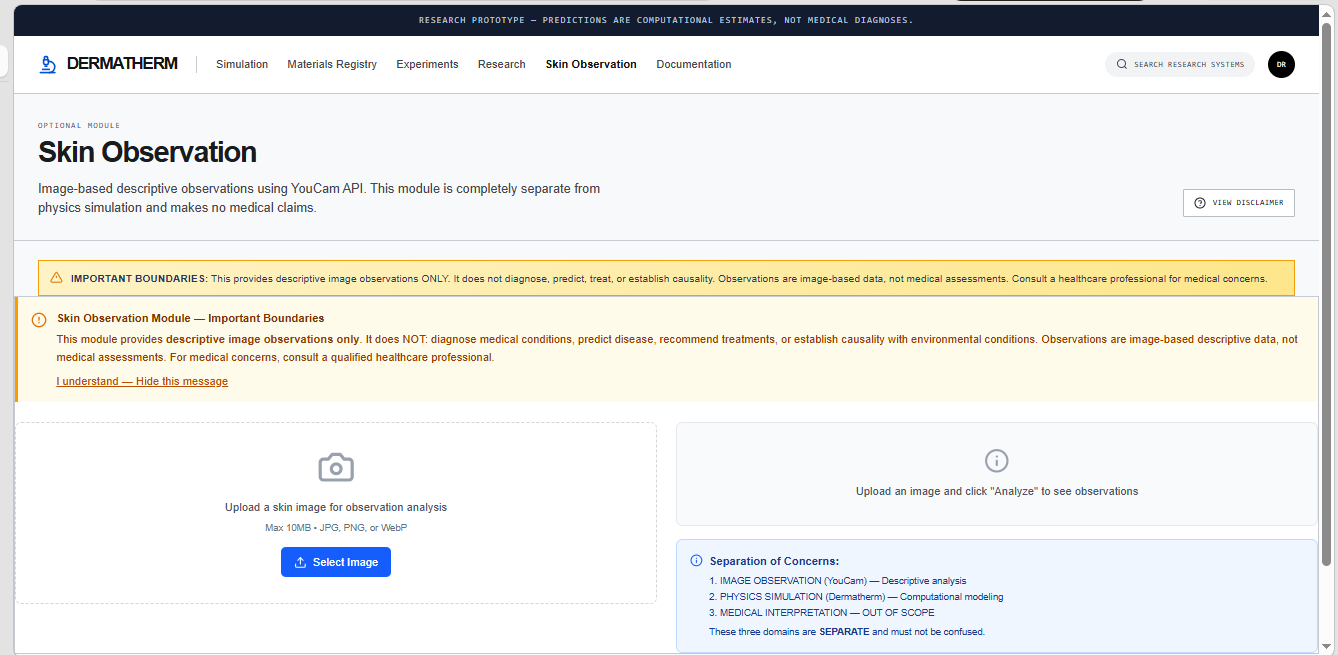
Dermatherm is not intended to provide medical diagnosis or replace experimental validation.
How we built it
We built Dermatherm as a research-oriented software prototype combining mathematical modeling, numerical simulation, and AI.
The core pipeline is:
Environmental conditions → Material properties → Physical model → Numerical simulation → 2D fields → Physics-informed ML → Material insights
We formulated heat and moisture transport using physical equations and modeled their behavior across the textile domain.
The software prototype combines a backend for the computational logic and an interactive frontend for configuring simulations and visualizing temperature and moisture distributions.
We also used AI-assisted research tools to accelerate literature exploration and technical development, while keeping the physical model and scientific assumptions explicitly defined.
Our research workflow uses scientific literature to identify relevant physical parameters, equations, and material properties rather than treating the AI model as a black box.
Challenges we ran into
The biggest challenge was not building another AI interface. It was making sure the AI was connected to meaningful physics.
Some of the main challenges were:
Translating heat and moisture transport concepts into a computational model Representing coupled physical processes in a 2D domain Finding reliable material parameters from scientific literature Working with limited experimental data Balancing scientific rigor with what can realistically be simulated in a hackathon Designing a prototype that communicates complex physical behavior without overwhelming the user Avoiding unsupported claims when experimental validation is not yet available
This forced us to distinguish clearly between simulation, prediction, and experimental validation.
Accomplishments that we're proud of
We are particularly proud that Dermatherm goes beyond a conventional recommendation-based AI project.
We built a prototype around a scientific research question, rather than starting with a generic AI model and looking for a problem afterward.
We were able to:
Develop a physics-based modeling framework Build 2D temperature and moisture visualizations Create an interactive prototype Connect material properties with environmental conditions Establish a foundation for physics-informed machine learning Design a potential B2B application for textile R&D Turn a research hypothesis into a demonstrable software prototype
Most importantly, Dermatherm gives us a foundation that can be experimentally validated and expanded into a real computational material research platform.
What we learned
We learned that combining AI with scientific domains requires a different mindset from conventional machine learning.
More data is not automatically better if the underlying physical assumptions are wrong.
We also learned the importance of:
Understanding the physical meaning of model parameters Separating assumptions from experimentally validated facts Using scientific literature carefully Treating physics as a constraint rather than simply another feature Designing scientific software for people who may not be experts in AI
The project also taught us that a strong research prototype does not need to pretend that every scientific question has already been solved.
What's next for Dermatherm
The current prototype is the beginning of a longer research roadmap.
Next steps:
- Experimental validation
Compare simulations against controlled experiments using real textile samples.
- Better material characterization
Build a larger database of experimentally measured thermal and moisture-related properties.
- Physics-Informed Neural Networks
Train and validate PINNs against numerical and experimental reference data.
- Faster simulation
Develop physics-informed surrogate models capable of approximating expensive simulations much faster.
- Industrial collaboration
Work with textile and sportswear R&D teams to evaluate whether computational screening can improve early-stage material development.
- Climate-adaptive materials
Extend the platform to different climates, textile structures, and environmental conditions.
Our long-term vision is to transform Dermatherm into a virtual laboratory for climate-adaptive material research.


Log in or sign up for Devpost to join the conversation.