-
-
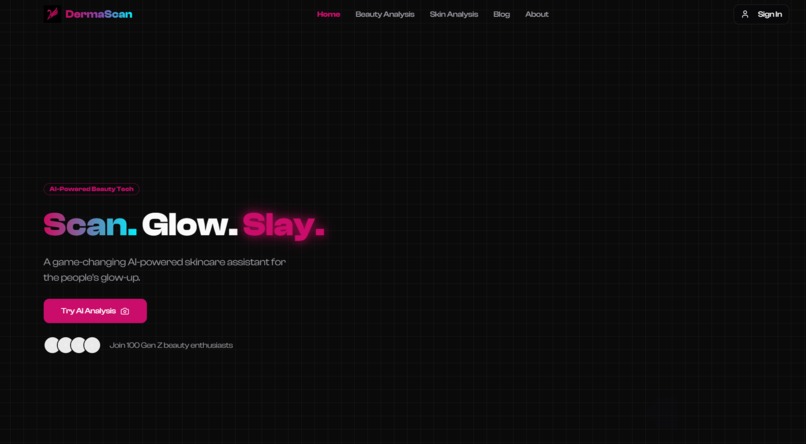
DermaScan homapage
-
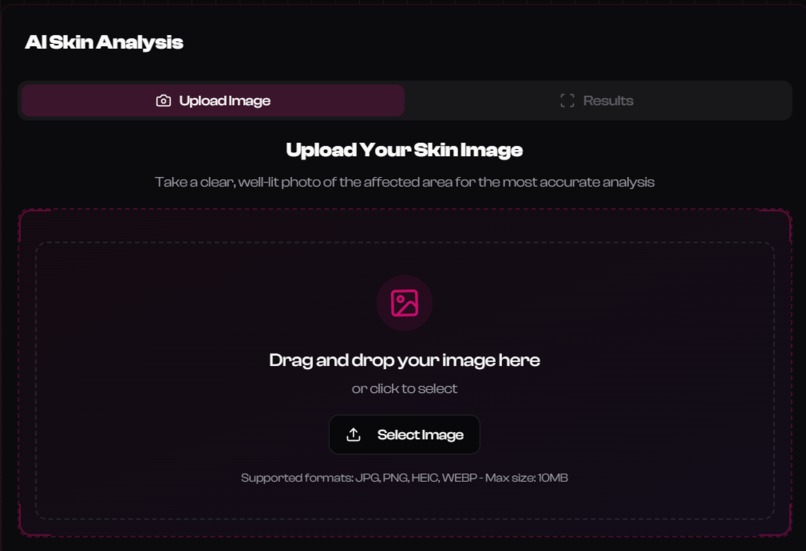
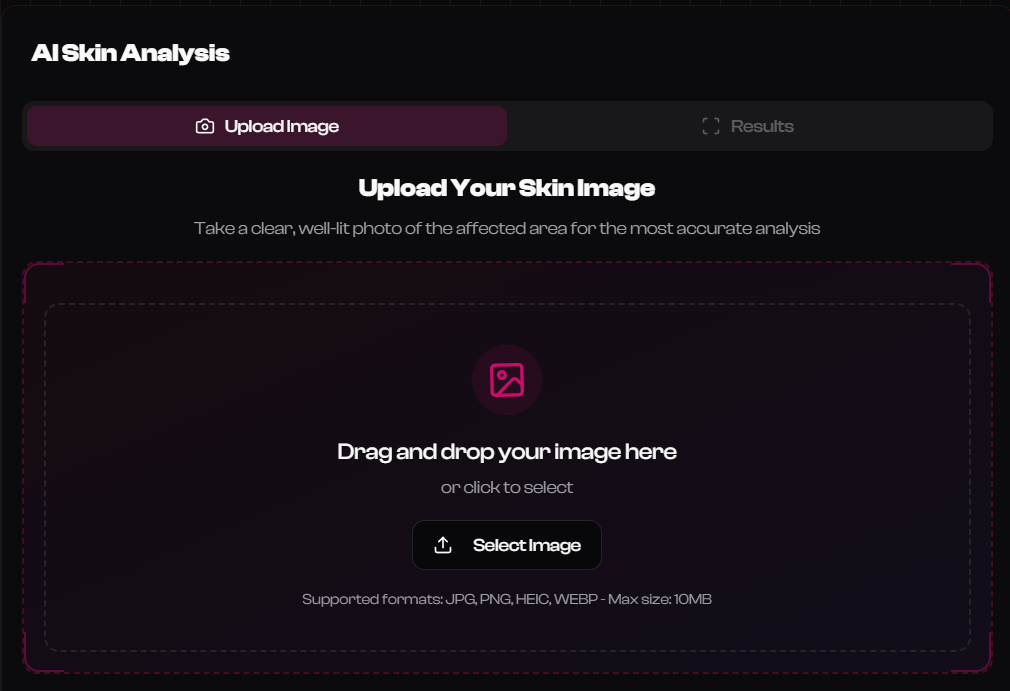
skin picture upload
-
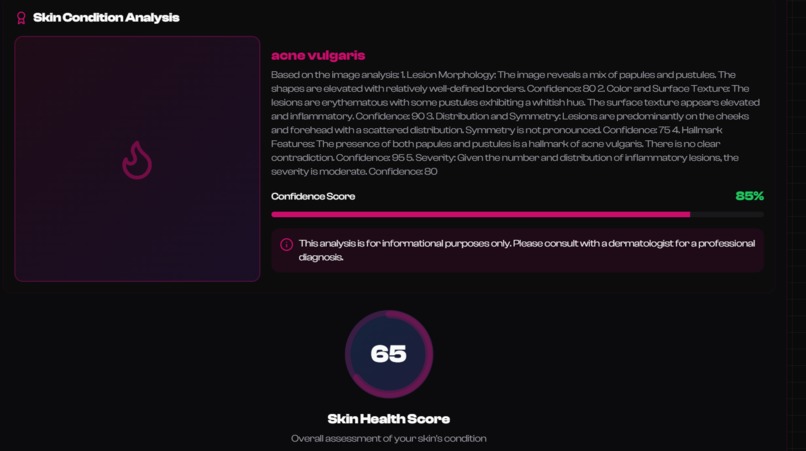
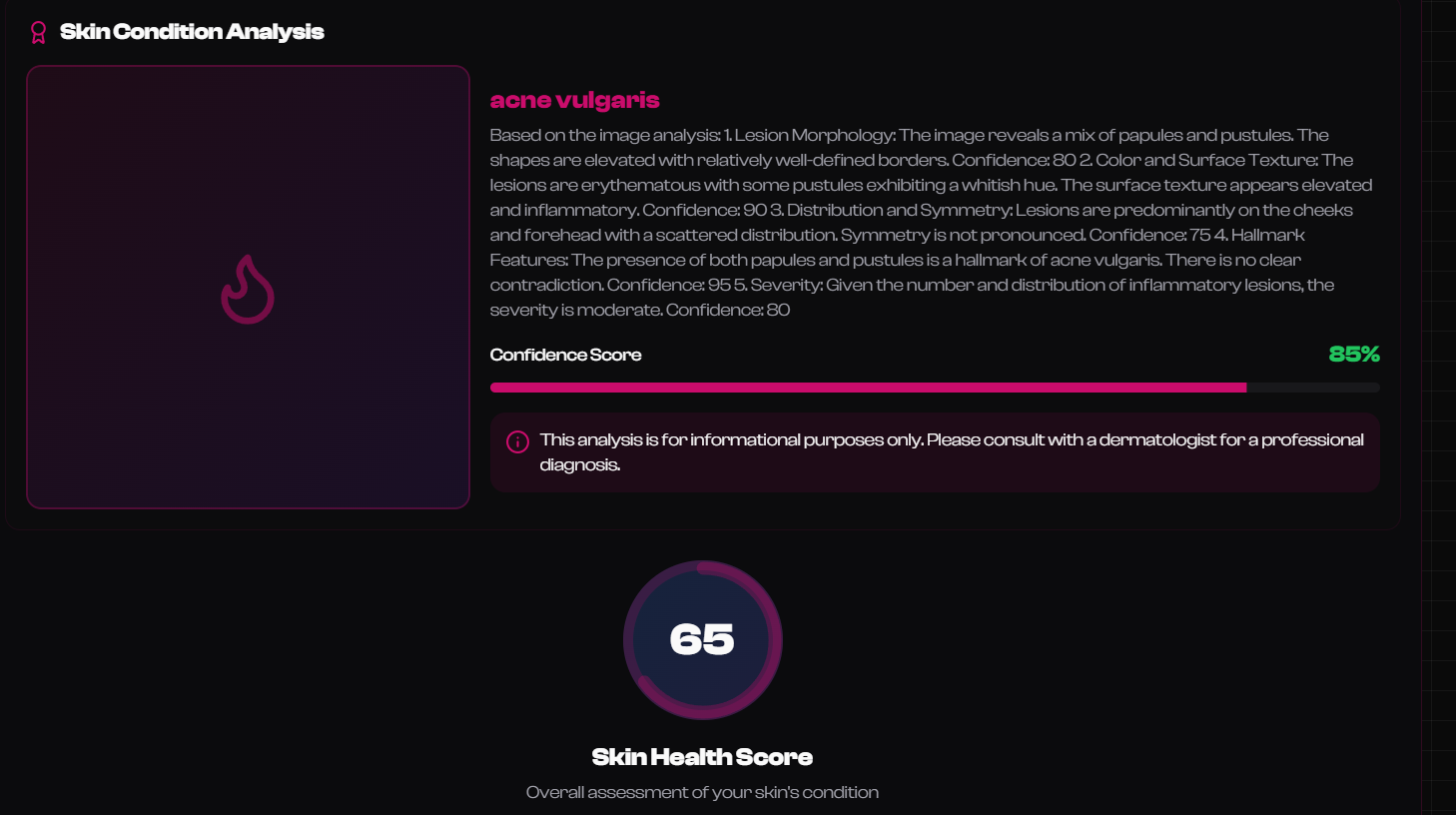
Skin disease prediction
-
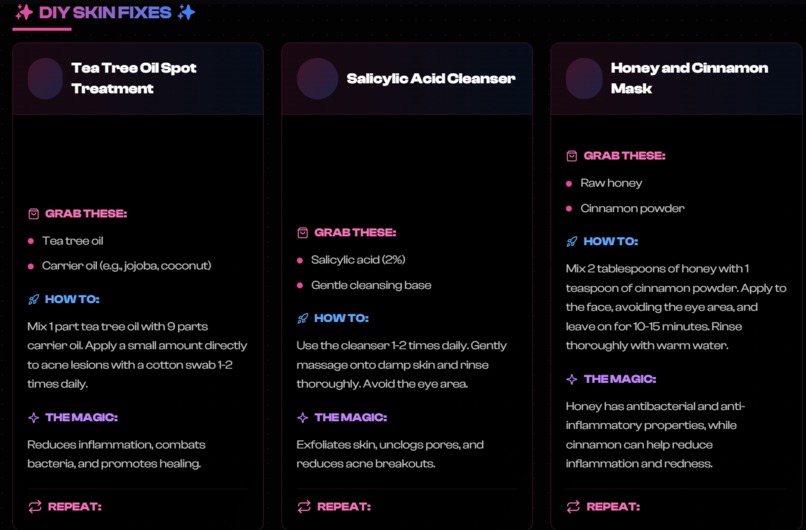
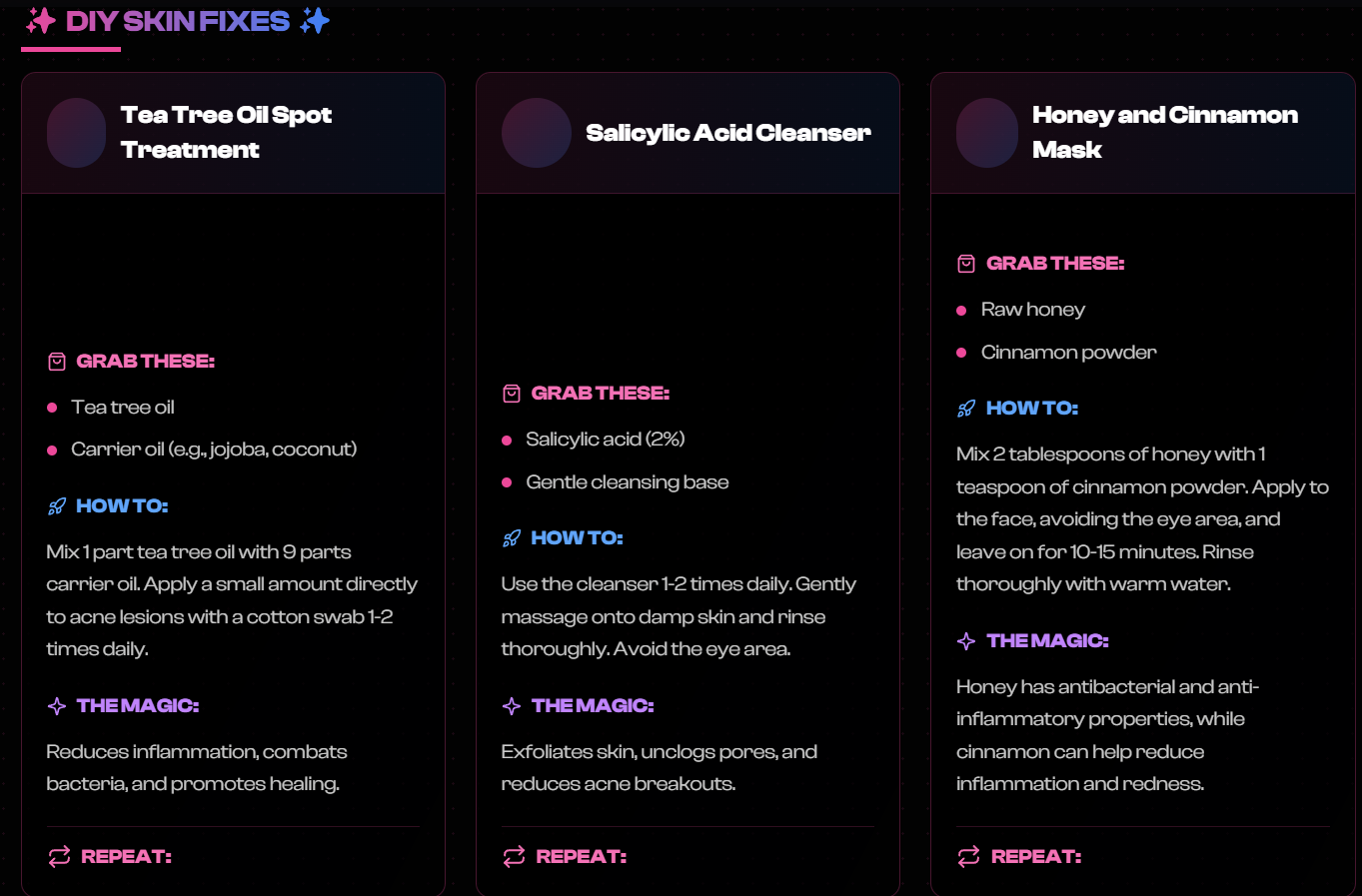
Home remedies
-
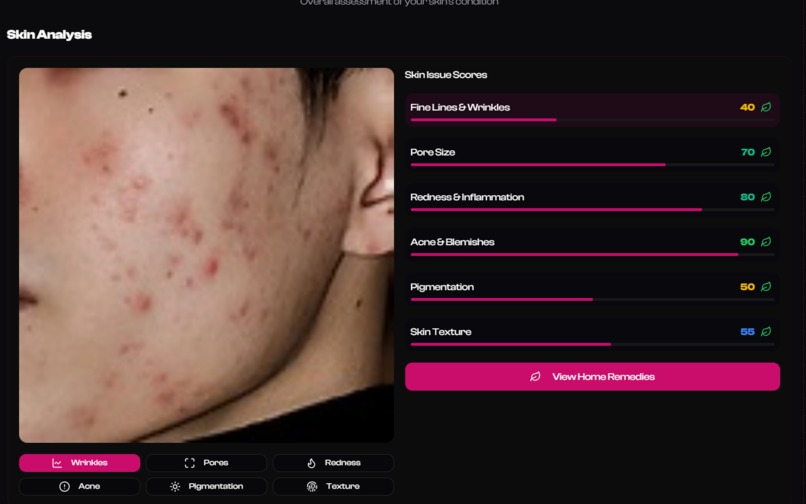
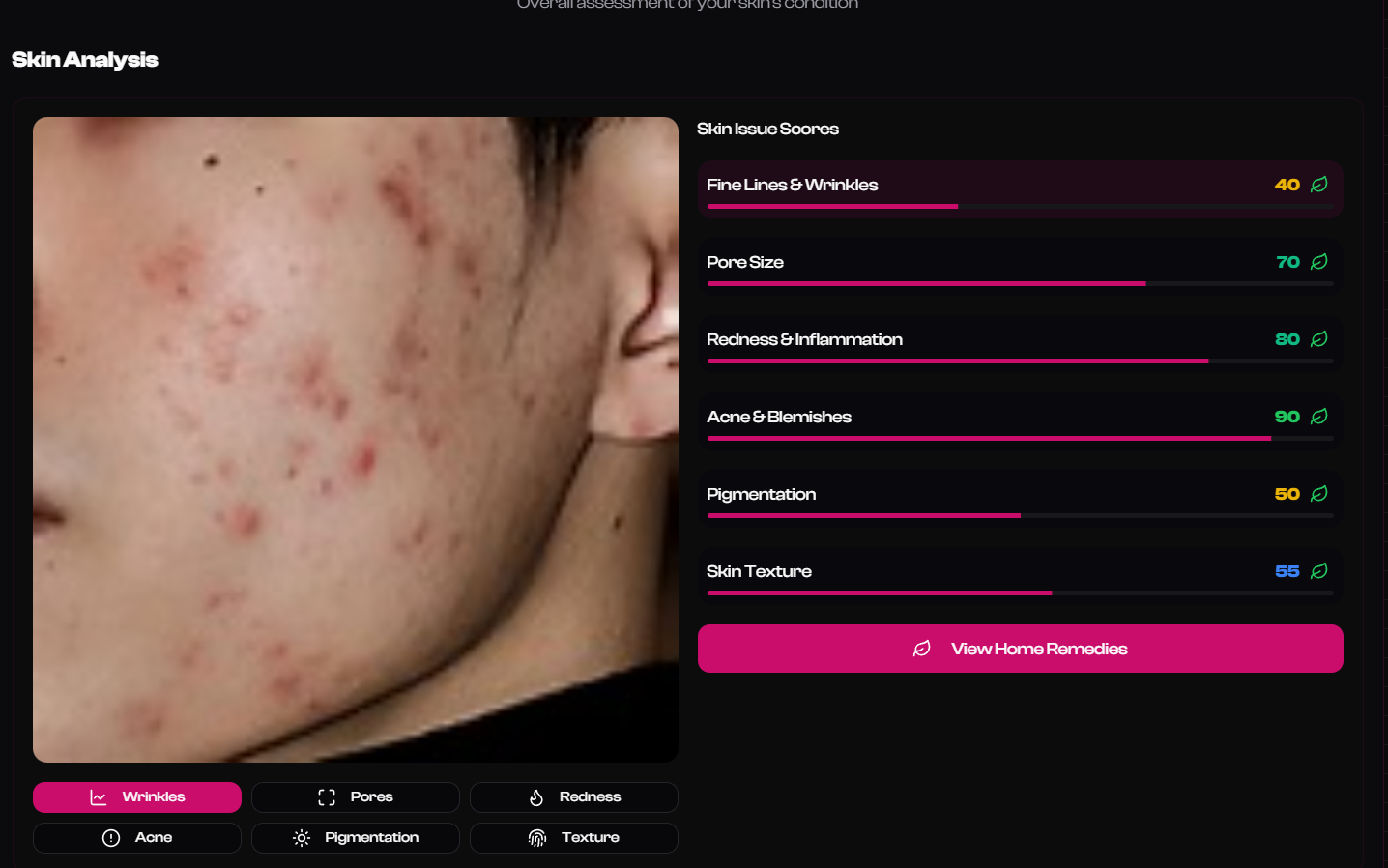
Skin health score
-
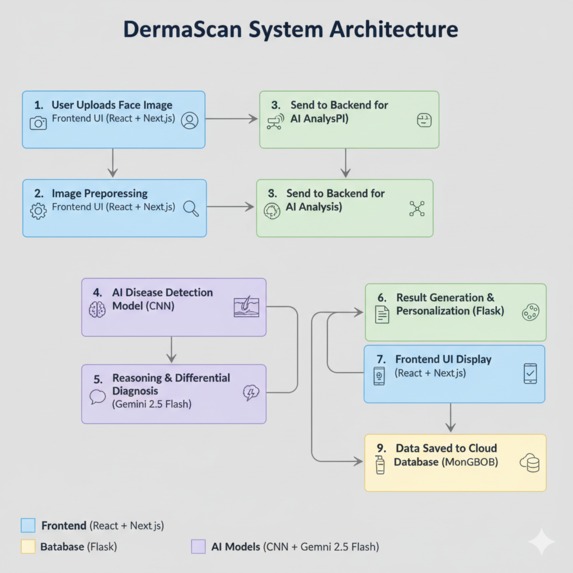
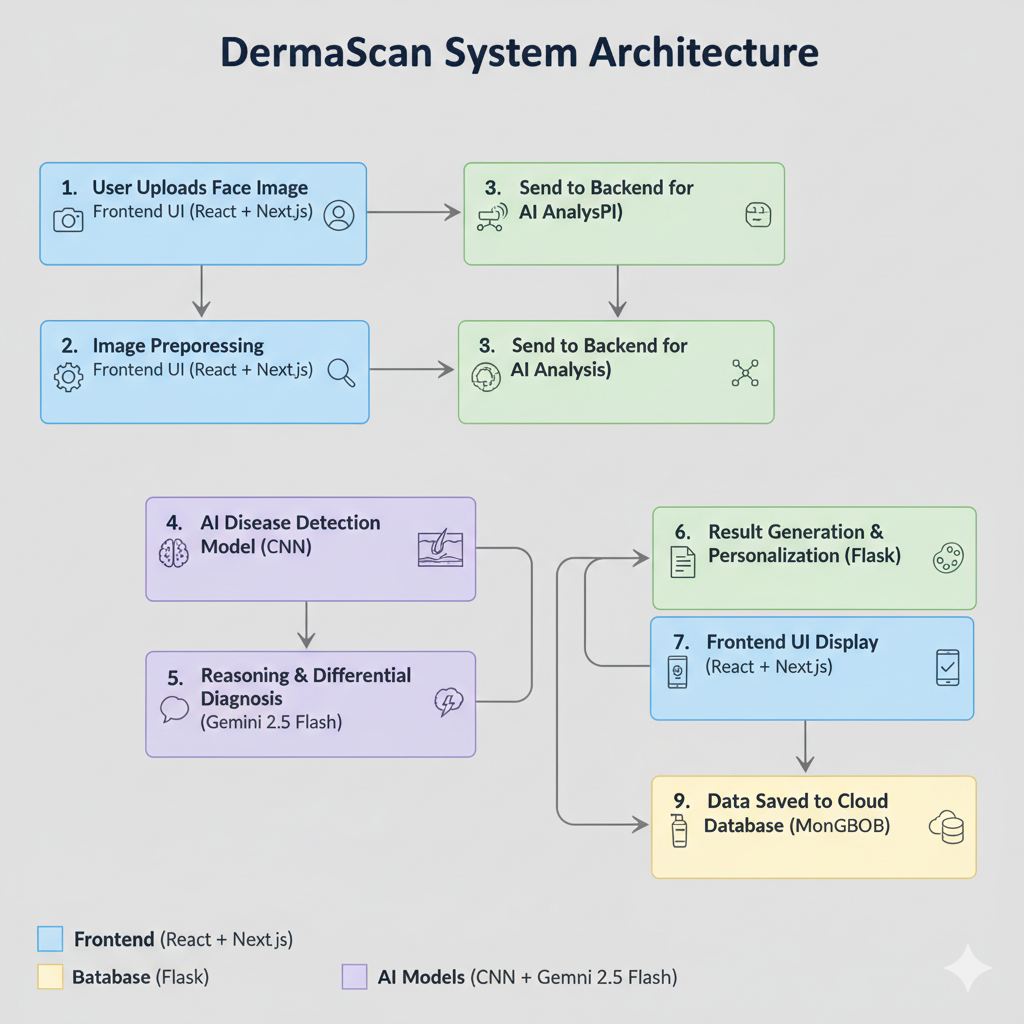
DermaScan System architecture
-
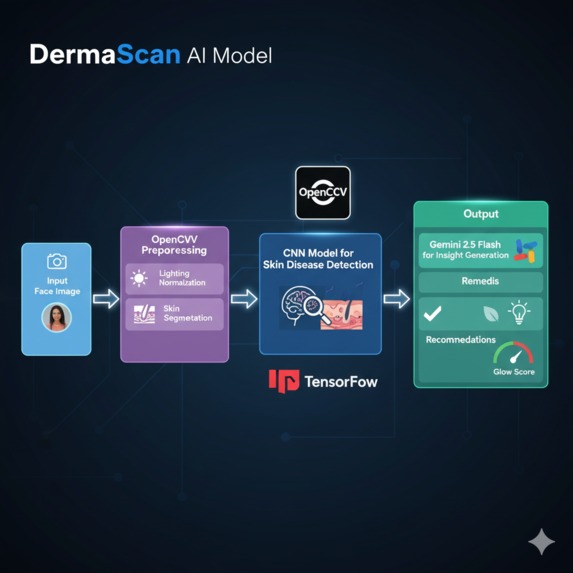
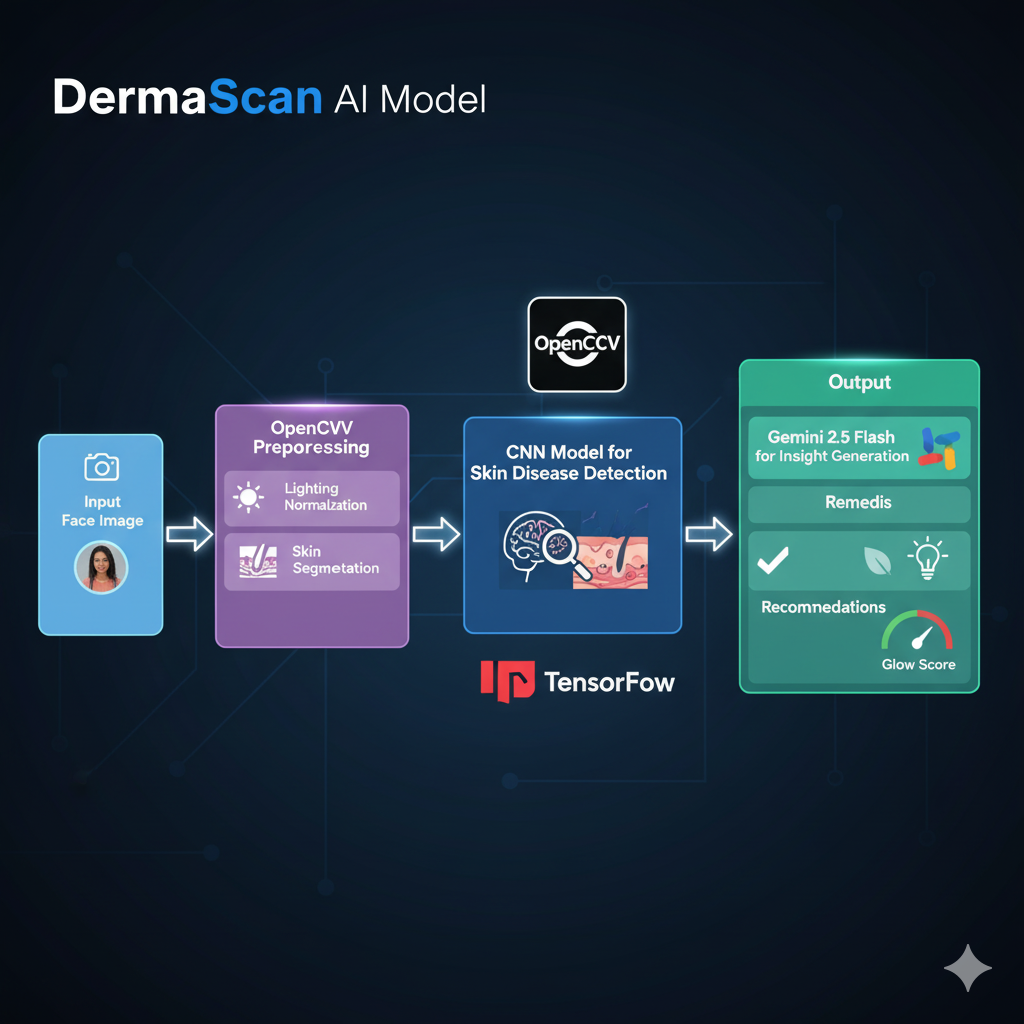
AI ML architecture and flow
💡 Inspiration
Globally, millions of individuals experience persistent dermatological challenges such as acne, eczema, pigmentation, and dermatitis. Despite this prevalence, dermatological care remains largely inaccessible, costly, and inconsistent.
We identified a fundamental opportunity: Can artificial intelligence replicate a dermatologist’s diagnostic intelligence with real-time precision and accessibility?
That insight gave rise to DermaScan — an AI-driven dermatology and skin analytics platform that merges advanced computer vision with multimodal reasoning.
Our vision is to create a seamless intersection of medical-grade analysis and consumer-level usability, where AI provides clinically relevant insights through an interface designed for trust and empathy.
✨ What It Does
DermaScan transforms a standard smartphone camera into a real-time dermatological scanner. It captures facial imagery, performs computational analysis using deep learning models, and outputs a detailed skin health assessment, including diagnostic predictions, glow analytics, and personalized care recommendations.
Within seconds, users receive an interpretive report supported by AI reasoning and quantitative analysis.
🧠 Core Features
AI-Driven Dermatological Classification Convolutional Neural Network (CNN) models trained on annotated dermatology datasets detect early-stage conditions such as acne, eczema, and fungal infections. The model generates condition probabilities and evidence heatmaps for interpretability.
Facial Glow and Texture Analysis Implements tone histogram analysis, symmetry measurement, and Gray-Level Co-occurrence Matrix (GLCM) texture evaluation to derive a composite Glow Index, representing skin vitality and uniformity.
Adaptive Skincare Recommendation Engine Through integration with Google Gemini 2.5 Flash, DermaScan applies multimodal reasoning to produce tailored skincare and lifestyle recommendations based on image data, environmental context, and user profiles.
Skin Health Analytics Dashboard Provides a quantitative overview of dermatological health progression using time-series visualizations and anomaly detection algorithms.
Self-Learning Insight Layer Employs incremental model retraining on anonymized user data to improve generalization across demographics and lighting conditions.
🧩 How We Built It
Frontend (UI/UX)
- Stack: React.js, Next.js, Tailwind CSS, Framer Motion
- Architecture: Component-based modular design optimized for scalability and dynamic rendering
- Design Philosophy: Minimal, clinical-grade interface with smooth transitions and low cognitive load
- Core Features: Real-time image capture interface, live inference visualization, and asynchronous AI response rendering
Backend (Infrastructure)
- Framework: Flask (Python) with RESTful API endpoints
- Functionality: Handles inference requests, Gemini reasoning queries, and data persistence
- Database: MongoDB Atlas for structured user profiles and historical scan logs
- Security: JWT-based authentication and AES-256 encryption for health data
AI and Machine Learning Stack
Model Architecture:
- CNN model for disease detection trained on multi-ethnic dermatological datasets
- Image preprocessing pipeline using OpenCV for illumination correction, face region extraction, and normalization
- Texture and tone analysis using histogram equalization and spatial filtering
- Gemini 2.5 Flash integration for text synthesis, reasoning, and contextual insights
Frameworks & Libraries: TensorFlow, Keras, OpenCV, NumPy, Pandas, Scikit-learn
Optimization: Model quantization and TensorFlow Lite conversion for edge inference with minimal latency
Training Strategy: Data augmentation, dropout regularization, and adaptive learning rate schedulers for stability
Deployment Architecture
- Frontend: Deployed on Vercel for SSR optimization and edge network caching
- Backend: Hosted on Render with GPU-backed inference scaling
- Database: Cloud-hosted MongoDB cluster with automated backups
- CI/CD Pipeline: GitHub Actions for model versioning, API updates, and containerized deployment via Docker
⚔️ Challenges We Faced
- Managing lighting and pose inconsistencies — solved using OpenCV-based photometric normalization and augmented training data
- Ensuring dataset fairness across diverse skin tones using an expanded Fitzpatrick dataset
- Reducing inference latency through model pruning and GPU-optimized threading
- Designing a user interface that preserves clinical precision while maintaining consumer-level usability
- Implementing stable integration with Gemini for context-driven NLP interpretation
🏆 Accomplishments
- Developed a fully functional AI dermatology pipeline capable of live inference
- Combined diagnostic modeling, glow scoring, and skincare recommendation systems into one cohesive framework
- Built a deployable multi-layer architecture ready for telemedicine integration
- Optimized inference latency below 500ms on mid-tier hardware
- Achieved interpretability via Grad-CAM visualizations for transparent AI predictions
🎓 What We Learned
- Medical AI requires rigorous fairness testing and ethical data governance
- Combining AI-driven insights with empathetic UX significantly improves trust and adoption
- Cross-domain collaboration between machine learning, design, and clinical knowledge accelerates innovation
- Explainability and user interpretability are critical for medical AI applications
🚀 What’s Next
DermaScan is evolving into a complete AI dermatology and telehealth framework integrating diagnostics, consultations, and predictive analytics.
Upcoming Features
- AI-assisted doctor consultations with automated Gemini health summaries
- Predictive modeling for skin condition forecasting and progress analytics
- Augmented reality overlays for live skin visualization
- IoT-based environmental factor monitoring (UV, hydration, air quality)
- Federated learning pipeline for privacy-preserving global model improvement
🌈 Vision
We envision AI dermatology as a ubiquitous, accessible, and clinically reliable service — bridging the gap between healthcare and personal wellness.
DermaScan aims to establish a global skin intelligence infrastructure, enabling anyone to understand, monitor, and optimize their skin health using computational analysis and AI reasoning.
This is not just diagnostic automation — it’s dermatological intelligence, re-engineered through data and empathy.
Built With
- ai
- flask
- framermotion
- gemini
- gemini2.5-flash
- google-prediction
- keras
- ml
- next.js
- opencv
- python
- react.js
- tailwind
- tensorflow
- typescript
- vercel


Log in or sign up for Devpost to join the conversation.