-
-
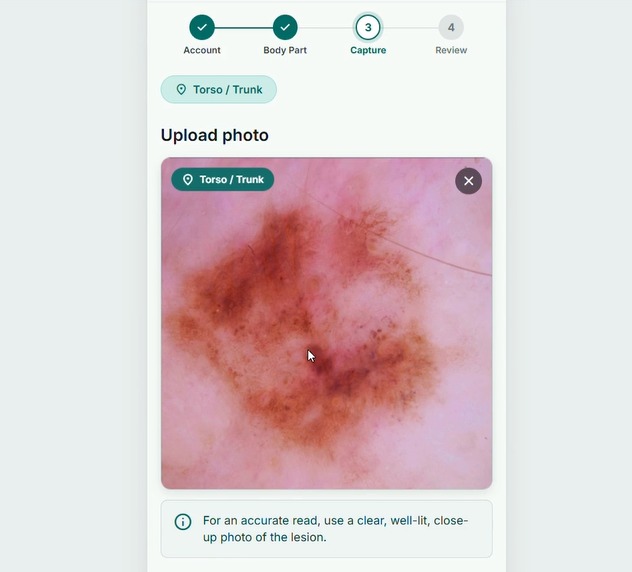
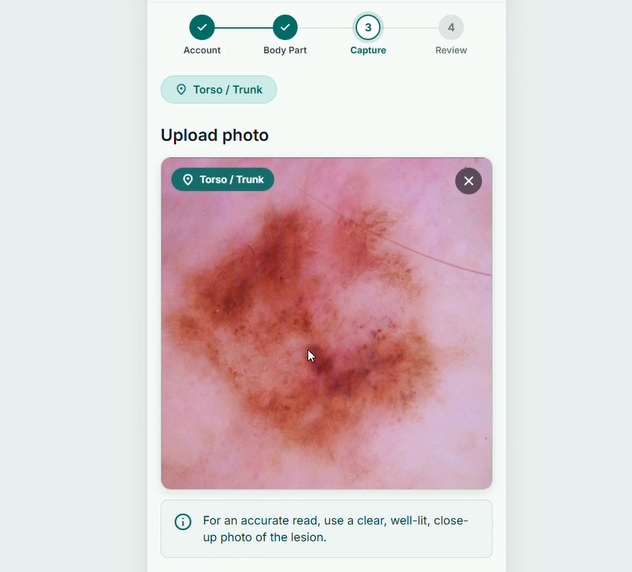
Upload page
-
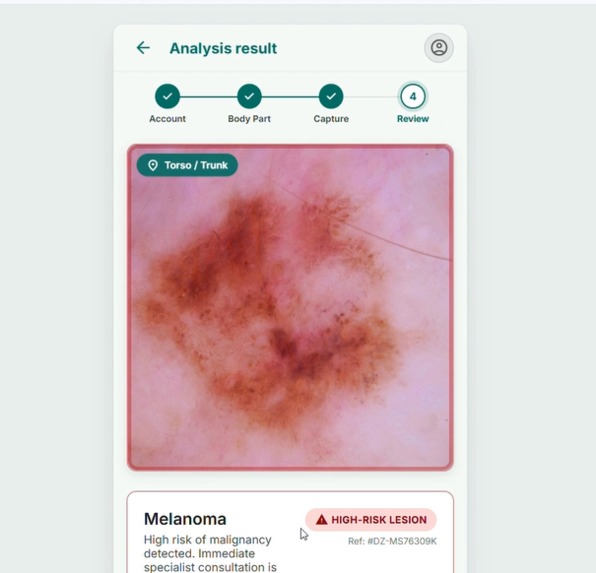
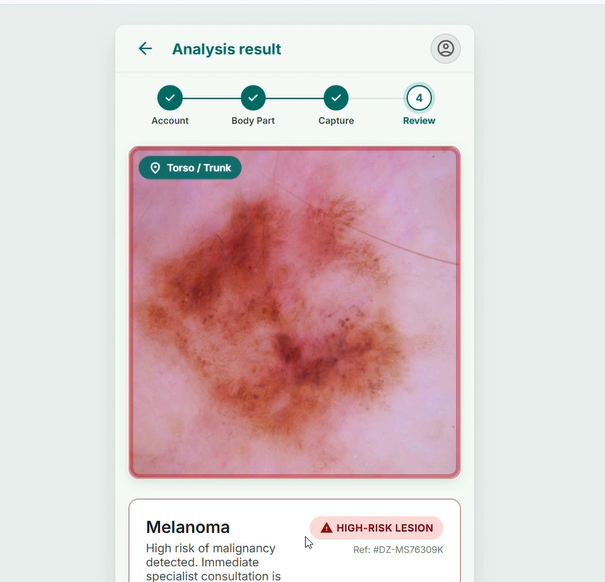
Prediction Result (High risk)
-
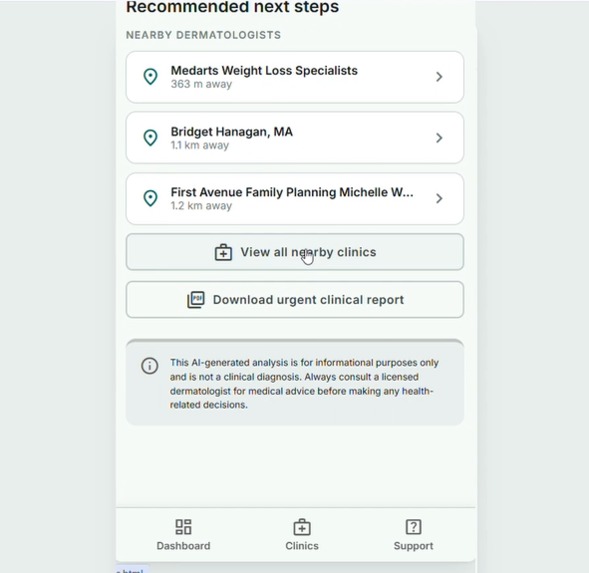
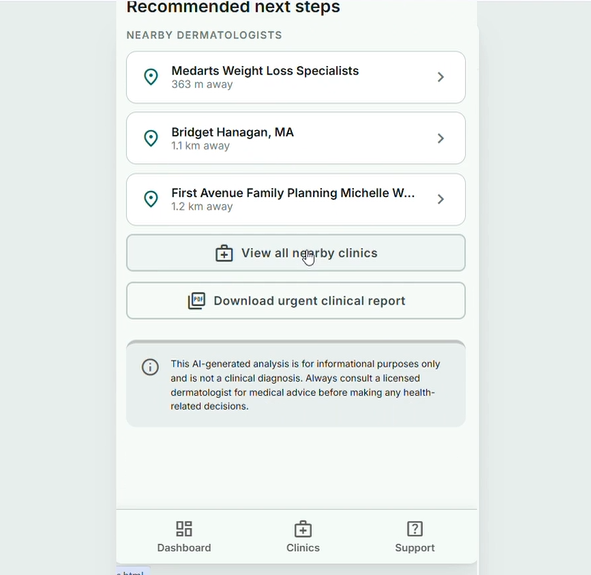
Next Step(High risk)
-
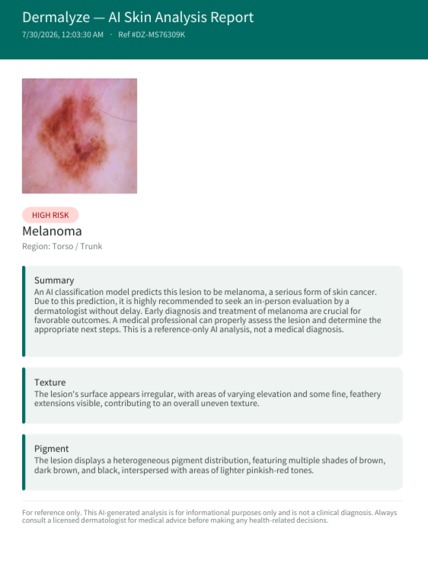
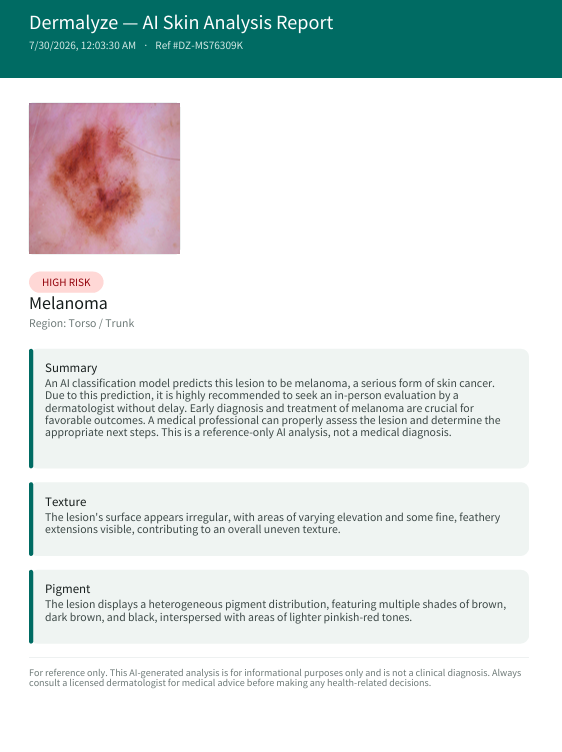
High risk Report
-
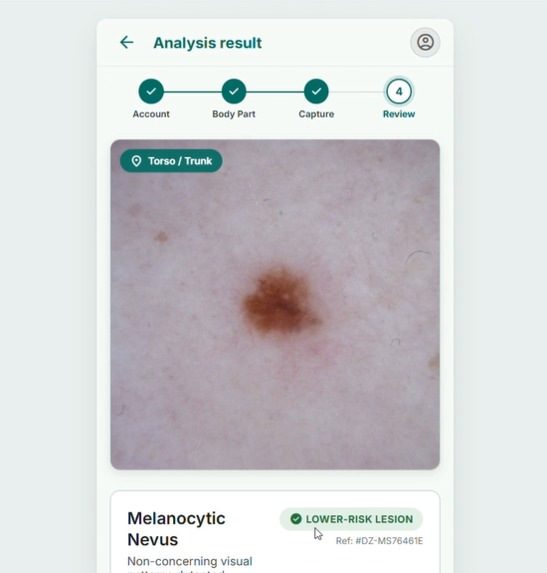
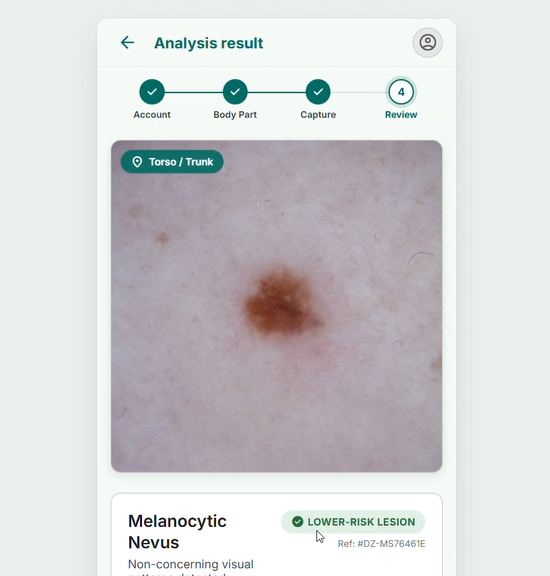
Prediction Result(Low risk)
-
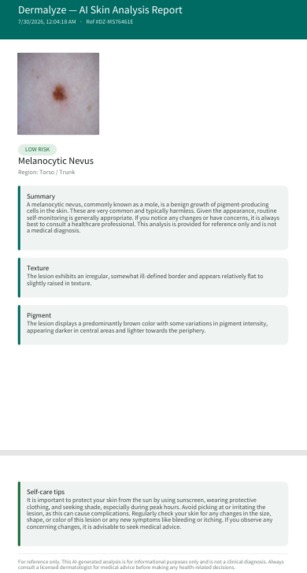
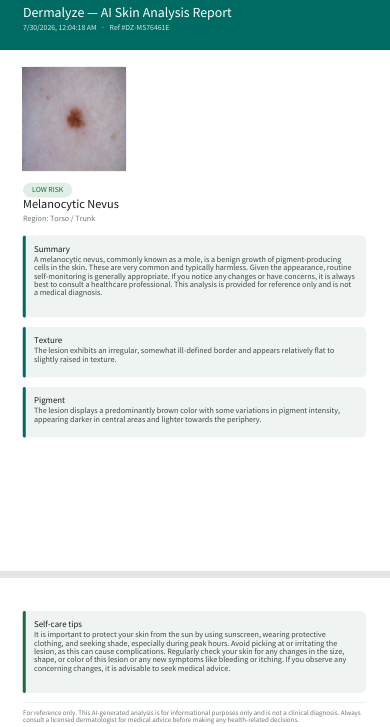
Low risk Report
-
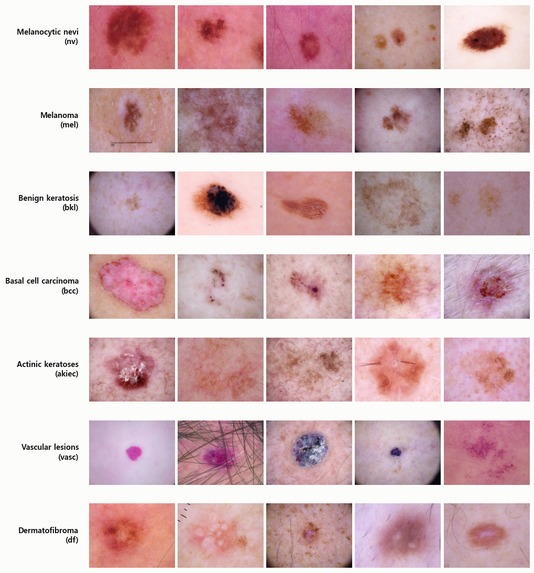
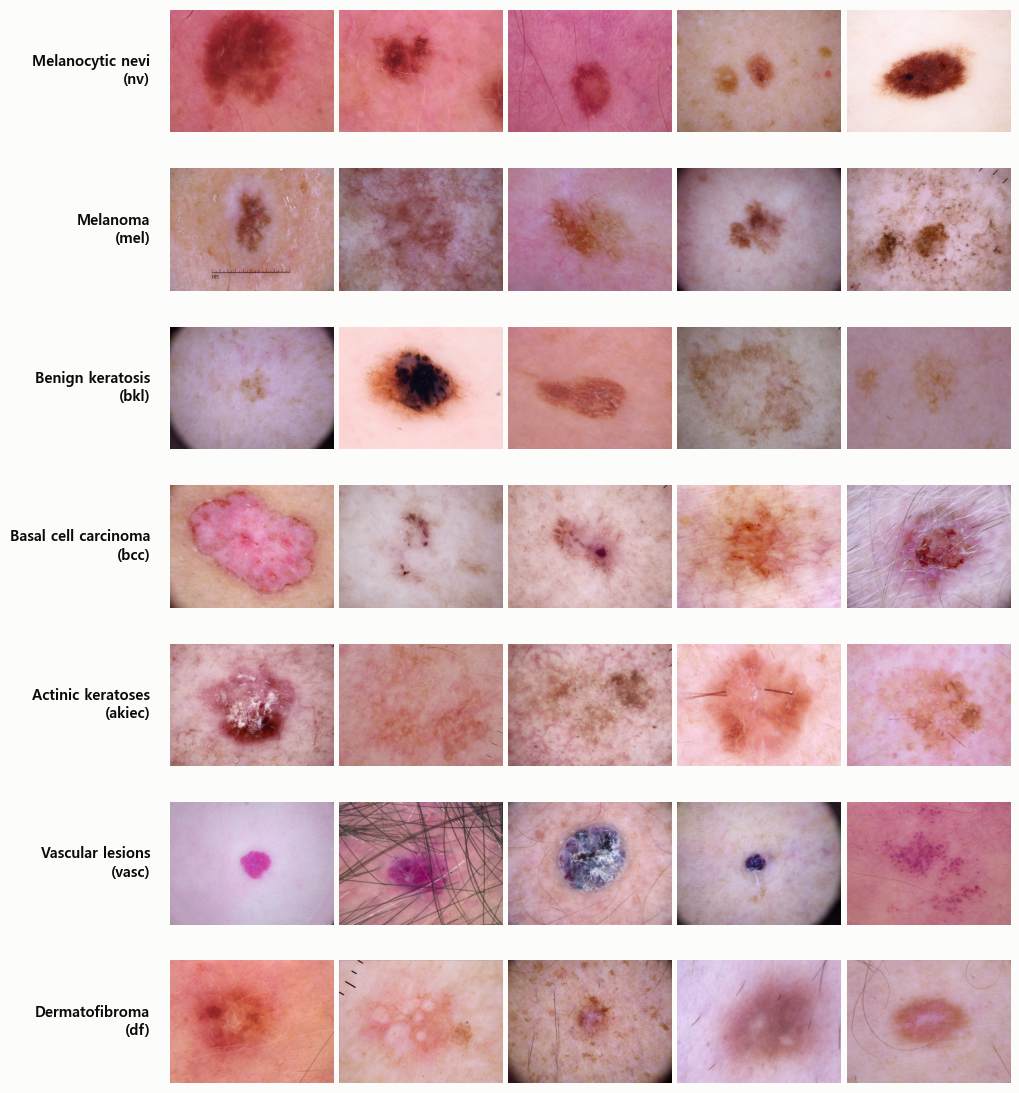
7-Class Sample Images
-
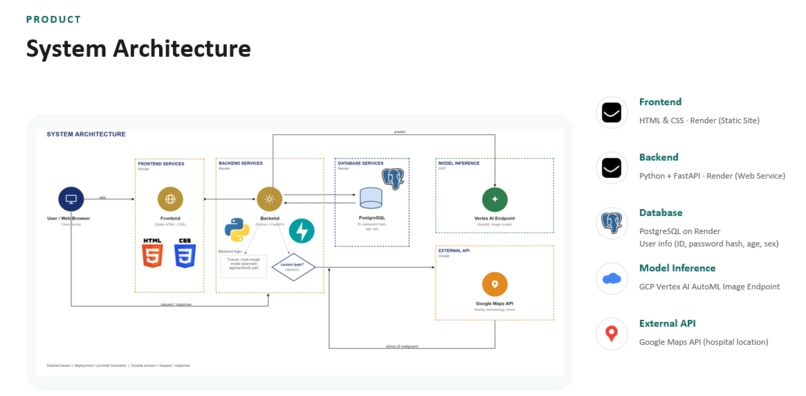
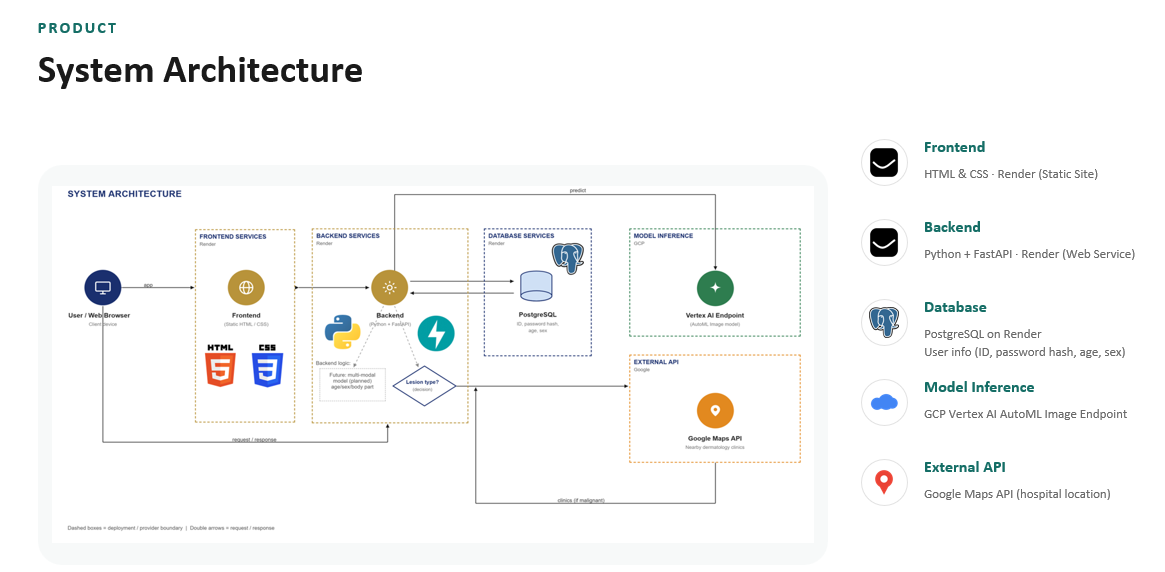
System Architecture
-
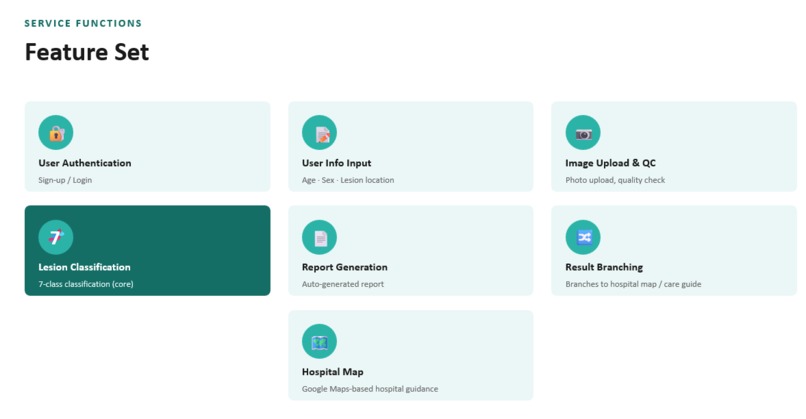
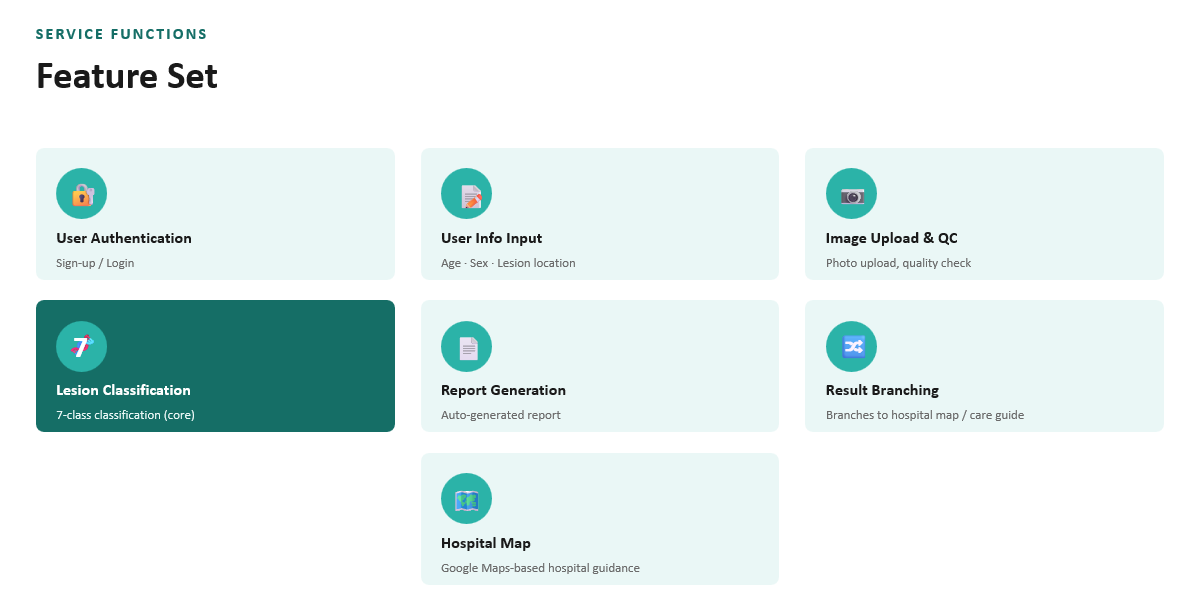
Feature Set
Project Overview
- Problem Statement: People who notice a new or changing skin lesion often lack an accessible way to understand what it may represent and what they should do next.
- Solution Overview: DERMALYZE predicts which of seven predefined skin lesion categories an uploaded image most closely matches and provides different next-step guidance based on the predicted risk level.
- Key Features: 7-class lesion prediction, High Risk / Low Risk branching, automated analysis reports, self-care guidance, and nearby hospital recommendations.
- Technologies Used: Python, FastAPI, HTML/CSS, PostgreSQL, Google Cloud Vertex AI AutoML Image, Render, Google Maps API, REST API, and GitHub.
- Target Users: People who notice visible skin lesions or changes and want an accessible first step to better understand them before deciding whether professional medical evaluation may be appropriate.
Inspiration
Skin lesions are visible, but understanding what they may represent can be difficult for people without medical expertise. Even after receiving an AI prediction, users may still be left with an important question: What should I do next?
DERMALYZE is an AI-powered skin lesion analysis service that predicts which of seven predefined lesion categories an uploaded image most closely matches. Instead of stopping at classification, it routes users into High Risk or Low Risk pathways and provides tailored next steps—professional medical evaluation and nearby hospital guidance for High Risk results, or self-care and monitoring guidance for Low Risk results. DERMALYZE is designed as a prediction and decision-support tool, not a clinical diagnostic service.
Our team wanted to build something that goes beyond simply displaying a classification result.
This inspired us to create DERMALYZE, an AI-powered skin lesion analysis service that predicts which of seven lesion categories an uploaded image most closely matches and then provides a different next step based on the predicted risk level.
DERMALYZE = Dermatology + Analyze
DERMALYZE is not designed to provide a clinical diagnosis or replace medical professionals. Instead, it serves as a prediction and decision-support tool that helps users better understand visible skin changes and determine an appropriate next step.
What it does
DERMALYZE provides an end-to-end skin lesion analysis experience.
Users can create an account, enter basic information such as age, sex, and lesion location, and upload an image of a skin lesion. The image is then analyzed by our AI model and classified into one of seven lesion categories.
The key feature of DERMALYZE is what happens after the prediction.
Based on the predicted lesion category, the system assigns the result to one of two risk pathways:
High Risk
If the model predicts one of the three predefined high-risk lesion categories, the result is classified as High Risk.
The system then:
- Generates a detailed result report
- Clearly communicates the elevated risk level
- Recommends seeking professional medical evaluation
- Provides nearby hospital information using Google Maps
Low Risk
If the predicted result belongs to one of the remaining lesion categories, it is classified as Low Risk.
The system then:
- Generates a personalized result report
- Provides appropriate self-care guidance
- Suggests how the user can continue monitoring the lesion
This risk-based branching is one of the main differences of DERMALYZE.
Rather than ending the experience with a prediction such as “Your lesion belongs to Class A,” DERMALYZE connects the prediction to an actionable next step:
Skin Image → 7-Class Prediction → Risk Classification → Personalized Next Step
Our target users are people who notice visible changes or lesions on their skin and want an accessible first step to better understand them. DERMALYZE helps users interpret an AI prediction and provides different next-step guidance based on the predicted risk level.
Our goal is not to diagnose disease, but to make AI predictions more understandable and useful for users.
How we built it
We built DERMALYZE as an end-to-end AI-powered web service.
Our overall workflow is:
User → Web Application → Backend → AI Model → Risk Classification → Report / Hospital Guidance
The frontend was developed using HTML and CSS and deployed on Render as a static site.
The backend was built with Python and FastAPI and deployed on Render as a web service. It handles user requests, communicates with the AI model, manages prediction results, and determines which risk pathway should be provided to the user.
For user management, we used PostgreSQL on Render to store account and user information such as age, sex, and lesion location.
For the AI component, we used a Google Cloud Vertex AI AutoML Image endpoint to perform skin lesion image classification. When a user uploads an image, the backend sends the image to the model endpoint and receives a prediction for one of seven lesion categories.
After receiving the model prediction, the backend applies our risk-branching logic.
If the predicted class belongs to one of the three predefined high-risk categories, the system generates a High Risk report and directs the user toward professional medical evaluation. It also connects to the Google Maps API to provide nearby hospital information.
For Low Risk predictions, the system generates a report containing self-care and monitoring guidance.
This allowed us to build a complete pipeline:
Authentication → User Information → Image Upload → AI Prediction → Risk Classification → Report Generation → Next-Step Guidance
Challenges we ran into
One of our first challenges was class imbalance in the skin lesion image dataset.
Some lesion categories contained significantly more images than others, which could cause the model to favor majority classes and perform poorly on underrepresented categories.
To address this, we analyzed the distribution of each class and applied targeted geometric augmentation techniques such as image rotation and flipping. More augmentation was applied to underrepresented classes to create a more balanced training dataset.
Another important challenge was data leakage.
Multiple images in the dataset could belong to the same underlying lesion. If images of the same lesion appeared in both the training and validation sets, the model could effectively encounter the same lesion during both training and evaluation, producing misleadingly high performance.
We therefore reviewed the dataset structure and considered lesion-level relationships when organizing and validating the data split.
Another major challenge was moving from model development to a working service.
Training an image classification model was only one part of the project. We also had to connect the model endpoint to FastAPI, manage prediction requests, implement risk-based branching logic, generate reports, connect Google Maps, manage user data in PostgreSQL, and deploy both the frontend and backend.
We encountered several issues involving cloud permissions, endpoint configuration, API connections, and backend integration while building this pipeline.
We also worked with limited cloud credits and computing resources, which required us to carefully manage when the Vertex AI endpoint was active during development and demonstration.
Accomplishments that we're proud of
We are most proud that DERMALYZE became more than a standalone image classification model.
We built a working end-to-end AI service that connects model predictions to meaningful user actions.
The completed system includes:
- User sign-up and login
- User information input
- Skin lesion image upload
- Seven-class skin lesion prediction
- Risk-based result classification
- Automated report generation
- Self-care guidance for Low Risk results
- Hospital guidance for High Risk results
- Google Maps-based hospital information
- PostgreSQL-based user data management
- Google Cloud Vertex AI model inference
- A deployed frontend and backend on Render
Our biggest accomplishment is the risk-based next-step system.
Many classification systems stop after returning a predicted class. DERMALYZE adds another layer by interpreting the prediction within a predefined risk pathway and providing different guidance depending on the result.
In other words, our service does not simply answer:
“What type of lesion might this be?”
It also helps answer:
“Based on this prediction, what should I do next?”
What we learned
The biggest lesson from DERMALYZE was that building a useful AI product requires much more than achieving good model performance.
We learned how strongly data quality, class imbalance, augmentation strategies, and data splitting methods can affect the reliability of machine learning results.
We also learned that a prediction alone does not necessarily provide enough value to a user.
For an AI system to be useful, the result needs to be translated into information that users can understand and act on. This led us to design DERMALYZE around a prediction-to-action workflow, rather than treating image classification as the final output.
On the engineering side, we gained practical experience integrating multiple components into one service: Vertex AI, FastAPI, PostgreSQL, Render, Google Maps API, and a web frontend.
Most importantly, we learned the difference between building an AI model and building an AI-powered product.
A complete AI product requires reliable data, model inference, backend logic, cloud infrastructure, user experience, and clear communication of what the AI result does—and does not—mean.
What's next for Dermalyze
Our next goal is to expand DERMALYZE from a single-image analysis service into a more continuous skin lesion monitoring platform.
Instead of analyzing only one image at a time, users could periodically upload images of the same lesion and compare changes over time.
Future versions could track changes such as:
- Lesion size
- Color
- Shape
- Visual appearance over time
This could allow DERMALYZE to provide users with a clearer history of how a lesion is changing rather than relying on a single snapshot.
We also plan to improve the model by incorporating more diverse skin lesion datasets and, where appropriate, clinically validated data to improve generalization across different users and image conditions.
Another important next step would be collaboration with medical professionals to review both the risk-classification criteria and the guidance presented to users.
Ultimately, we want to continue developing DERMALYZE around the same principle that shaped this project:
AI should not simply provide a prediction—it should help users understand what that prediction means and what an appropriate next step may be.
Built With
- automl
- css
- fastapi
- github
- google-cloud
- google-maps
- html
- image-classcification
- machine-learning
- postgresql
- python
- render
- rest-api
- vertexai

Log in or sign up for Devpost to join the conversation.