-
-
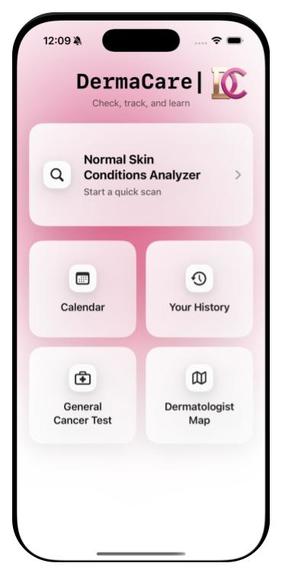
Cover Photo
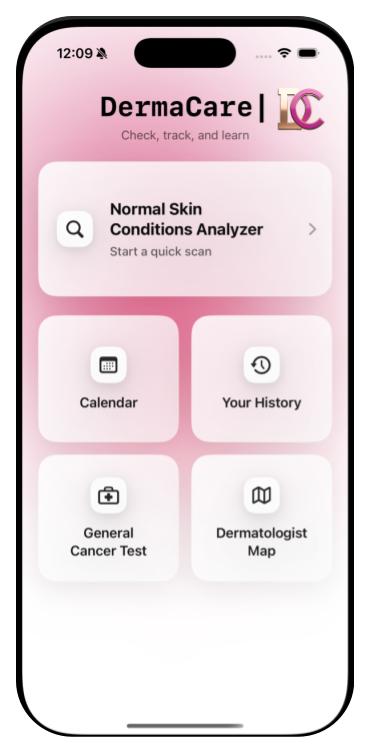
Inspiration
Growing up, we've seen how geography shapes access to healthcare. For communities in suburban and rural areas, the nearest hospital could be hours away, leading to a delayed diagnosis. For those who do live closer to care, even getting an appointment in today's healthcare system can take weeks. We built Dermacare because early detection shouldn't be a privilege, dependent on someone's location.
What it does
Dermacare analyzes skin conditions and skin cancers through a user-friendly interface. From the comfort of their homes, it allows users to take a picture of their mole or a potential area of their skin they want to diagnose. This picture is then fed to a behind the scenes Machine Learning Model to give the user a instant diagnosis. In addition, our app also features other aspects such as making calendar notes and updating the users' history. However, it is important to note that this app is not 100% accurate in detecting skin conditions and Dermacare is not a replacement for professional medical advice, but an "assistant" to support early detection and awareness.
How we built it
Dermacare was built using Swift, leveraging Apple's iOS framework to create a smooth mobile experience. To train the machine learning models, we used datasets of skin conditions from Kaggle and used TensorFlow to improve accuracy. The camera and gallery integration allows users to take and upload images of their skin directly within the app, later being processed by the model and giving an output of what skin condition it could potentially be.
Challenges we ran into
One of the many difficulties we faced was integrating the Machine Models within our app. To combat this, we watched several tutorials and read through online queries of people who had the same difficulties as us. Eventually, we were able to successfully use the Camera and Gallery aspect and run it through our Machine Learning Model for a final diagnosis for our user. Another difficulty we faced was the Spinner Page which launches when you first open the app. While the spinner worked well, we also wanted to incorporate audio to make the user experience even better. However, the incorporation of the audio presented another challenge which required several more days of research.
Accomplishments that we're proud of
We're proud to have achieved about 70% accuracy while testing. Beyond just the numbers, we're proud of what this project hints at for the future, taking a step one by one towards accessible early cancer detection. Knowing how an improved Dermacare can improve someone's health outcome, even slightly, felt significant to us.
What we learned
We learned how technology can be used in a variety of different fields, especially in the field of Biomedical Technology. By using the iOS framework, we were able to merge technology and medicine together to create a real world product to help the community. We learned to fine tune our machine learning models and design an interactive UI that is easy to use for our users. This project allowed us to think not only as computer engineers, but also as part of a community, a community where we can make a true impact. It also tested our collaboration skills and our dedication towards our work, from celebrating small wins to grinding through the tough challenges.
What's next for Dermacare
We're excited to connect with mentors and others who are also passionate about bridging the gap between AI and healthcare. We vision Dermacare growing beyond just an app and into a true healthcare assistant. In an ideal future, Dermacare could be integrated with health corporations like Sutter Health and Kaiser Permanente, so that when a Dermacare user arrives for their appointment, the physician already has a basic understanding of the situation (imaging history/relevant patient information).
Built With
- kaggle
- machine-learning
- mobile(ios)
- swift
- tensorflow
- xcode

Log in or sign up for Devpost to join the conversation.