-
-
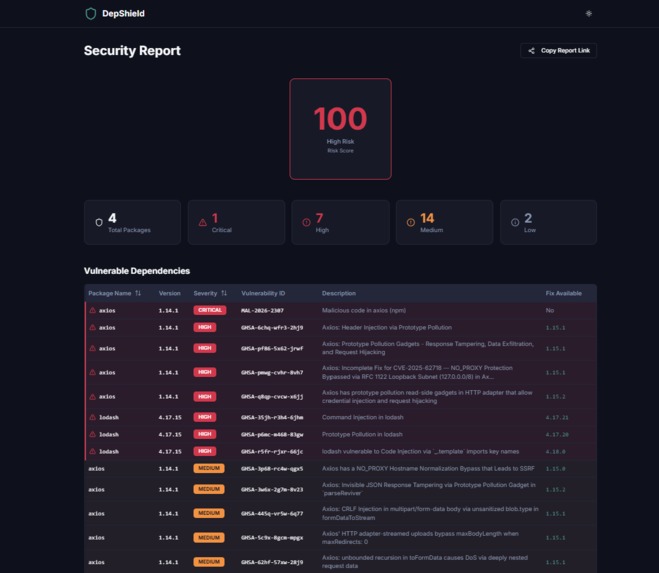
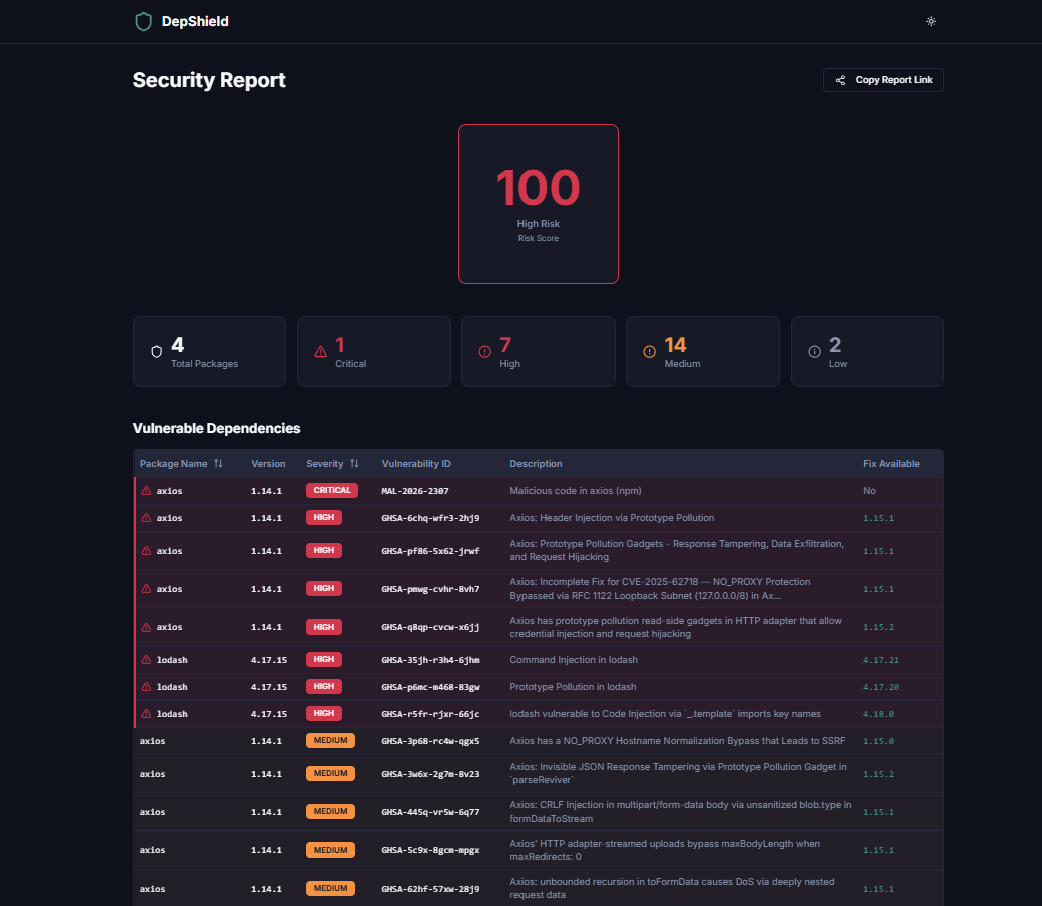
screenshot of the results page showing the full report with the risk score ring, severity badges, and vulnerability table
The Problem
On March 31, 2026, a North Korean threat actor compromised axios — the most downloaded JavaScript HTTP library with over 100 million weekly downloads — and silently deployed a backdoor across developer machines and CI/CD pipelines worldwide. Before that, the Shai-Hulud worm tore through the npm ecosystem in September 2025, self-replicating across 180+ packages. Mini Shai-Hulud hit SAP's developer ecosystem in April 2026.
Every one of these attacks had one thing in common: developers had no
idea what was running inside their npm install.
What I Built
DepShield is a dependency security audit tool that gives every developer instant visibility into what's hiding in their JavaScript dependencies — before it costs them.
Paste your package.json or package-lock.json. DepShield scans every
dependency against the OSV.dev vulnerability database (Google's open
source vulnerability intelligence platform), then generates a full
security report with:
- 🔴 Risk score (0–100) with animated visual ring indicator
- 📊 Severity breakdown — Critical, High, Medium, Low counts
- 📋 Per-vulnerability details — CVE/GHSA ID, description, and exact safe version to upgrade to
- 🔧 Actionable fix commands — copy-paste
npm installcommands to remediate every vulnerable package - 🔗 Shareable report links — encode your full scan into a URL to share with your team or security officer
- 🔒 100% client-side — your code never leaves your browser
How I Built It with MeDo
I built DepShield entirely through MeDo's conversational interface using Advanced Mode. I described the full product spec — tech stack, layout, user flow, API integration, and visual design — in a single detailed prompt. MeDo's multi-agent system generated the full-stack application in one pass, including the OSV.dev API integration via a custom plugin.
From there I iterated through MeDo's chat interface to:
- Fix the JSON parser to handle all
package.jsonandpackage-lock.jsonformats (v1, v2, v3) - Implement a two-stage API fetch — batch query followed by parallel detail fetching using
Promise.allacross 20+ vulnerabilities simultaneously - Add severity badge styling, animated SVG risk score ring, grouped collapsible vulnerability sections, and base64-encoded shareable reports
The Most Impressive Thing MeDo Generated
The two-stage OSV API integration with parallel fetching — from a single
conversational prompt, MeDo wired up a custom plugin, handled the
querybatch response, fired parallel GET /v1/vulns/{id} requests for
every vulnerability ID returned, parsed severity/summary/fix fields from
each response, and rendered everything into a live report with progress
indicators. That would have taken me hours to write manually.
Challenges
- OSV
querybatchonly returns IDs, not full details — had to design a two-stage fetch pattern and communicate that clearly to MeDo through iterative prompting - Version string parsing —
package-lock.jsonv2/v3 usesnode_modules/axiosas keys; the parser needed to handle all three lockfile formats plus raw dependency objects - Severity mapping — OSV uses
MODERATEwhile the UI neededMEDIUM; MAL- prefixed IDs (confirmed malware) needed to always resolve to CRITICAL regardless of other fields
What I Learned
MeDo rewards precision. The quality of the output is directly proportional to how clearly you specify the problem — not just what to build, but the exact user flow, the API request/response shape, the edge cases, and the visual tone. Treat MeDo like a senior engineer: give it a proper spec, not just a vague idea.
What's Next
- GitHub Actions integration — scan on every PR automatically
- Support for
requirements.txt(Python),go.mod,Cargo.toml - Email report delivery
- Badge generator for README files showing dependency health score
Built With
- javascript
- medo
- osv.dev-api
- react
- shadcn/ui
- tailwind-css
- typescript
- vite

Log in or sign up for Devpost to join the conversation.