-
-
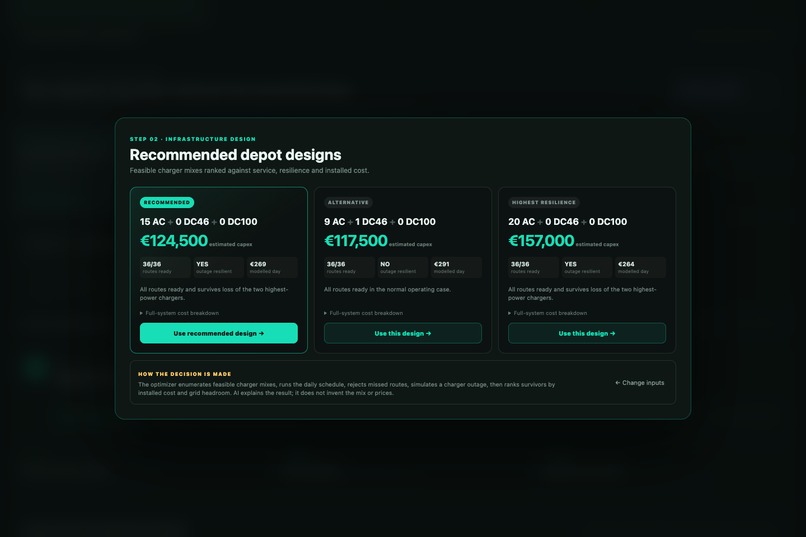
03 Infrastructure Design
-
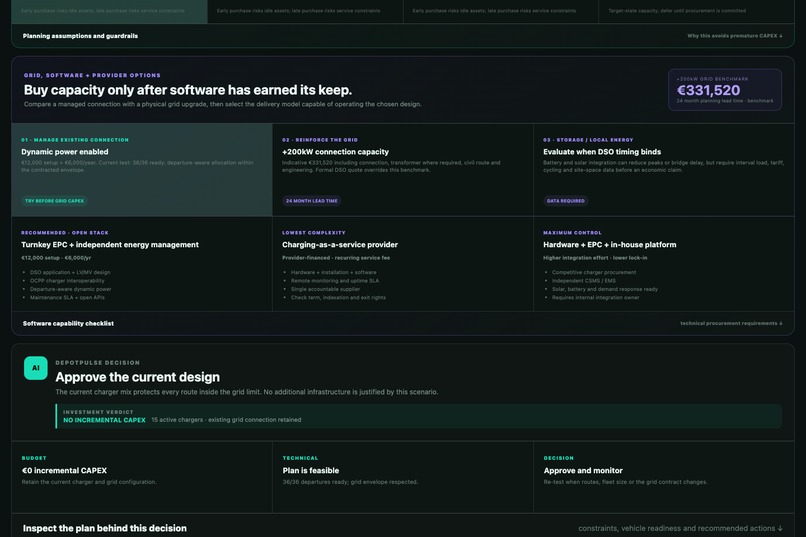
04 Digital Twin
-
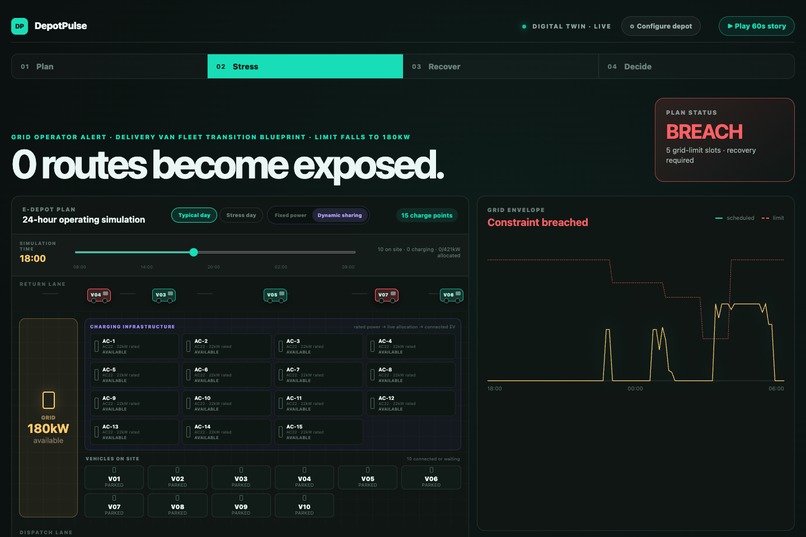
05 Stress Scenario
-
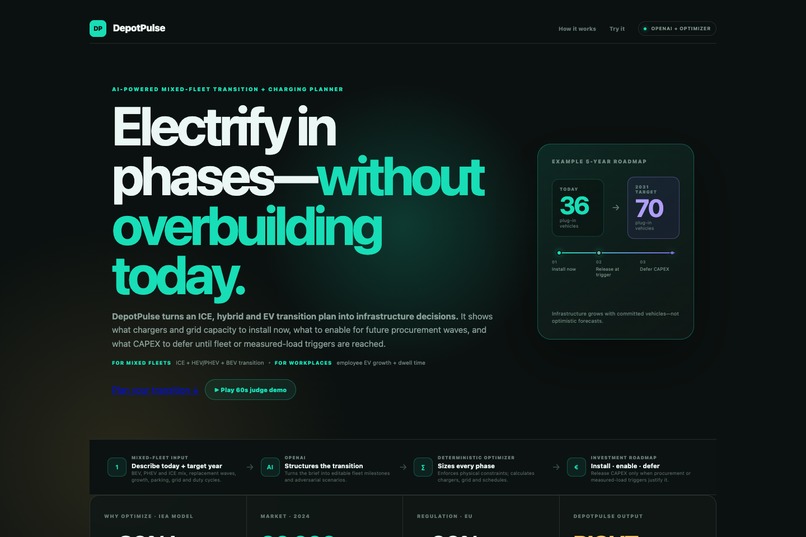
01 Landing Transition
-
02 Fleet Intake
Inspiration
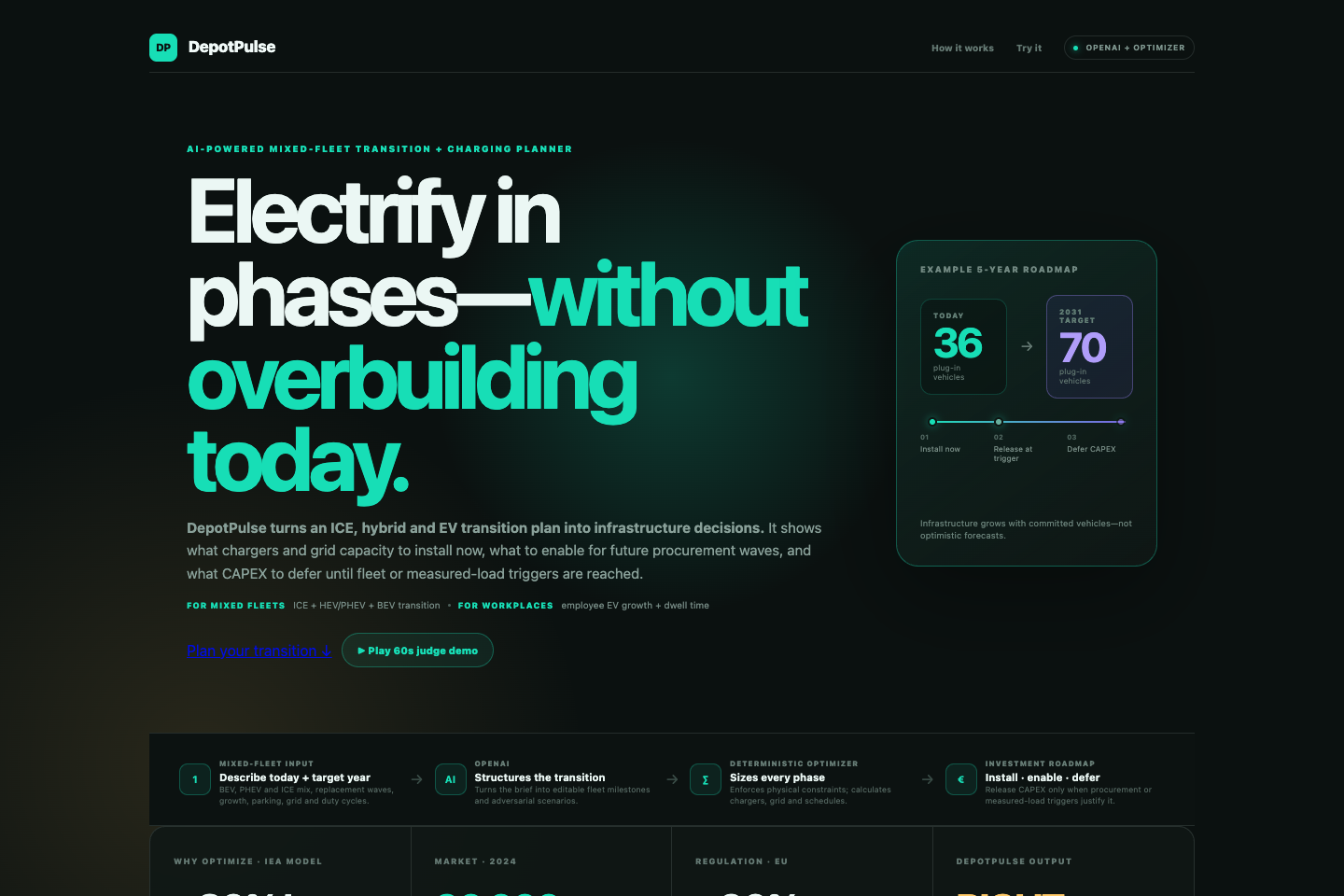
Fleet electrification decisions are usually split across spreadsheets, route exports, supplier quotes, grid studies, and charger-sizing tools. That fragmentation creates two expensive risks: buying infrastructure too early or approving an EV transition that the depot cannot physically operate.
Real fleets also do not switch overnight. ICE and hybrid vehicles coexist with PHEVs and BEVs while vehicle numbers, routes, energy demand, grid constraints, and procurement dates change over several years.
DepotPulse was built to answer one practical question:
What should a fleet operator install now, prepare for later, or defer—and will the resulting depot actually work?
DepotPulse is an independent personal project built with synthetic demonstration data. It is not affiliated with, endorsed by, or developed on behalf of any employer or fleet operator.
What it does
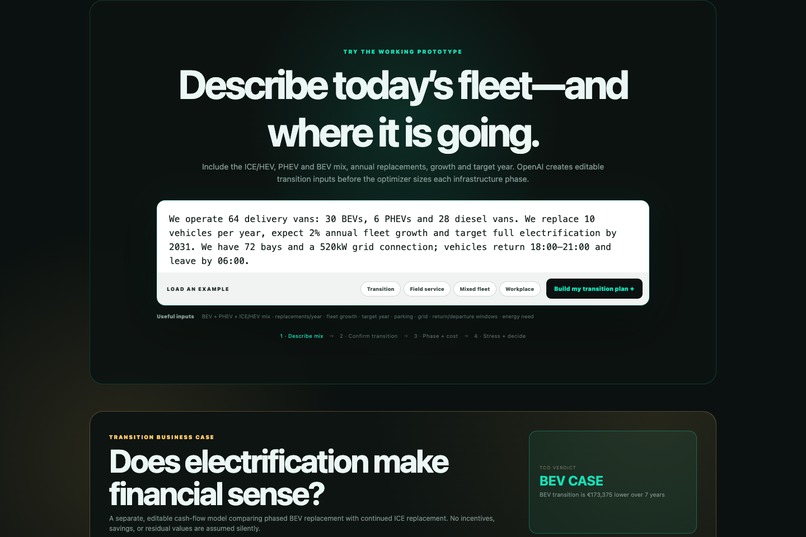
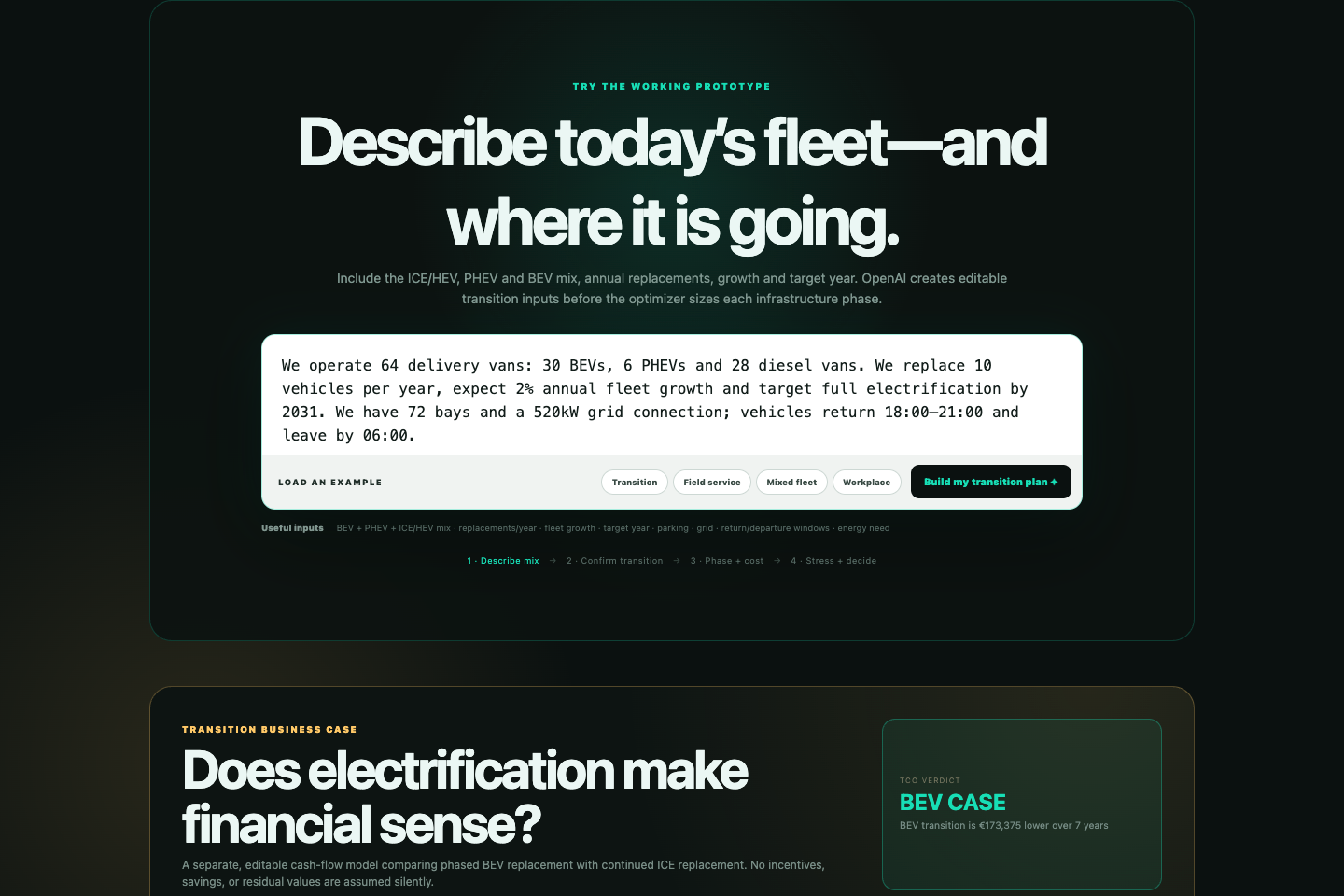
DepotPulse is an AI-assisted planning digital twin for mixed-fleet electrification. A fleet manager describes the current fleet, transition targets, depot constraints, and commercial assumptions in ordinary language. GPT-5.6 converts that brief into strict, editable inputs. A deterministic model then calculates the operational and financial results.
The workflow includes:
- Mixed ICE/HEV, PHEV, and BEV transition planning
- Phased vehicle replacement and fleet-growth modelling
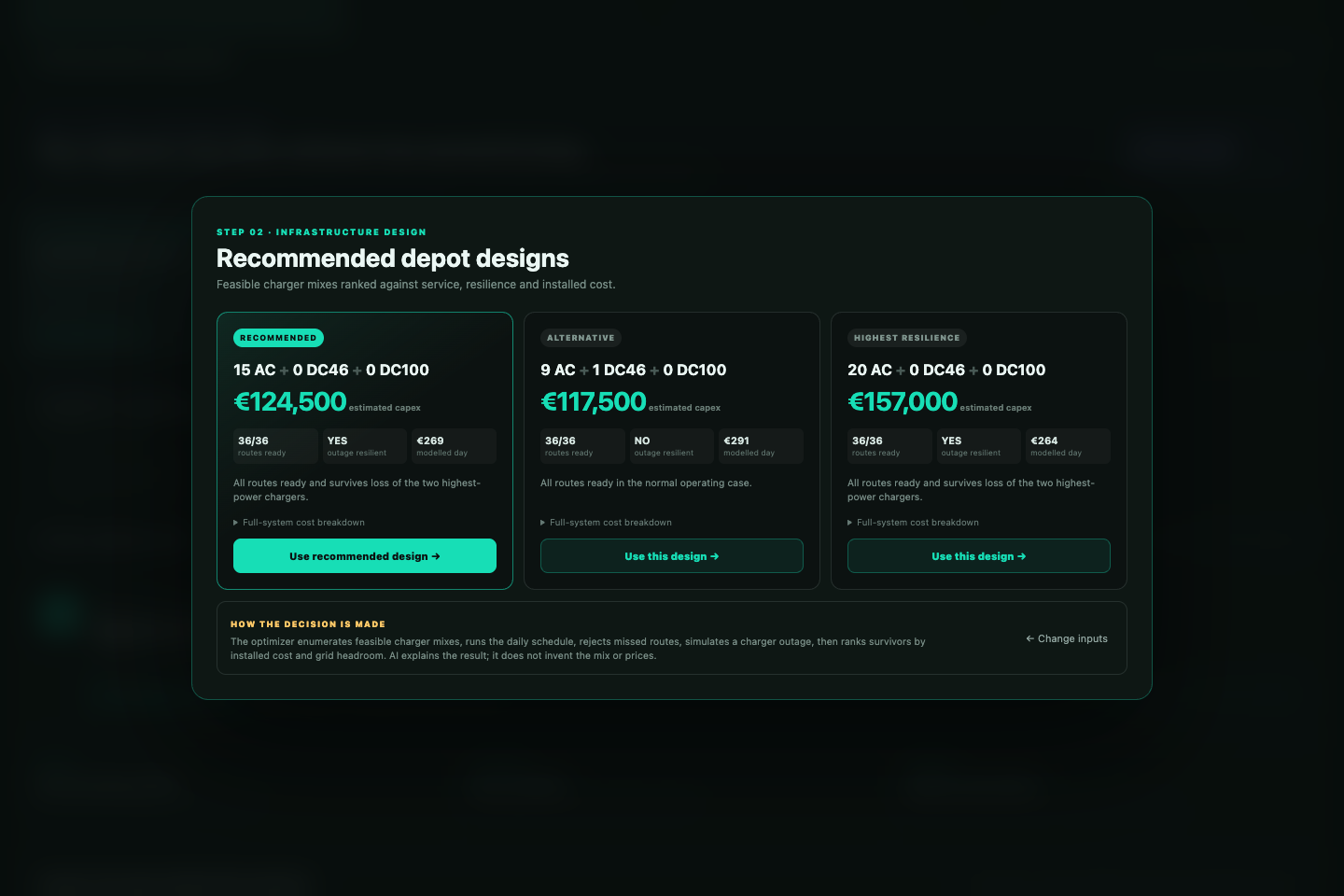
- Charger, grid, transformer, civil-works, and software costs
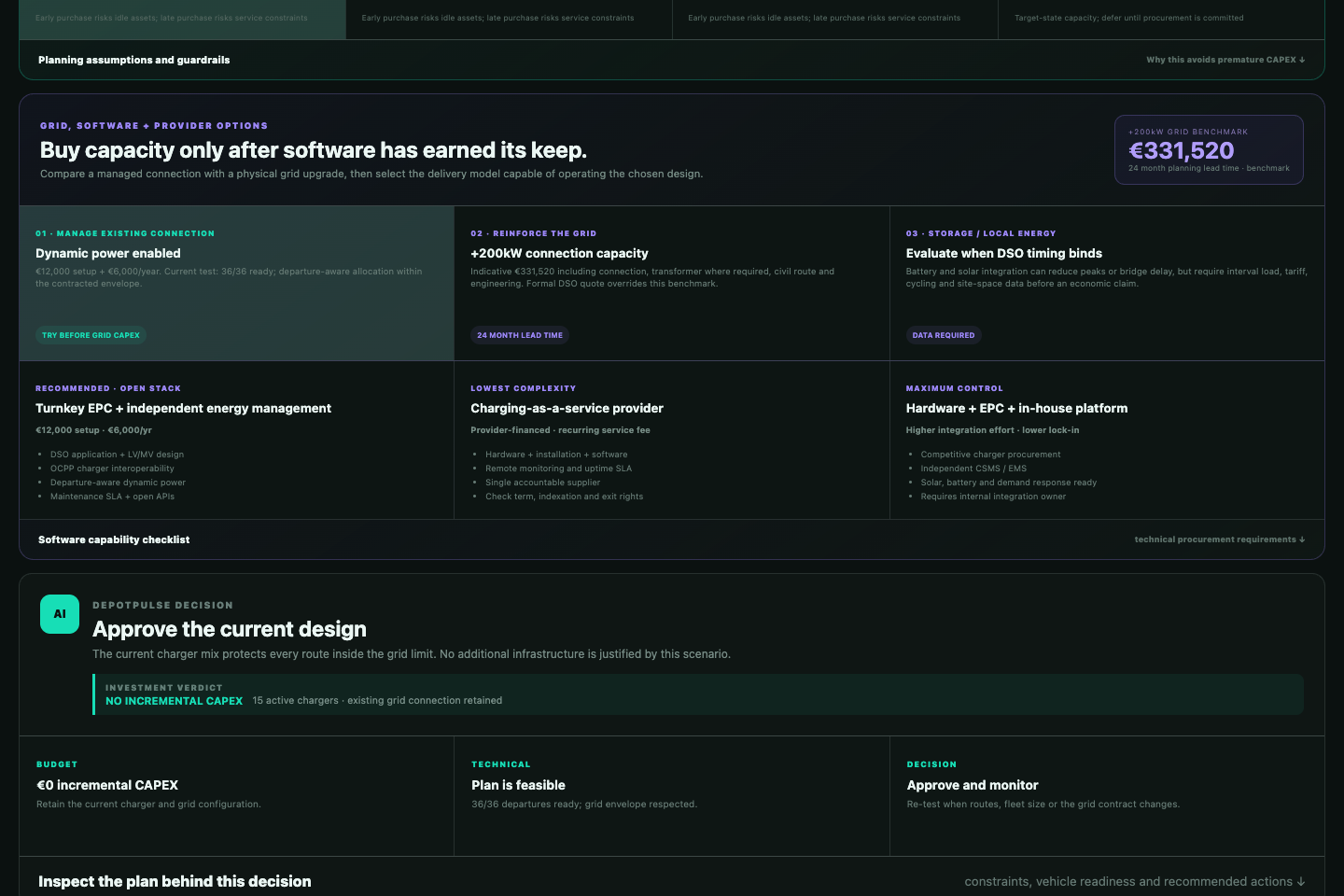
- Dynamic power management and grid-upgrade alternatives
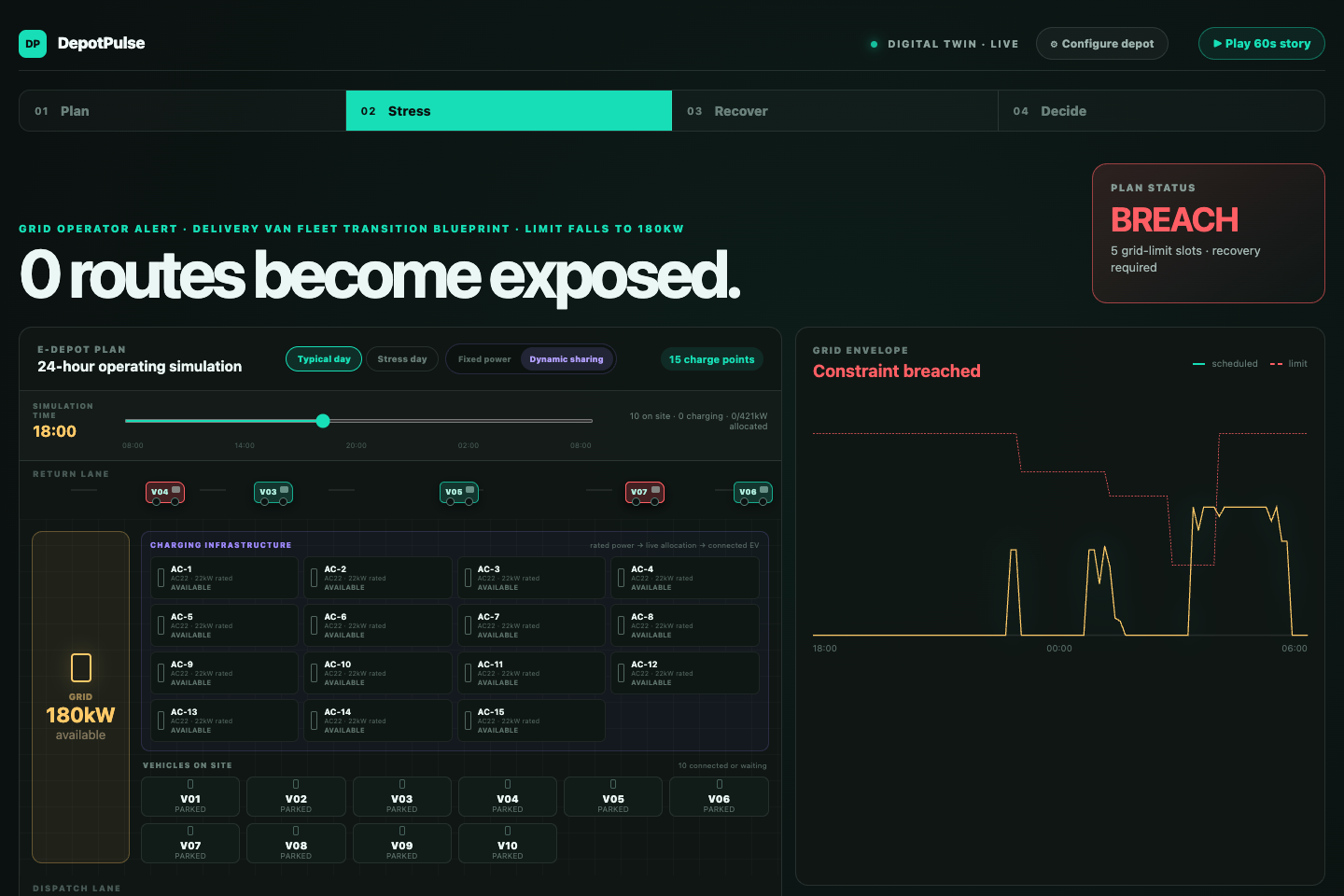
- Vehicle-level charging across 96 fifteen-minute time slots
- Departure readiness, missed routes, and peak grid demand
- AI-generated disruption and accelerated-transition scenarios
- Priced operational, software, charger, and grid decisions
- Infrastructure-provider capability comparisons
- ICE-versus-BEV TCO, cash flow, break-even, and sensitivities
- Operational CO₂ impact
DepotPulse can recommend spending nothing when an operational change solves the problem. When investment is necessary, it identifies what is required, its indicative cost, and the technical or fleet-growth trigger that justifies it.
How we built it
DepotPulse uses React, TypeScript, and Vite for the product experience, with server-side OpenAI Responses API integrations.
GPT-5.6 is used through five strict Structured Output workflows:
- Fleet brief → editable mixed-fleet blueprint
- Disruption description → bounded operational incident
- Operator concern → three typed adversarial scenarios
- Verified model results → grounded explanation
- Commercial brief → editable TCO assumptions and disclosed defaults The model is deliberately not allowed to calculate feasibility, schedules, savings, or the final TCO verdict.
Those outputs come from deterministic TypeScript logic that models vehicle availability, energy requirements, charger occupancy, grid envelopes, infrastructure costs, phased procurement, cash flow, and operational emissions.
This creates an inspectable architecture:
Messy fleet-manager brief ↓ GPT-5.6 Structured Outputs ↓ Typed, editable assumptions ↓ Deterministic depot and financial models ↓ Verified decision and grounded explanation If an AI route is unavailable, DepotPulse identifies and uses a deterministic fallback instead of presenting it as live AI.
How Codex helped
Codex was the engineering collaborator throughout Build Week. It helped:
- Convert an EV-infrastructure model into TypeScript
- Build the React product and server-side API routes
- Create and audit the scheduling and stress-testing logic
- Enforce charger-slot and vehicle-slot exclusivity
- Design strict GPT-5.6 JSON schemas and bounded prompts
- Diagnose state, server, and scenario-generation bugs
- Add mixed-fleet transition, grid economics, provider options, TCO, and CO₂
- Run production builds, API smoke tests, and live GPT-5.6 verification
- Prepare judge testing, demo, and submission documentation
We made the core product and domain decisions, including the mixed-fleet framing, phased investment logic, grid-cost treatment, separation of TCO from physical feasibility, and the requirement that infeasible plans remain visibly infeasible.
Challenges we faced
Keeping AI useful without letting it invent the answer
Natural-language input makes the tool accessible, but infrastructure decisions require accountable calculations. We solved this by limiting GPT-5.6 to interpretation, scenario generation, and grounded explanation. Deterministic code owns every operational and financial verdict.
Modelling a transition rather than a static EV fleet
Fleet electrification happens in procurement waves. DepotPulse therefore models ICE/HEV, PHEV, and BEV populations over time and links infrastructure releases to fleet-count and measured-load triggers.
Treating grid capacity as a real investment
Extra grid power is not merely another numeric input. It may require a DSO connection, transformer, switchgear, civil works, permitting, and long lead times. DepotPulse compares reinforcement with managed charging, revised charger mixes, storage, and deferred investment.
Making failure honest
Additional chargers cannot solve every constraint. A late-returning vehicle may simply lack sufficient dwell time. DepotPulse preserves that infeasibility and recommends operational alternatives instead of manufacturing a positive result.
What we learned
The strongest AI architecture was not “ask a model for the plan.” It was combining GPT-5.6’s ability to structure ambiguous human requirements with a transparent model capable of rejecting an attractive but physically impossible recommendation.
We also learned that fleet managers need two connected—but separate—proofs:
- Does electrification make financial sense?
- Can the depot physically deliver it?
DepotPulse connects both without allowing optimistic commercial assumptions to contaminate operational feasibility.
What’s next
A production version would add:
- CP-SAT or MILP optimization
- Route, telematics, tariff, and charger integrations
- Country- and DSO-specific connection benchmarks
- Supplier quotes and financing scenarios
- Multi-depot portfolio optimization
- Seasonal energy and lifecycle-emissions modelling The current prototype uses synthetic demonstration data and editable planning assumptions. Costs are not supplier quotes, and CO₂ results cover operations rather than full lifecycle emissions
Built With
- codex
- gpt-5.6
- openai
- optimization

Log in or sign up for Devpost to join the conversation.