Inspiration
Banks face severe outreach capacity and budget caps. The challenge is to identify who to call under real-world constraints and quantify the portfolio probability of achieving target deposit conversions.
What it does
This project is an end-to-end, decision-support prototype designed for banks operating under strict marketing budgets and limited outreach bandwidth.
- Rather than simply scoring leads, it connects three practical business layers: Predicts which bank customers have the highest propensity to subscribe to a term deposit using an ensemble of classical gradient boosting and a 6-qubit Variational Quantum Classifier (VQC).
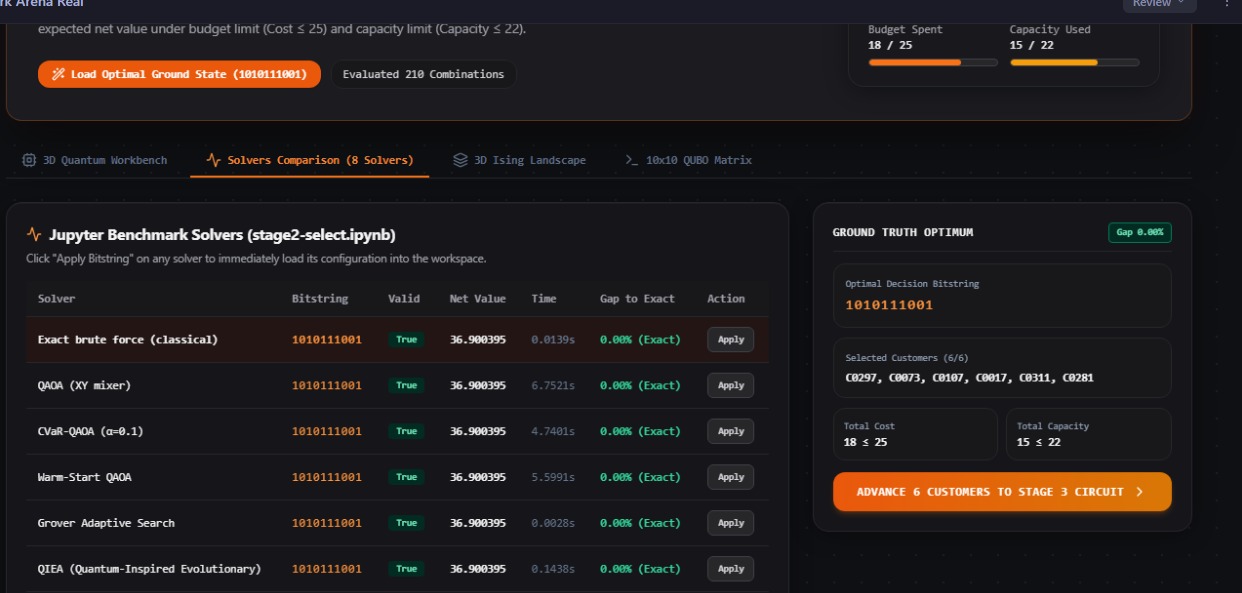
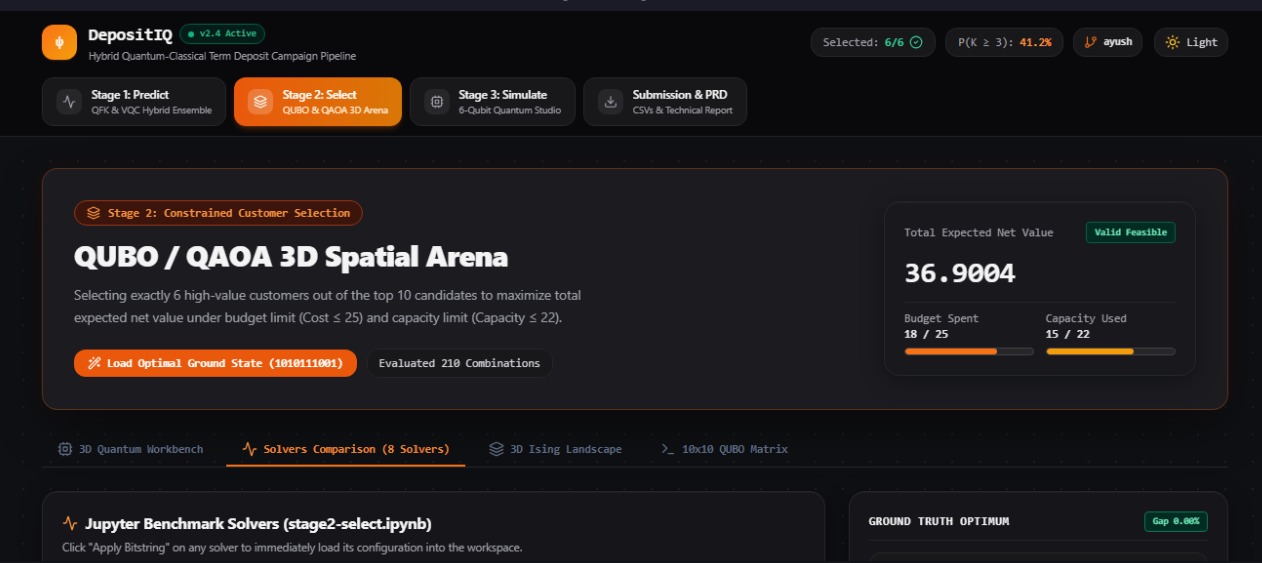
- Selects the optimal, constrained cohort of customers to contact to maximize expected deposit return while strictly adhering to outreach limits (selecting exactly 6 candidates with cost and capacity using combinatorial solvers and simulated XY-mixer QAOA.
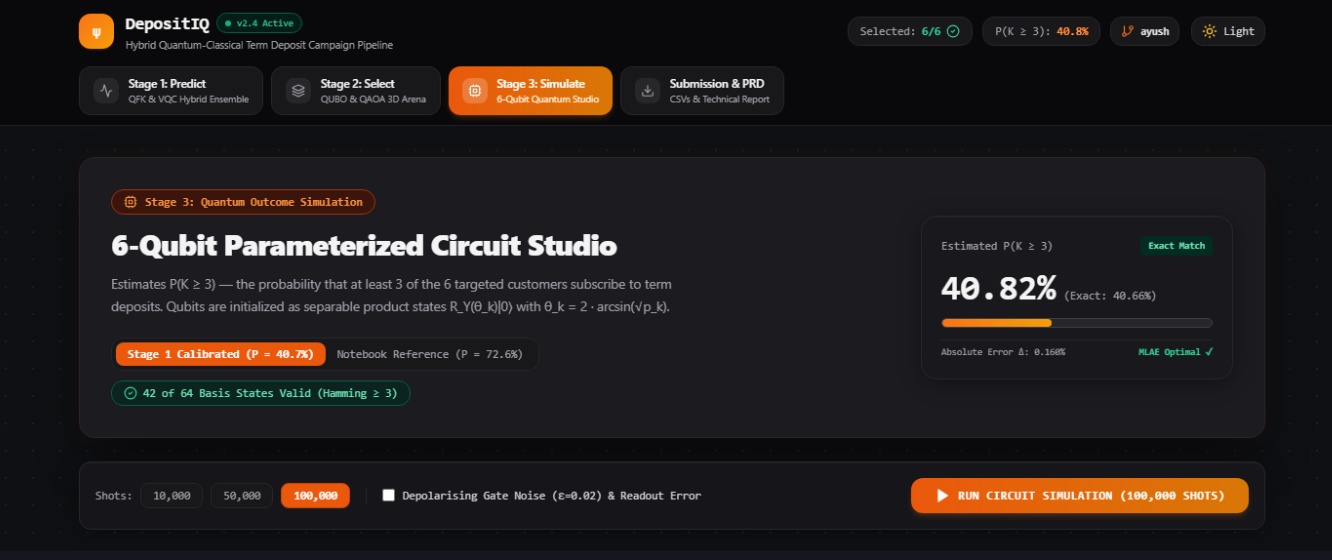
- Estimates the portfolio-level risk and conversion probability of achieving target business outcomes (specifically, the exact group chance of securing at least 3 subscriptions) using quantum circuit amplitude estimation (MLAE) cross-verified against classical dynamic programming.
How we built it
We engineered an end-to-end, three-stage hybrid decision-support pipeline integrating classical machine learning, combinatorial optimization, and quantum circuit simulations to solve a resource-constrained financial campaign problem
Stage 1 (Predict): Preprocessed 300 imbalanced bank records (11.7% base rate) and benchmarked 4 classical algorithms against 2 simulated 6-qubit quantum models (QFK and VQC) across 90 ensembles. The top pipeline—calibrated Gradient Boosting + VQC log-odds averaging (ROC-AUC 0.618, PR-AUC 0.272)—ranked the candidate pool.
Stage 2 (Select): Formulated a constrained combinatorial optimization model to pick exactly 6 customers within cost ($\le 25$) and capacity ($\le 22$) limits to maximize net portfolio value. Solved this across all 210 subsets and benchmarked QUBO annealing against Dicke-state initialized QAOA with an XY mixer.
Stage 3 (Estimate): Encoded individual customer subscription probabilities into single qubits via $R_y(\theta_i)$ rotations in a 6-qubit product state. Quantified the campaign success rate ($\ge 3$ conversions) using simulated Maximum Likelihood Amplitude Estimation (MLAE) and validated it with exact Poisson-binomial dynamic programming.
Challenges we ran into
Severe class imbalance: 300 customer records, 15 features, only 35 subscriptions (11.7% base rate). Hard operational bottlenecks: Contact cost $\le 25$, capacity $\le 22$, exact selection count $= 6$. Group risk uncertainty: Moving beyond individual probabilities to measure joint campaign success.
Accomplishments that we're proud of
End-to-End Decision Link: Connected individual predictive scoring directly to constrained combinatorial budgeting and group risk estimation instead of stopping at standalone classification metrics.
100% Valid QAOA Constraint Enforcement: Achieved a 1.000 valid-state probability using an XY mixer to strictly preserve the 6-customer selection constraint, outperforming standard penalized X-mixers (0.573) and matching the exact classical optimum (36.9004).
Effective Hybrid Ensembling: Demonstrated that blending classical tree models with simulated VQC log-odds improves ranking on highly imbalanced financial data.
Exact Analytical Risk Validation: Cross-verified quantum circuit sampling and MLAE against Poisson-binomial dynamic programming and 64-state enumeration to confirm an exact campaign success probability of 40.66%.
What's next for DepositIQ
- Data Leakage & Split Integrity Fix: Re-partition data strictly along time-based out-of-time splits to prevent inflated offline metrics.
- Propensity vs. Uplift: Implement randomized controlled trials (A/B uplift modeling) to isolate true incremental lift.
- Beyond Independent Assumptions: Expand Stage 3 from unentangled product states to parameterized entangling circuits modeling correlated default/subscription events.
Built With
- kaggle
- machine-learning
- python
- qiskit
- quantum
