-
-
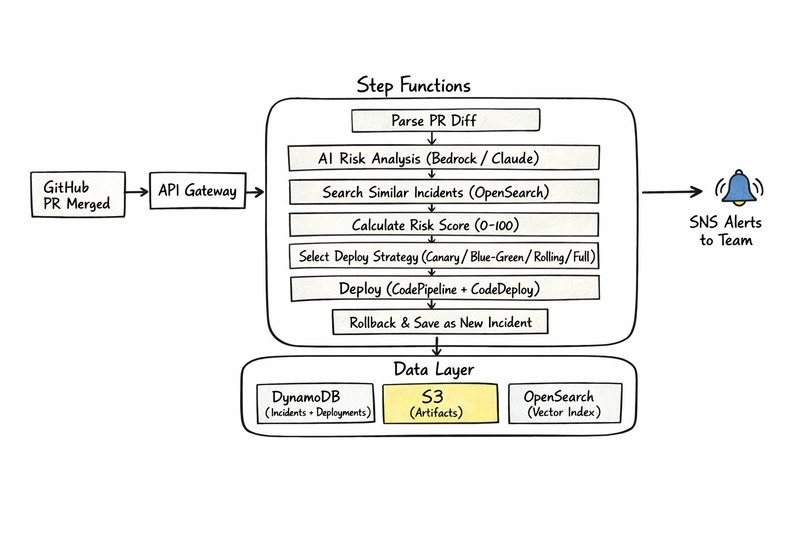
DeployGuard System Operational Flow”
-
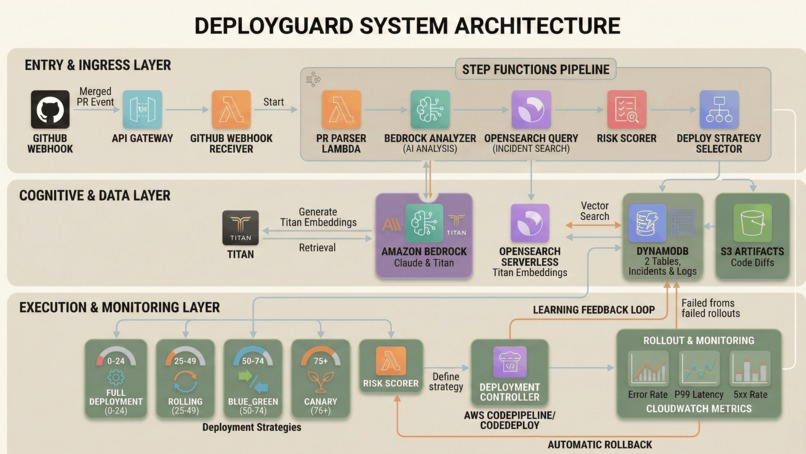
DeployGuard: AI-Driven Deployment Risk Analysis Architecture
Inspiration
Software deployments are one of the biggest sources of production outages. Even experienced engineering teams accidentally introduce breaking changes like database schema drops, API contract changes, or authentication misconfigurations. These failures often happen not because engineers are careless, but because organizations lose institutional knowledge over time. Postmortems exist, but engineers rarely review them before deploying.
I built DeployGuard to preserve this lost knowledge and turn it into an intelligent deployment safety system. By combining AI analysis with historical incident data, the system can automatically detect risky deployments and recommend the safest rollout strategy.
What it does
DeployGuard is an AI-powered deployment intelligence system that analyzes code changes before deployment and determines the safest way to release them.
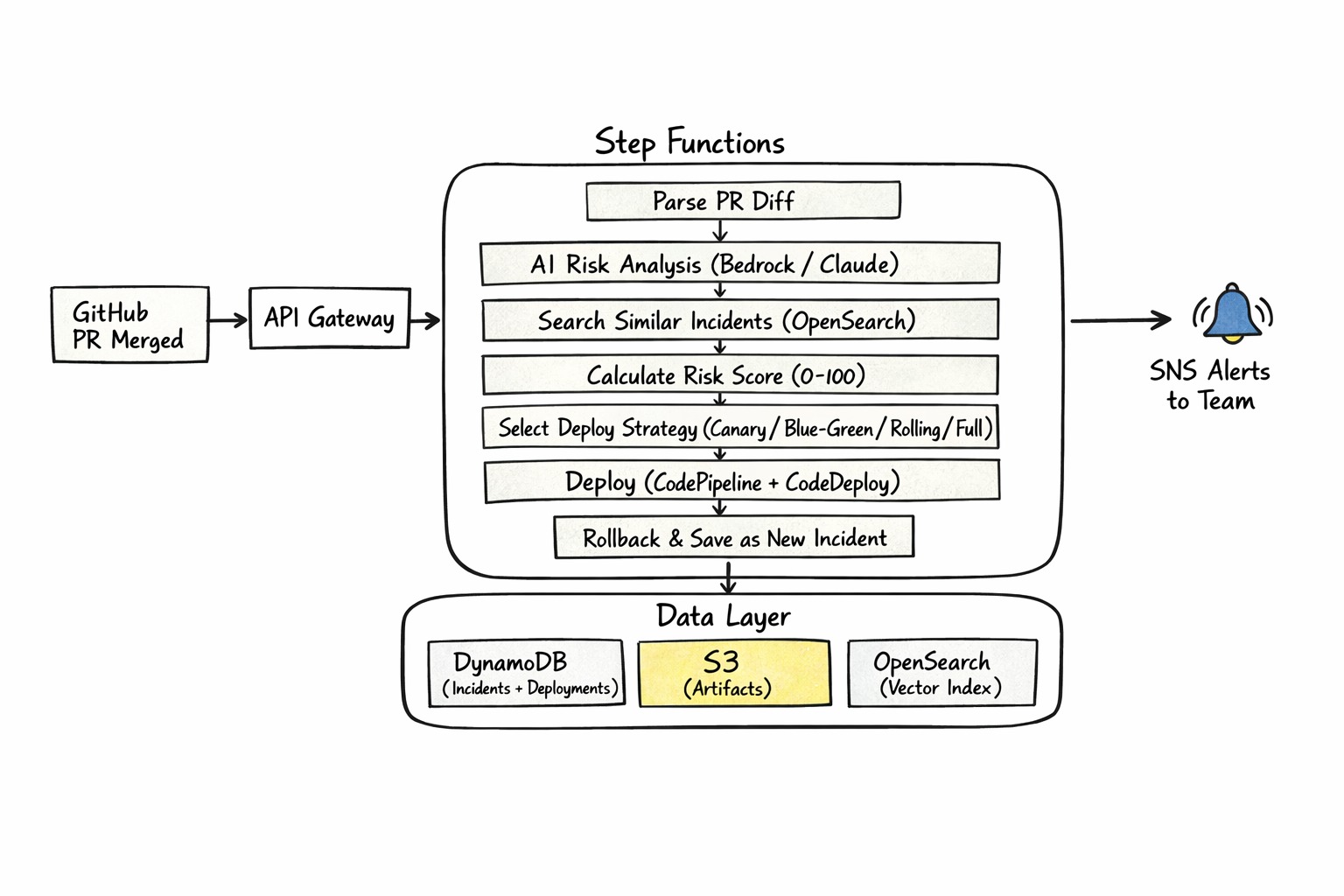
When a pull request is merged, DeployGuard automatically:
- Analyzes the code diff across key risk dimensions such as database changes, authentication updates, API modifications, and infrastructure updates
- Uses AI to understand the potential impact of the change using Amazon Nova models via Amazon Bedrock
- Searches historical incidents to identify similar failures that happened before
- Calculates a deployment risk score between 0–100
- Automatically selects the safest deployment strategy such as Canary, Blue-Green, Rolling, or Full Deployment
The entire process takes less than 30 seconds and helps teams prevent outages while reducing time spent on manual deployment reviews.
How I built it
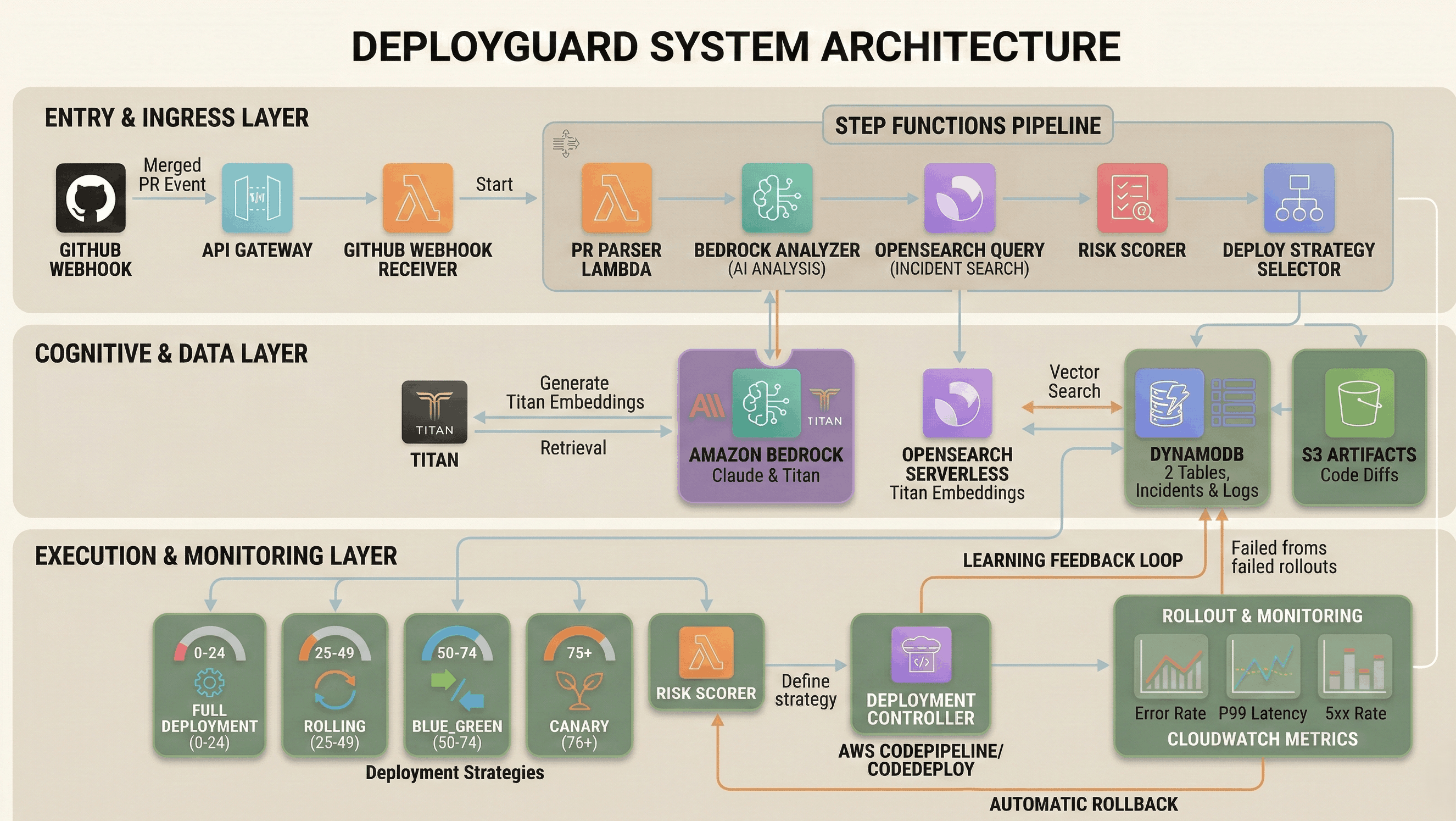
DeployGuard is built using a serverless architecture on AWS.
Key components include:
- Amazon Nova via Amazon Bedrock for AI-powered code analysis and risk reasoning
- Amazon Titan Embeddings for generating semantic embeddings of code changes
- Amazon OpenSearch Serverless for hybrid vector and keyword search to find similar historical incidents
- AWS Lambda to run event-driven analysis functions
- AWS Step Functions to orchestrate the deployment intelligence pipeline
- Amazon DynamoDB to store deployment records and incident history
- Amazon EventBridge to trigger workflows when pull requests are merged
- AWS CodeDeploy and AWS CodePipeline to execute deployment strategies
Additionally, I explored using DigitalOcean Object Storage to store deployment artifacts and analysis outputs in a simple and scalable manner. Its S3-compatible API and lightweight setup make it a viable alternative for managing artifacts outside of the core AWS pipeline.
The system analyzes code changes, computes risk scores, selects deployment strategies, monitors deployments through CloudWatch metrics, and automatically rolls back if issues occur.
Challenges I ran into
One challenge was designing accurate prompts for AI risk analysis. Early versions marked too many changes as high risk, which reduced the usefulness of the system. I refined the prompts with more specific patterns and examples so the model could better distinguish between safe and risky changes.
Another challenge was tuning vector similarity search. Finding the right similarity thresholds and ranking weights required experimentation to balance relevant incident matches with precision.
Handling large pull request diffs also required truncation strategies to stay within model token limits while still preserving meaningful context for analysis.
Accomplishments that I'm proud of
Building DeployGuard as a solo project and delivering a fully functional AI-driven deployment intelligence system is something I’m particularly proud of. The platform can automatically analyze pull request changes, evaluate deployment risks using Amazon Nova through Amazon Bedrock, and match them with historical incidents using vector similarity search.
I successfully implemented an end-to-end pipeline that:
- Automatically analyzes pull request changes
- Generates explainable deployment risk scores
- Matches code changes with similar historical incidents
- Selects the safest deployment strategy automatically
- Enables monitoring and automatic rollback during deployments
Most importantly, DeployGuard demonstrates how advanced deployment intelligence — often built internally by large technology companies — can be made accessible to any engineering team using AWS, while also being flexible enough to integrate with external storage solutions like DigitalOcean Object Storage.
What I learned
Building DeployGuard taught me how powerful AI can be when combined with real DevOps workflows. AI reasoning alone isn’t enough — it needs to integrate directly with deployment pipelines and monitoring systems.
I also learned the importance of explainability in AI-driven infrastructure tools. Engineers are more likely to trust automated systems when they clearly understand why a deployment decision was made.
Additionally, designing event-driven serverless systems helped me create a scalable architecture that reacts automatically to every code change, while also exploring interoperability with external storage services like DigitalOcean Object Storage.
What's next for DeployGuard AI-Driven Deployment Risk Intelligence
Next, I plan to expand DeployGuard by:
- Supporting multiple version control platforms beyond GitHub
- Integrating with developer IDEs to warn engineers about risky code changes before they commit
- Training models on larger incident datasets to improve risk prediction accuracy
- Adding dashboards to visualize deployment risk trends across repositories
- Integrating with incident response tools like Slack and PagerDuty
- Exploring deeper integration with external storage providers like DigitalOcean Object Storage for multi-cloud flexibility
My long-term vision is to make DeployGuard a fully autonomous deployment safety platform that continuously learns from deployments and prevents outages before they reach production.
Built With
- amazon-api-gateway
- amazon-bedrock
- amazon-cloudwatch
- amazon-dynamodb
- amazon-eventbridge
- amazon-nova
- amazon-opensearch-serverless
- amazon-titan-embeddings
- amazon-web-services
- amazon-web-services-(aws)
- aws-codedeploy
- aws-codepipeline
- aws-iam
- aws-lambda
- aws-secrets-manager
- aws-step-functions
- aws-x-ray
- digitalocean-gradient-ai-(exploratory)
- digitalocean-object-storage-(s3-compatible)
- event-driven
- github-webhooks
- json
- python-3.12
- serverless-architecture
- yaml

Log in or sign up for Devpost to join the conversation.