Inspiration
Planning for a travel is no easy task: choosing a destination and obtaining a plane ticket isn't where it all ends. The journey on the plane can sometimes be tedious and uncomfortable, and upon arrival, you may feel lost and disappointed to discover that the restaurant you wished to go to decided to close early for the day. So what if we had a product that allows you to enjoy a pleasant ride and arrange activities for your arrival day accordingly? That's where we come in!
What it does
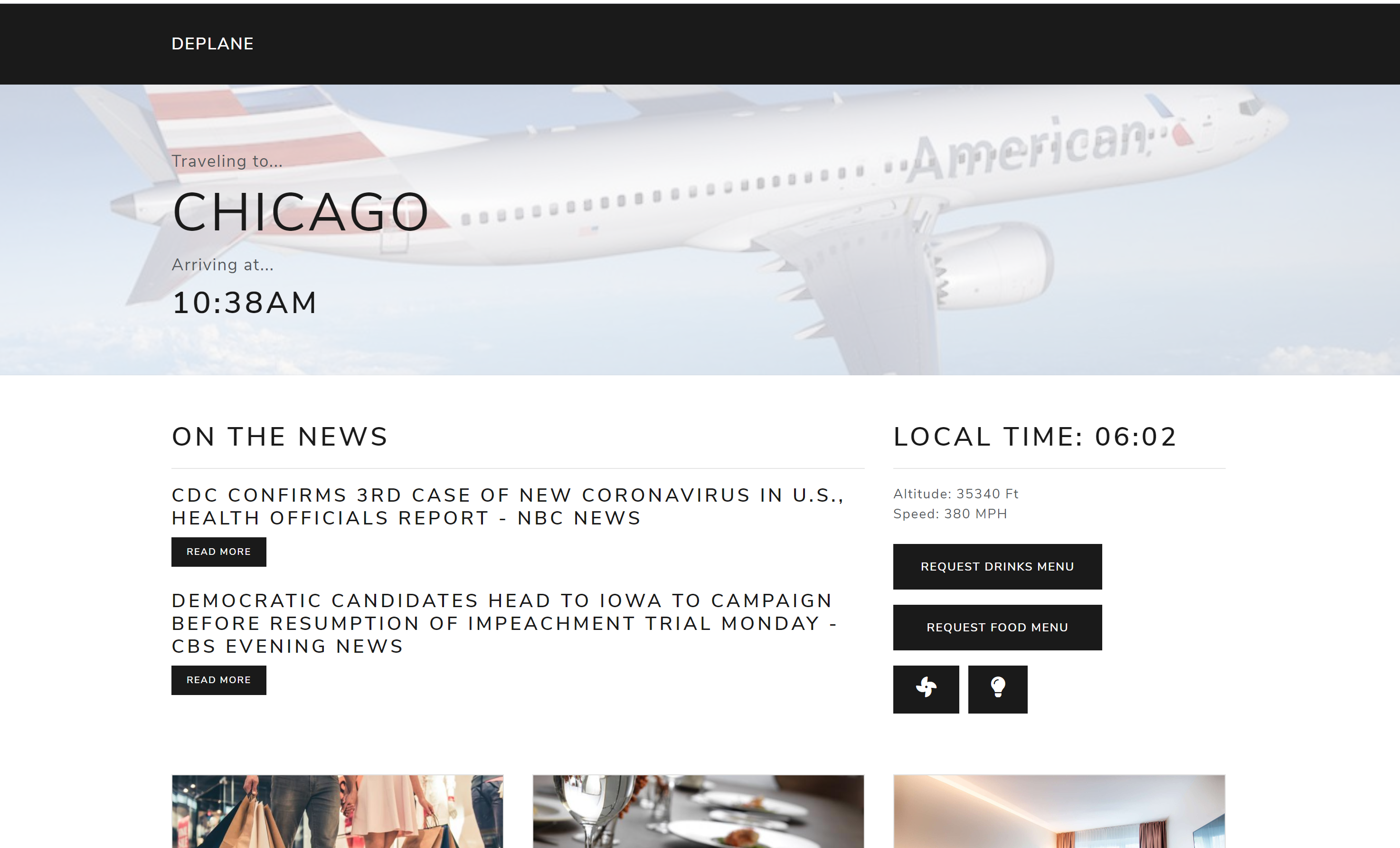
DePlane allows the user to both obtain information about their landing destination and allows them to control features found during flight. The dashboard will allow the user to view shopping, lodging, transit, restaurants, and attractions located at their arrival city. It also contains a “On the News,” section that will provide the most recent local news articles relating to the destination. DePlane also allows the passenger to control the overhead passenger service unit--which control the fan and light settings--alongside giving them options to request flight menus.
How we built it
We used Node.js to create a web server for our project. For the front-end, we implemented Bootstrap, which allows our website to by dynamic and mobile-friendly. For the collection of data about the plane and trip, we implemented American Airlines’ FlightEngine source from Github. For the acquisition of data about places near the airport, we used Google’s Places API. To get the distance from the airport to them, we also implemented Google’s Distance Matrix API. Using them, we created our own back-end service that is accessible throughout our app. Lastly, we used the Google Maps JavaScript API to display the data to the users and filter results as desired.
Challenges we ran into
When we were attempting to implement the use of Google’s Places API, we ran into issues with how Google’s APIs accepted Latitude and Longitude for locations. American Airlines’ Flight Engine API gave us the Latitude and Longitude for it Airports without a way of specifying North or South for Latitude, or East or West for longitude. Because the Places API needed the coordinates to be specified, we manually overrode the data when we parsed it into our own APIs.
Accomplishments that we're proud of
We are proud to have created our own back-end service comprising of multiple API’s, as it made accessing our data much easier and faster. Also, we are proud to have implemented the caching of different results from the API’s to limit the requests made to the services.
What we learned
We learned how to implement Google’s API’s, as we were given credits to be able to implement them. We also learned how to access API’s resourcefully to not go over any limits presented with the services.
What's next for DePlane
In the future we believe the addition of more API’s, such as Uber and Lyft’s pick up services would be beneficial to the UX. Ideally they would be able to find a place they want to visit using our Google Map API implementation, and then request a ride to the location seamlessly. We would like to have DePlane only display the businesses that would be open during the time that the passenger arrives at the destination. The more media and news outlets would be modified to keep providing new news articles to keep the passenger informed and entertained.
Built With
- bootstrap-(html5-+-css3)
- javascript
- jquery
- ngrok
- node.js
- socket.io
- web

Log in or sign up for Devpost to join the conversation.