-
-
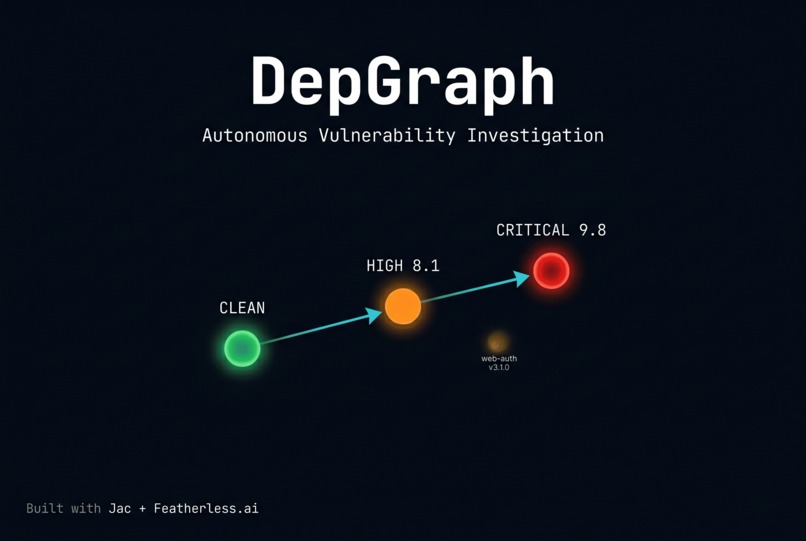
Depgraph thumbnail
-
Problem
-
Depgraph Summary
-
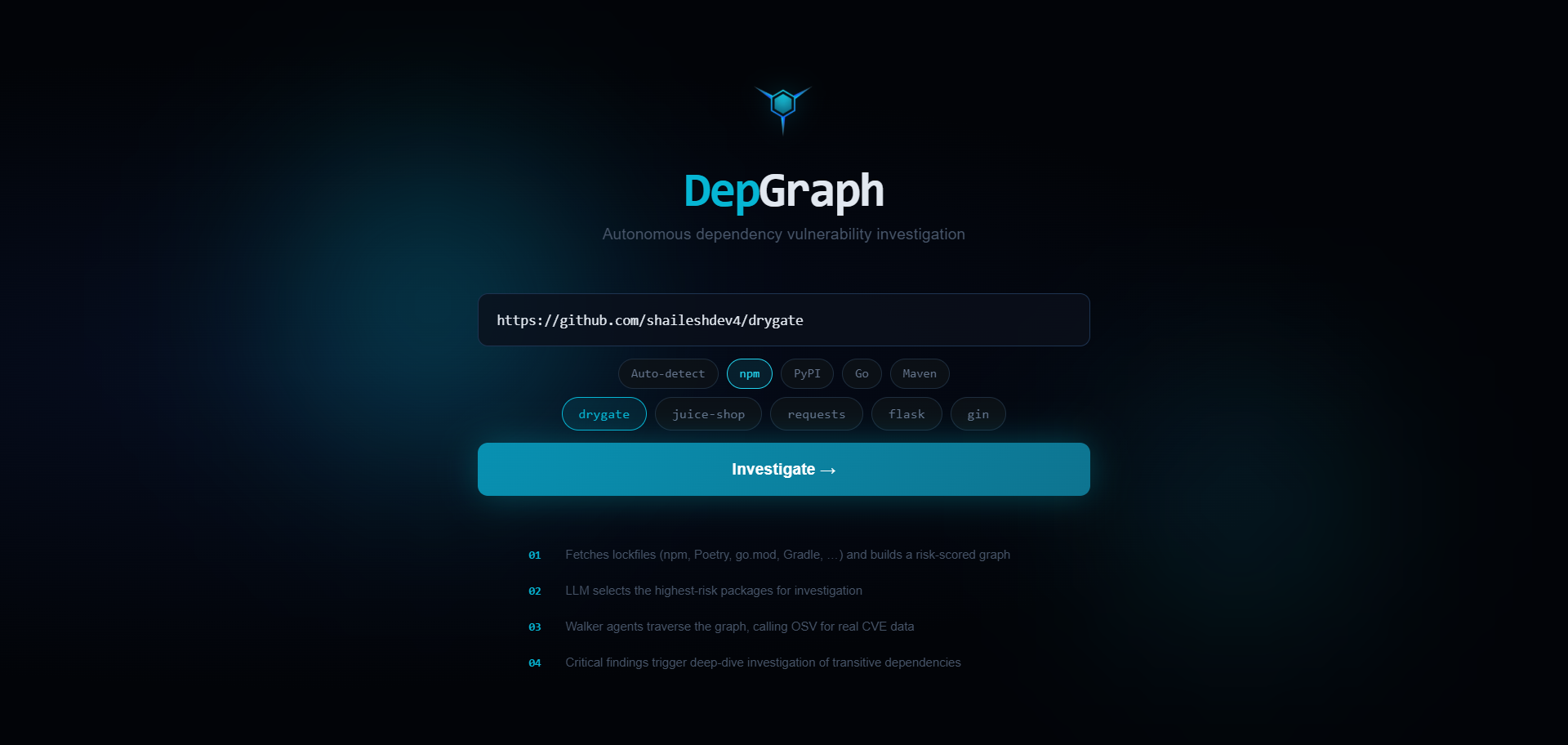
Landing Page
-
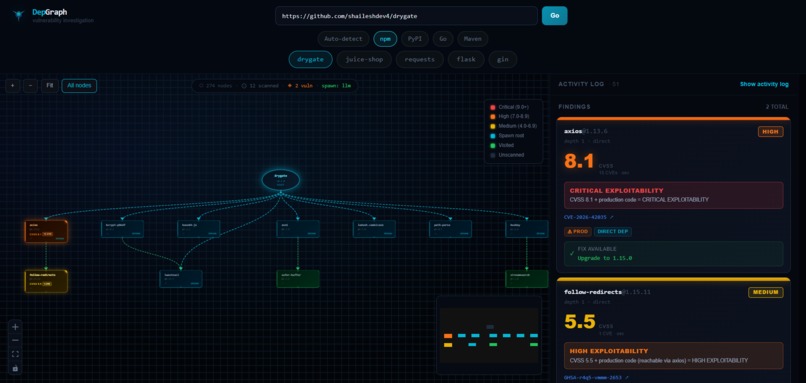
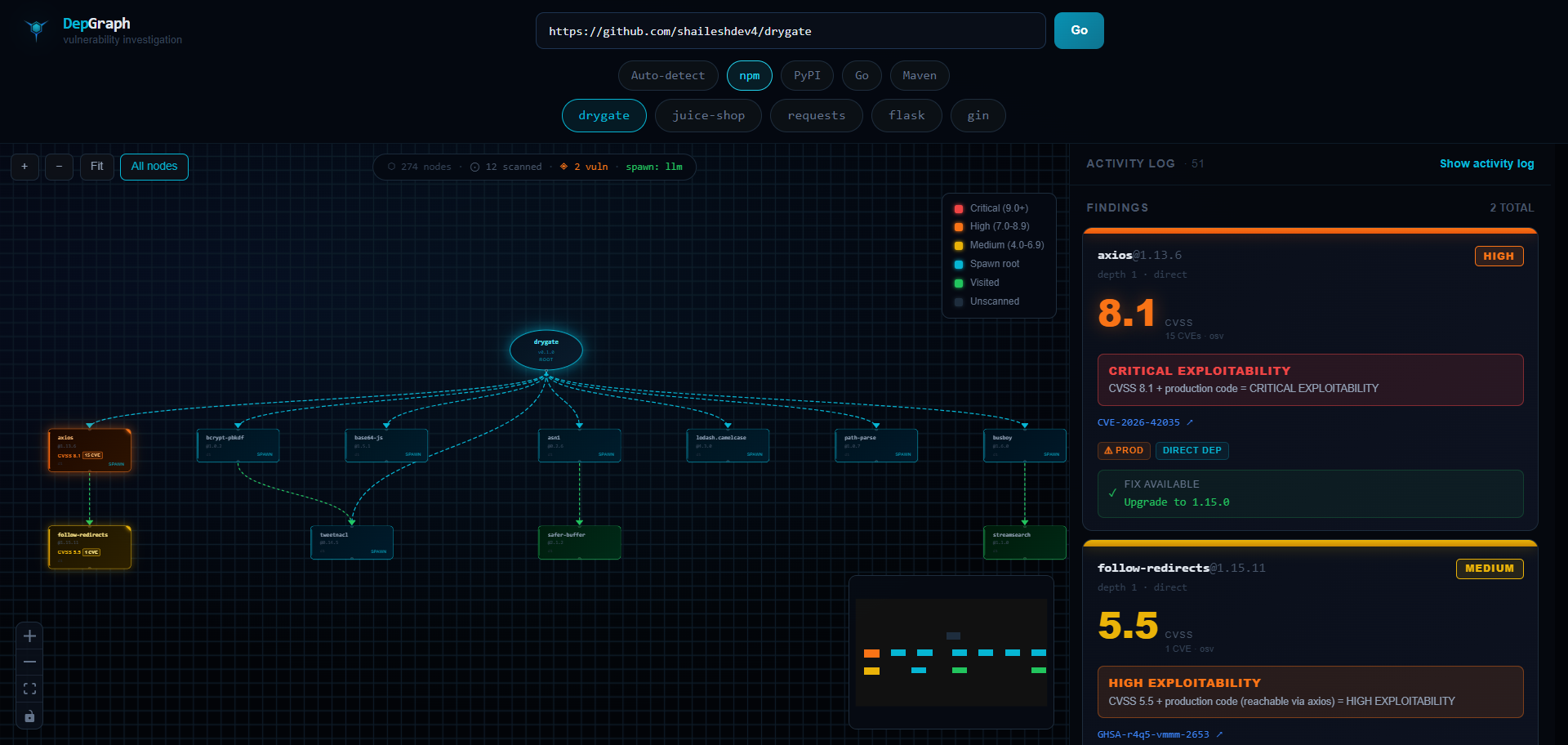
DepGraph Analysis
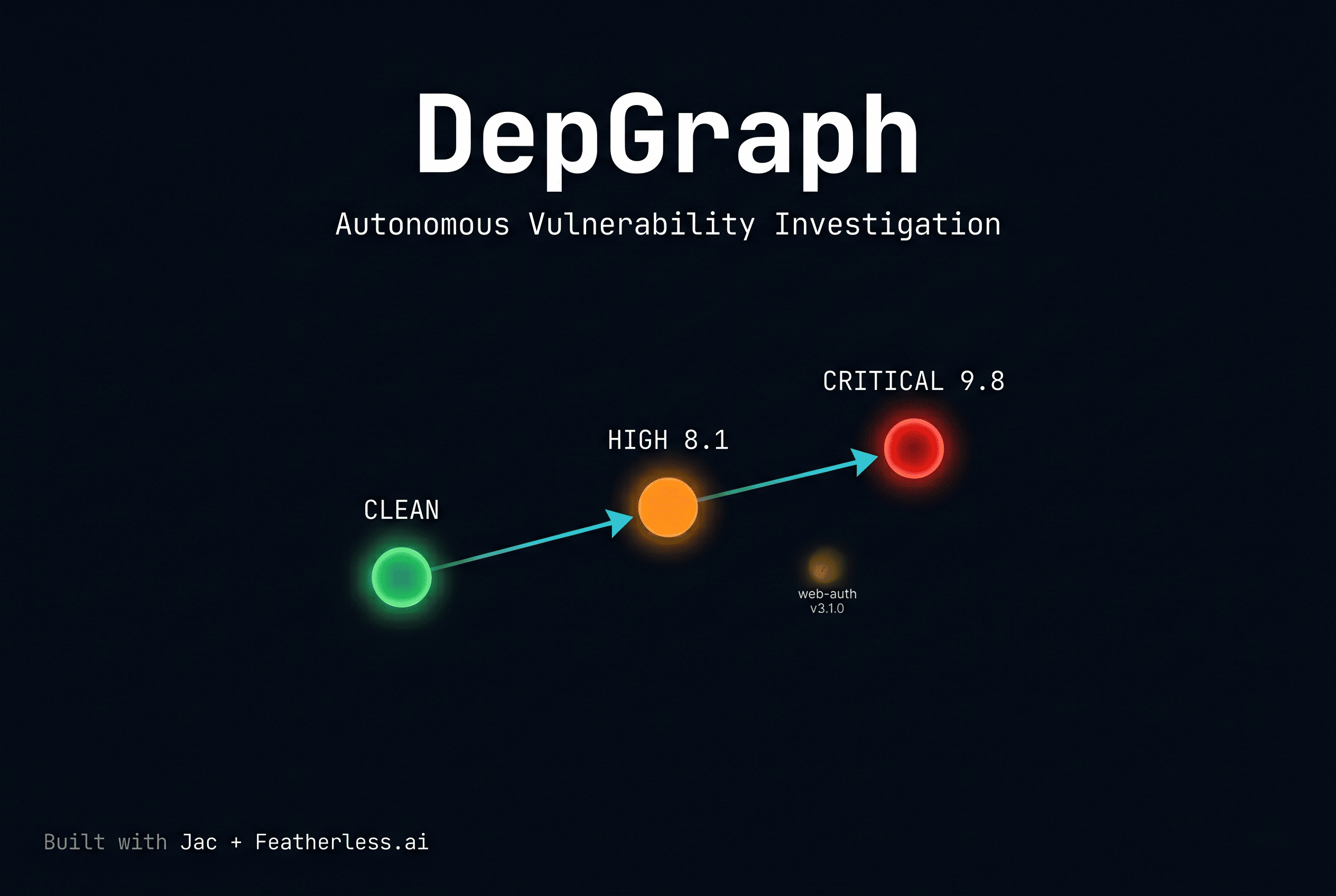
DepGraph - JacHacks Spring 2026
- Try it live: depgraph.vercel.app
- API: depgraph-production.up.railway.app
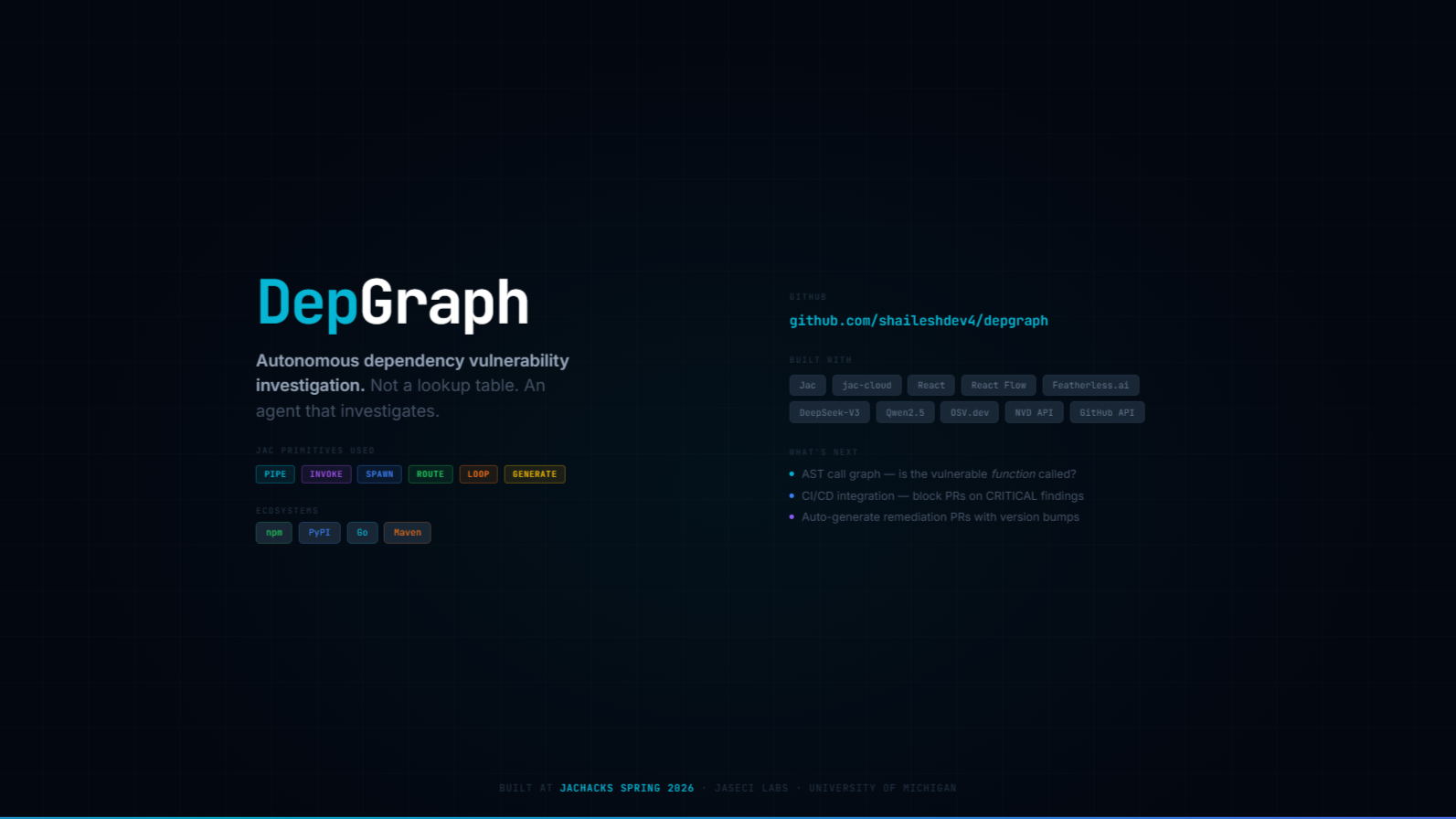
- Repo: github.com/shaileshdev4/depgraph
Inspiration
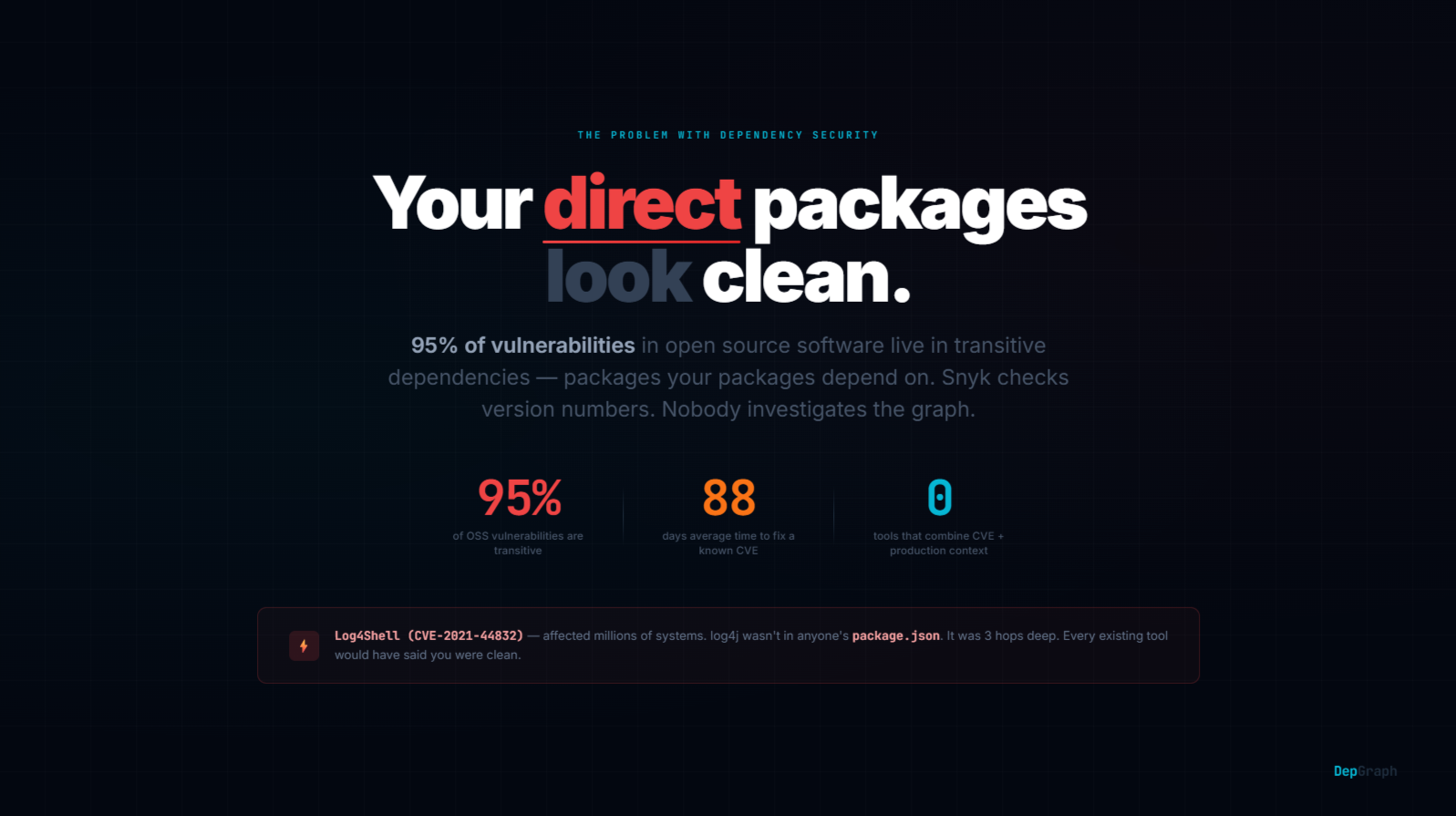
You ran your security scan this morning. It came back clean.
You're not clean.
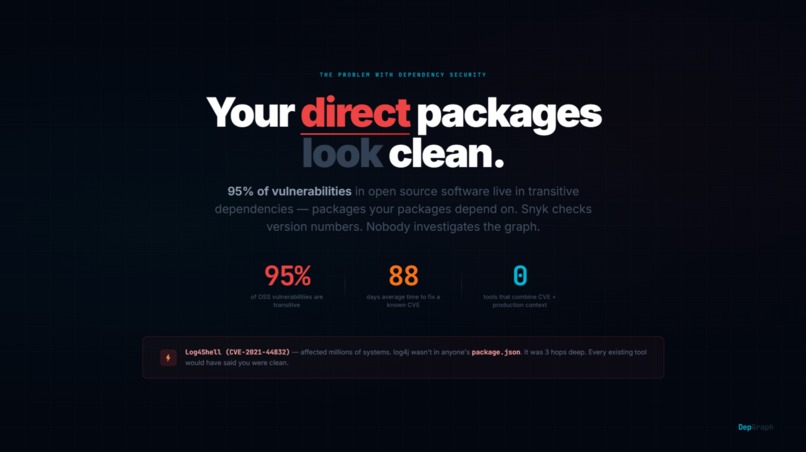
95% of vulnerabilities in open source software live in transitive dependencies - packages your packages depend on, three, four, five hops deep. Snyk checks level one. Your code doesn't run on level one.
Log4Shell wasn't in anyone's package.json. Event-stream wasn't either. Every security tool said: clean. Millions of systems went down.
We wanted to build something that actually investigates.
The industry's answer is a lookup table. We built an investigation agent.
What it does
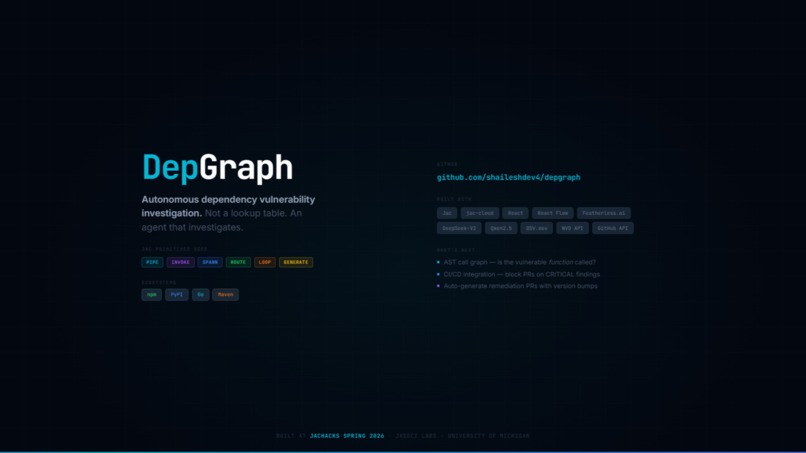
DepGraph is an autonomous dependency vulnerability investigation agent built natively in Jac.
Give it a GitHub repository URL. It:
- Fetches and parses your lockfile - npm, PyPI, Go modules, or Maven
- Builds a risk-scored dependency graph - ~200 nodes filtered from thousands using security-aware heuristics
- Deploys LLM-driven walker agents - the LLM selects which packages to investigate using Jac's Route primitive, with zero hardcoded traversal logic
- Traces multi-hop transitive chains - follows vulnerability paths through the dependency tree (e.g., axios → follow-redirects → CVE)
- Classifies production exposure - checks whether vulnerable packages are imported in production code, test code, or build tooling via GitHub code search
- Generates an exploitability verdict - CVSS 8.1 + production auth code = CRITICAL EXPLOITABILITY. Same CVE in a test file = LOW risk.
- Produces validated remediation plans - specific version upgrades, conflict-checked via the Loop primitive
The result: not just "this CVE exists" but "this CVE is in your production auth code, CVSS 9.8, upgrade to version X - validated, no breaking changes."
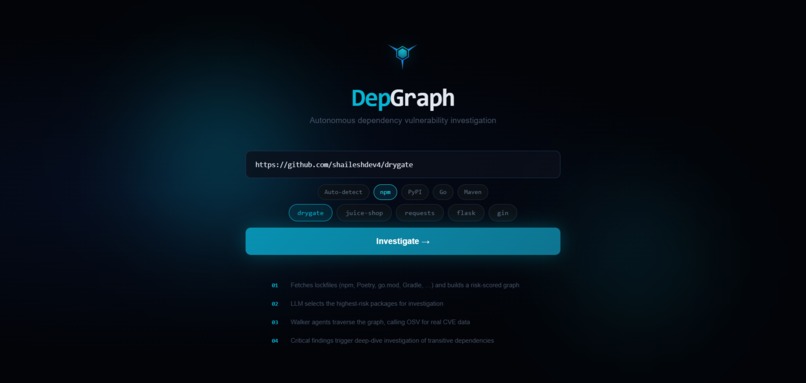
Demo: Paste https://github.com/shaileshdev4/drygate into the live app and watch the graph + activity log.
How we built it
DepGraph is built entirely in Jac, Jaseci's AI-native programming language. The entire backend - graph model, walker agents, LLM routing, API server - is Jac. The frontend is React + Vite consuming the Jac API.
Jac architecture
The dependency graph is modeled natively in Jac:
Packagenodes connected byDependsOnedgesCVEnodes attached to vulnerable packagesUsageContextnodes storing production/test classificationRemediationPlannodes with validated upgrade paths
Six of Jac's seven LLM primitives are used - genuinely, not decoratively:
| Primitive | Where | Why it's essential |
|---|---|---|
| Pipe | Lockfile manifest → Package nodes | Sequential ingestion pipeline |
| Invoke | OSV API + GitHub search at each node | Real CVE data fetched mid-traversal |
| Spawn | 8 parallel SubtreeWalkers | LLM selects investigation roots |
| Route | Next dependency hop selection | LLM decides traversal path - zero if/else |
| Loop | Remediation validation | Iterate until conflict-free upgrade plan |
| Generate | Executive summary | Final report generation |
Model routing via Featherless.ai
Three different models for three different tasks:
- Qwen2.5-7B-Instruct - spawn root selection (reliable JSON output on large lists)
- DeepSeek-V3-0324 - routing decisions + executive summary (best reasoning)
- Qwen2.5-Coder-32B-Instruct - usage context classification (code understanding)
The Route primitive
The core innovation: visit [-->] by llm(incl_info={...}) - the LLM selects which neighboring package node to traverse to next based on accumulated risk signals (CVSS, CVE count, critical findings, usage surface). No conditional logic. The language architecture is the agent architecture.
Exploitability verdict
After CVE discovery and production classification:
exploitability = CRITICAL  if CVSS >= 7 and surface == "production"
               = HIGH      if CVSS >= 4 and surface == "production"
               = LOW       if surface == "test"
               = MEDIUM    otherwise
This single combination - something no existing consumer security tool produces - is DepGraph's core differentiator.
Deployed for the hackathon
We ship a split production stack so judges and users can try it without cloning:
| Layer | Host | URL |
|---|---|---|
| UI | Vercel | https://depgraph.vercel.app/ |
| Jac API | Railway | https://depgraph-production.up.railway.app |
The Vercel build sets VITE_API_URL to the Railway API. The backend runs jac start -p $PORT --no_client with async investigations self-calling the same container via PORT (Jac on 8080 inside Railway). CORS is enabled so the browser can poll /walker/investigation_status across origins.
Challenges we ran into
1. The Route primitive's output format
Jac's visit by llm() expects a list[int] of neighbor indexes. DeepSeek-V3 consistently returned full index ranges ([0,1,2..13]) or markdown-wrapped JSON. We solved this by moving to an explicit def choose_neighbor_indexes() -> list[int] by llm() with a strict single-index docstring prompt, CVSS-aware fallback, and Qwen2.5-7B for spawn selection where JSON reliability matters most.
2. Large lockfiles (2MB+)
create-react-app has 2,120 packages in its lockfile. Building 2,120 Jac nodes caused memory issues and walker timeouts. We implemented risk-scored filtering - scoring every package by depth, name heuristics, version age, and ecosystem attack surface - then capping at 200 nodes. This is actually how production SCA tools work. We turned a technical constraint into a feature.
3. OSV fixed_version parsing
OSV returns patched versions inside affected[].ranges[].events[].fixed - a 3-level nested structure. Our initial implementation set fixed_version: "" for every CVE, silently breaking the entire remediation pipeline. Once found and fixed, the Loop primitive immediately started producing validated upgrade plans.
4. GitHub API rate limits for usage context
Fetching import context for all 69 packages in a repo hit GitHub's 30 requests/minute search limit. Solution: only fetch context for spawn targets + CVE-positive packages - the ~10 packages that actually matter for the investigation.
Accomplishments that we're proud of
The exploitability verdict is real and novel. We verified it against multiple repositories. jsonwebtoken imported in production auth routes = CRITICAL. The same package imported only in test files = LOW. No existing free tool makes this distinction.
The Route primitive genuinely works. The activity log shows the LLM routing from
axios → follow-redirectsbecause axios had 15 CVEs and CVSS 8.1, not because we wroteif cvss > 7: investigate_follow_redirects(). That's the difference between an agent and a script.Multi-hop transitive chains are visible.
drygate → axios → follow-redirects- three hops, the vulnerability path is visually traceable in the graph and in the activity log.Four ecosystems. npm, PyPI, Go modules, Maven - same agent, same graph model, same exploitability analysis.
Shipped and demoable. depgraph.vercel.app is live for JacHacks - not just localhost.
What we learned
Jac's Object-Spatial Programming model is the right abstraction for security investigation. A dependency graph is literally a spatial data structure, and a security agent is literally computation that needs to move through it. The match isn't cosmetic - the Route primitive letting an LLM decide graph traversal paths without if/else is genuinely hard to do this cleanly in Python, LangGraph, or any existing framework.
The hardest part of building an agentic system isn't the LLM calls - it's the data model. Getting the Jac graph nodes right (Package → CVE → UsageContext → RemediationPlan as connected nodes rather than flat dicts) made every walker simpler to write and every piece of information naturally available at the right traversal step.
CVSS alone is a meaningless number without deployment context. The same CVE means completely different things in production auth code vs a test helper. That insight - obvious in retrospect - is absent from most existing security tools. DepGraph encodes it in every verdict.
What's next for DepGraph
- Call graph analysis - the remaining gap. Currently we know a package is in production code. The next step is tracing whether the specific vulnerable function is actually called (AST analysis of repo source).
- CI/CD integration - run DepGraph as a GitHub Action on every PR; block merges when CRITICAL EXPLOITABILITY findings are introduced.
- Remediation PR generation - not just a plan, an actual pull request with the version bump.
- Expanded ecosystem support - Rust (Cargo), Ruby (Bundler), PHP (Composer).
- Persistent investigation history - compare security posture across commits over time (today sessions are in-memory on the API host).


Log in or sign up for Devpost to join the conversation.