Inspiration
Release and change reviews rely on the Jira dependency graph visible when a reviewer checked it. A day later, a prerequisite may be reopened, a new blocking link may be added, two issues may form a dependency cycle, or a linked security ticket may be hidden behind permissions—yet a single issue status badge does not show what drifted since the review.
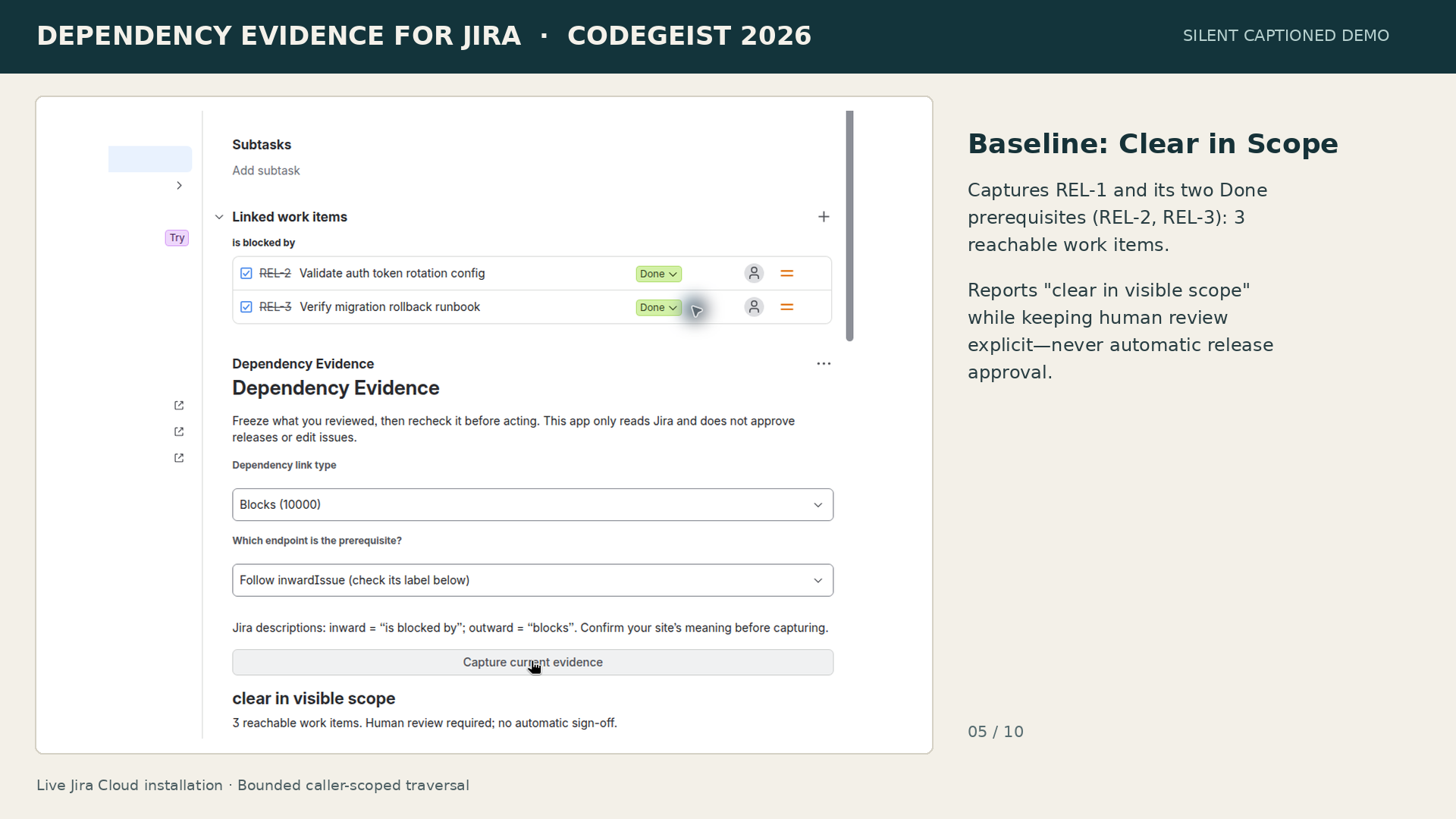
Dependency Evidence for Jira freezes the visible dependency context behind a review into a scope-bound snapshot, then rechecks current Jira state against that baseline before a team acts.
What it does
- Explicit prerequisite scope: Inside a native Forge
jira:issuePanel, the reviewer selects an actual Jira issue-link type (such asBlocks) and confirms whetherinwardIssueoroutwardIssueis the prerequisite using the site's own link labels (is blocked byvsblocks). Related or duplicate links are never silently guessed as blockers. - Bounded caller-scoped capture: Collects reachable prerequisites via
api.asUser().requestJira(read:jira-workonly) in bounded pages (up to 60 issues, 6 levels, 12 pages), producing a JSON record bound tosite_id,root_key,link_type_ids,direction, and a SHA-256 edit-detection digest. - Field-level drift recheck: Comparing current Jira evidence against a saved baseline reports changed fields (
status,summary,updated,dependencies), newly reachable blockers, strongly connected dependency cycles, and scope mismatches. - Conservative unknown-state handling:
403forbidden,404missing/hidden,429rate-limited, or pagination-stalled items stay explicitunknownrecords—they never becomedoneor authorize a release. No snapshots are stored on a server.
How we built it
- Atlassian Forge (
nodejs24.x, Runs on Atlassian): Nativejira:issuePanelmodule built with@forge/react(UI Kit 2),@forge/bridge,@forge/resolver, and@forge/api(api.asUser().requestJira+route). Deployed toproductionand verified live on Jira Cloud (REL-1..REL-4). - Deterministic graph & diff engine: Independently implemented JavaScript traversal, Tarjan-style cycle grouping, baseline compatibility checks, and escaped self-contained offline HTML reports (
src/cli.js), backed by 19 behavior tests, TypeScript UI Kit checks, and esbuild bundles (npm run check+forge lint).
Challenges we ran into
- Permission & visibility boundaries: Jira does not distinguish a deleted key from an issue hidden by permissions (
404), and multi-page JQL searches are not atomic. Designing the data contract so missing, forbidden, or truncated items remainunknownrather than disappearing prevented false "all clear" verdicts. - Site-specific link semantics: Different Jira sites orient
inwardIssueandoutwardIssuedifferently across custom link types, so the UI surfaces live/rest/api/3/issueLinkTypedescriptions before capture.
Accomplishments & What we learned
Separating frozen review evidence from release sign-off keeps human accountability clear: a Jira done status category is a workflow field, not an organization-wide proof of delivery, and making post-review drift inspectable turns dependency checks into repeatable engineering hygiene.
Disclosures
- AI assistance: Codex assisted with architecture, implementation, tests, and documentation. Runtime behavior is 100% deterministic—it makes zero LLM or Rovo calls.
- Open source & licensing: Original code is MIT (
https://github.com/misakamikotoghr-5205/dependency-evidence-forge). Official@forge/*packages remain governed by Atlassian Developer Terms (seeTHIRD_PARTY_NOTICES.mdanddocs/landscape.md).
Built With
- atlassian-forge
- esbuild
- javascript
- jira
- node.js
- react
- typescript
- ui-kit
