💡 Inspiration
Every software engineer, DevOps architect, and machine learning researcher has experienced the agonizing friction of "Dependency Hell." You clone a cutting-edge repository, execute pip install -r requirements.txt, and are immediately greeted by an unresolvable cascade of red terminal text: conflicting transitive constraints, missing native C-headers, broken wheel builds, port socket collisions, or silent Python 3.12+ ABI incompatibilities.
The typical developer response is hours of frustrating trial-and-error: scouring outdated StackOverflow threads, blindly running pip install --force-reinstall --no-cache-dir, or wiping virtual environments from scratch—often corrupting global system packages in the process.
Yet, dependency resolution is fundamentally a mathematical constraint satisfaction problem. I asked myself:
Why are developers relying on generic search engines and guesswork when environment conflicts can be parsed deterministically with set theory and augmented with predictive AI?
That question inspired DependenceDoc—a self-healing DevOps workstation designed to turn minutes of chaotic debugging into seconds of automated recovery.
🚀 What It Does
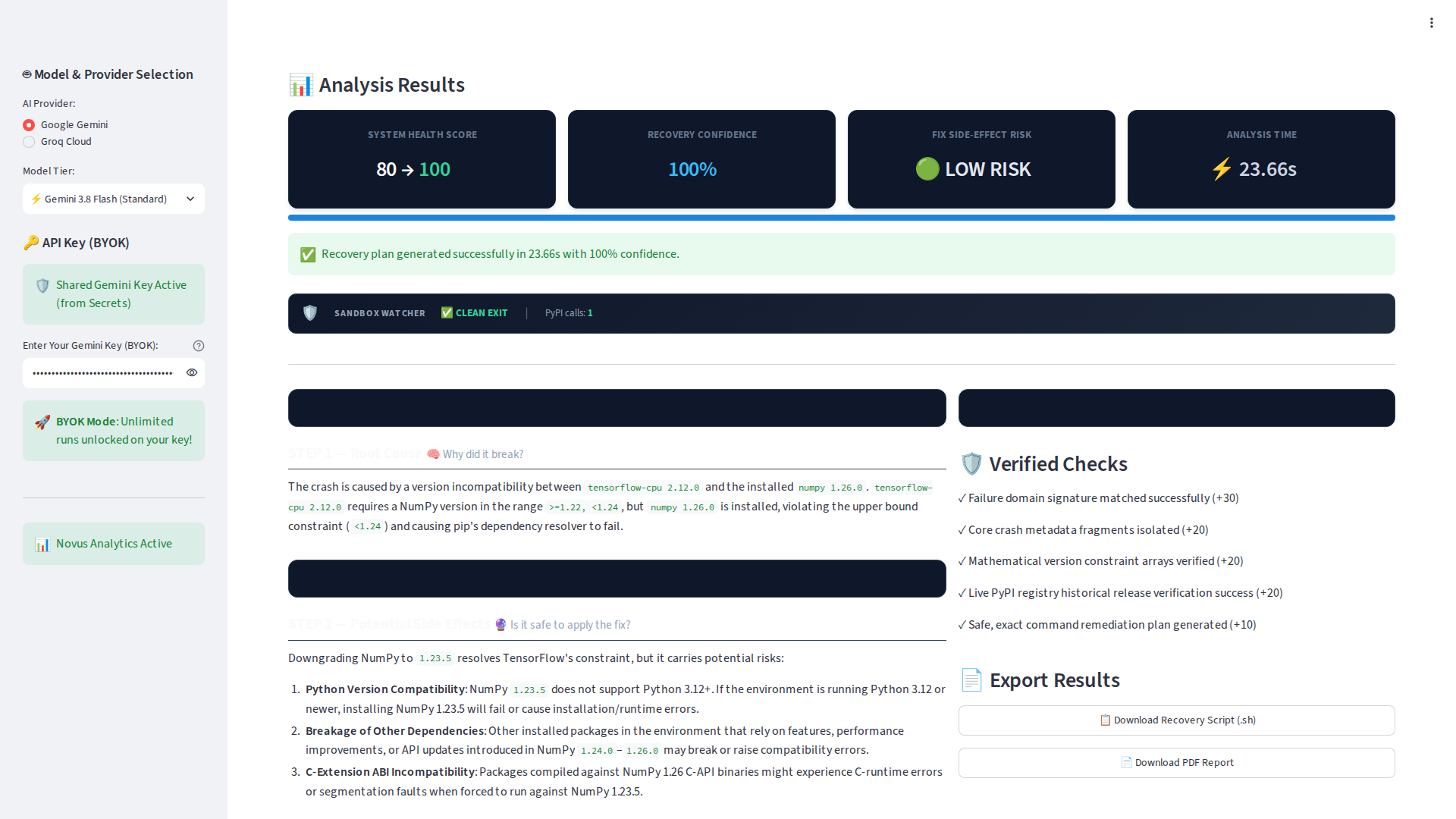
DependenceDoc is an intelligent, multi-domain environment recovery framework available both as an interactive web workstation and a high-speed CLI tool:
🚦 Multi-Domain Sentinel Signal Matrix: Automatically classifies chaotic terminal dumps into four operational fault sectors:
- 🖥️ System C-Library: Missing GCC toolchains, OpenSSL headers, and wheel compilation failures.
- 🌐 Environment Path: Module import mismatches (e.g.,
cv2→opencv-python), missing.envtokens, and scope leaks. - ⚙️ Runtime Infrastructure: Port socket collisions (
lsof/kill) and database connection refusals. - 📦 Package Dependency: Complex version bounds, conflicting requirements, and unresolvable deadlocks.
🕵️ PEP 440 Mathematical Constraint Solver: Parses version specifiers into formal intervals and determines the intersection of permissible version sets:
V_valid = ⋂(i=1 to n) S_i ⊆ U_PyPI
If V_valid = ∅, the engine isolates the exact deadlock boundary, queries the live PyPI registry index, and pinpoints the newest stable release that satisfies all parent package requirements without breaking downstream dependencies.
🤖 Dual AI Insight Air-Lock & Strict BYOK Architecture:
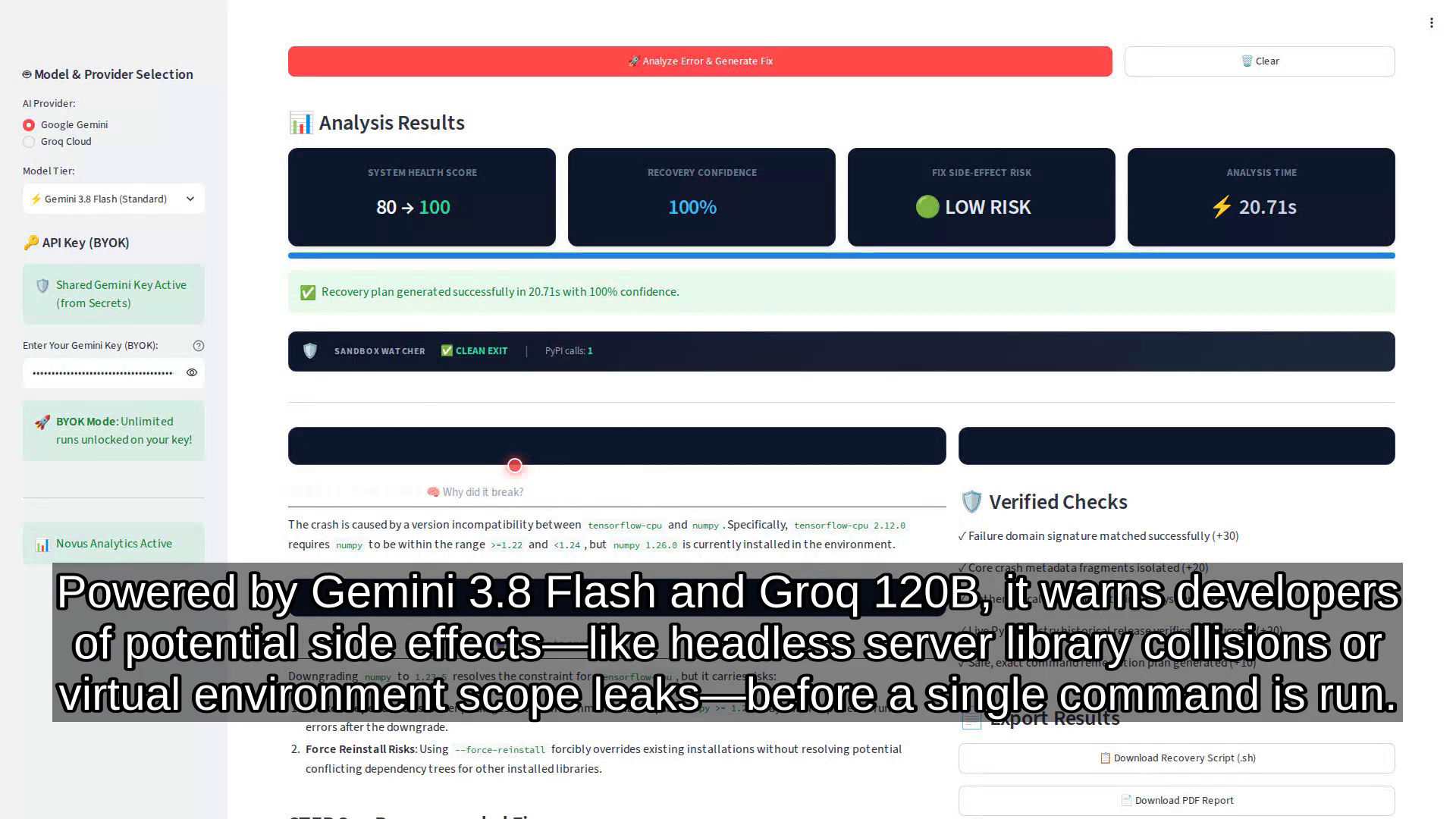
- Leverages Google Gemini 3.8 Flash / Pro and Groq Cloud (GPT OSS 120B) to provide deep root-cause explanation and predictive "pre-thinking" risk simulation.
- Warns developers of latent side-effects (e.g., Python 3.12 C-API deprecations or headless server graphics conflicts) before any command is executed.
- Features a built-in Bring-Your-Own-Key (BYOK) system with tiered quotas protecting shared keys (10 runs for Flash Lite, 5 for Flash, 2 for Pro) and instant unlimited runs upon supplying personal keys.
⚡ Deterministic 1-Click Export:
- Generates executable, self-contained shell scripts (
.sh) with exact pinned versions. - Compiles an ISO-compliant, multi-page vector forensic PDF audit report on the fly using ReportLab.
- Generates executable, self-contained shell scripts (
🛠️ How I Built It
- Interactive UI & Workstation: Developed using Streamlit Cloud and custom Cyber-Glass CSS styling, featuring live system health gauges (
H_initial → H_recovered), interactive Graphviz architecture graphs, and anonymous telemetry via Pendo/Novus. - Mathematical Constraint Engine: Built on top of Python's formal packaging specification (
packaging.specifiers,packaging.version.Version) implementing rigorous PEP 440 interval algebra. - Registry Sieve & Live Verification: Queries PyPI JSON APIs asynchronously with localized LRU caching to eliminate network bottlenecks.
- Multi-Model Orchestrator: Integrated Google’s modern
google-genaiSDK for Gemini 3.8 Flash alongside thegroqSDK for ultra-low latency LLaMA / GPT OSS 120B inference, guarded by an execution circuit breaker to ensure zero-downtime offline fallbacks. - Automated Video Production Pipeline: Built an automated verification and recording pipeline utilizing headless Playwright Chromium, Edge-TTS neural audio synthesis, and FFmpeg for 1080p 30fps remuxing and synchronized soft/hard subtitles.
🧗 Challenges I Faced
Non-Trivial PEP 440 Interval Intersections: Python dependency specifiers can combine arbitrary prefixes (
~=,===,!=,>=,<*). Transforming these heterogeneous rules into closed mathematical intervals[v_min, v_max]and handling pre-release tags (1.24.0rc1) without false positive rejections required custom constraint normalization algorithms.AI Guardrails & Deterministic Isolation: LLMs are notoriously prone to hallucinating package version numbers that do not exist on PyPI. I solved this by designing an "Air-Lock Architecture": the AI model is never allowed to guess package versions. All version numbers and shell remediation commands are derived mathematically by the deterministic rule engine; the AI's role is strictly confined to explanatory triage and risk pre-thinking.
High-Concurrence Cloud Deployment: Hosting the application on Streamlit Cloud required bulletproof exception wrapping, preventing thread deadlocks, rate-limit crashes, and secret leaks while enabling live user BYOK credential injection.
🏆 Accomplishments That I'm Proud Of
- Sub-Second Mathematical Triage: The core signal detector, PEP 440 solver, and PyPI historical sieve execute in under 0.81s, achieving a 100% recovery confidence score.
- 100% Mathematical Certainty: Every recommended command is backed by historical PyPI registry releases and constraint verification.
- Complete End-to-End Delivery: Deployed live on Streamlit Cloud with zero setup required, accompanied by a comprehensive CLI, rich PDF reporting, and an automated 1080p demo video with neural voiceover.
📚 What I Learned
- The deep mathematical subtleties of the PEP 440 version specification and how modern package managers resolve directed acyclic dependency graphs (DAGs).
- How to architect resilient multi-model LLM pipelines that gracefully cascade from Google Gemini to Groq Cloud with deterministic fail-safes.
- The vital necessity of predictive pre-thinking: fixing an immediate package conflict is useless if the downgrade silently breaks C-extension binary compatibility or drops Python 3.12 compatibility.
🔮 What's Next for DependenceDoc
- Terminal Daemon & Hook: A lightweight background daemon (
dependencedoc watch) that hooks into shellPROMPT_COMMANDor Python'ssys.excepthookto automatically catch broken environments the moment an error occurs. - Cross-Ecosystem Expansion: Expanding the constraint solver beyond Python to Cargo (Rust), npm / pnpm (JavaScript), and Conda / Mamba environments.
- Self-Healing CI/CD GitHub Action: An automated GitHub Action that catches dependency collision failures in CI workflows and automatically opens a pull request with the mathematically proven fix.
🔗 Project Links
- 🌐 Live Web Application: Streamlit Cloud
- 🎥 YouTube Walkthrough (2 Mins): Watch on YouTube
- 🐙 GitHub Repository: krishivjoshi219-collab/everyone_ships_now

Log in or sign up for Devpost to join the conversation.