-
-
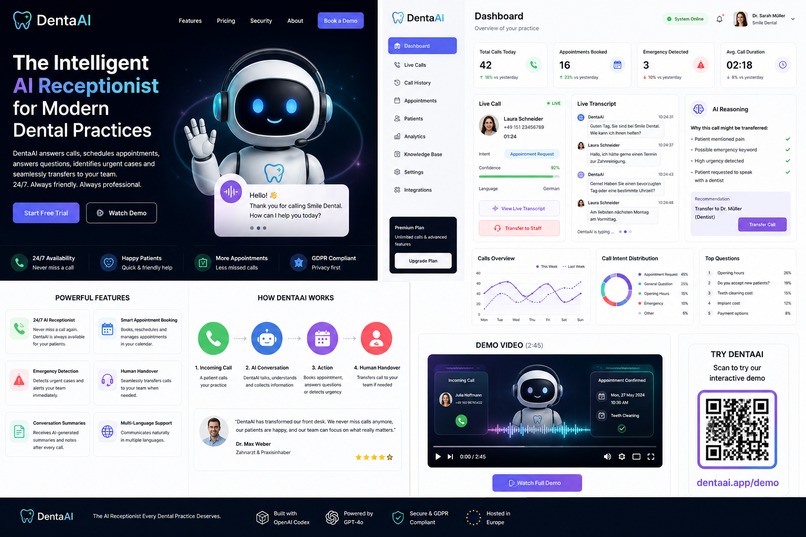
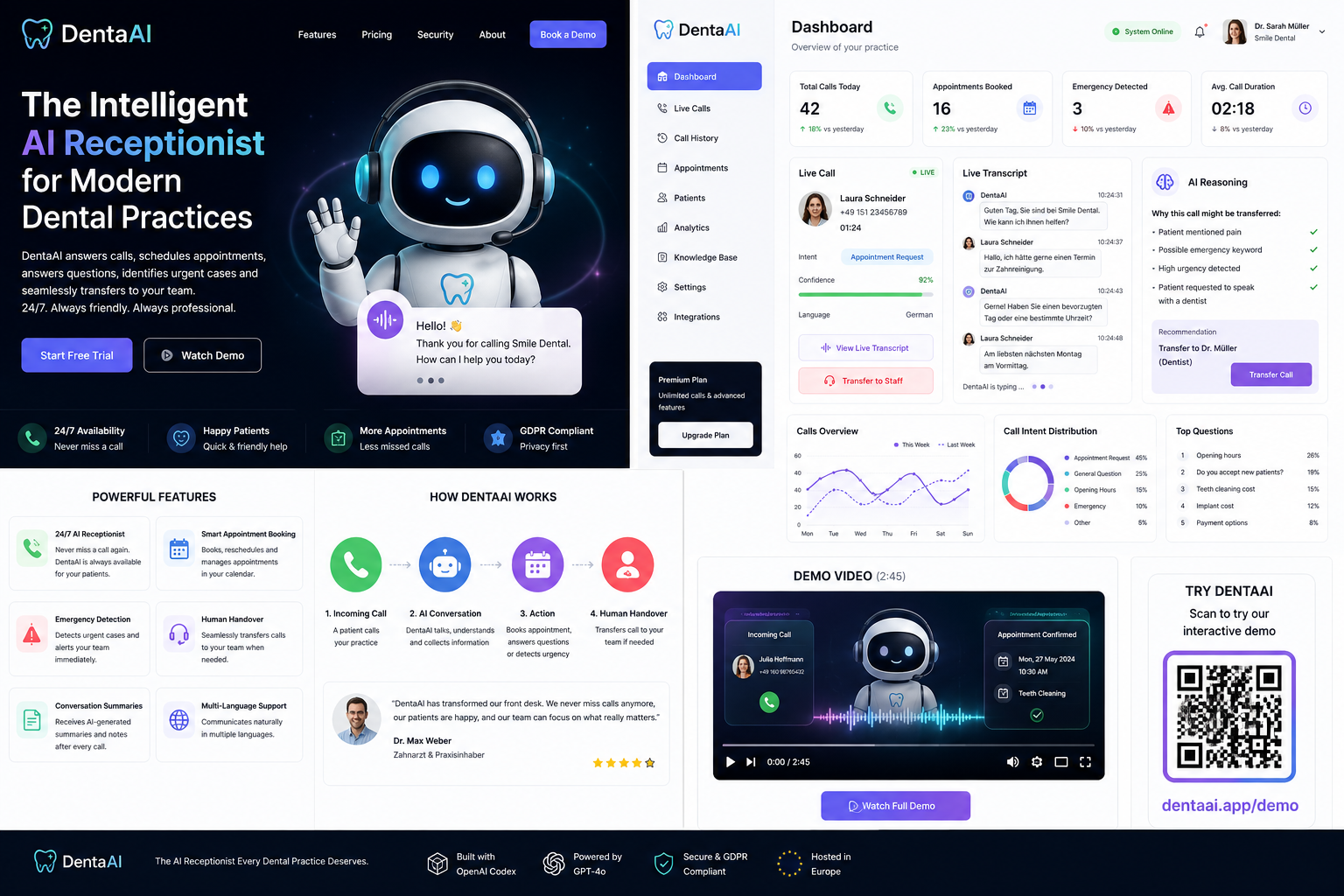
DentaAI landing page, dashboard, and OpenAI Challenge Mode overview.
Inspiration
Dental practices lose a lot of valuable time to repetitive phone work: appointment requests, opening-hour questions, cancellations, and urgent pain calls. At the same time, patients expect fast answers, and health-related information needs careful handling. DentaAI was inspired by the idea of giving dental teams a calm, privacy-aware AI receptionist that can handle routine calls and knows when a human should take over.
What it does
DentaAI is a local-first AI receptionist prototype for dental practices. It demonstrates how an AI assistant could answer incoming calls, understand patient intent, support appointment-related workflows, identify urgent cases, and present everything in a clear dashboard.
The prototype includes:
- a product landing page
- an interactive call demo
- a practice dashboard
- a dedicated OpenAI Challenge Mode
- simulated live transcription
- explainable AI reasoning
- urgency and confidence indicators
- local audit-style events
- privacy and safety notes
How we built it
The project was built as a static web prototype using HTML, CSS, and vanilla JavaScript. The dashboard uses scripted demo data, browser-based interactions, and Canvas charts to show how the product experience could work in a real dental practice.
OpenAI Codex was used as the main development collaborator to prepare the project structure, improve the documentation, test the demo flow, package the repository for GitHub, and make the submission Devpost-ready.
Challenge Mode
The Challenge Mode is the main demo path. It walks through a simulated urgent dental call and shows the transcript, detected intent, urgency level, confidence score, AI reasoning, audit log, and final human handoff recommendation.
Local-first and privacy
DentaAI is designed around the principle: as local as possible, as external as necessary. Sensitive practice and patient context should stay under practice control whenever possible. Optional cloud, telephony, calendar, or AI integrations should be explicitly configured and protected with encryption, access controls, retention policies, and legal review.
Prototype disclosure
This is a challenge prototype, not a production medical, diagnostic, telephony, or scheduling system. Telephony, appointments, AI outputs, latency values, audit logs, and statistics are partly simulated to demonstrate the intended user experience and product logic.
What is next
Next steps would include real telephony integration, speech-to-text, text-to-speech, calendar synchronization, clinic-specific rules, secure local storage, role-based access, and clinical/privacy review before any real-world deployment.
Built With
- by
- canvas
- css
- github
- html
- javascript
- local-first-architecture
- openai-codex
- privacy

Log in or sign up for Devpost to join the conversation.