-
-
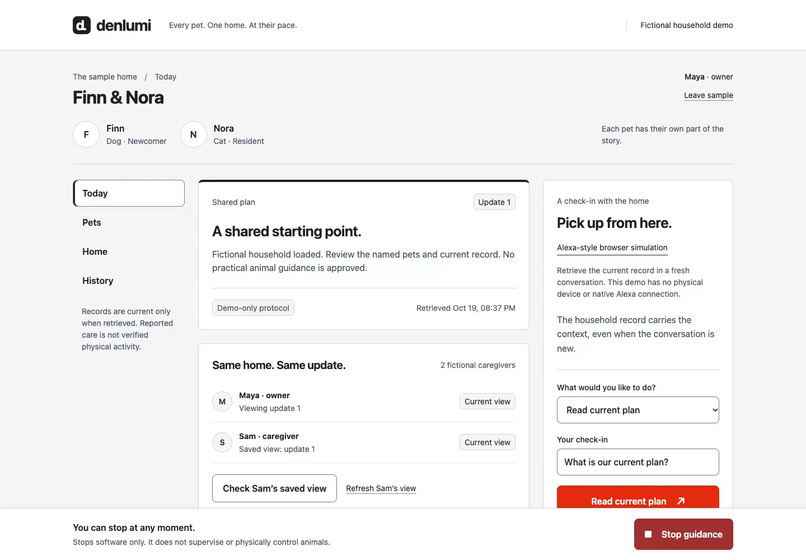
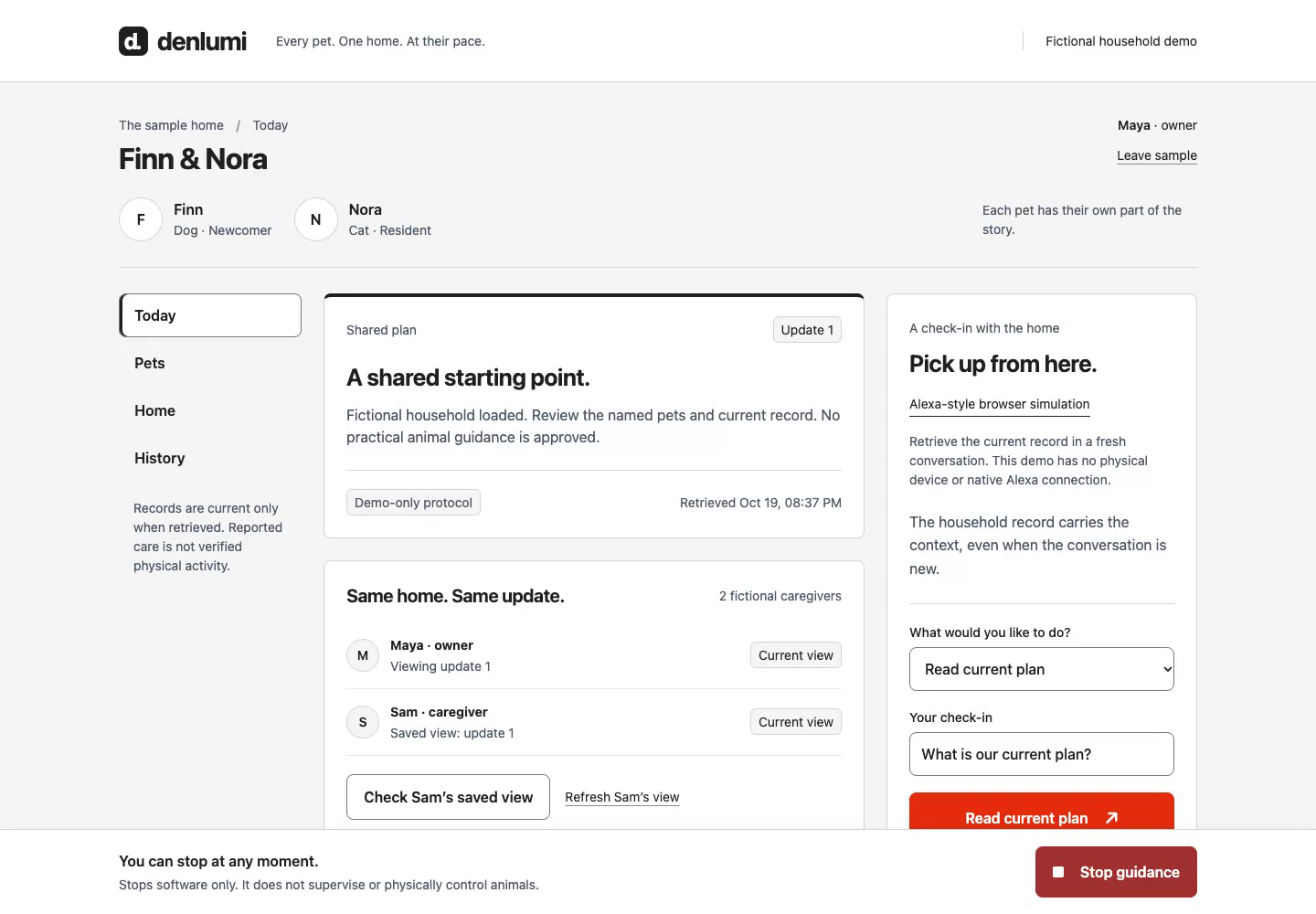
Earlier real local-app capture with fictional records; not a live hosted backend.
-
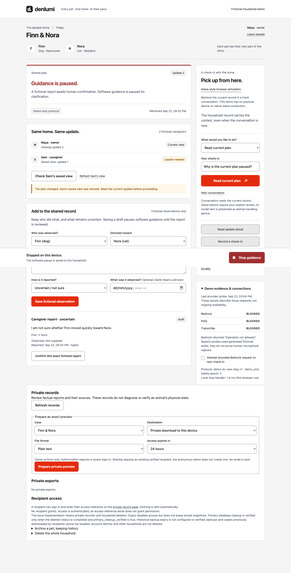
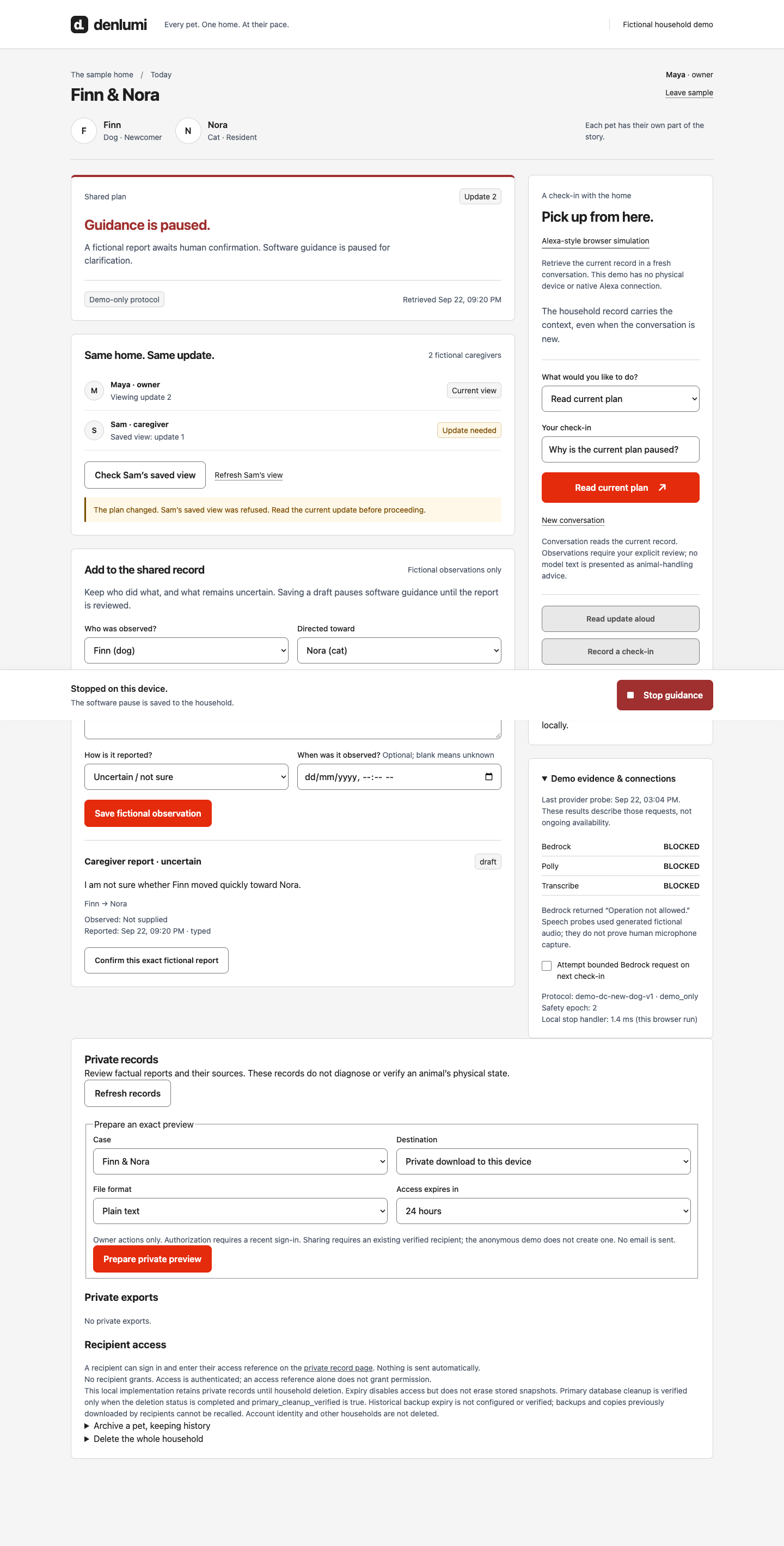
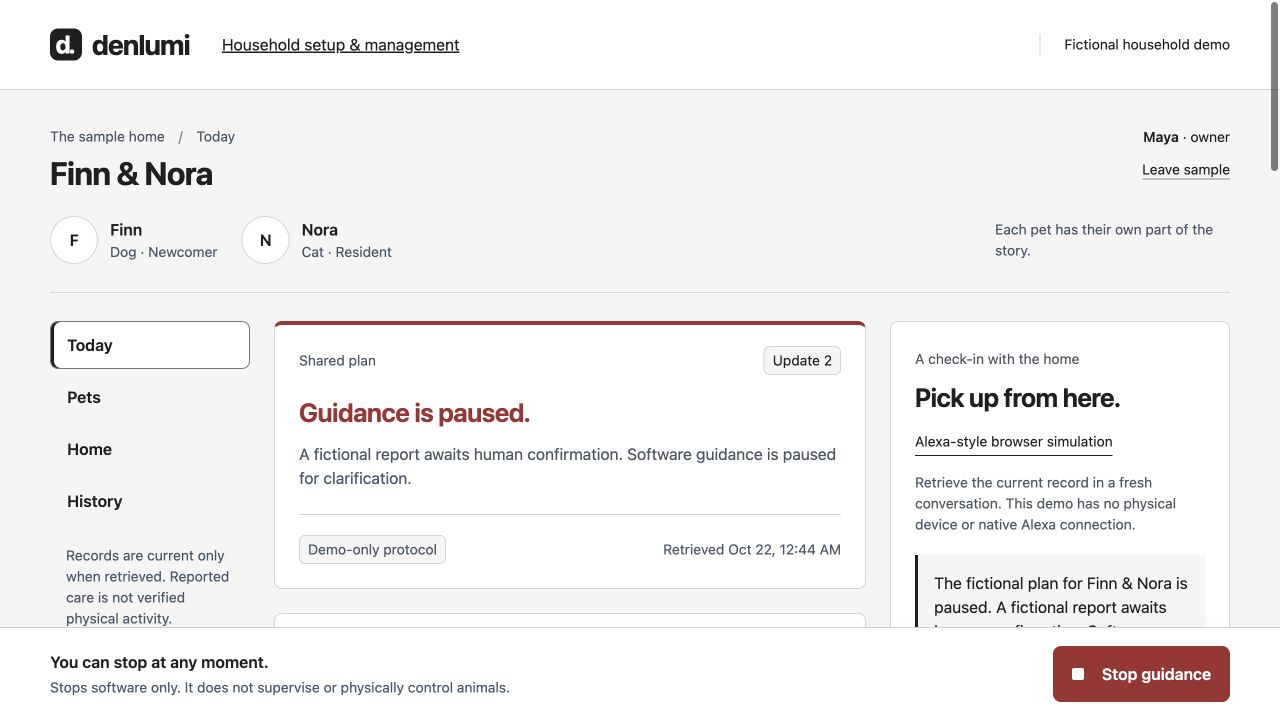
Earlier real local-app capture: paused guidance and an outdated caregiver view.
-
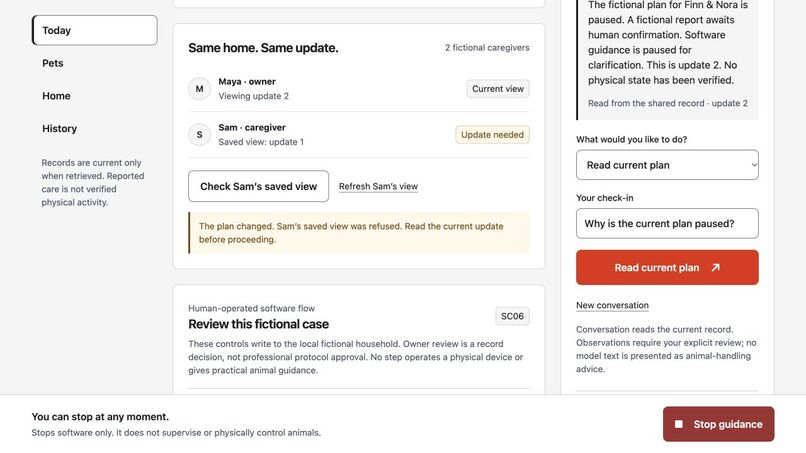
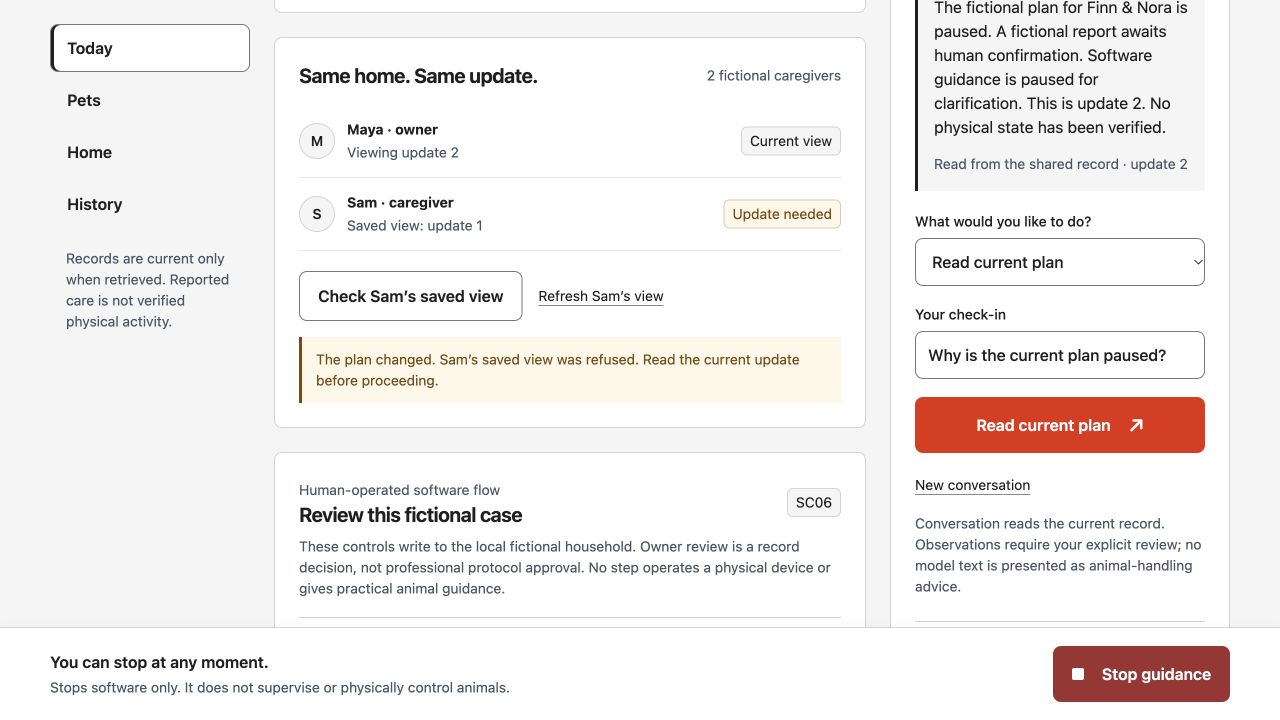
Fresh local capture: Maya has update 2; Sam's update 1 is refused. HTTP MCP reads the current record. Fictional demo.
-
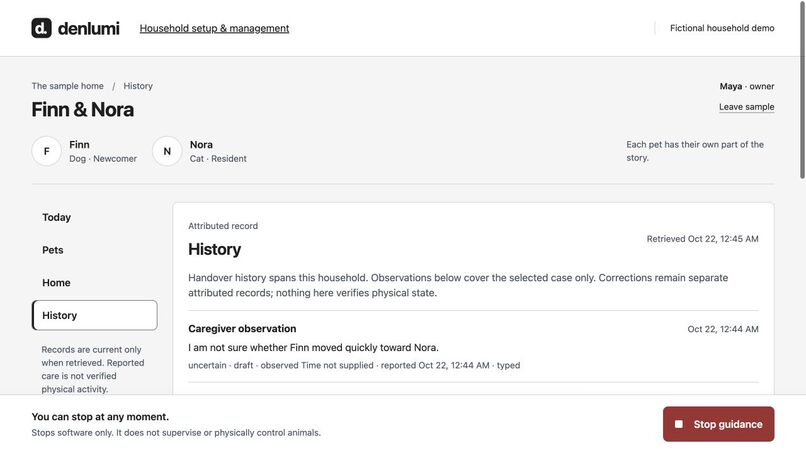
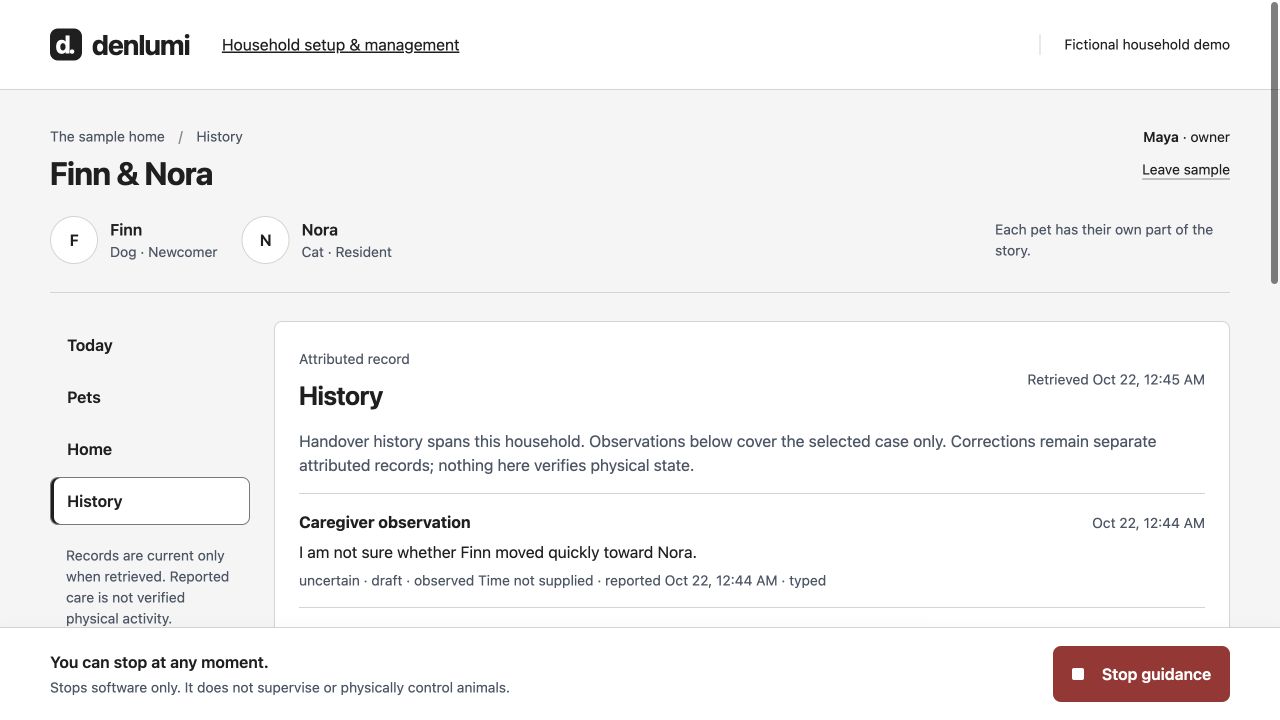
Fresh local history: attributed report, uncertainty, unknown observation time and report time remain separate. Fictional records.
-
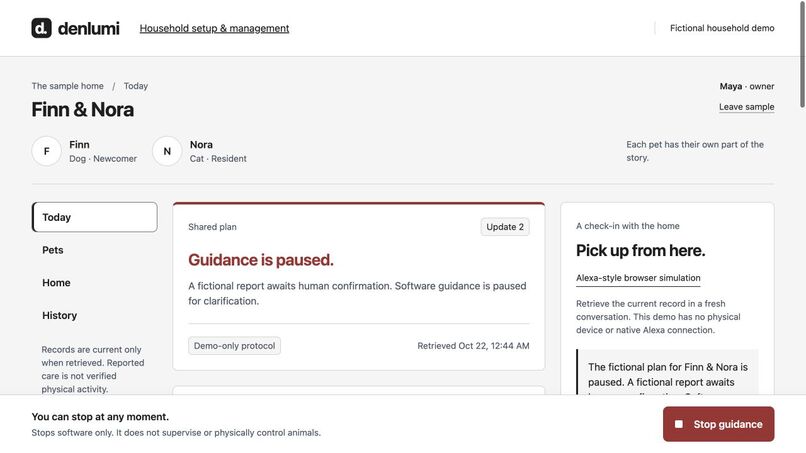
Fresh local app: an unconfirmed fictional report pauses software; the current database record is retrieved again.
-
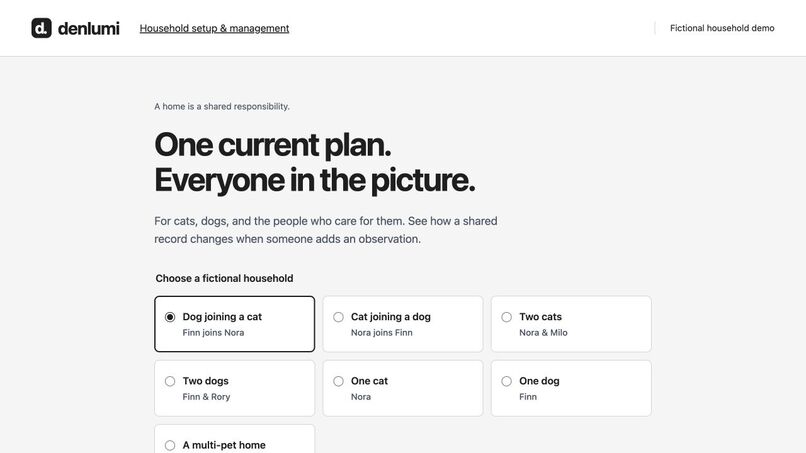
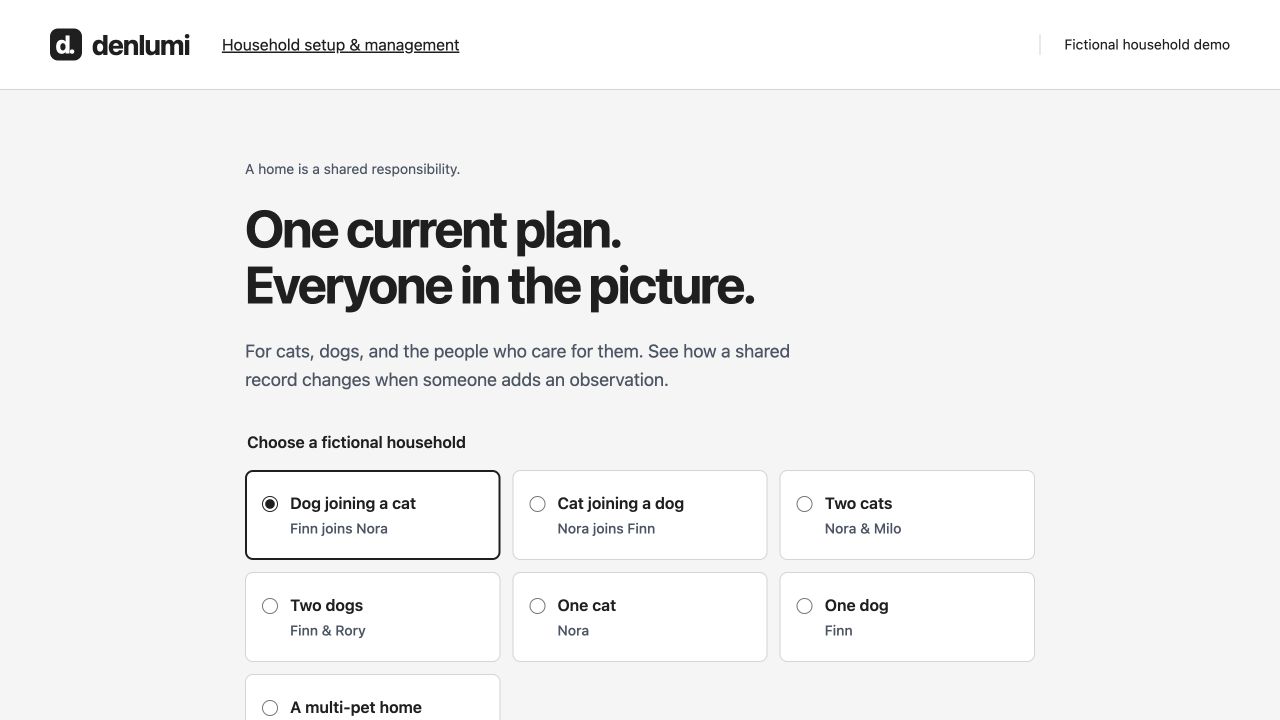
Actual local entry screen: distinct cat-cat, dog-dog, cat-dog, single-pet and multi-pet fictional samples.
Inspiration
A shared home can have several caregivers and several versions of what happened. One person records a concern; another returns with yesterday's plan. A conversational interface is useful only if it can recover the current household record, preserve uncertainty, and refuse work that has become stale.
Denlumi explores that coordination problem through a fictional Alexa-style browser simulation. The product hypothesis is that a clear handover and an appropriate pause can be more useful than another generic answer. We have not established customer demand or demonstrated animal behavior improvement.
What it does
Denlumi connects a current plan, attributed reports, caregiver handovers and private factual records. In the fictional demonstration, an owner reviews the exact plan, each caregiver acknowledges the current handover, and a fresh preflight checks whether a software session may start.
An observation retains who reported it, which pet acted toward which pet, whether the statement is affirmed, negated or uncertain, and when it was observed versus reported. Human confirmation remains separate from the assistant's tools. A relevant concern pauses software guidance and makes dependent work stale. Another caregiver cannot continue with an old plan; a fresh conversation retrieves the current state through authenticated HTTP MCP.
The demonstration has distinct cat–cat, dog–dog and cat–dog contexts, including both newcomer directions. Single-pet care does not invent a second pet. A three-pet household keeps separate pair contexts and offers no group session. Routine reports remain reports: a caregiver reporting a task done is not proof that an animal ate or that an action occurred.
Local Stop works without a network or model. It stops this device's software and audio; it cannot separate, monitor or supervise animals. An offline household update remains visibly unsynchronized until the server commits it. Private factual previews and exports require explicit human action; the model cannot send records, invite people, clear holds, advance plans, change medication or operate devices.
How we built it
The current local application uses Next.js 16.4.2, React 19.3.1, TypeScript and Node.js 22.23.4. Local Supabase Auth and PostgreSQL provide authenticated identities, household scope and persistent state. Consequential operations recheck authority and current versions, including a monotonic safety epoch that invalidates dependent work after a relevant change. Database constraints, row-level security and server checks support one another.
The simulation makes real authenticated Streamable HTTP MCP requests using protocol version 2025-11-25 and SDK 1.32.1. A new conversation retrieves database state rather than relying on chat history. Its bounded assistant has a six-tool-call total per turn and at most two model rounds. The demonstrated fallback answers are explicitly sourced from database templates. P9 added streaming request-size limits, read/write budgets and bounded transport admission, expiry and abort/deadline cleanup; these are local process controls, not distributed deployment protections.
AWS SDK integrations are present for Bedrock Converse, Amazon Polly and Amazon Transcribe Streaming. Earlier real Polly/Transcribe requests succeeded with fictional generated audio; a separate synthetic-microphone browser drill exercised actual speech endpoints and offline Stop. These are provider/software observations, not human voice acceptance. Real Bedrock inference attempts returned ValidationException: Operation not allowed; no successful Bedrock-generated answer or model-driven MCP loop is claimed. On October 22, the owner renewed the AWS session; STS, model discovery and the active Nova Micro inference profile passed, but one real bounded Converse request still returned ValidationException: Operation not allowed.
Challenges we ran into
The difficult work was preserving authority when state changes. Local checks exposed stale review controls after failed reads, a previous answer left visible beside a new error, a saved report whose refresh failure looked like a refused write, and report text cleared during delayed sample entry. We corrected those paths and recorded the evidence and its limits.
Bedrock onboarding also stopped at a real authorization blocker. Model discovery and an active inference profile did not establish permission to invoke it. We kept the blocked status visible and retained database-backed functionality. Accumulated older local fixtures previously caused database/Auth timeouts. A fresh native environment passes the current suite, while accumulated-old-fixture performance remains unverified. A new public-source clone also exposed a real setup bug: the pinned experimental CLI rejects legacy status flags. We corrected the distributed credential helper and added regressions. A separate Docker VM attempt hit image-store I/O and filesystem-journal errors under storage pressure; no successful Docker replay is claimed.
Accomplishments
The documented local slice connects exact plan review, separate authenticated caregiver acknowledgment, preflight, report, pause, stale-work refusal, fresh MCP retrieval and private preview across the supported fictional shapes. It includes permission, duplicate-work, failure and offline-Stop checks, and automated desktop reflow and native browser zoom evidence.
The current local P9 operations/security checks passed 227/227 domain/Auth/database tests, 60/60 production typed-browser tests and five isolated synthetic/mocked voice tests, plus typecheck, production build, seven existing HTTP proofs, nine security HTTP checks and seven fictional pairing shapes. The voice mocks used no real provider endpoint or credential. The typed checks exercise keyboard, constrained reflow, zoom-related software behavior, reduced motion, forced colors, outage/deletion recovery and fictional pairing journeys. These are local automated results on the current source, not human accessibility/usability, clean-machine Docker replay or older-record recovery. Earlier 105/110-domain and 29-browser results retain their historical limits.
On October 22, a fresh public-source clone, fresh dependency installation, cold native service downloads and a new local database/Auth environment passed all 227 domain/Auth/database tests, 60 typed-browser workflows, five isolated mocked-voice checks, 11 setup-boundary and seven export-boundary tests, typecheck/build, actual authenticated HTTP MCP, nine HTTP security checks and a zero-known-vulnerability lockfile audit. The repaired public setup helper generated that clone's own private credentials without the previous private adapter. This is a clean local native setup on the same Apple Silicon Mac, not an independent machine, Docker, Linux, human accessibility or provider acceptance.
The local 104-second film contains real October 19 browser footage with original SVG explanation and Higgsfield Seed Audio's built-in Grady narration, edited and checked October 20. It predates final P9 dependency/security hardening; no updated recording of that build is claimed. Automated caption/decoding/playback checks and AI sampled-frame review do not establish human listening or voice acceptance.
The 3:2 project cover is a separate original brand illustration created with Codex's built-in image-generation tool; its model identifier is not exposed. It is not an application screenshot. Four new gallery images are unaltered October 22 captures of the running local app with fictional records, alongside two clearly captioned earlier captures.
What we learned
An assistant's confident sentence cannot substitute for a current, authorized record. We made reported facts, uncertainty, software pause and human approval visible as separate states. A useful demo should also reveal provider failure without presenting a fallback as a successful model call.
What's next
Remaining work includes accumulated-old-fixture performance/old-record recovery, clean-machine Docker replay and human supported-device usability/accessibility and voice acceptance. Provider latency/cost/retention verification, approved table-specific metadata retention, continuous consented cleanup, full backup expiry/restore and production-scale/real-operator withdrawal acceptance remain open. The October 22 renewed AWS identity passed, while the actual Bedrock inference recheck remained blocked with ValidationException: Operation not allowed. All bundled protocols remain demo_only; each exact practical version needs real qualified review before customer use. Local P9 automated hardening and bounded operations are complete within their recorded scopes; P9 human/operational acceptance remains open. Source, film and updated static showcase are public; the owner retains personal declarations and final submission.
Built With
- amazon-web-services
- model-context-protocol
- next.js
- node.js
- postgresql
- react
- supabase
- typescript

Log in or sign up for Devpost to join the conversation.