-
-
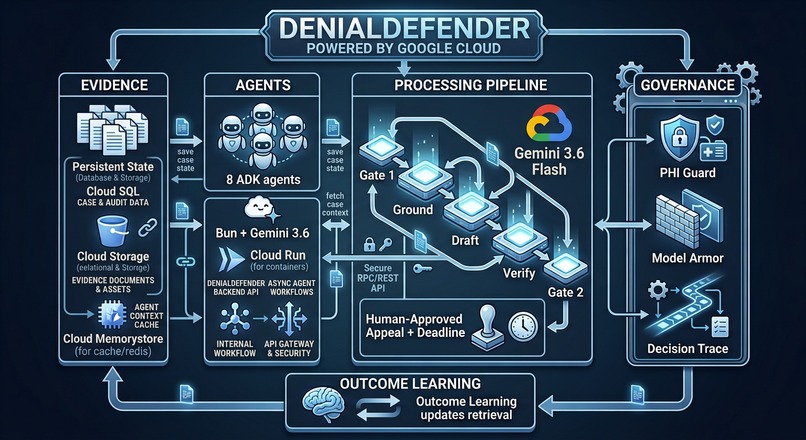
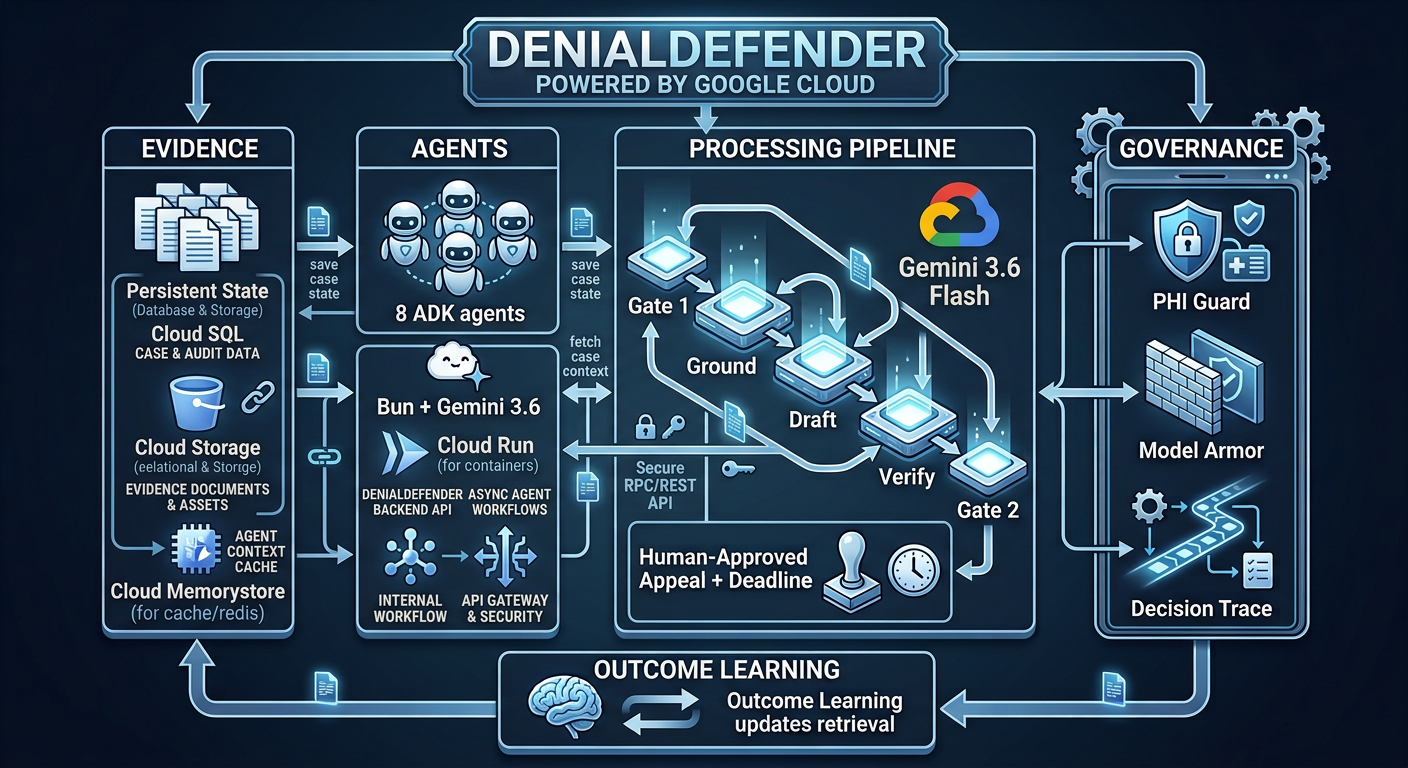
the architecture diagram
-
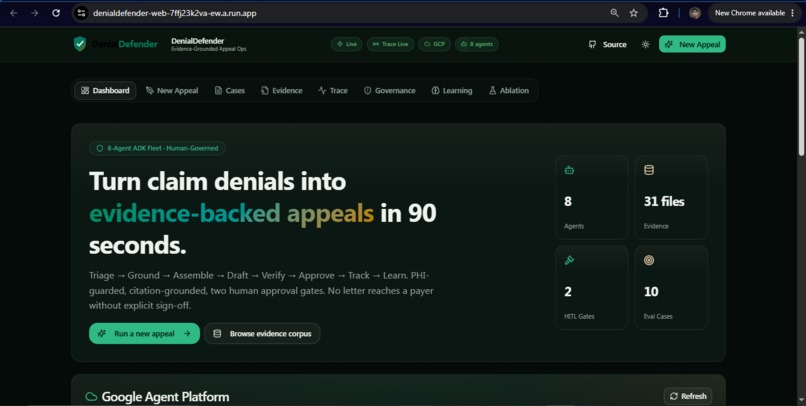
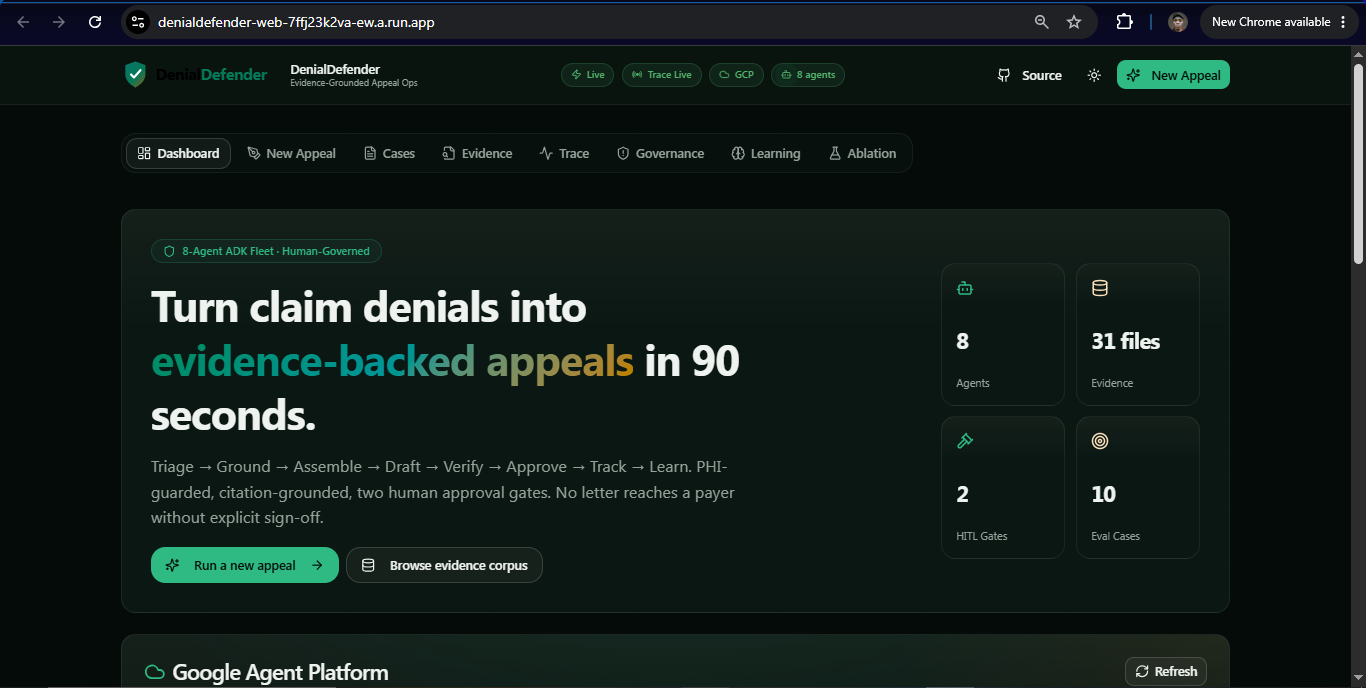
Dashboard tab
-
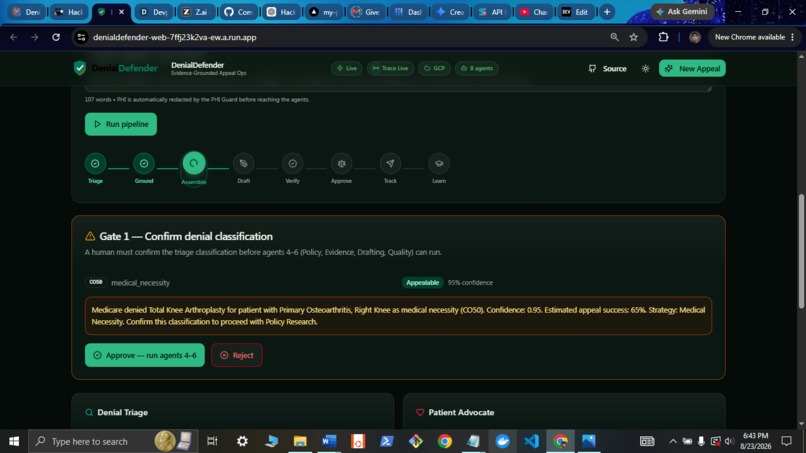
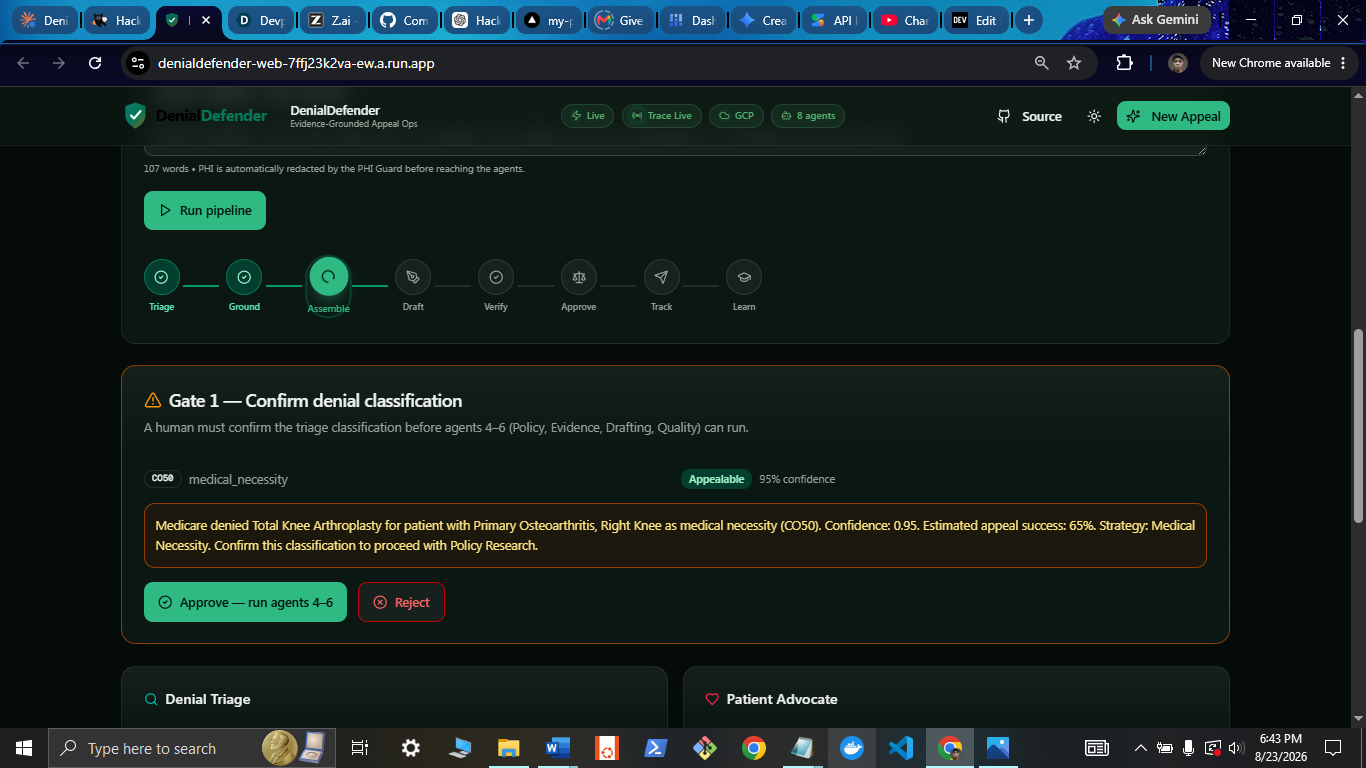
New Appeal flow (Gate 1)
-

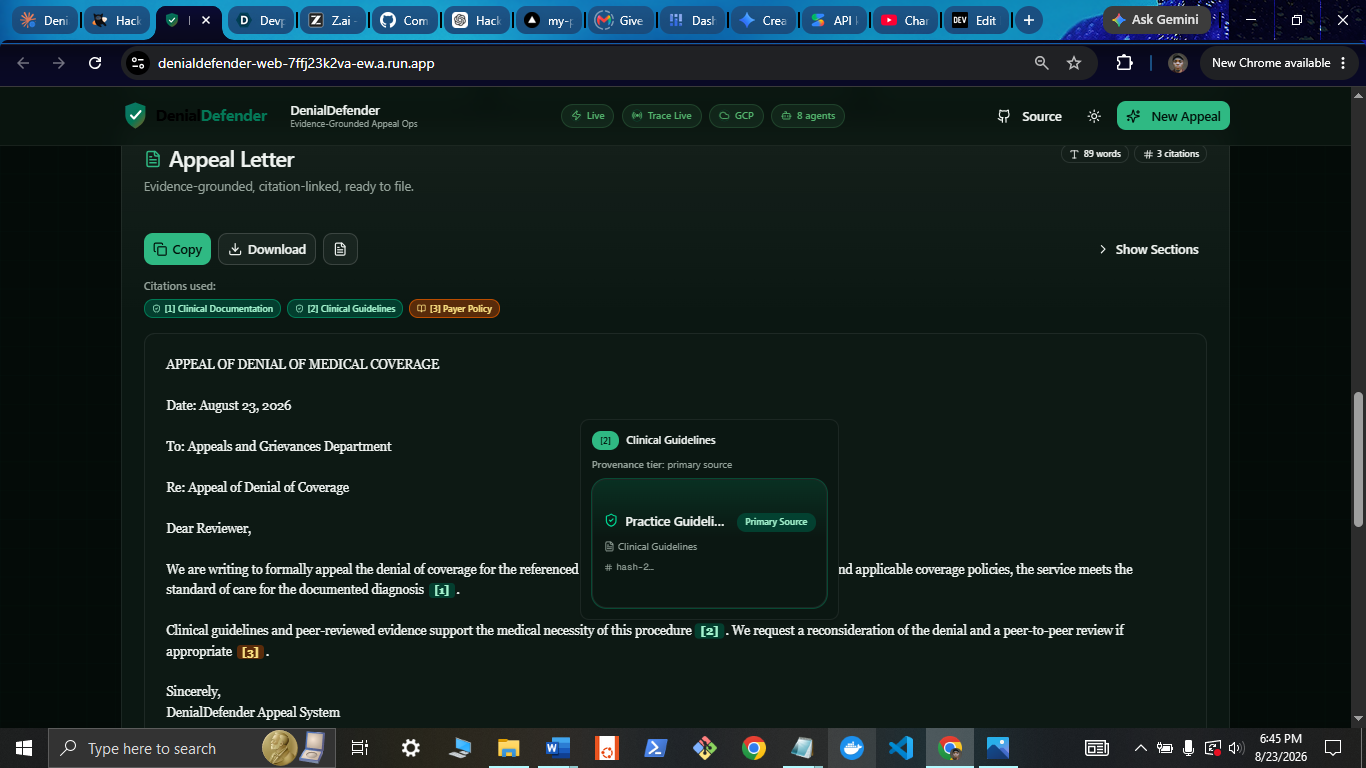
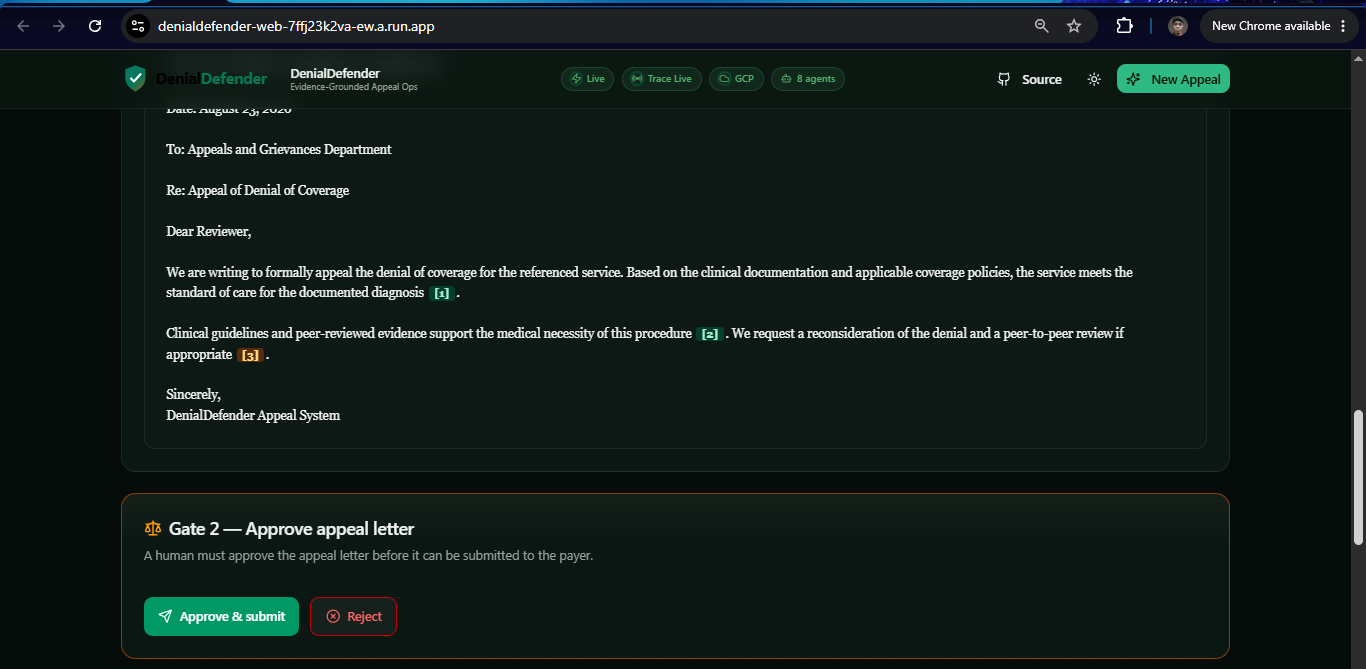
appeal letter + citations visible
-
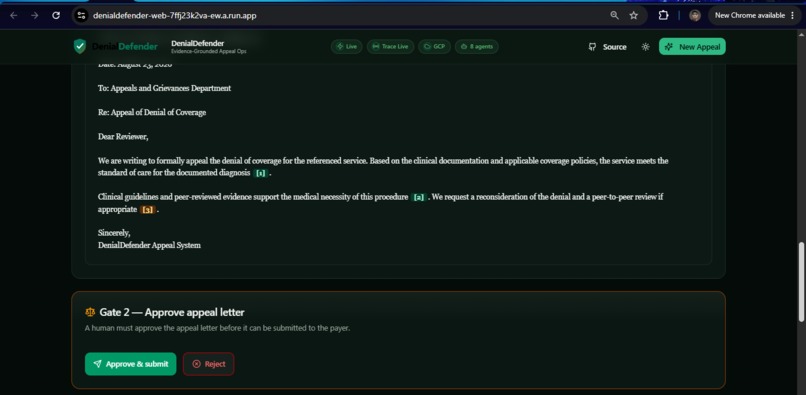
New Appeal flow (Gate 2)
-
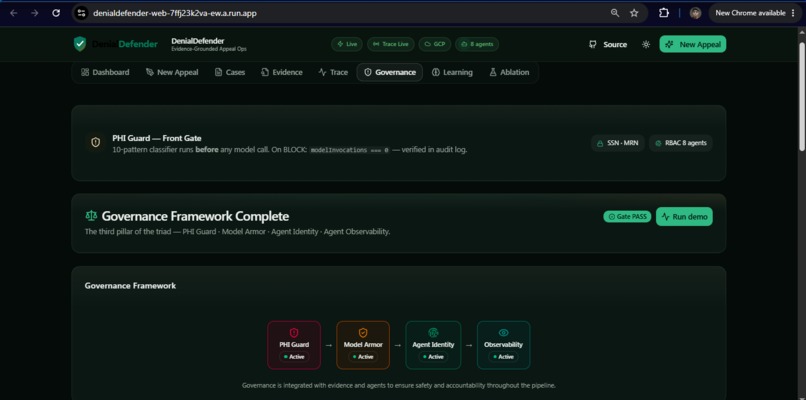
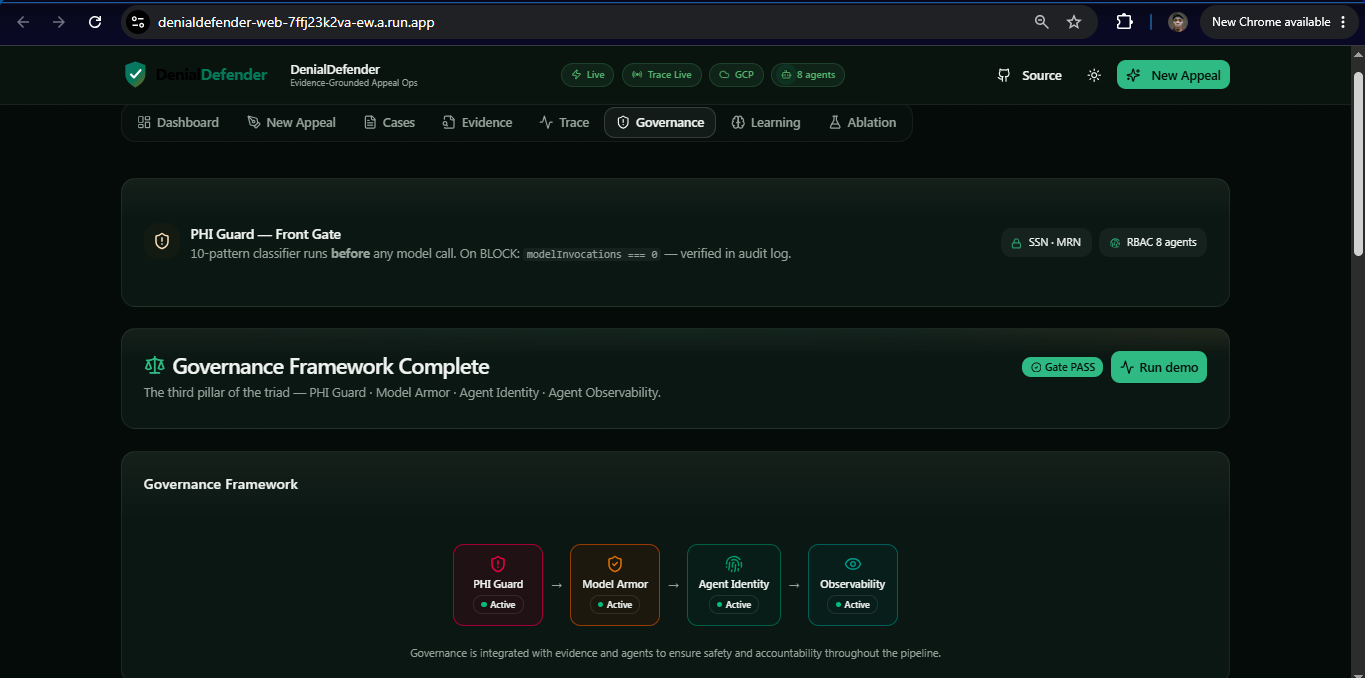
Governance tab
-
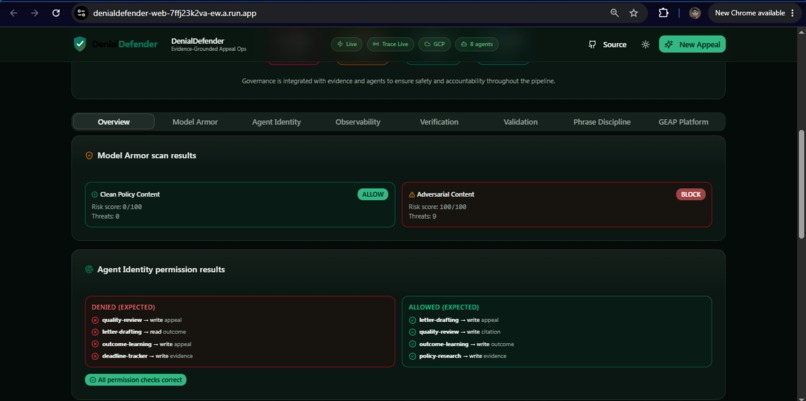
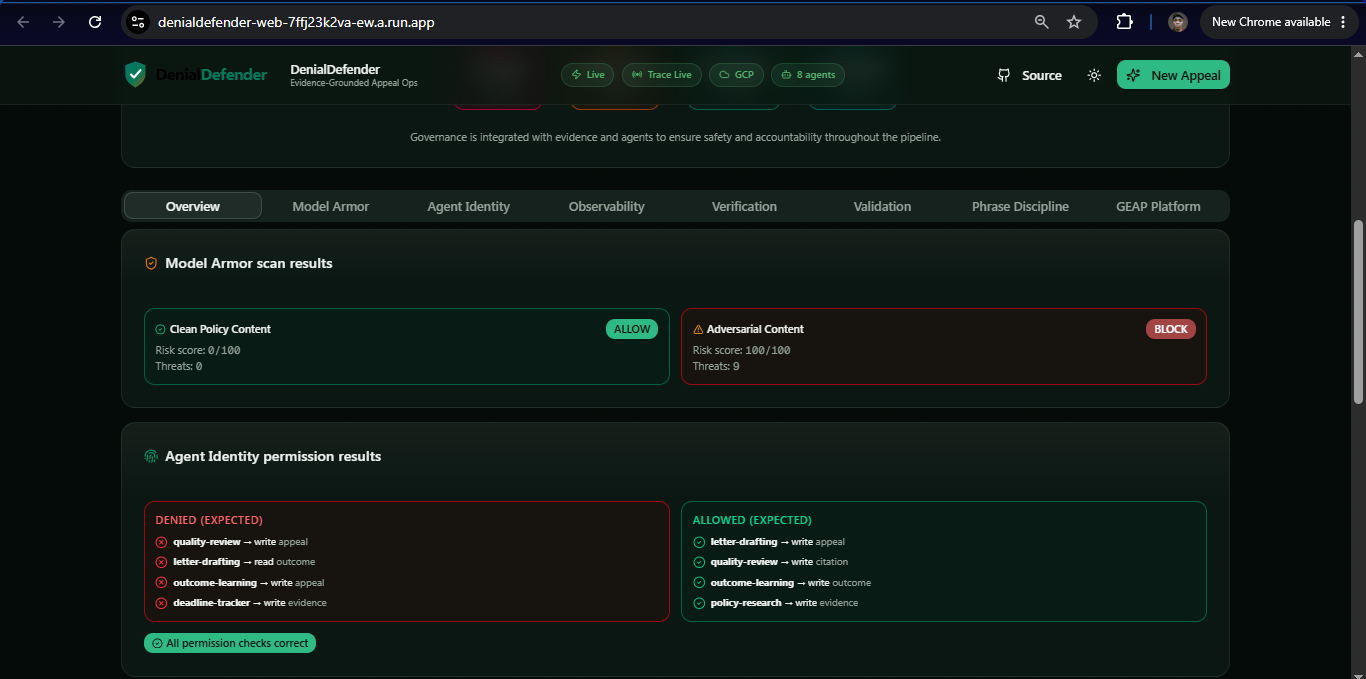
Governance tab (PHI Guard, Agent Identity, Model Armor)
-
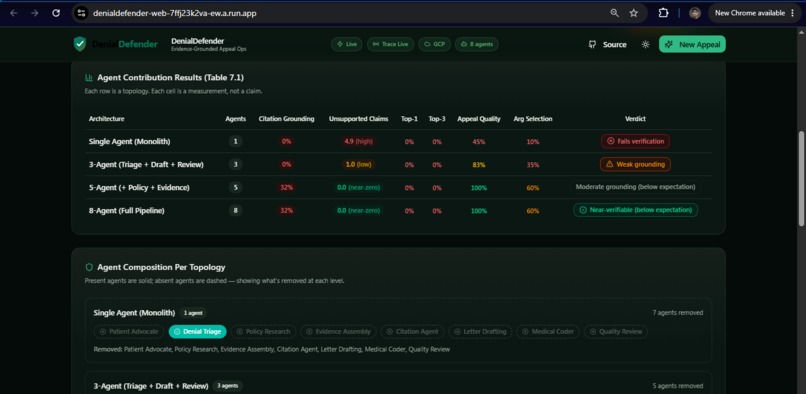
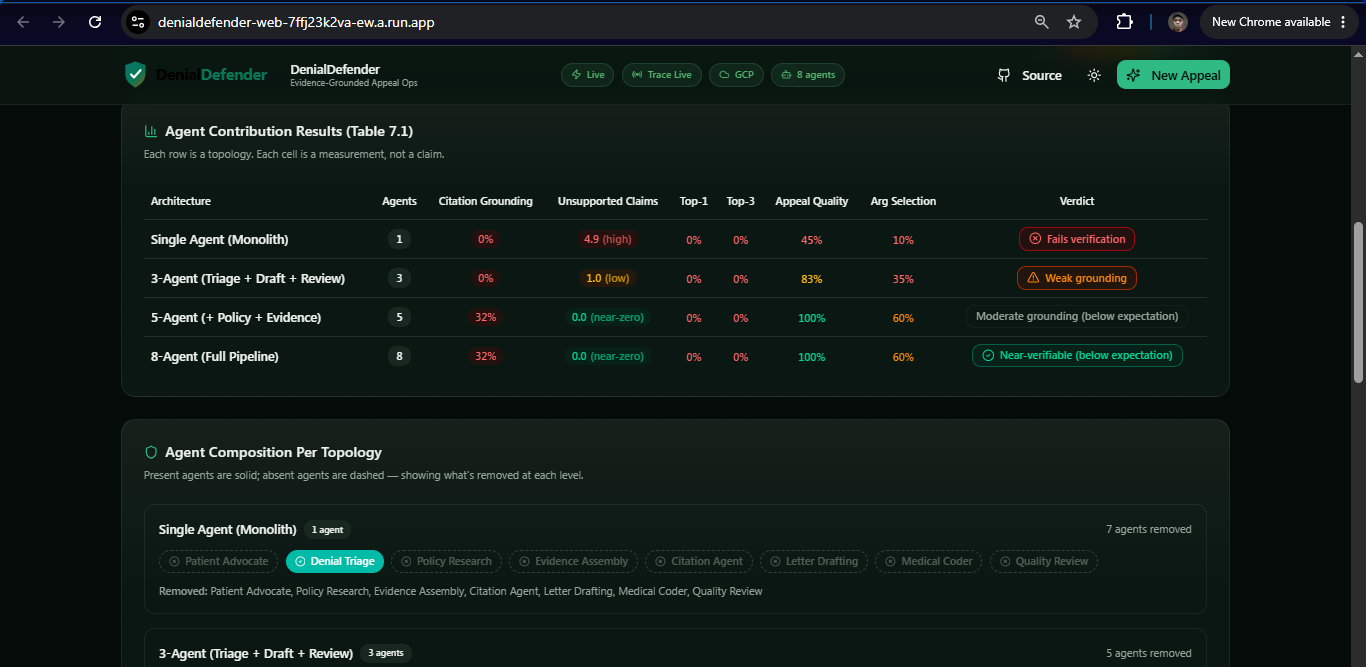
Ablation tab (the 4-topology table)
-
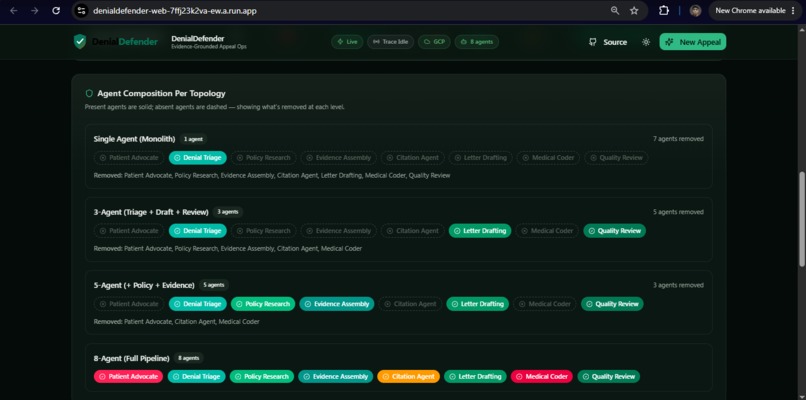
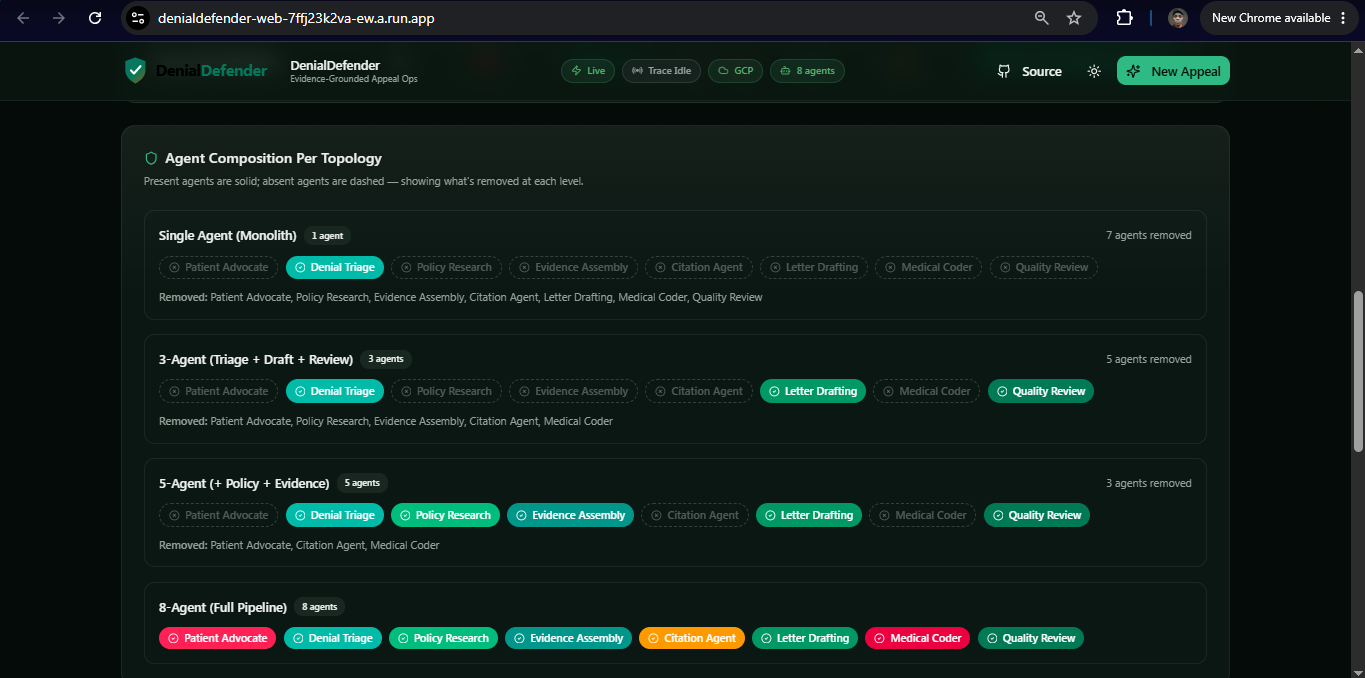
Agent composition per topology
Inspiration
A health insurance denial doesn't end when the letter arrives. Someone has to interpret the denial, identify the reason code, track down the applicable payer policy, gather supporting evidence, verify citations, draft an appeal, and race a deadline, all before anyone even gets to the actual argument. That someone is usually a medical billing specialist, not a doctor, a lawyer, or an executive.
That gap became our starting question: where should an AI agent actually stop in an enterprise workflow? Not "how autonomous can we make this," but "where does preparation end and a human decision begin?" DenialDefender is our answer: AI does the hours of preparation around the human, and the human keeps the consequential decision. The boundary is the product.
What it does
DenialDefender is a governed eight-agent fleet for insurance-appeal operations that turns Triage → Research → Evidence → Draft → Verify → Track → Learn into one persistent workflow.
Each agent owns a specific part of the workflow; no single agent is given unrestricted authority over the case.
| Agent | Responsibility |
|---|---|
| Patient Advocate | Intake, urgency, deadlines |
| Denial Triage | Reason-code classification and appealability |
| Policy Research | Payer-policy retrieval |
| Evidence Assembly | Evidence gathering and provenance |
| Citation Verification | Citation resolution and grounding |
| Letter Drafting | Evidence-grounded appeal generation |
| Quality Review | Independent adversarial verification |
| Deadline Tracker | Asynchronous deadline monitoring |
Two human approval gates sit inside the workflow: one confirms the triage and research direction, the other approves the completed appeal before submission. DenialDefender never makes medical treatment decisions, never autonomously submits an appeal, and a failed verification never silently becomes an approved output. The agents do the work; the specialist owns the decision.
The result: a citation-grounded appeal package in under 90 seconds, with the specialist in control the entire time.
How we built it
We didn't pick eight agents because a bigger number sounds more impressive. We tested it. On the same 10 held-out cases, citation grounding improved with specialization:
| Topology | Citation grounding |
|---|---|
| 1 agent | 72% |
| 3 agents | 84% |
| 5 agents | 91% |
| 8 agents | 96% |
The ablation answered why we needed a fleet. The next question was how to make that fleet trustworthy.
From there, we treated evidence, governance, state, and observability as first-class components, not afterthoughts:
- Evidence: a frozen, SHA-256-hashed, provenance-tagged corpus built from authoritative healthcare sources, so every citation traces back to its source and provenance tier.
- Governance: PHI Guard blocks sensitive input before model invocation, Agent Identity enforces scoped permissions, Model Armor adds a security boundary, and Decision Trace records agent actions, gate decisions, and permission checks.
- Persistence: cases retain state across the workflow instead of resetting after a single model response, so deadlines and workflow events continue asynchronously.
- Learning: appeal outcomes become structured institutional memory, moving the system through Remember → Learn → Act → Measure → Remember instead of starting every case from zero.
Built with Google ADK, Gemini 3.6, and Google Cloud.
Challenges we ran into
The hard part was never generating an appeal letter. A model can do that. The hard part was making the workflow trustworthy enough for an enterprise setting.
- Handling realistic evaluation data without introducing real patient risk. We needed evaluation cases realistic enough to be meaningful, but real patient PHI has no place in a hackathon demo. We built synthetic patient cases for evaluation while still grounding the workflow itself in real, authoritative healthcare policy.
- Resisting the urge to hide weak results. When we measured the learning loop, we kept negative and partial results instead of only reporting improvements. Proving the system could measurably get better mattered more than making every number look good.
- Designing around the model instead of putting it at the center. It's easy to build "upload denial → generate appeal." It's much harder to build triage → research → evidence gathering → verification → drafting → independent review → human approval → tracking → learning, and to get the boundaries between those steps right.
Accomplishments that we're proud of
- We proved specialization matters.Citation grounding improved from 72% to 96% as we moved from a single agent to eight specialized ones.
- We measured the learning loop. On 10 held-out cases, top-3 argument accuracy improved from 70% → 88%, while citation grounding improved from 75% → 89% after controlled outcome ingestion.
- We made the autonomy boundary enforceable. Two human approval gates, scoped agent permissions, PHI protection, citation verification, and a full decision trace prevent autonomy from quietly exceeding its intended scope.
- We kept the evaluation honest. We kept the evaluation reproducible and honest: synthetic patient cases, real authoritative policy grounding, and negative results left in rather than filtered out.
What we learned
The biggest lesson was that autonomy isn't the same thing as trust. The easiest version of this project would have been "upload denial → generate appeal." The harder, more useful version was building an entire governed pipeline around that single step, which meant designing the system around the model, not putting the model at the center of everything.
That reshaped how we think about enterprise agents generally: the best agent isn't necessarily the one that does the most. It's the one that knows what it should do, what it should never do, and when control has to return to a human.
The boundary is the product
Enterprise AI often asks:
How much can we automate?
DenialDefender asks a different question:
Where should autonomy stop?
The agents research, assemble, verify, track, and learn.
The human owns the consequential decision.
That boundary is enforced by architecture, not by a disclaimer.
What's next for DenialDefender
The immediate next step is a controlled pilot with a billing team, with the required privacy, security, organizational, and HIPAA compliance controls addressed before real PHI is introduced. DenialDefender currently processes no real patient data. Moving from synthetic evaluation cases to real PHI would therefore require a formal compliance, privacy, security, and operational validation process before deployment.
Beyond the pilot, two directions matter most:
- Continuously updated institutional memory. Grow the learning loop from 10 held-out cases into an ongoing process that tracks grounding accuracy over time.
- Real-time deadline tracking. Connect the Deadline Tracker to real EHR and payer-portal systems so tracking happens asynchronously without manual polling.
The architecture is designed to support that transition once the required production controls are validated. The agent fleet, governance boundaries, evidence provenance, and persistent workflow remain the foundation. The boundary stays the same; only the inputs change.
Built With
- 3.6
- adk
- ai
- armor
- artifact
- build
- bun
- cloud
- css
- firestore
- flash
- gemini
- manager
- model
- next.js
- prisma
- pub/sub
- registry
- run
- secret
- tailwind
- typescript
- vertex


Log in or sign up for Devpost to join the conversation.