Inspiration
We live in Satipo, a small town deep in the Peruvian Amazon. Every rainy season, dengue comes back. Every year, someone we know gets sick. The government spends millions on fumigation — but fumigation kills adult mosquitoes, not larvae. The mosquito keeps coming back because no one stops it before it flies.
We are six high school students who decided to stop waiting for someone else to fix this.
What it does
DengueStop is an IoT + AI system that predicts dengue larval risk using real climate data from Satipo and automatically deploys Bti — a WHO-approved biological larvicide — into water containers before larvae become mosquitoes.
- A DHT22 sensor reads temperature and humidity in real time
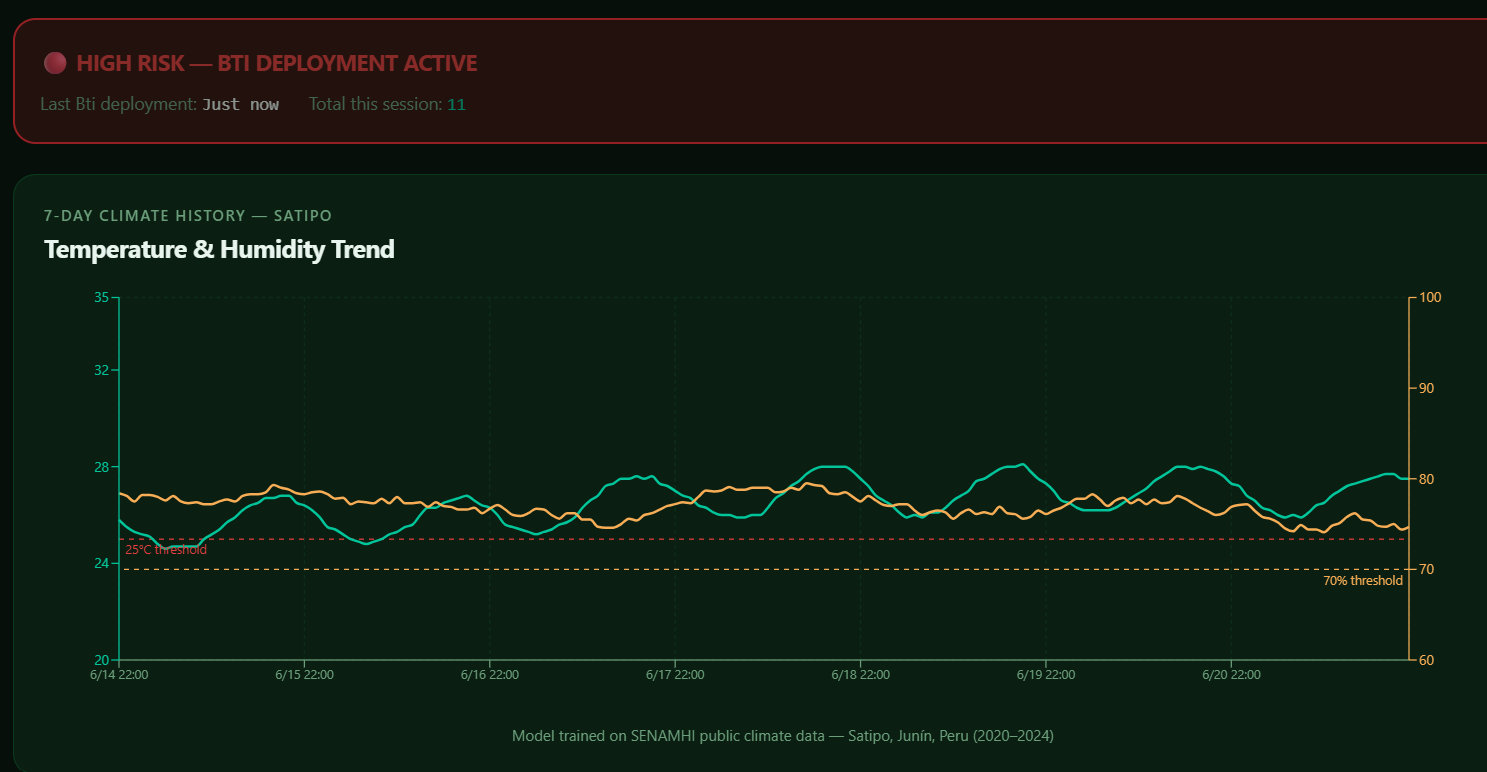
- An AI predictive model trained on historical SENAMHI climate data forecasts high-risk days for larval reproduction
- When risk is detected, an ESP32 microcontroller activates a micro-pump that releases Bti directly into the water
- A dashboard shows risk levels, sensor data, and deployment history for community health workers and families
The Bti only works on larvae by ingestion — it does not affect eggs or pupae. We say this clearly because hiding a limitation is worse than explaining it honestly.
How we built it
- Hardware: ESP32 microcontroller + DHT22 temperature/humidity sensor + 5V micro-pump + relay module
- AI layer: predictive risk model using public SENAMHI climate data from Satipo (temperature, humidity, precipitation history)
- Dashboard: built to visualize real-time sensor readings, risk predictions, and Bti deployment events
- Field data: our team mapped water containers in our neighborhood, calculated the Larval Index (IR%), and collected real Aedes aegypti larvae for laboratory experiments
- Biological agent: VectoBac WG (Bti) sourced from the only verified Peruvian distributor (PISAPIG'S, Lima)
Challenges we ran into
- No disaggregated dengue data exists for Satipo at the district level — national databases only go down to the department. We had to visit the local health center in person to request case records.
- Bti is not commercially available in Satipo or Huancayo. We had to identify and contact the sole verified distributor in Lima and arrange shipment to the Amazon.
- Building a predictive AI model with limited local data required us to use public SENAMHI historical records and validate predictions against our own field observations.
Accomplishments that we're proud of
- We are the first student team in Satipo — and possibly in Peru — to combine IoT environmental monitoring with automatic biological larvicide deployment in a single system.
- We reviewed 5 similar IoT systems built across Latin America (Argentina, Brazil, Ecuador) and confirmed that none of them combine our three core elements: climate-based AI prediction + automatic Bti release + low cost replicable design (S/93–160, approximately USD $25).
- Our field data — larval index, container mapping, climate correlation — is original. No other competing team has data from Satipo.
What we learned
We learned that the hardest part of solving a real problem is not building the technology — it is going outside and collecting the data yourself. AI can predict. Sensors can measure. But someone has to walk into a neighborhood with a white tray, scoop water from a bucket, and count larvae by hand.
That person is us.
What's next for DengueStop
- Complete the controlled experiment: 4 Bti concentrations × 3 independent replications → mortality data at 24h, 48h, 72h
- Expand the predictive model with two full rainy seasons of local climate + case data
- Partner with the Satipo Health Network to pilot the system in 10 homes during the next dengue season
- Present at EUREKA 2026 (Peru's national science competition, Category E) and Samsung Solve for Tomorrow 2026
Built With
- apis
- claude
- cloud-services
- consensus
- databases
- frameworks
- gpt
- languages
- lovable
- perplexity
- platforms

Log in or sign up for Devpost to join the conversation.