-
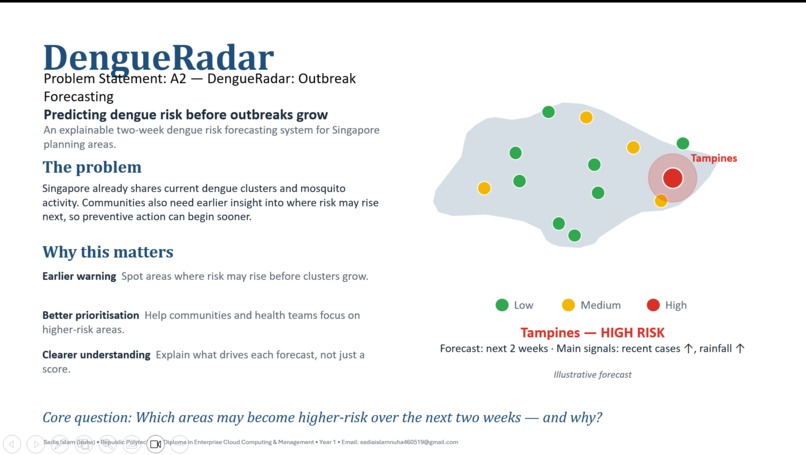
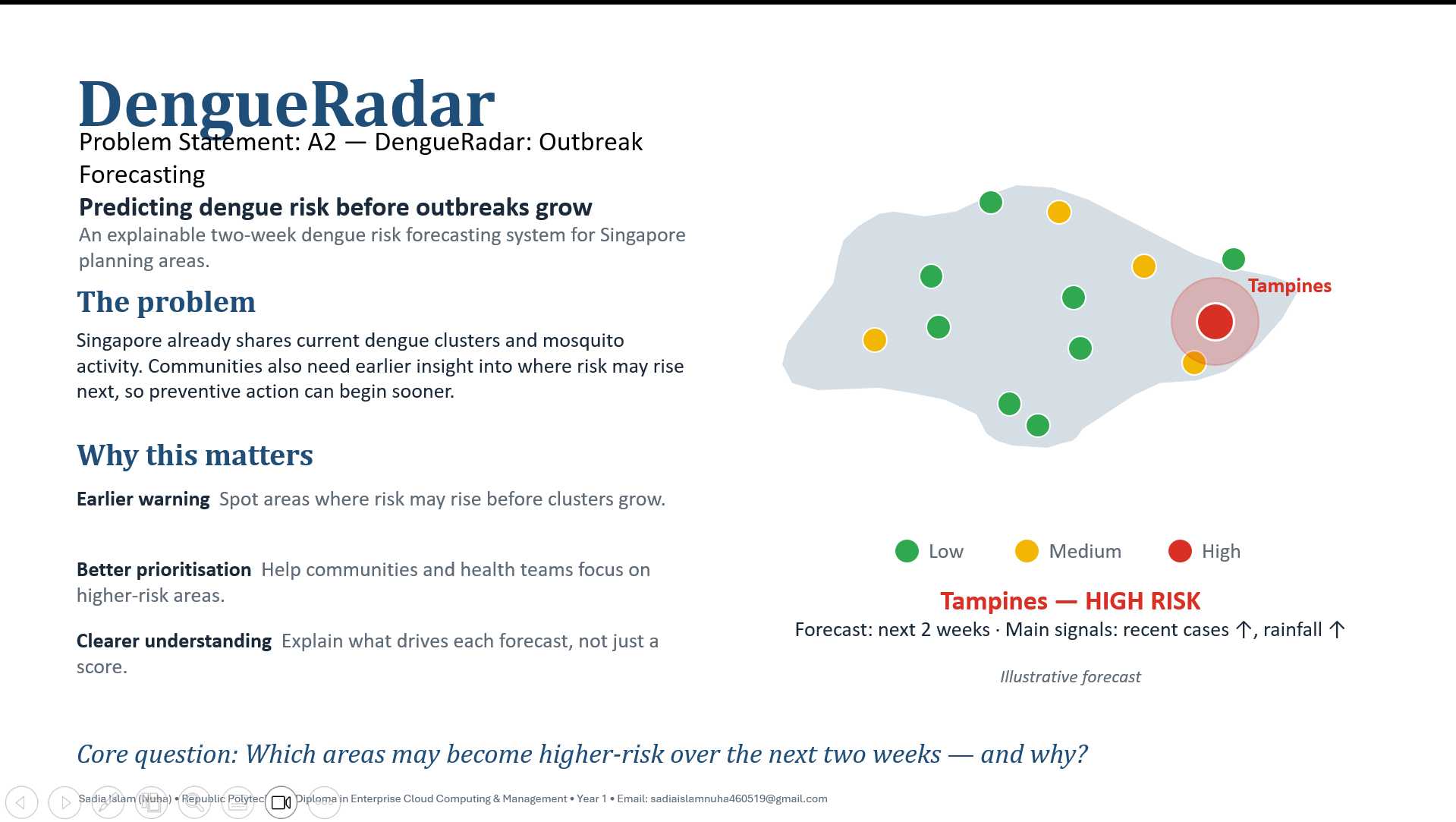
DengueRadar concept: an explainable two-week dengue risk forecast for Singapore planning areas. Illustrative forecast only.
Inspiration
Inspiration DengueRadar was inspired by Singapore’s existing dengue monitoring efforts and by the book Defeating Dengue: A Multistakeholder Approach to Problem Solving. The book highlighted that dengue is not solved by technology alone — effective prevention also depends on timely information, community participation, and coordination between different stakeholders. This led me to think about how public dengue and weather data could be turned into an earlier, easier-to-understand warning system. Instead of only showing where dengue activity is happening now, DengueRadar aims to estimate where risk may rise over the next two weeks, explain the main factors behind the forecast, and help communities act earlier.
What it does
DengueRadar is a proposed two-week dengue risk forecasting system for Singapore planning areas. It would combine public dengue, rainfall, temperature and location data to classify each area as Low, Medium or High risk. Rather than only showing a risk score, DengueRadar would also explain the main factors behind the forecast, such as:
- rising dengue activity
- increased rainfall
- favourable temperature conditions The aim is to make the forecast easier to understand and more useful for preventive action.
How I plan to build it
DengueRadar would use Databricks as the main platform for data processing and predictive modelling. The proposed workflow is:
- Ingest public dengue and weather datasets from NEA and data.gov.sg.
- Clean and combine the data by location and time.
- Aggregate the information by Singapore planning area.
- Train a predictive model using historical dengue and weather patterns.
- Forecast dengue risk up to two weeks ahead.
- Classify each planning area as Low, Medium or High risk.
- Display the results through an interactive Singapore map or web dashboard.
- Explain the main factors contributing to each forecast. If shortlisted, I would also compare the forecasting model against a simple baseline to check whether it provides useful improvement over recent historical trends.
Challenges I ran into
One challenge was understanding how DengueRadar could add value without simply recreating Singapore’s existing dengue monitoring tools. After reviewing current public-facing dengue information, I decided to focus the project on forward-looking, explainable forecasts rather than only displaying current clusters. Another challenge was keeping the idea realistic for the hackathon. Since I am still developing my coding skills, I chose to focus on a clear end-to-end forecasting workflow rather than proposing an overly complex AI system. I also had to think carefully about how predictions could lead to useful action instead of becoming just another dashboard.
Accomplishments that I'm proud of
At this stage, I am proud of developing a focused project concept that connects data, forecasting, explainability and social impact. I have:
- identified the main public datasets needed for the project
- developed a realistic Databricks workflow
- designed a two-week planning-area risk forecasting concept
- included explainability so users can understand why risk may be increasing
- considered how the forecast could support residents, community organisations and public-health planners I am also proud that the project is designed to complement existing dengue monitoring, rather than trying to replace it.
What I learned
Through researching this project, I learned that dengue prevention is much more complex than simply predicting case numbers. Data is useful only when people can understand it and act on it. I also learned the importance of designing technology around existing systems. Instead of asking, “How can I build another dengue map?”, I started asking: “What information could help people act earlier?” That question became the main idea behind DengueRadar. I also learned more about how environmental factors such as rainfall and temperature can be connected with historical dengue patterns for forecasting.
What's next for DengueRadar
If DengueRadar is shortlisted, the next step would be to build the working prototype in Databricks. I would focus on:
- connecting the selected public datasets
- preparing the data by planning area and time
- developing and testing the forecasting model
- comparing it against a simple baseline
- building an interactive Singapore risk map
- adding clear explanations for each forecast
- testing how well the system predicts future dengue activity In the longer term, DengueRadar could potentially include automated risk alerts and clearer recommendations for different users, while continuing to complement Singapore’s existing dengue monitoring efforts.
Built With
- databricks
- machine-learning
- pandas
- python
- sql

Log in or sign up for Devpost to join the conversation.