-
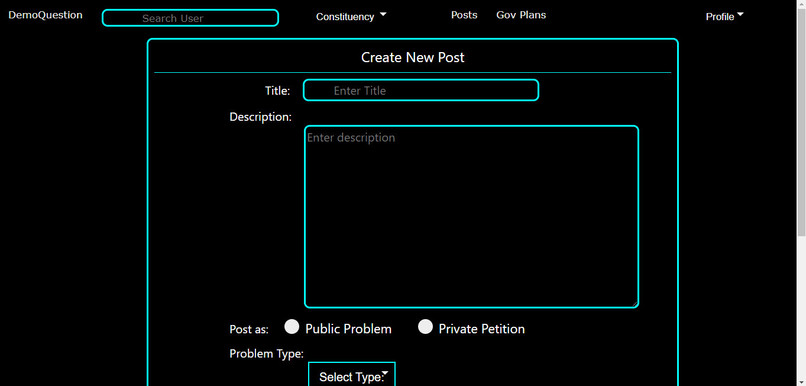
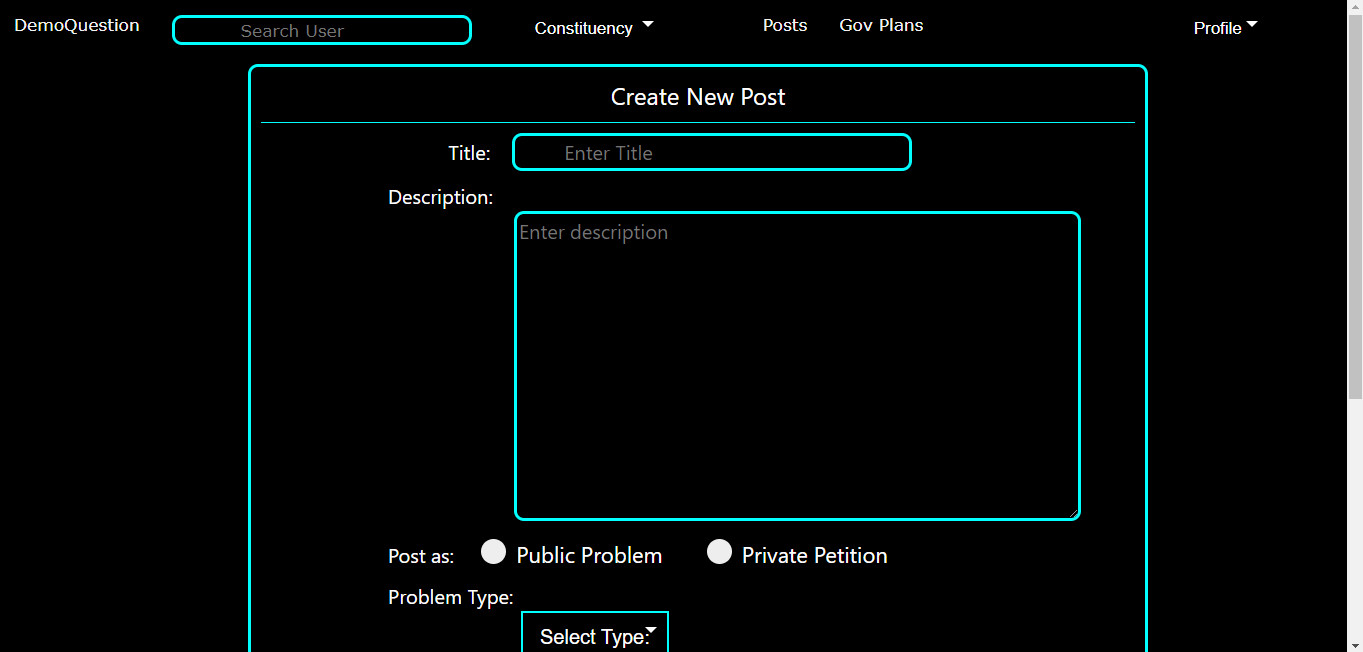
Create Post Form(Sample)
-
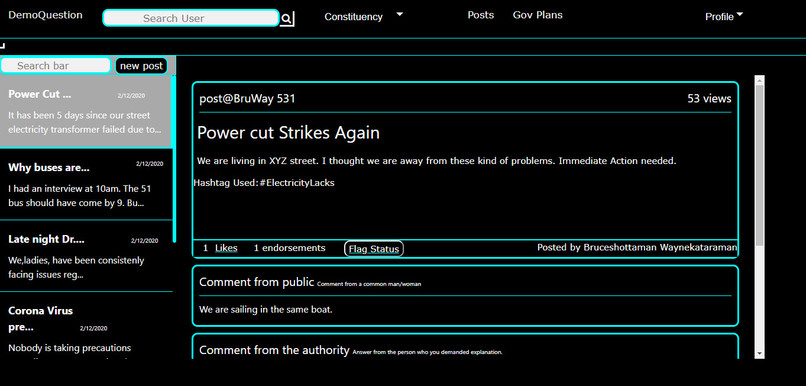
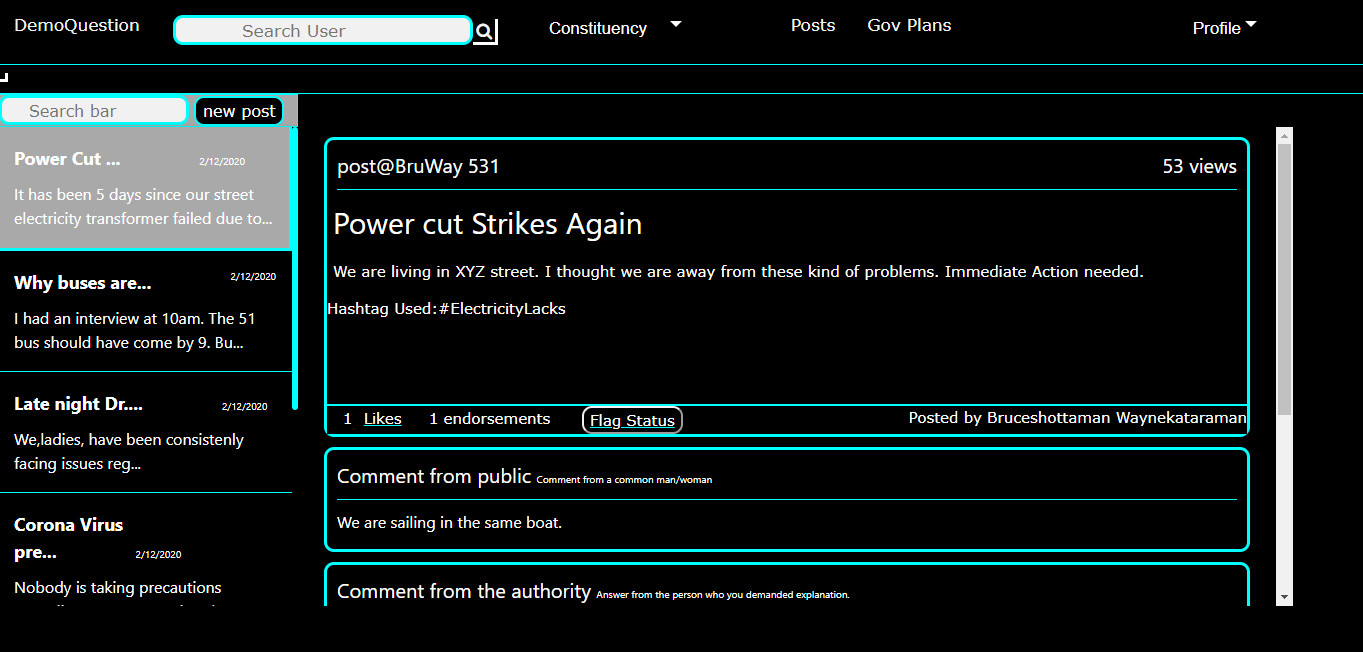
Home Page(Sample)
Inspiration
I always wondered about the interest of humankind to measure any kind of quantity whether it is about measuring distance in meters or measuring weight in grams or measuring volume in liters, etc. In fact, we even measure a person's popularity with the likes and shares he/she gets in social media. But what about democracy? Of course, we have many measures like CPI, DI,etc. But these measures are actually not exact. They just rely on survey taken with random citizens. But what if we could measure democracy? What if democracy could be digitized?
What it does
My web application is just a model of how e-democracy will look like. It is based upon a simple concept. The country can be divided into states. The state can be divided into constituencies. The constituencies can be divided into cities, towns, villages. Users are divided into 3 categories: 1.Citizens, 2.Public Servants 3. Politicians. Users will be posting their problems. There are 3 kinds(categories) of problems:
- DLP(Daily Life Problems within home issues like power-cut,etc.)
- MTDLP(More than Daily Life Problems which occur within your locality like late buses,etc.)
- HLP(High Level Problems which demand explanation directly from politicians. For example, Enough budget has not been allocated by the state government for state university expenses which causes rise in tuition fees of students.) Both DLP, MTDLP will have Flags which means whomever they tag(For example, Electricity Office in your COnstituency), the flag will be raised to them as an indicator of a problem to be solved. This flag can be passed on by authorities within them. By this means, the citizens can actually know who is responsible if their problem keeps on continuing. HLP don't have flags because the government can't be very transparent in regard with serious issues because their transparency might make the people panic. Both MTDLP and HLP will have hashtags to categorize problems. For example, two users living in same locality might have issues with late buses and post the same problem as separate posts. In order to categorize these kind of problems, we have hashtags. Each Problem will have a threat status which is the key to determine the efficiency of the government. Threat Status is actually a rating on the scale below: PS(Problem Solved) 1 2 3 4 5 TB(Trust Broken) This threat status will be updated by the user every 24 hours. Either email will be sent to them or when they login to the website, a pop-up without close buttons will show up asking his/her current threat status. Now, Efficiency of Government= (the number of problems with threat status=PS/(total number of problems(total_problems)) Accountability of Government=(the number of problems with threat status<3/(total number of problems(total_problems)) These formulas can be altered to break-down efficiency and accountability for a particular constituency, city, government office, government department, civil servants, politicians, etc. This app will let people as well as the government know where exactly efficiency of the government is being problematic. Also, this app will allow people, civil servants and politicians to get to know about the exact problems people face within a particular locality, constituency or city and the number of people believing in fake news will be reduced. People, civil servants and politicians will stay connected. The efficiency and accountability calculated is actually a measure of how well democracy is being protected in the ruling party's governance. Also, these meausres serve just like imDB movie ratings. Though imDb ratings might not tell about the actual quality of the movie, it justs says how many people love watching the movie. Similarly, these measures just say how many people are actually happy about the government which is what is more important in democracy rather than just categorizing whether the government is good or bad.
How I built it
My main problem was that this app was way too hard to build single handedly(I am the only member in my team. In fact, I am the team.) I didn't want to use APIs and libraries because this entire communication app should have its own uniqueness. I went through many templates in Google APIs but none matched what I wanted exactly except few websites like Piazza for which I couldn't find appropriate APIs and libraries they used. I just built some html pages as user interfaces(in terms of citizens).
Challenges I ran into
As you can see, it is like building a social communication like Facebook, Twitter within 36 hours gap. I tried to at least get a model full stack web application of the app along with my friends who were supposed to be my team. But due to corona virus threat, none of them showed up here and I was left alone. So, I couldn't do anything much and I couldn't do the back end too. So, I have just done 16-20% of the entire project. I would have done a lot more but my circumstances didn't allow me.
Accomplishments that I'm proud of
The home page itself had 10-16 features to build. That is how I created the design for this app. I would have implemented at least 60-70% of the front-end(as HTML).
What I learned
I learnt a lot about many UI features of social networking apps like likes for post, filtering div tags, autocorrect suggestions for a searchbar, live filtering searchbar, onclick display block, filtering based on hidden data stored in an onclick display block, etc.
What's next for DemoQuestion
I will definitely develop my entire design for this project into a full-stack web application and I will make this web application which will be accepted by the people as a non-ignorable reality.

Log in or sign up for Devpost to join the conversation.