-
-
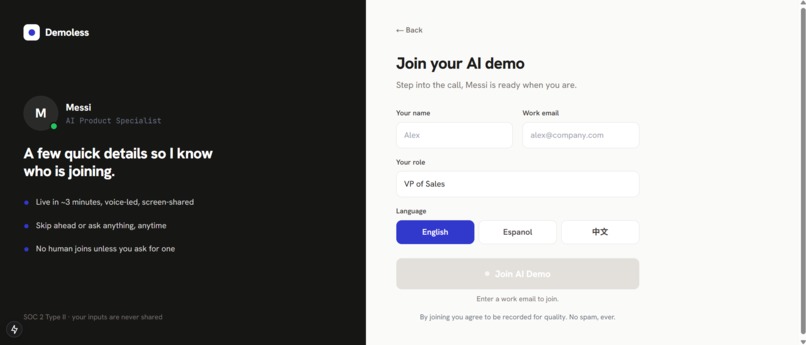
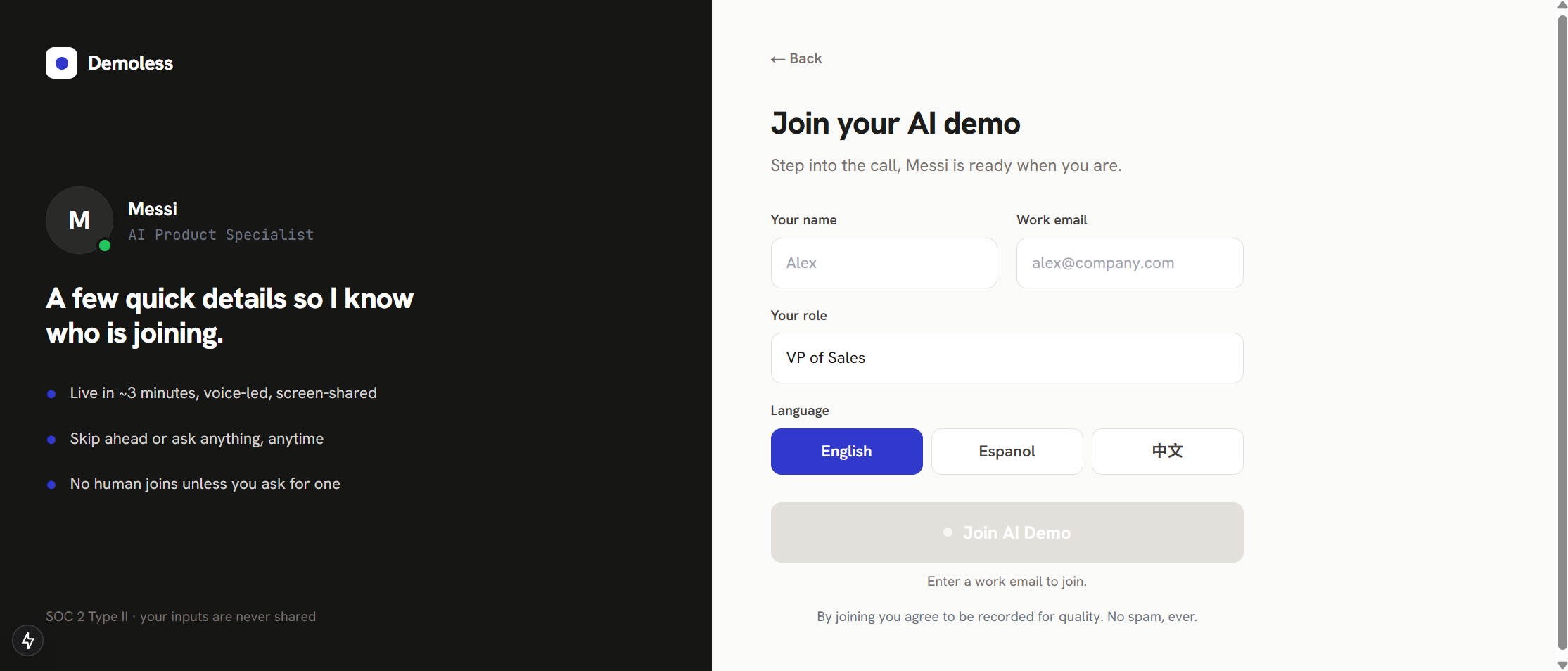
User info input -> triggers role selection
-
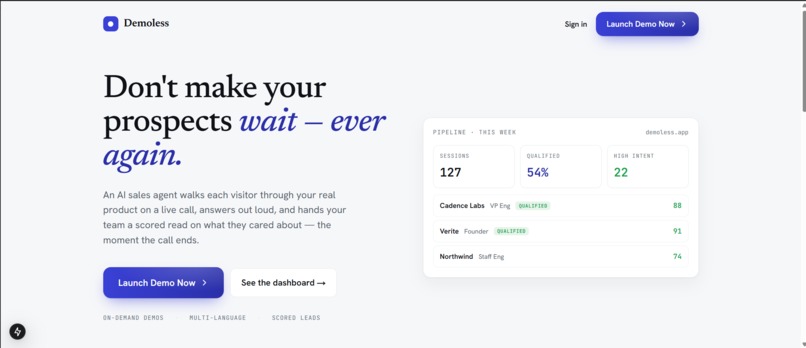
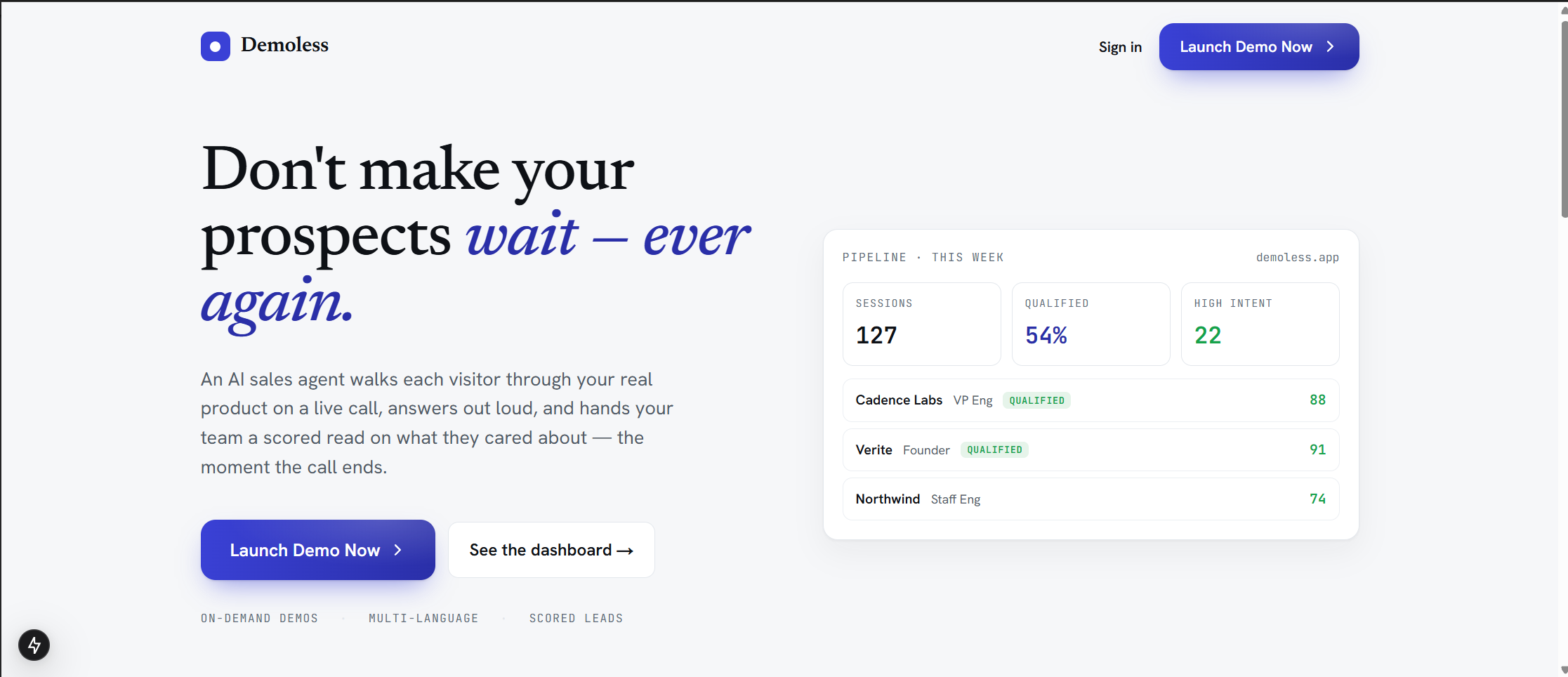
Home page
-
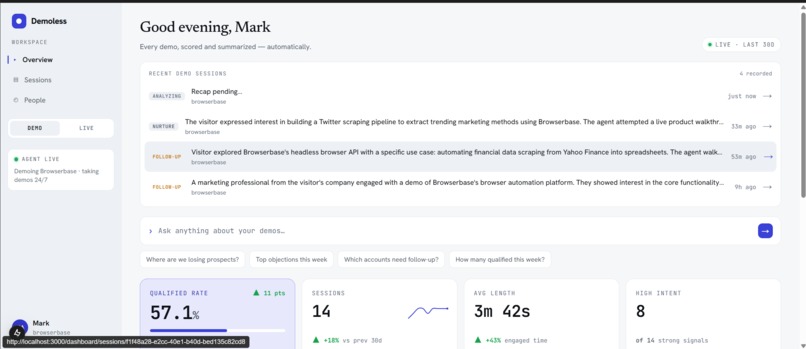
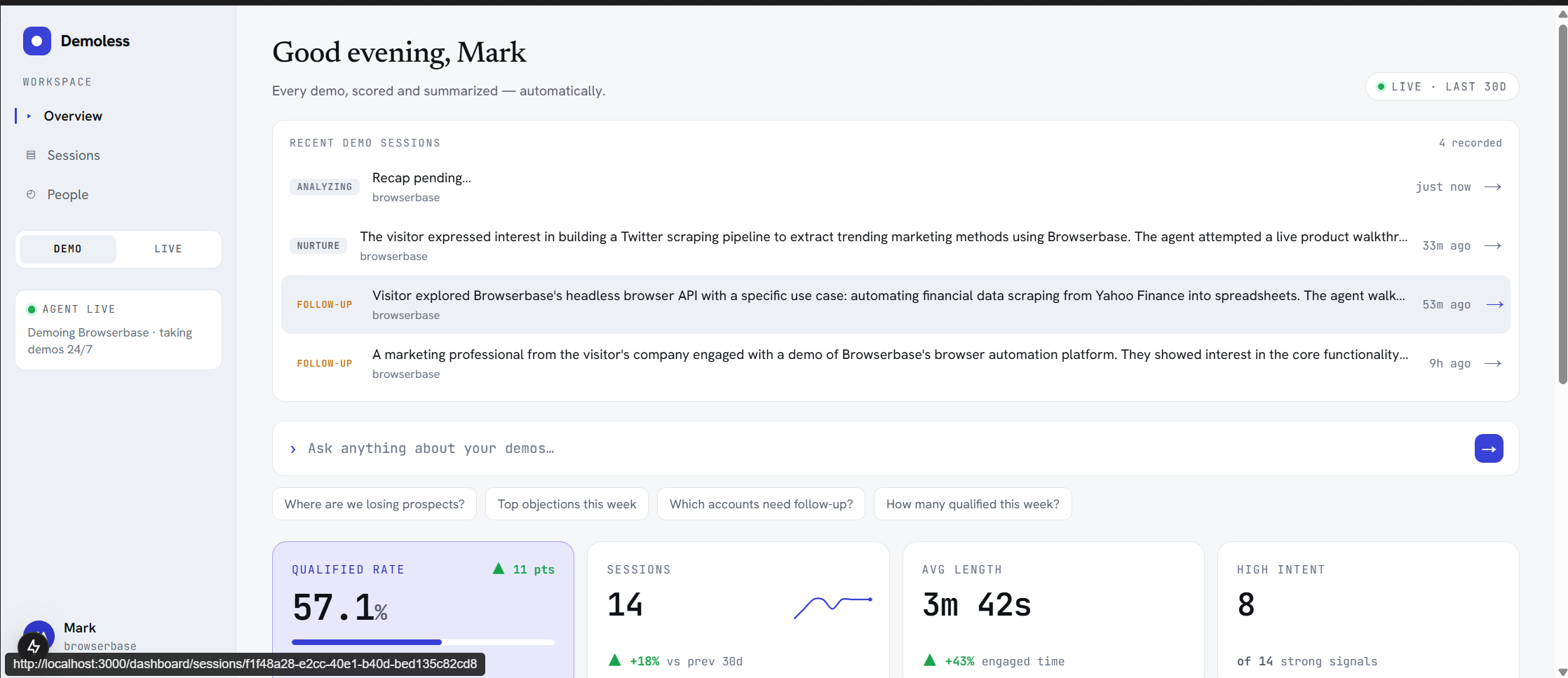
Dashboard overview
-
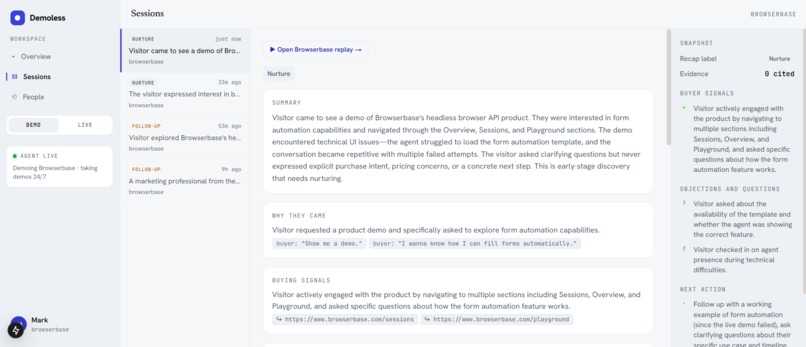
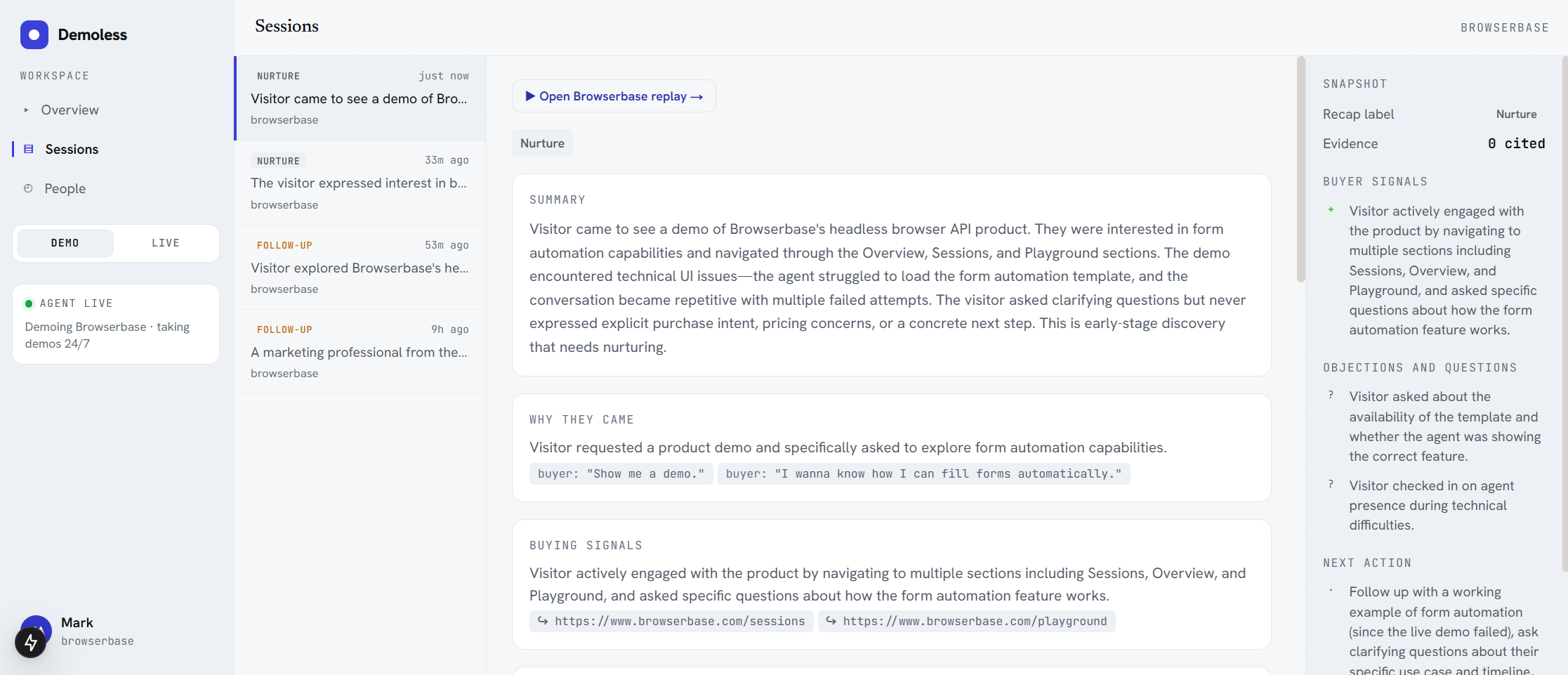
Session insights
-
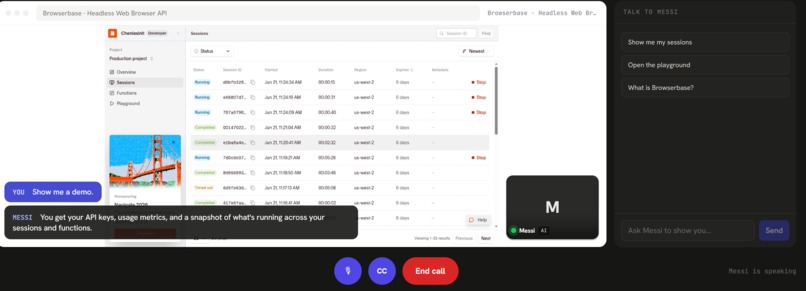
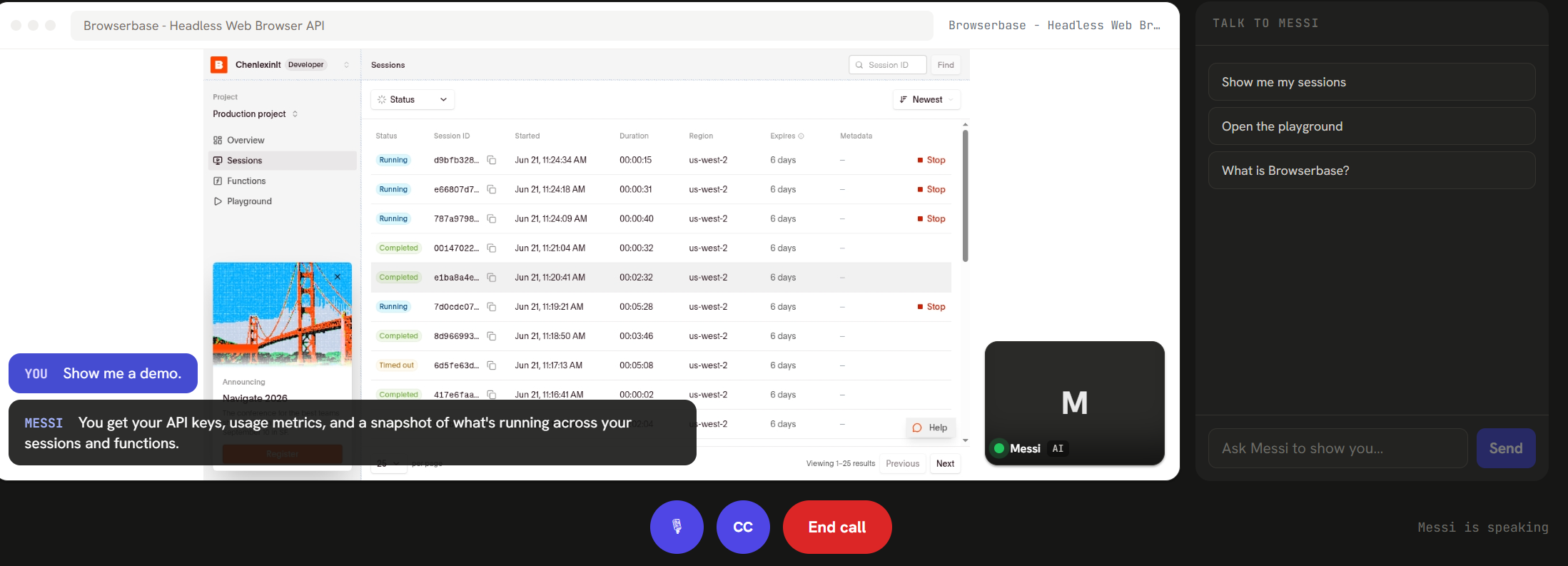
Live demo
Demoless
An AI product specialist that runs live, personalized software demos on your website, 24/7.
Inspiration
For most B2B software companies, the live demo is where deals are won, and it is also the biggest bottleneck in the funnel. A visitor lands on the site with real intent, clicks "Book a demo," fills out a form, and then waits days for a calendar slot. By the time a human rep finally jumps on a generic call, the moment of interest is long gone. Demos do not scale: reps are expensive, they sleep, they are not available the instant a prospect is curious, and they cannot be in fifty time zones at once. The result is a leaky funnel where the vast majority of interested visitors never see the product actually work.
We wanted to remove that bottleneck entirely. What if every visitor could get a real, live demo the second they wanted one, with a specialist who already knows the product cold, drives the actual app on screen, adapts to who is asking, and remembers them next time? That is Demoless: it sits on a company's site and demos their product for them, around the clock, so sales teams wake up to warm, qualified pipeline with full conversation context instead of cold form fills.
What it does
Demoless is an AI-led product demo platform. A visitor enters a few details, joins a live call, and talks to an AI product specialist named Messi. From the visitor's point of view:
- They talk, Messi talks back. Messi listens through the microphone (speech to text), thinks, and answers out loud with natural, low-latency voice. The visitor can interrupt mid-sentence and Messi stops and adjusts, the way a real rep would.
- Messi drives the real product live. Instead of describing features, Messi opens an actual cloud browser session that the visitor watches in real time, navigating the live product, clicking through real flows, and narrating only the value, not the clicks.
- It grounds every answer in the product. Before stating a fact, Messi retrieves the most relevant product documentation through semantic search, so answers are grounded in the company's real docs rather than guessed.
- It personalizes to who is asking. The visitor picks their role on the way in, which Messi classifies into a technical or non-technical persona and matches its depth and language to: precise and technical for engineers and builders, plain and outcome-focused for product, ops, and marketing roles. It keeps refining that read as the conversation unfolds.
- It remembers the buyer. Useful context (pain points, interests, objections, next steps) is saved during the call, and a returning visitor is greeted with a callback to what they cared about last time.
- It speaks multiple languages. The voice loop supports English, Spanish, and Mandarin, switchable on the fly, and can auto-detect the visitor's language from their first words.
- It hands off to the team. Every session is saved and analyzed into a post-demo packet for an operator dashboard, so the sales team gets structured, evidence-backed insights instead of a raw transcript. After each demo the agent also reflects on how it went and captures lessons it can apply to future demos.
How it works (end to end)
Visitor mic
   -> Speech to text (Deepgram nova-3)
      -> Claude brain (streaming, native tool use)
            - drives a real cloud browser (Browserbase)
            - retrieves grounded answers (Redis vector search)
            - remembers buyer context (Redis)
      -> Text to speech (Deepgram Aura-2)
   -> Visitor hears the answer and watches the live browser
A single streaming "brain" owns voice, browser control, and memory at once. As Claude generates a reply, the system speaks it sentence by sentence so the visitor hears the first words before the full answer is finished, and it executes browser and memory actions in the same loop.
How we built it
- Frontend: Next.js (App Router) with TypeScript and Tailwind CSS for the buyer-facing demo room and the operator dashboard. Next.js API routes serve the supporting data (agent name, operator info, the live notes feed, and auth), while the live demo itself streams over a WebSocket to the voice backend.
- Shared types: TypeScript across the whole stack. The frontend and backend share the same types for the voice protocol messages, buyer memory, and session records, which kept the real-time contract between them reliable.
- Voice backend: A Node WebSocket gateway manages each live conversation: turn-taking, barge-in (interruption handling), session lifecycle, and streaming audio to the browser.
- Speech: Deepgram for speech to text (nova-3) and text to speech (Aura-2), with a provider-agnostic TTS layer that also supports OpenAI and ElevenLabs voices. Mandarin output routes to OpenAI because it has the voice coverage Aura lacks.
- Brain and tool use: Anthropic's Claude is the orchestrator, running a streaming native tool-use loop with six tools (navigate, click, look, remember, search the knowledge base, and report sales phase). We run Claude Haiku 4.5 for cheaper token usage at the volume a 24/7 agent demands, and the same model handles post-session analysis and cross-session learnings. The model is configurable.
- Live browser: Browserbase powers each cloud browser session, using Sessions, an embeddable live view the visitor watches, replay links, persistent pre-authenticated contexts (to demo signed-in products), and a Playwright integration so Messi drives the real product. Stealth and proxy support is available for sites that need it.
- Memory and storage: Redis and Redis Stack hold two separate layers: per-buyer memory (profile and notes, ranked by importance and recency) and a product knowledge base (a larger document corpus retrieved by semantic search). Redis also backs session and dashboard state.
- Retrieval: OpenAI embeddings power vector search over the product knowledge base so Messi answers from real docs.
- Tooling: The project was built and debugged with Claude Code.
Challenges we ran into
- Making the agent feel like a sharp rep, not a tour guide. Getting Messi to show rather than narrate, lead with the buyer's biggest pain, and stop selling past a yes took heavy prompt engineering and persona tuning. Solved.
- Two memories that should not be confused. "Who is this buyer" and "what does the product do" are different problems with different storage and retrieval. We built them as two distinct Redis-backed layers, one ranked by importance and recency, the other by semantic vector search. Solved.
- Latency in a real-time voice loop. Speech, model output, browser actions, and audio playback all compete for the same seconds. We pipelined text to speech per sentence, cached the model prompt prefix, and tuned endpointing and barge-in so the conversation feels live. Solved.
Accomplishments that we're proud of
- A single streaming brain that listens, thinks, talks, drives a real browser, and remembers, all in one loop.
- Persona-aware demos: the visitor's selected role drives a technical or non-technical persona that shifts the agent's depth and language, refined further through the conversation.
- A complete memory and storage system covering agent memory, grounded knowledge retrieval, and post-demo insights.
- Real-time voice with interruption handling and multilingual support (English, Spanish, Mandarin).
- Demonstrably smarter responses through prompt engineering, agent memory, and disciplined tool use, plus the foundation for the agent to learn from each completed demo.
What we learned
We learned how to build an autonomous, agentic system from scratch and make it genuinely useful in real time: coordinating voice, live browser control, retrieval, and memory inside one streaming loop without it falling apart under latency. We learned how much of an agent's quality lives in prompt design, persona shaping, and grounded tool use rather than the model alone, and we designed the storage and knowledge layers with future scaling in mind as the user base grows.
What's next for Demoless
- CRM integration with tools such as HubSpot, Salesforce, and Clay, so qualified pipeline and full conversation context flow straight into the sales team's workflow.
- Deeper self-improvement for the agent, moving from per-session reflection toward continuous learning loops and reinforcement from outcomes.
- FAQ and conversion logs that capture recurring questions and the answers that led to buying intent, so the agent responds faster and sells better over time.
- Additional tool access so the agent can demo more complex workflows.
Built With
- anthropic
- browserbase
- deepgram
- next.js
- node.js
- openai
- playwright
- tailwindcss
- typescript
- vitest
- websocket


Log in or sign up for Devpost to join the conversation.