-
-
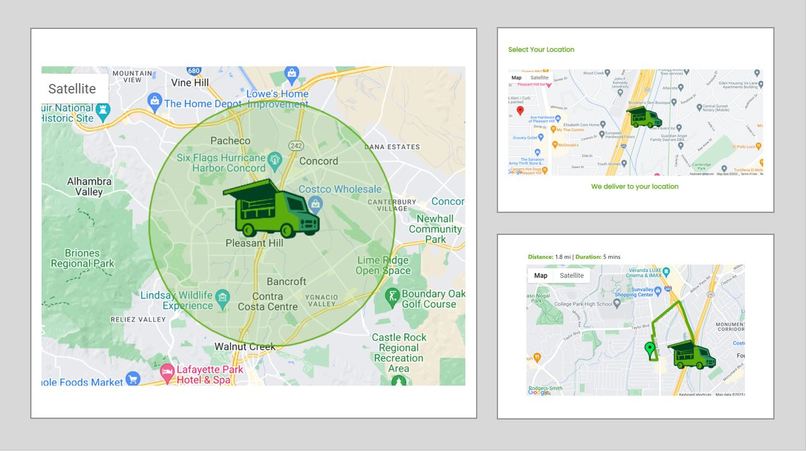
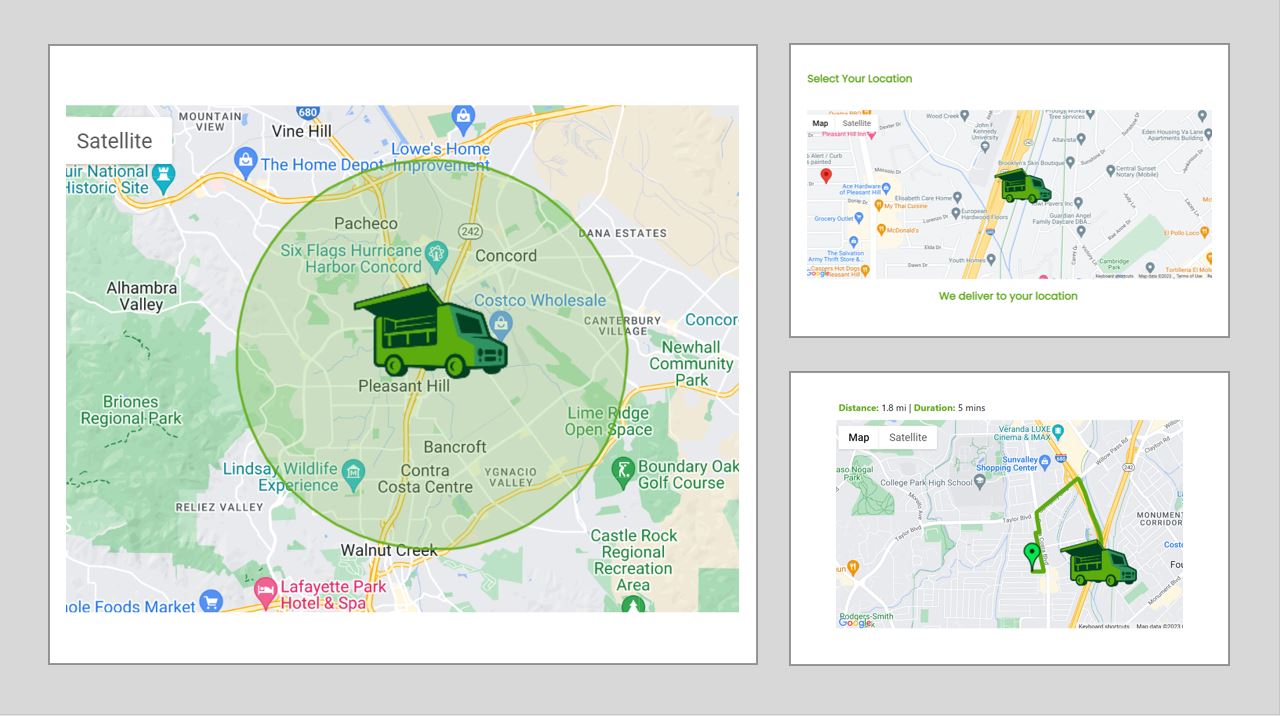
Geolocation
-
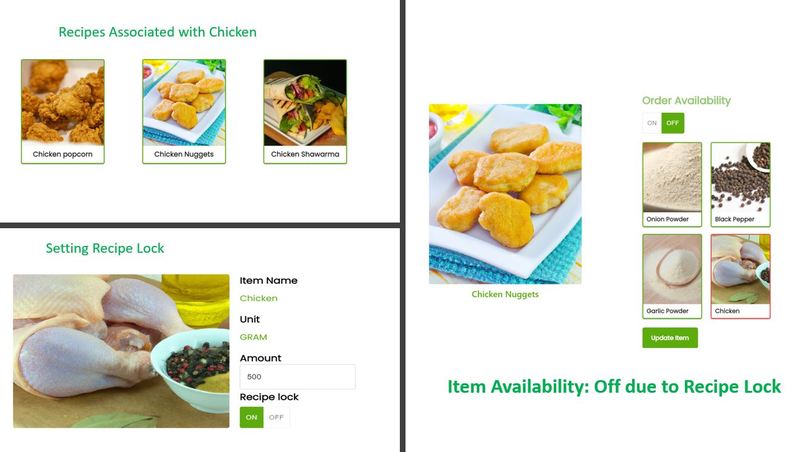
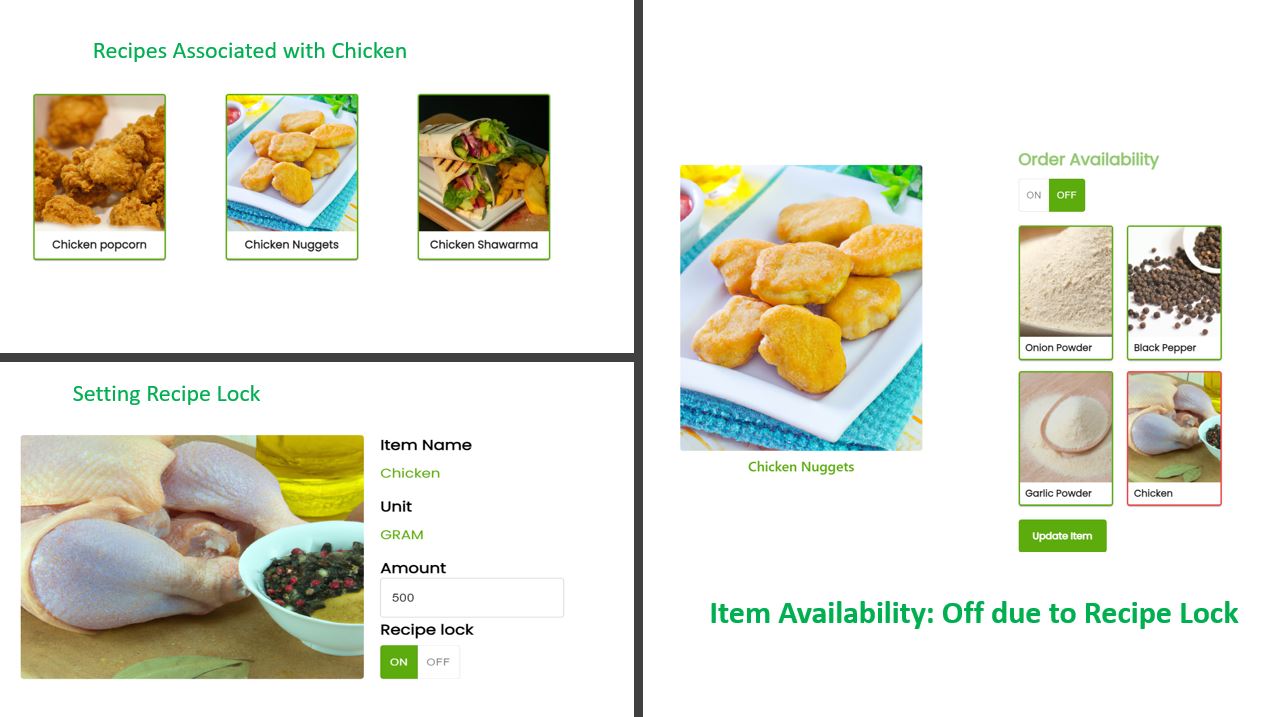
Recipe Lock
-
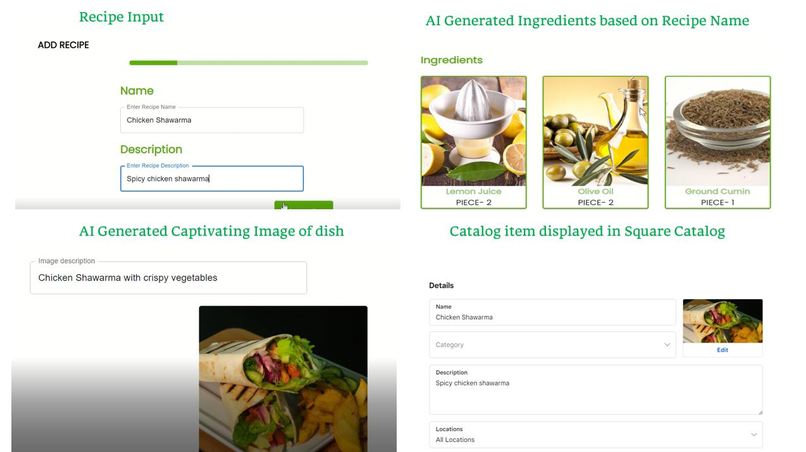
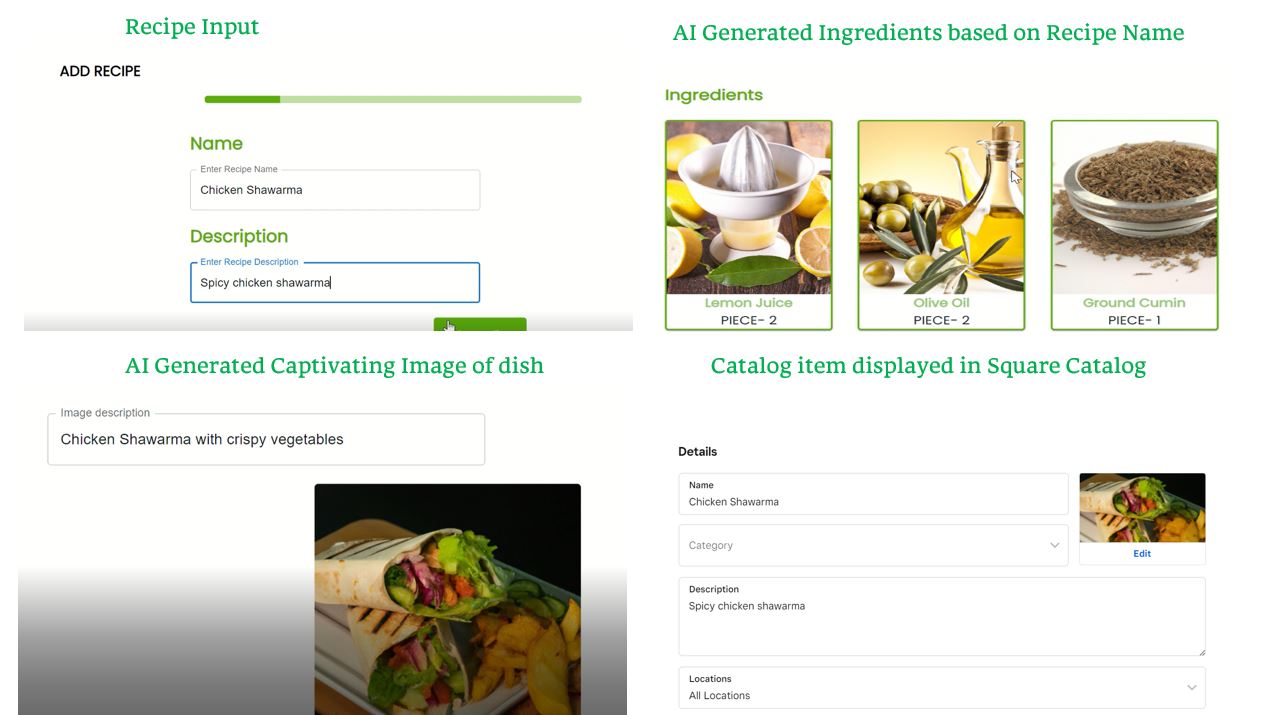
Catalog Creation
Inspiration
One day, during a conversation with a food truck manager, I became aware of the challenges they encountered: the arduous task of generating an enticing recipe catalog, the need to lock recipes when ingredients were unavailable, and the struggle of managing geolocation efficiently. Motivated by their challenges, I was driven to assist food truck managers by harnessing the power of the latest technologies.
What it does
Roaming Kitchen is a cutting-edge food truck management solution that revolutionizes the way food trucks operate and delight their customers. By harnessing the power of AI, geolocation, and seamless integration with Square APIs, Roaming Kitchen offers a comprehensive set of features designed to streamline operations, enhance customer experience, and drive business growth.
Catalog Creation:
Roaming Kitchen revolutionizes catalog creation by harnessing the power of AI. With a simple recipe name input, AI not only automatically generates captivating images but also generates the ingredients list, eliminating the burden of manually taking pictures and creating ingredient lists for managers.
This innovative approach saves time, reduces costs, and ensures a visually enticing menu that entices customers to explore and indulge in the delectable offerings. With Roaming Kitchen, managers can effortlessly showcase their culinary creations and focus on delivering exceptional food experiences to their customers.
Smart Inventory Management:
Managers can easily add ingredients to their inventory and keep track of stock levels. Roaming Kitchen's smart inventory management feature helps ensure accurate stock management, reducing waste and enabling managers to efficiently plan their purchases and maintain optimal inventory levels.
Geolocation:
Roaming Kitchen's geolocation feature offers a range of benefits for both customers and managers. With the Geofence feature, food truck managers can create a designated area within which they can efficiently deliver orders. Customers can conveniently select their location, ensuring a smooth ordering experience and checking the availability of their desired menu items for delivery.
With Roaming Kitchen's geolocation feature, managers can also access real-time directions and routes to efficiently deliver orders, saving time and ensuring timely service. This functionality streamlines the entire process, allowing managers to focus on providing exceptional food experiences to their customers while maximizing their operational efficiency.
Recipe Lock
Recipe Lock is a revolutionary feature offered by Roaming Kitchen that tackles a common problem faced by food truck managers and customers. Without Recipe Lock, managers and customers alike waste significant time and effort dealing with the challenges of unavailable ingredients. Research shows that on average, food truck managers spend approximately 2-3 hours per week manually locking individual recipes associated with unavailable ingredients, resulting in a loss of productivity and increased operational costs.
Furthermore, customers often face frustration when they come across menu items that are unavailable due to ingredient shortages. Studies indicate that customers spend an average of 10-15 minutes per order browsing through menus, only to discover that certain items cannot be ordered. This leads to disappointment and a negative customer experience, which can impact customer loyalty and overall revenue.
However, with Recipe Lock, these challenges are effectively addressed. By automating the process of hiding unavailable recipes, managers can save an average of 2-3 hours per week, allowing them to focus on other crucial aspects of their food truck business. Moreover, customers can enjoy a seamless and efficient ordering experience, with no wasted time on unavailable items. The implementation of Recipe Lock not only enhances productivity for managers but also improves customer satisfaction, leading to increased sales and repeat business.
Enhanced Customer Experience:
Roaming Kitchen provides customers with a user-friendly interface that makes exploring food truck menus, adding items to the cart, and placing orders a breeze. With an intuitive design and smooth navigation, the app enhances the overall customer experience, ensuring simplicity and enjoyment in discovering and ordering from food trucks.
Order Management:
Roaming Kitchen streamlines order management, allowing managers to efficiently process and track incoming orders. The app provides a centralized platform for managing orders, ensuring accuracy, and improving operational efficiency. Managers can easily view, update, and fulfill orders, keeping customers satisfied and the food truck running smoothly.
How I built it
- Frontend development was accomplished using React framework, leveraging its flexibility and component-based architecture. The UI design was enhanced with the use of Tailwind CSS for streamlined styling and responsiveness.
- The backend was developed using the Spring Boot framework, providing a robust and scalable foundation for the application. It enabled efficient handling of data processing and business logic.
- For data storage, Mysql was utilized as the database management system. Its relational model ensured reliable and structured data storage, supporting the application's functionality seamlessly.
- Integration with Square's system was achieved using the Square Java SDK.
Seamless Application Deployment with Bunnyshell:
- Bunnyshell, was employed to seamlessly deploy the application. Dockerfiles were created for both the frontend and backend, allowing for efficient containerization and deployment across various environments.
- To further optimize performance, Google's Distroless images were utilized for the Spring Boot application. These lightweight images exclude unnecessary components, resulting in faster startup times and reduced resource consumption.
- The use of Docker containers and Distroless images not only enhanced performance but also improved scalability and portability, enabling the application to be easily deployed and managed in diverse environments.
- Overall, the combination of Bunnyshell's hosting capabilities, Docker containers, Distroless images, and efficient deployment processes contributed to a streamlined deployment workflow and enhanced performance of the application.
Challenges I ran into
Integrating AI-generated images: Ensuring that the AI-generated images seamlessly integrate with the Square catalog required careful handling of data formats and compatibility.
Geolocation accuracy: Achieving precise geolocation data and ensuring accurate delivery availability required thorough testing and fine-tuning of the geolocation API integration.
Recipe locking logic: Implementing a robust recipe locking mechanism that automatically hides recipes containing unavailable ingredients posed challenges in terms of algorithm design and database management.
API integration complexities: Working with multiple APIs, such as Square API and Google Geolocation API, involved understanding their documentation, handling authentication, and managing potential conflicts or limitations between them.
Containerization and Docker: Setting up Docker containers for the frontend and backend, along with configuring the necessary networking and dependencies, required troubleshooting issues related to containerization and ensuring smooth communication between containers. Deployment automation: Automating the deployment process and ensuring proper environment setup, including handling configuration variables, required careful coordination and scripting.
Accomplishments that I am proud of
One of my proudest accomplishments is creating an application that directly addresses the challenges faced by food truck managers. By implementing features such as inventory management, recipe locking, and order fulfillment, I have built a solution that simplifies their daily operations and enables them to focus on providing exceptional culinary experiences to their customers.
Implementing AI algorithms to automatically generate recipe catalogs based on inputted recipe names was a major achievement. It involved leveraging AI technologies to accurately generate ingredient lists, resulting in time savings for food truck managers.
Implementing the AI-generated catalog image feature was a significant accomplishment. It not only saves time and resources but also enhances the visual appeal of the menu, contributing to a better customer experience.
Developing a user-friendly interface and intuitive design for the Roaming Kitchen application
I take pride in optimizing the application's performance by utilizing Google's Distroless images for the Spring Boot application and incorporating Docker containers for the frontend and backend. These measures ensure enhanced performance, scalability, and resource efficiency.
I am proud of being able to conceive, design, and develop the entire Roaming Kitchen application from scratch within the course of the hackathon.
What I learned
Throughout this project, I gained a comprehensive understanding of the unique challenges and requirements faced by food truck businesses. This experience allowed me to delve into the intricacies of inventory management, menu creation, and customer engagement specific to the food truck industry.
Working with Square APIs and Google's Geolocation API provided me with valuable insights into integrating third-party services into an application. I learned how to leverage these APIs effectively to enhance functionalities such as catalog creation, order management, and geolocation-based services.
During the development process, I gained hands-on experience in efficient application deployment using Bunnyshell. I learned to create and configure Dockerfiles for both the frontend and backend, enabling seamless containerization and easy scalability. Additionally, by leveraging Google's Distroless images for the Spring Boot application, I significantly improved performance and enhanced the overall security of the application.
What's next for Roaming Kitchen
- The next step for Roaming Kitchen is to incorporate advanced analytics and reporting capabilities. This will provide valuable insights to food truck managers, allowing them to make data-driven decisions and optimize their operations further.
- Implement OAuth authentication to enhance the security of the application. By integrating OAuth, users will have a secure and streamlined login experience, protecting their personal information and ensuring the integrity of their data
- Roaming Kitchen plans to integrate with popular third-party services, such as delivery aggregators, to provide a seamless end-to-end experience for both food truck managers and customers.
- Improve the user interface and design of the application, making it more visually appealing, intuitive, and user-friendly.
Built With
- ai
- amazon-web-services
- bunnyshell
- geolocationapi
- mysql
- react
- springboot
- square
- tailwind
- tidb

Log in or sign up for Devpost to join the conversation.