-
-
DemetIQ - Helping you care for the ones you love, one day at a time.
Inspiration
I've seen firsthand what it's like to watch someone you love live with dementia. The agitation episodes are the hardest part — not just for the patient, but for the caregiver who feels helpless, exhausted, and heartbroken, especially when the person they're caring for no longer remembers who they are.
That feeling of losing hope while still showing up every day — that's what DementIQ is built for. Caregivers deserve a tool that helps them stay one step ahead, so they can show up prepared instead of overwhelmed.
What it does
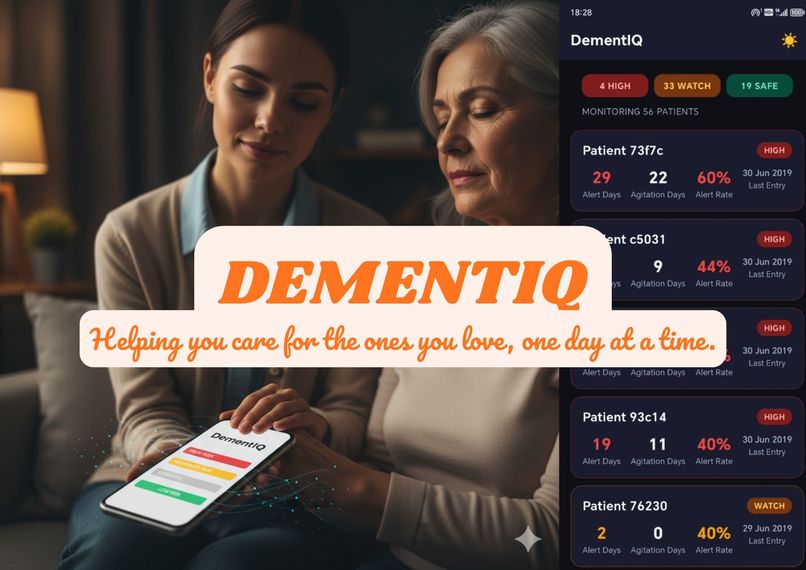
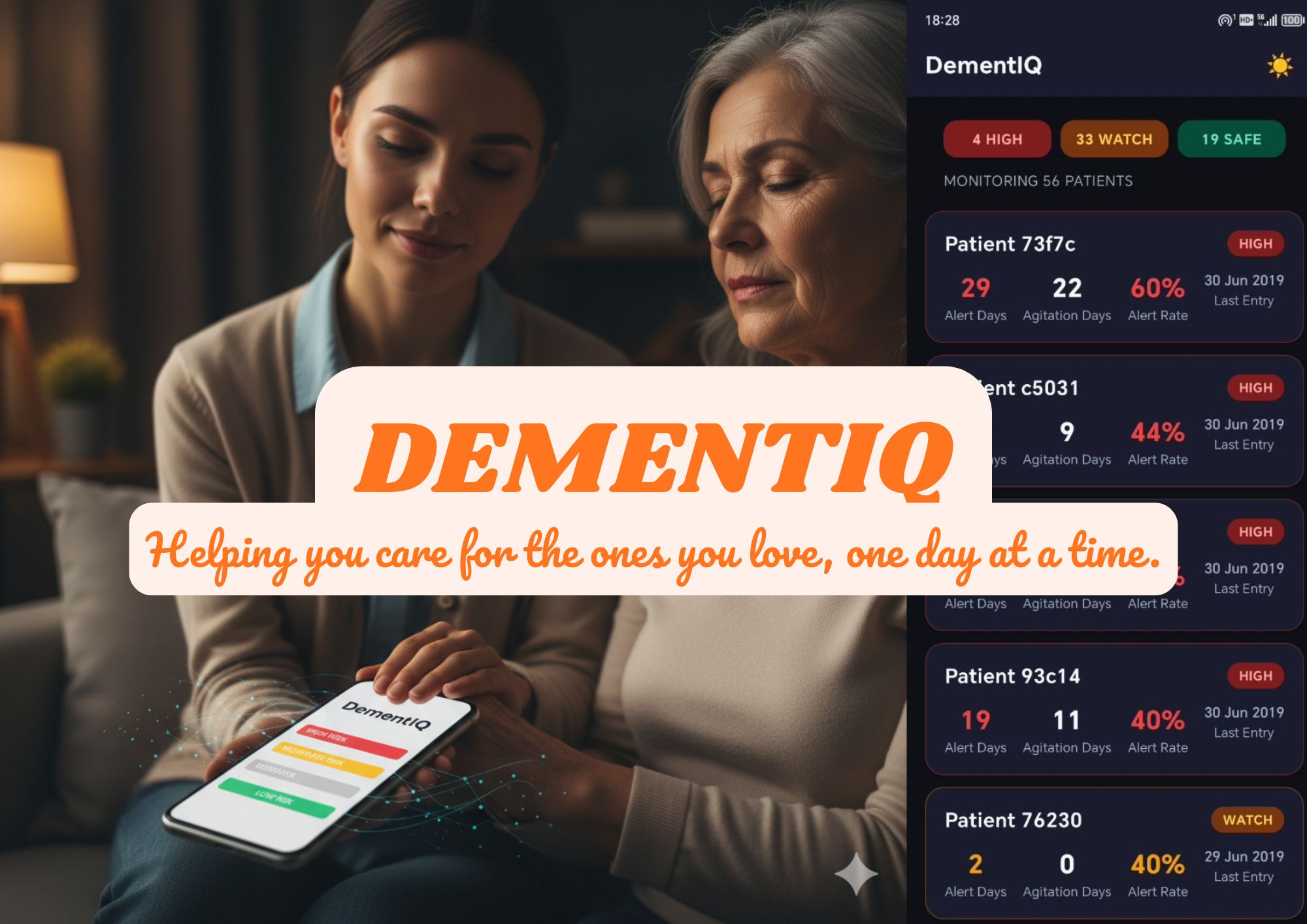
When a caregiver opens DementIQ, they immediately see their patients ranked by risk level — HIGH, WATCH, or SAFE — based on that day's sensor data analysis. No guessing, no waiting for something to go wrong.
Tapping into a patient's profile reveals their risk history, day-by-day trends, and a Care Tip — an AI-generated, plain-language guide on how to approach that person today based on their recent behavioral patterns.
If a patient is flagged HIGH risk, the caregiver can directly notify a clinician from within the app — turning an early warning into real action before a crisis happens.
How we built it
DementIQ brought together everything from my software engineering journey — machine learning, full-stack web development, and mobile app development — into one end-to-end system.
The foundation is the TIHM dataset (Imperial College London), the only open-source dementia dataset combining multimodal daily sensor data — activity, sleep, and physiology — with real clinical agitation labels. This made it the right choice for training a meaningful model.
From there, a Python pipeline handles feature engineering, trains a Random Forest classifier using Leave-One-Patient-Out cross-validation, and outputs daily risk predictions. A Node.js and Express.js API serves those predictions to both a React web dashboard and a React Native mobile app — DementIQ — where caregivers interact with the system daily.
Challenges we ran into
Finding a suitable dataset was the first major hurdle. Real dementia patient data is sensitive and rarely open-access — it took significant research before landing on the TIHM dataset as the right foundation.
The next challenge was the data itself. Out of 2,722 daily records, only ~109 were agitation events — a 4% positive rate. A standard model would simply predict "no agitation" every day and still achieve 96% accuracy, which is completely useless in a real caregiving context. Solving this required SMOTE oversampling, threshold tuning at 0.13, and prioritizing recall over precision — because missing a real agitation event is far more harmful than a false alarm.
Accomplishments that we're proud of
The moment predictions.json came out of the pipeline for the first time was the turning point. That file meant the model was real, the data was working, and everything built on top of it — the dashboard, the alert system, the mobile app — suddenly became possible.
From there, seeing it come together as a full working product felt genuinely rewarding: a complete end-to-end system achieving 79% recall on agitation detection, validated with Leave-One-Patient-Out cross-validation — an honest method that indicates the model can generalize to patients it has never seen before.
What we learned
This project taught me as much about persistence as it did about technology. Finding the right dataset, getting guidance from my advisor, training the model through countless iterations, and finally shipping a polished mobile app — each step required pushing through the urge to give up.
On the technical side, building a React Native and Expo app from scratch was completely new territory. Debugging took hours that sometimes felt endless — but the moment something finally worked made every minute worth it.
What's next for DementIQ
The dream is simple — no caregiver should feel alone in this journey. DementIQ's next step is to reach more caregivers, reduce their daily stress, and remind them that the person they are caring for — who may no longer remember their name — is still their loved one. That bond deserves every tool we can build.
On the technical side, the roadmap includes:
- Validating the model on datasets beyond TIHM for broader generalizability
- Multilingual Care Tips to serve non-English speaking caregivers globally
- Integration with wearable sensors for richer, real-time behavioral signals
- A clinician-facing dashboard for coordinated care between families and medical teams
- Exploring larger language models for more personalized and context-aware Care Tips

Log in or sign up for Devpost to join the conversation.