-
-
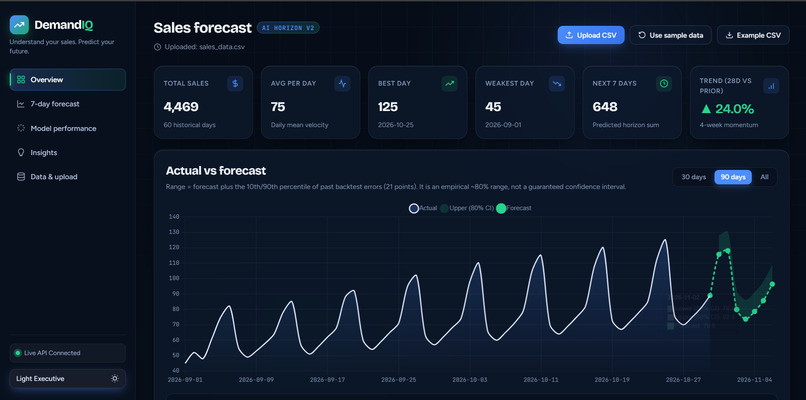
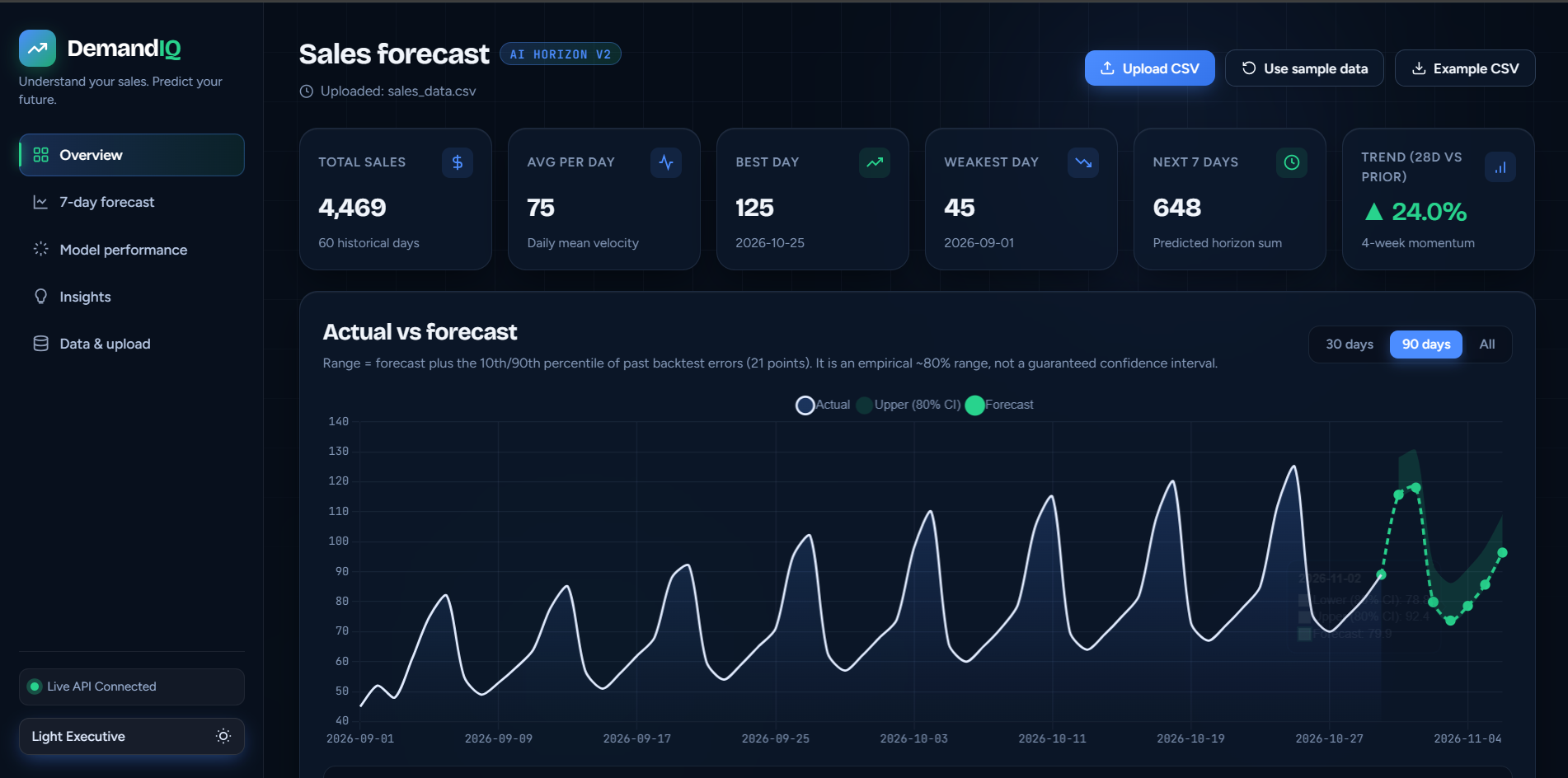
Actual vs forecast
-
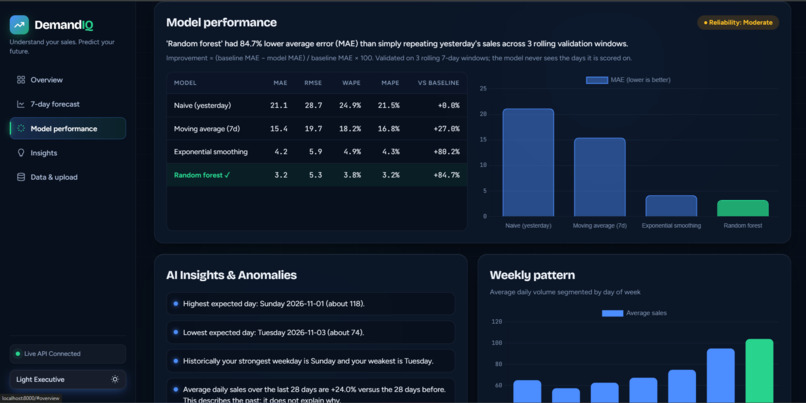
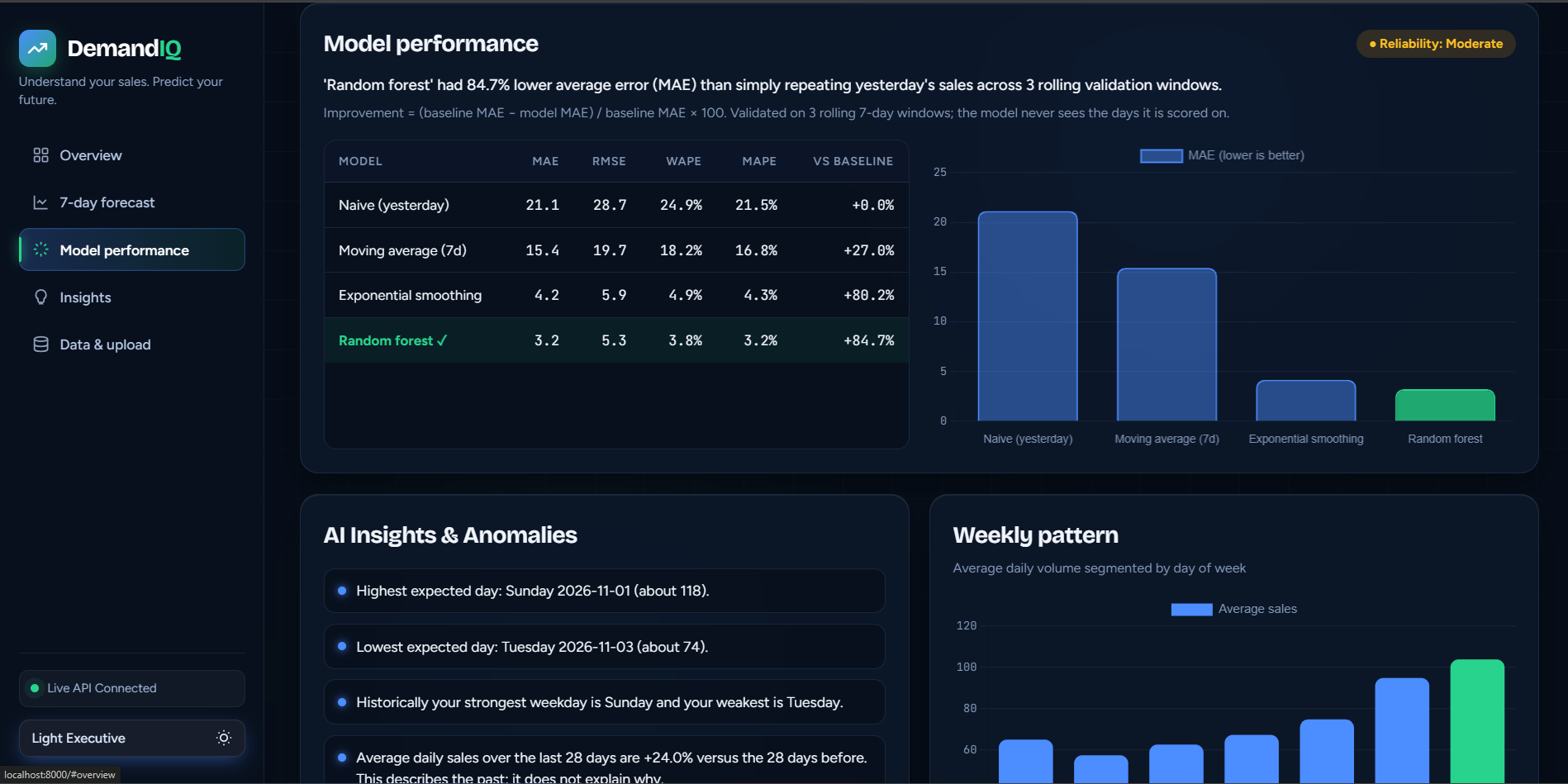
Model performance
Project Story — DemandIQ
Inspiration
I wanted to build something practical that connects machine learning with a real business problem. Small businesses generate sales data every day, but understanding that data and predicting future demand can be difficult without expensive tools or technical knowledge.
I came up with DemandIQ: a simple application that helps small businesses understand their sales history and get an idea of what the next 7 days might look like.
My goal was not just to build another forecasting model, but to create a complete tool that makes predictions understandable and useful.
What it does
DemandIQ is a sales forecasting web application that allows users to upload their daily sales data through a CSV file and receive a 7-day forecast.
It provides:
- Sales analysis: Overview of historical sales and key performance metrics.
- 7-day forecasting: Predictions of upcoming sales.
- Model comparison: Evaluates different forecasting approaches against a naive baseline.
- Forecast visualization: Displays historical sales, predictions, and an uncertainty range.
- Data quality checks: Detects duplicate dates, missing values, invalid entries, and other data issues.
- Sales insights: Highlights patterns and potential anomalies in the data.
The idea is to help users make more informed decisions based on their historical sales rather than relying entirely on guesswork.
How we built it
I built DemandIQ using Python for the forecasting and backend logic, with FastAPI handling the API and web application integration.
For forecasting, I implemented and compared several approaches:
- Naive forecasting.
- 7-day moving average.
- Exponential smoothing with weekday effects.
- Random Forest regression using historical sales features.
Instead of randomly splitting the dataset, I used rolling-origin validation to evaluate the models on different periods of historical data.
The application selects the model with the lowest validation Mean Absolute Error (MAE). It also estimates a forecast range using historical backtesting errors.
I developed the dashboard to make the results easy to understand through visualizations, metrics, and clear feedback.
Challenges we ran into
One of the biggest challenges was making the forecasting results reliable rather than simply producing numbers that look convincing.
Some of the main challenges were:
- Handling incomplete, duplicated, and invalid sales data.
- Choosing appropriate forecasting models for relatively short datasets.
- Avoiding data leakage during model validation.
- Building a fair comparison between machine learning models and a simple baseline.
- Communicating uncertainty without presenting predictions as guaranteed results.
- Connecting the forecasting backend with an easy-to-use web interface.
These challenges pushed me to think more carefully about data quality, model evaluation, and how real users interpret predictions.
Accomplishments that we're proud of
I am particularly proud of turning a forecasting concept into a working end-to-end application.
Some achievements include:
- Building a complete sales forecasting workflow, from CSV upload to predictions.
- Implementing multiple forecasting approaches and comparing their performance.
- Using time-aware validation instead of random data splitting.
- Adding data quality reporting and anomaly detection.
- Providing an empirical forecast range instead of presenting predictions as certain.
- Deploying the application online so it can be accessed and tested.
Most importantly, I am proud that DemandIQ focuses on making machine learning practical and understandable.
What we learned
Working on DemandIQ helped me understand that building a useful machine learning application involves much more than training a model.
I learned more about:
- Time-series forecasting and feature engineering.
- Rolling-origin validation and preventing data leakage.
- Evaluating models using MAE.
- Handling real-world data quality problems.
- Detecting anomalies using robust statistical methods.
- Building APIs with FastAPI.
- Connecting machine learning functionality to a web dashboard.
- Communicating model limitations and prediction uncertainty.
It also taught me that a simpler model with honest evaluation can sometimes be more useful than a complicated model with misleading results.
What's next for DemandIQ
I would like to continue improving DemandIQ and make it more useful for real small businesses.
Some ideas for future development include:
- Supporting more forecasting horizons, such as 14 and 30 days.
- Adding more advanced forecasting models.
- Supporting multiple products and categories.
- Including external factors such as holidays, promotions, and seasonal events.
- Adding historical forecast accuracy tracking.
- Improving recommendations to help businesses understand when and why sales patterns change.
My long-term vision is to turn DemandIQ into a practical forecasting assistant that helps small businesses make better decisions using their own data.
Live Demo: https://demandiq-4jnb.onrender.com
Project: DemandIQ — Understand your sales. Predict your future.
Built With
- anomaly-detection
- artificial-intelligence
- chart.js
- css
- csv-processing
- data-analysis
- data-science
- data-visualization
- demand-forecasting
- exponential-smoothing
- fastapi
- html
- javascript
- machine-learning
- numpy
- pandas
- predictive-analytics
- python
- random-forest
- rest-api
- sales-forecasting
- scikit-learn
- statistical-modeling
- time-series-forecasting
