Inspiration
The idea came while I was observing the difficulties with demand/supply in the beginning of the corona virus epidemics outbreak. The players (doctors, nurses, carers for elderly, shops, hospitals, ministeries, regions, states...) have stored items: but these were inadequate. It is not practical/possible to store sufficient amounts of items 'always'.
Time is vital in the beginning. The strategic decisions are being made by committees of 'wise leaders' who cannot have experience, do not coordinate, and may have other issues. This works for standard repetitive situations but may lead to crucial mistakes in the new reality of a dangerous epidemics. Smaller players of both demand-supply may find it difficult to get attention of the crises leaders. Coordination is random or missing.
I also observed difficulties in distributing channels: even when you get stuff, you need to distribute it timely, and there were problems, with logistics and optimisation of resources.
My conclusion: the standard traditional perfectly ok administration mechanisms are inadequate in times of dangerous epidemics. Decisions by humans-administrators, possibly no adequate experience exists, may lead to strategically wrong decisions with huge bad effects.
The aim of our work is to provide a help, a support system, a 'NAVIGATION' which players can use if they want. And the navigations of the players should be inserted into a dynamic interacting network.
What it does
The network of platforms should help avoiding bad strategic decision, by employing mathematics and informatics tools such as game theory, optimisation, security, artificial intelligence.
Each platform (a node of the network) will be like 'DNA' of a multicellular organism, hence will be initially uniform for all players. It is 'made alive' by setting values to 'critical constants'.
The constants determine the role of the platform in the network (doctor, ministry,..., transportation,...), its hierarchical status (which platforms are its bosses, its subordinates) and the current epidemics situation relevant for the platform.
The following is repeated regularly:
- Each platform also receives input from hierarchically related platforms.
- Each platform calculates its current supply-demand (both minimal and optimal) with time frame and costs.
- The network calculates optimal transactions and outputs it as a suggestion to the platforms. Some suggestions are taken some are redone until a final output is reached.
A realisation of a transaction is a chain of supply-demand actions; each elementary step in the chain is a market step (associated with its cost) or hierarchical step (associated with a kind of electronic recipe).
How I built it
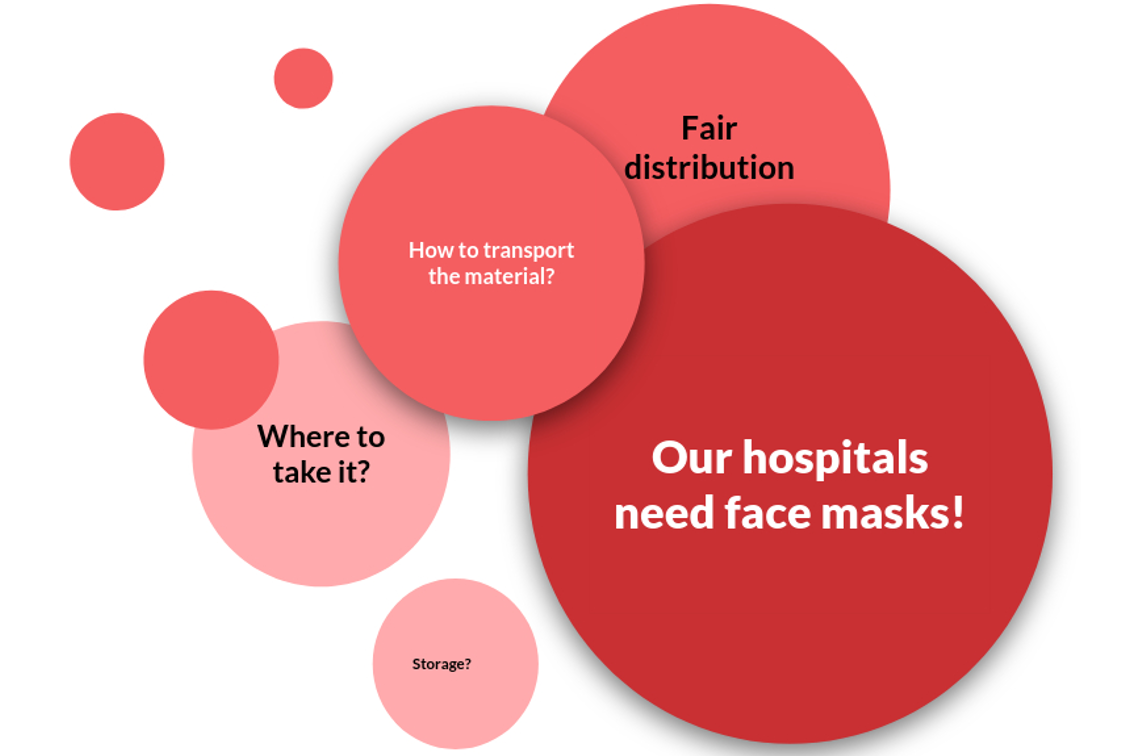
The strategy is described below in terms of Challenges. We decided to postpone the technicalities of the implementation and concentrate in specifying the problem. We are confident with the technical implementation given our expertise.
Challenges I ran into
The thing needs to work! in situations which we do not (completely) comprehend. Hence first principle is SIMPLICITY. Not universal complex many functions! Each platform conceptually simple, uniform, determined by a set of numbers.
The thing must contain communication mechanisms, inside the network and with the outside. The communication is to be simple, and in ALL languages. Hence, it will be by statements from a predetermined list. This is possible given the restricted function of the network. A feature of communication within hierarchy: a kind of electronic recipes. Since the network will be cross-domain, a unified communication protocol needs to be developed.
The network must be very flexible, easy to enter with my platform or delete my platform from it. This in fact makes the implementation challenging! An example of flexibility we have in mind is DEPOP. But, this network must be much more than that.
Introducing the structural constants and values is an important challenge of this project. Speaking with the virologist member of the team, the number of constants which are practically used to predict how an epidemics behaves in near future around a platform is relatively limited (small).
The calculations of the platforms (repeated regularly) are based on AI and Sharing of Data. The players generate data, e.g., how many respirators were needed in the local hospital yesterday. The players own their data and can share their anonymised data voluntarily for training of prediction mechanisms (AI) in the network. The prediction mechanisms answer queries like 'how many respirators will I need next week'. The players who share their anonymised data will have free access to the prediction mechanisms, those who do not share will pay for the access. Similar mechanisms are proposed by the 'Open ODR' project.
Security is crucially important as well as the protection of personal data according to GDPR principles.
There need to be strong reliability mechanisms embedded; we prefer this to be based on reviews mechanism (reliability indices) rather than central certification.
The network should support coordination! Using e.g. game theory tools, push against excess storing of commodities.
A related important part of the problem are 'incentives": how to motivate players to act in a useful cooperative way towards the common good, e.g., not to rise the cost of a rare commodity out of hand.
Training. The network will be initiated in peaceful times, but during epidemics people of different backgrounds will have to use this in short notice. Hence it must be extremely user-friendly and with well-developed training embedded. The elements of its interface should resemble common things in the internet.
It should be developed with public money, open source, and run with public monitoring (not of data but for security), and be as decentralised as possible.
Accomplishments that I'm proud of
We have a clear view of the specifications of the network and the platforms. I am glad the team is good. I wanted to have a state administrator in the team as well, which did not happen but I spoke with some on Friday. I believe we now have main features identified and there does not seem to be a strategic error.
What I learned
This may be an interesting concept! Is there sg like this around? Originally we had in mind, as related examples, DEPOP and workings of smart cities. But this has some important features which are quite different.
What's next for Demand/Supply in Epidemics
Our expertise is in mathematics, informatics, optimisation and game theory, law of internet and virology. We are confident with the technical implementation of this project given our expertise. The network should be developed with public money and be an open source. There should be monitoring by a public authority for the security. The network needs to be initiated and run in normal non-critical times and in different scales in order to test it and train the AI tools. The clear scalability increases the impact in epidemics and also in normal times. Having the network implemented will have a strong impact for the (corona virus) epidemics which may come back modified and into a different world since the proposed network is simple and adaptable.
The impact is clearly measurable by the size of the network and the number of transactions. Outside of the critical times of an epidemic, the network will be helpful for putting together the medical demand-support players and also supporting cooperation across borders in European medical demand-support.
Built With
- artificial
- game
- intelligence
- theory


Log in or sign up for Devpost to join the conversation.