-
-
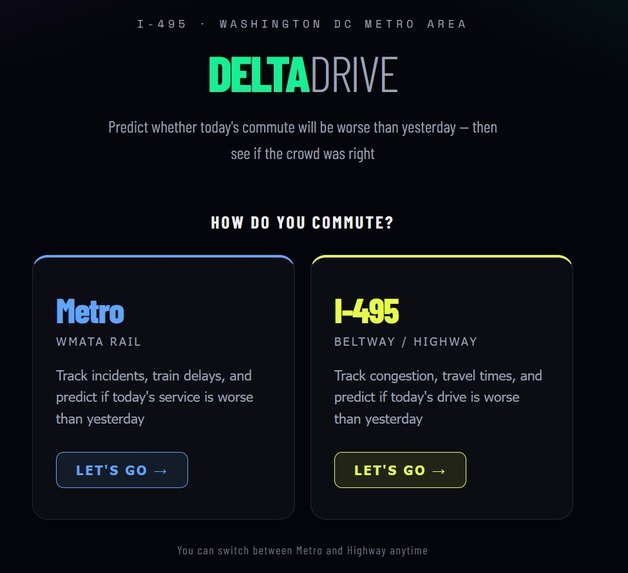
front_page
-
-
-
Inspiration
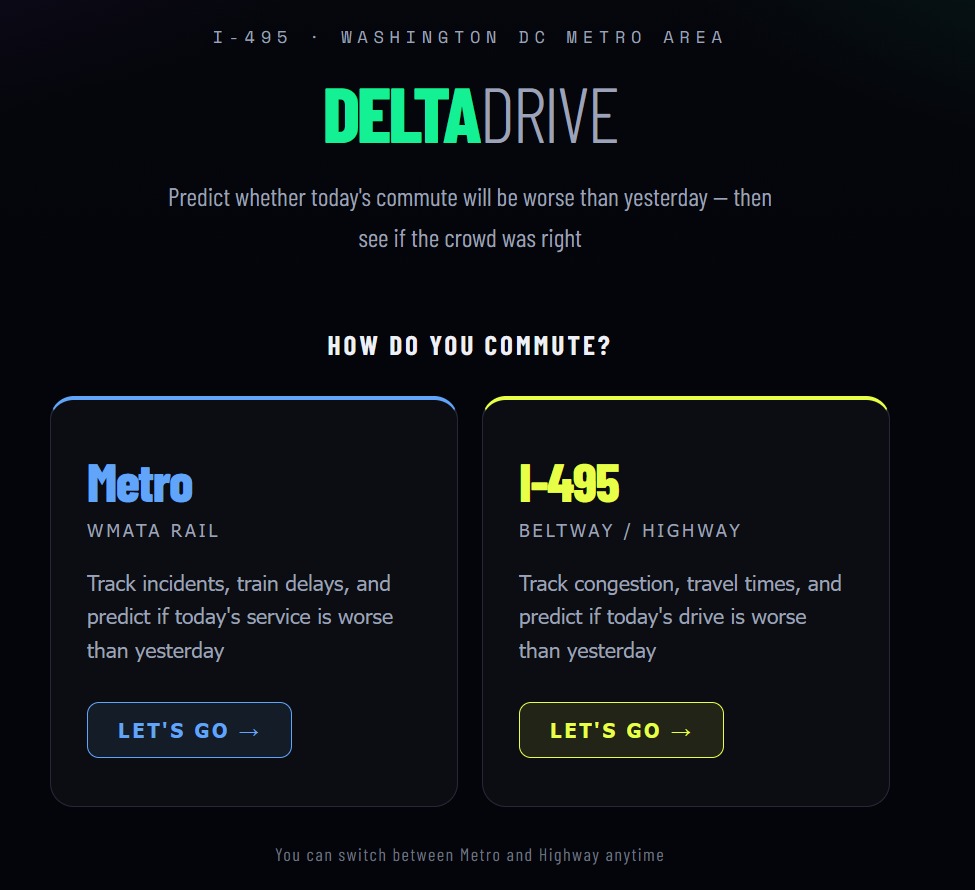
DC commuters face the same frustrating question every morning: is today going to be worse than yesterday? The I-495 Beltway and WMATA rail are two of the most congested corridors in the country, yet there's no single place to see both signals together, compare today against a historical baseline, and let a crowd make a verifiable prediction. We wanted to build that — not just a dashboard, but a live operational picture with skin in the game.
What it does
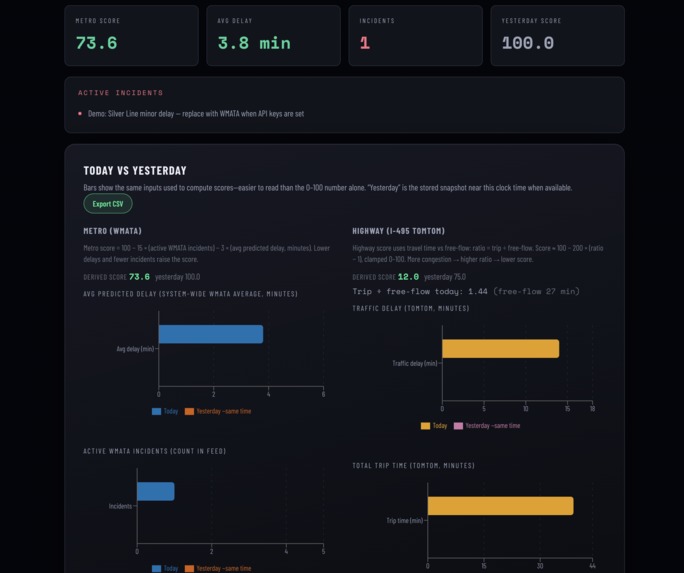
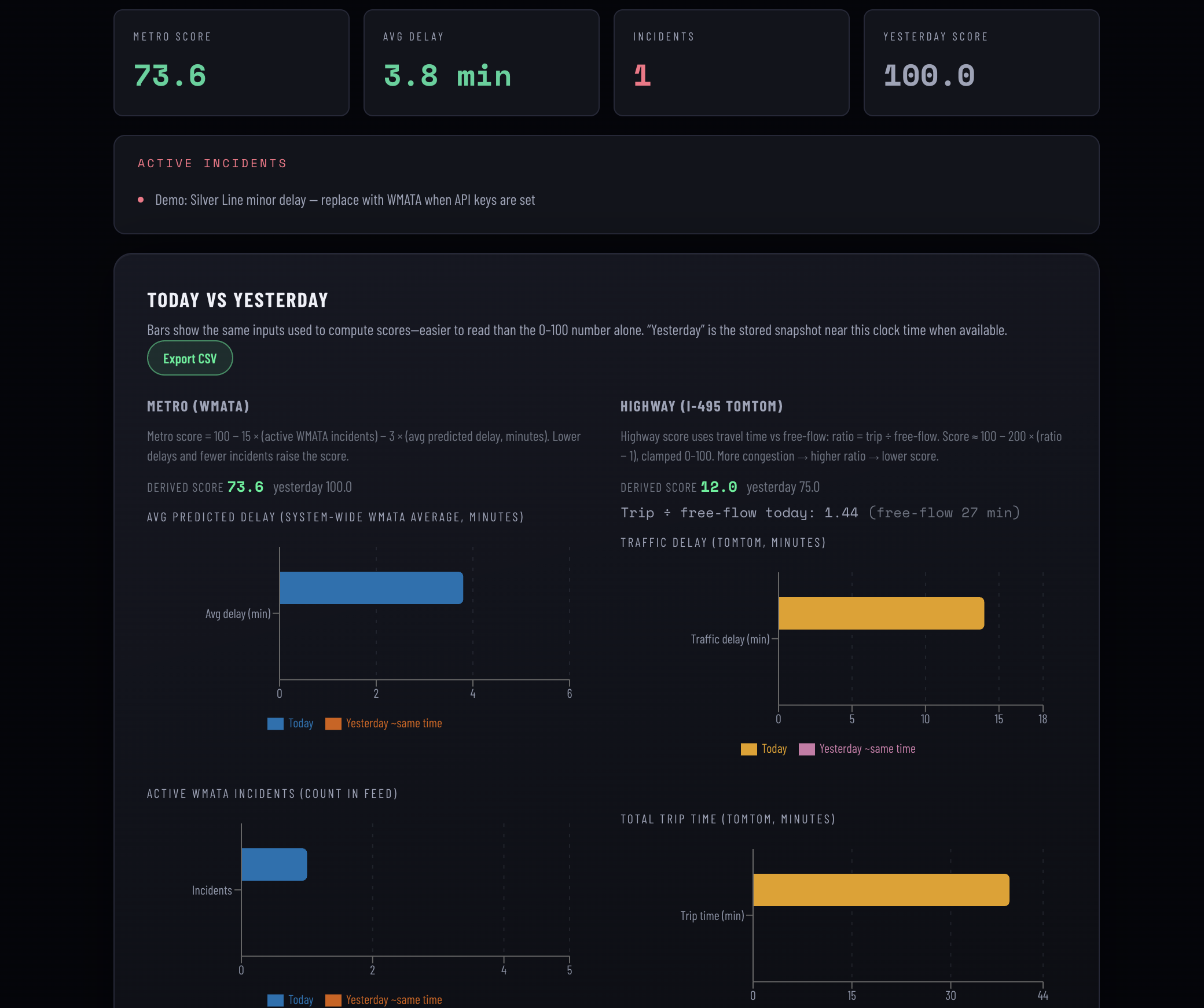
DeltaDrive is a real-time I-495 corridor intelligence app covering Springfield → Bethesda. It pulls live WMATA incident and train delay data alongside TomTom highway travel times, blends them into a composite 0–100 corridor score, and lets users explore the data through interactive brushable time-series charts. Every 5 minutes it snapshots conditions so you can compare today against the same clock time yesterday.
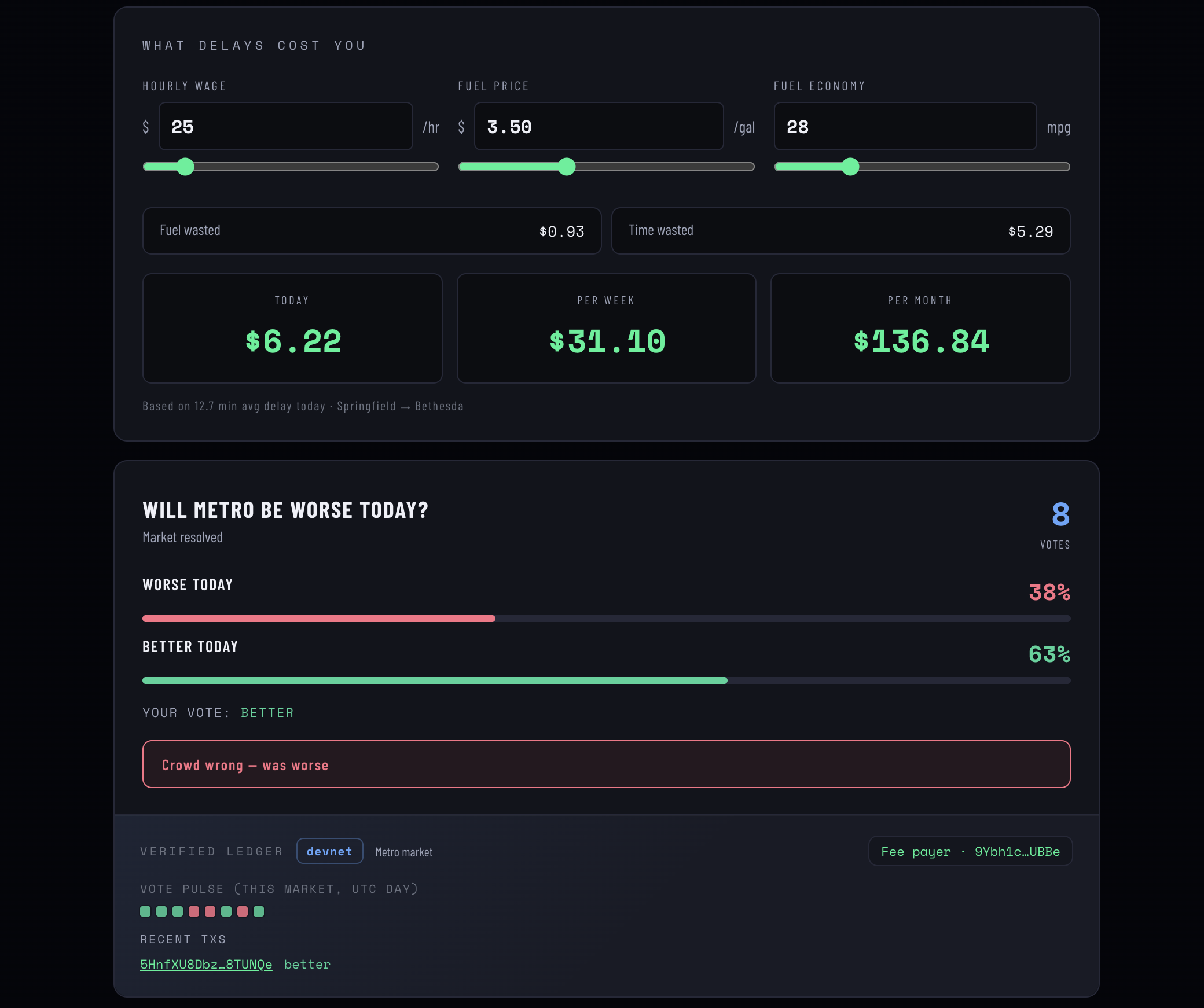
On top of the data layer sits an on-chain crowd prediction market: users connect a Solana wallet and vote whether today's commute will be better or worse than yesterday's. Votes are real Solana transactions using the SPL Memo program — the server verifies each signature before tallying, so the count is trustless. Results are revealed after 7 PM when the day's outcome is known.
How we built it
Frontend: Next.js 16 (App Router) with React 19, styled with Tailwind CSS and a custom dark-theme design system Charts: Recharts — area charts with brush zoom, composite score overlays, reference bands, today-vs-baseline bar comparisons Data: WMATA Incidents + StationPrediction APIs for metro; TomTom Routing API for highway travel time and free-flow baseline Blockchain: @solana/web3.js + Wallet Adapter (Phantom, Solflare); votes encoded as DDRIVE:v2:{better|worse}:{date} SPL Memo transactions on devnet Vote verification: Server-side RPC lookup — we fetch the transaction, extract the fee payer, parse the memo from logs, and only then record the tally in an in-memory store
Challenges we ran into
Getting the Solana vote verification right was the trickiest part. Legacy and versioned transactions expose the fee payer differently, and memo log parsing had to be robust against RPC response variations across node providers. We also had to design the snapshot pairing logic carefully — matching "today at 8:15 AM" against "yesterday at 8:15 AM ± 30 minutes" so the delta is meaningful rather than noisy.
On the visualization side, mixing metro scores (incident-driven) and highway scores (travel-time-driven) on the same axis required careful normalization and good scoring systems so neither signal dominated unfairly.
Accomplishments that we're proud of
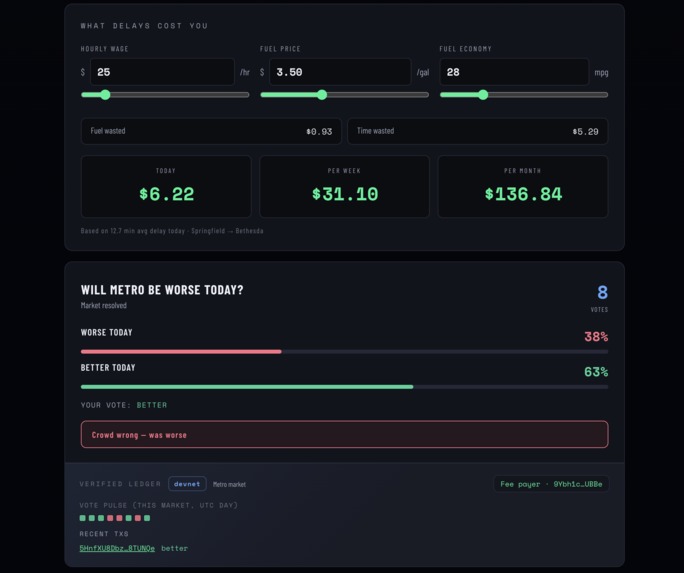
Every vote is a real blockchain transaction. When you click "Worse" or "Better," that's not just a number incrementing in a database — it's an actual entry written to the Solana blockchain, verified by our server before it counts. Every vote has a permanent, public receipt.
We calculated what delays actually cost you in dollars. Most apps tell you "there's a 14-minute delay." We tell you that delay costs you $5.29 in lost time and $0.93 in wasted fuel — today. And $136 this month. You plug in your wage and your car's fuel economy, and the app turns abstract delay minutes into real money coming out of your pocket. That reframes the whole commute question.
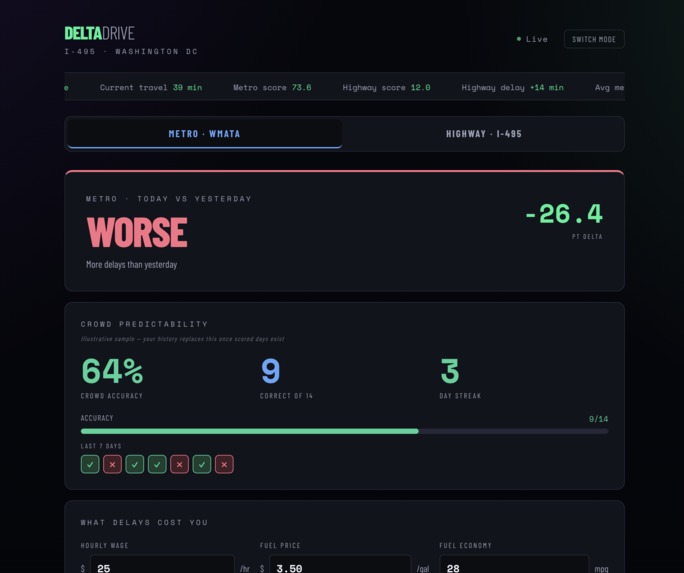
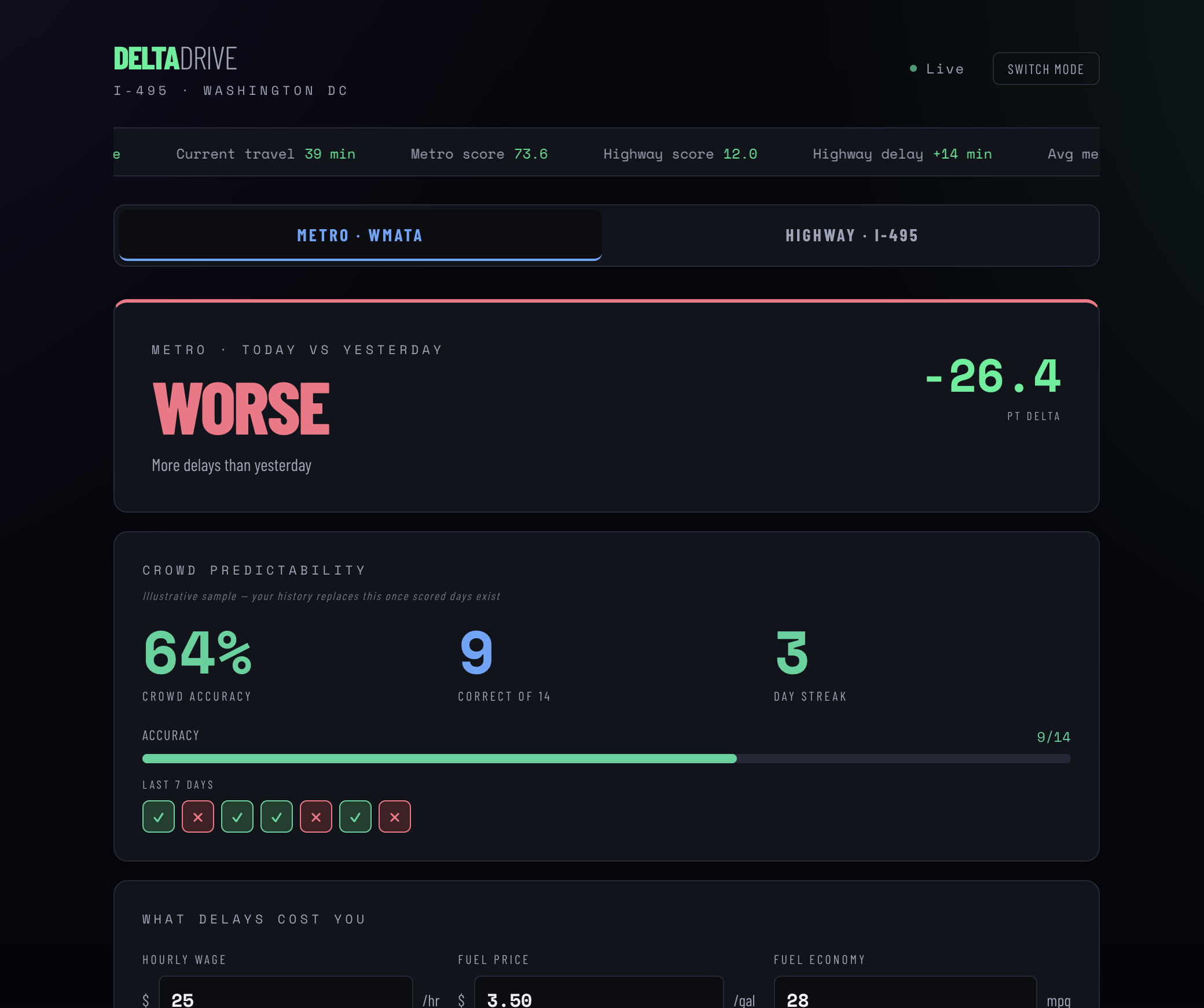
You can see how well crowds can predict delays. Instead of showing a static number, we built an interactive time-series chart where you can drag across history to see exactly when things got bad and how today compares to any previous day. You can also see the crowd's prediction record over time — whether commuters as a group are actually good at calling whether the road will be bad, or whether they're consistently overconfident or caught off guard. This will be useful to delivery networks and city planners alike.
Votes confirm in under a second, for almost no cost. On Solana's test network, each vote settles in less than a second and costs a fraction of a penny — proving that the "stake a tiny amount on your prediction" feature we're planning is actually viable at scale.
What we learned
The biggest technical surprise was that you don't need a full smart contract to record something permanently on a blockchain. Solana has a built-in feature called the "Memo program" — you can attach a short text note to any transaction, and it gets written to the blockchain forever, publicly readable, and impossible to alter. We used this to record each vote as a permanent receipt. It's like getting a timestamped, tamper-proof paper trail for free, without writing any custom contract code.
The bigger lesson was about trust. Real-time data is only useful if people believe it. We found that showing a single score (like "73.6 today") wasn't enough — people needed context to know if that was good or bad. That's why the dashboard always shows today vs. yesterday at the same time: it turns an abstract number into an answer to the question "is my commute worse than normal?" The crowd prediction mechanic reinforces this further — when you vote and then see whether you were right, you start to develop an intuition for what the scores actually mean. The accuracy tracker exists so you can ask yourself "do I actually read traffic better than the crowd?" and find out over time.
In short: the hard part wasn't collecting the data, it was designing the experience so the data felt worth trusting and worth coming back to check.
What's next for DeltaDrive
More Corridors — Right now DeltaDrive only covers I-495 and WMATA. The plan is to add I-270 (the route from Rockville/Gaithersburg into DC), I-66 (the main highway corridor from Northern Virginia), and the Purple Line (the new light rail connecting Bethesda to New Carrollton through College Park). Eventually this could expand to other cities entirely.
Persistent Vote Storage — Currently if the server restarts, all the vote tallies disappear. Adding Redis or a database means every vote gets saved to disk, so historical accuracy data and crowd predictions survive server restarts and deployments.
Live Traffic Map — An interactive map layer on top of the dashboard showing real-time congestion density along your route (color-coded by severity) plus pins dropped at the exact locations of active Metro incidents and delays — so instead of just a score number, you can see where the problem is.
Real-Money Predictions (Mainnet) — Right now votes are free and on Solana's test network. Moving to mainnet means users could attach a tiny real-money stake to each prediction — we're talking fractions of a cent (a "lamport" is Solana's smallest unit of currency, like a penny but much smaller). Correct predictions would win a share of what the wrong-side voters put in, adding real skin-in-the-game to the crowd forecasting.
Score Alert Notifications — Let users set a personal threshold like "notify me if the Metro score drops below 60." When live data crosses that line, a push notification hits their phone before they leave the house — early enough to actually change their commute decision.


Log in or sign up for Devpost to join the conversation.