-
-
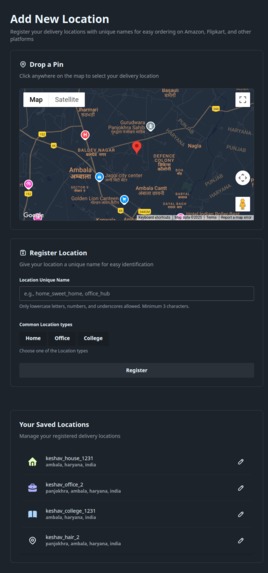
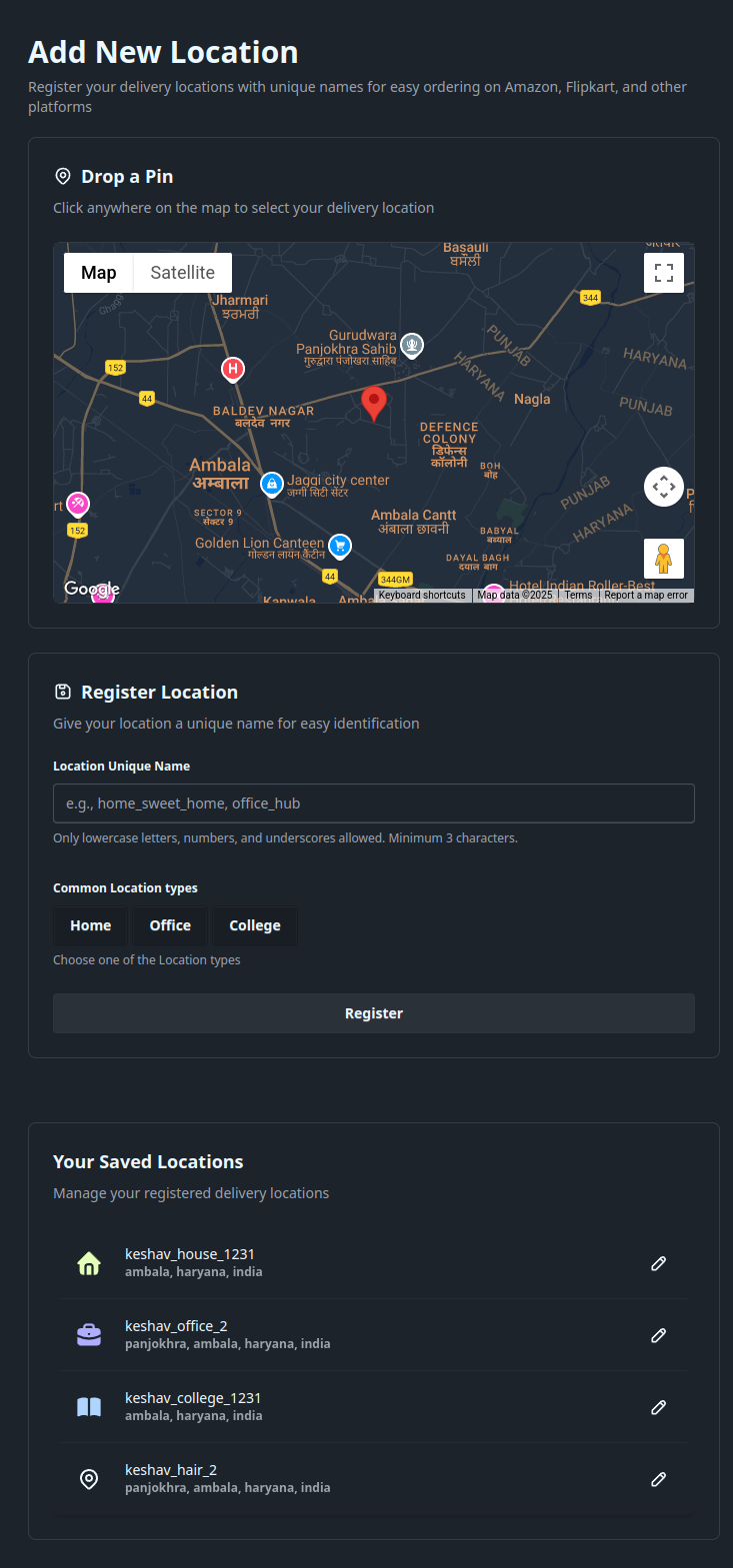
Customer Page. to add new Locations
Inspiration (Problem)
- Delivery people often struggle to find the exact location because the addresses are unclear or vague — like 'Near Bus Stand,' but where exactly?
- So the delivery person ends up calling the customer — sometimes more than once — just to find the right location
- This is Hassle for the customer and Delivery Partner all around the world
- According to industry studies:
- This leads to on average an extra 0.5 to 1km of travel per order, which wastes significant amount of fuel and time daily
- Companies like Delhivery and Uber Eats have reported millions in annual losses due to inefficiencies caused by poor address data.
What it does
- A platform that connects delivery agents and customers through unique location usernames for faster, hassle-free deliveries
- Customers generate a short, sharable @location_username (like @keshav_home) linked to their exact map pin.
- Delivery agents use this username to instantly get optimized directions to the location, reducing confusion and unnecessary calls
How we built it
- We built the backend using Django, which handles authentication, data storage, and API endpoints.
- The frontend is built with Svelte and styled using Tailwind CSS, making it lightweight, reactive, and visually intuitive.
- We used MySQL as the database to store user profiles, orders, and location-user mappings.
- Google Maps API was integrated to allow precise pin dropping, navigation view for delivery agents, and location validation.
- The architecture is designed to be scalable and serverless-deployment-ready, with focus on real-time usage and fast data access.
Challenges we ran into
- Integrating and simulating real-world delivery flows without access to internal APIs from e-commerce platforms like Amazon or Flipkart.
- Handling privacy concerns around making usernames public without compromising security.
Accomplishments that we're proud of
- Successfully built a working prototype that solves a real-world pain point using a simple and scalable system.
- Designed a clean, minimal UI that allows both customers and delivery agents to use the app with zero training.
- Developed a smart username-to-location system that mimics social handles, making address sharing simple and memorable
What we learned
- How to architect a scalable delivery-facing platform using Django and Svelte.
- Best practices for integrating mapping APIs and geolocation-based services. ## What's next for Delivery Helper
- Build an AI Based Chatbot that compiles the order information and serves it to the Customer
- Improve privacy model to make usernames optionally time-limited or masked


Log in or sign up for Devpost to join the conversation.