Inspiration
A mock trial costs $30–150k and gives a litigator one run with one panel. The interesting question is never "what will a jury do" — it's "which piece of evidence is carrying my case, and what happens when it's gone?" That is a sensitivity analysis, and sensitivity analysis wants hundreds of runs, not one.
The failure mode of "ask an LLM to simulate a jury" is that one context playing twelve jurors produces twelve flavors of the same reasonable opinion. Jurors have to be isolated — different contexts, different people, no leakage — and they have to commit before they hear each other. Our agent platform, Roundtable, already does per-tenant isolation as its core primitive. The jury is the vertical where isolation is the product.
We built this for an unlikely hero: not an enterprise back office, but the small-firm contingency litigator who will never have a $100,000 mock-trial budget — and the jury consultant who wants to run the experiment five hundred times instead of once.
What it does
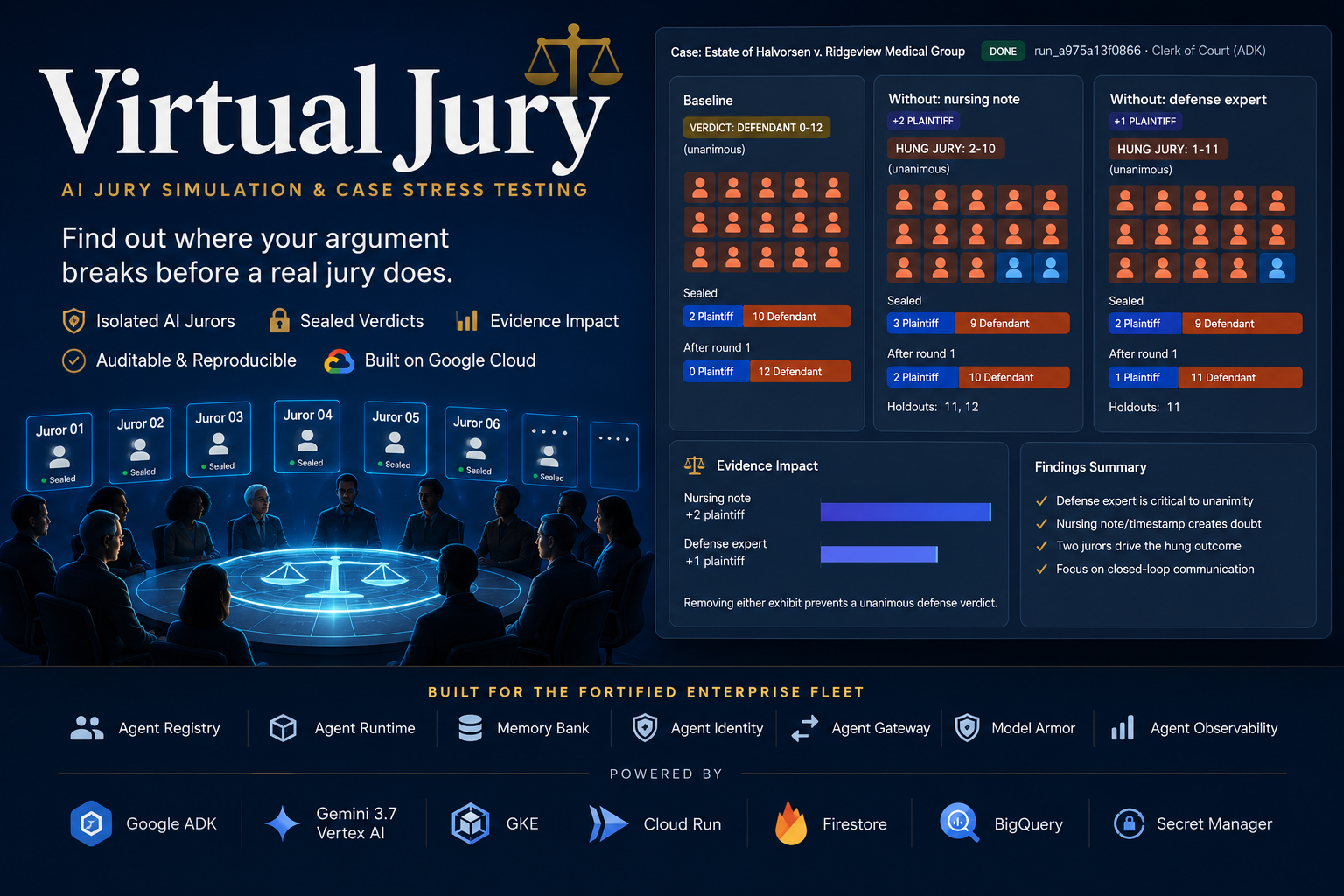
- Counsel submits a JurySpec: the case packet (summary, exhibits, witnesses, judge's instructions), a panel (size, seed), and variants ("without exhibit 2").
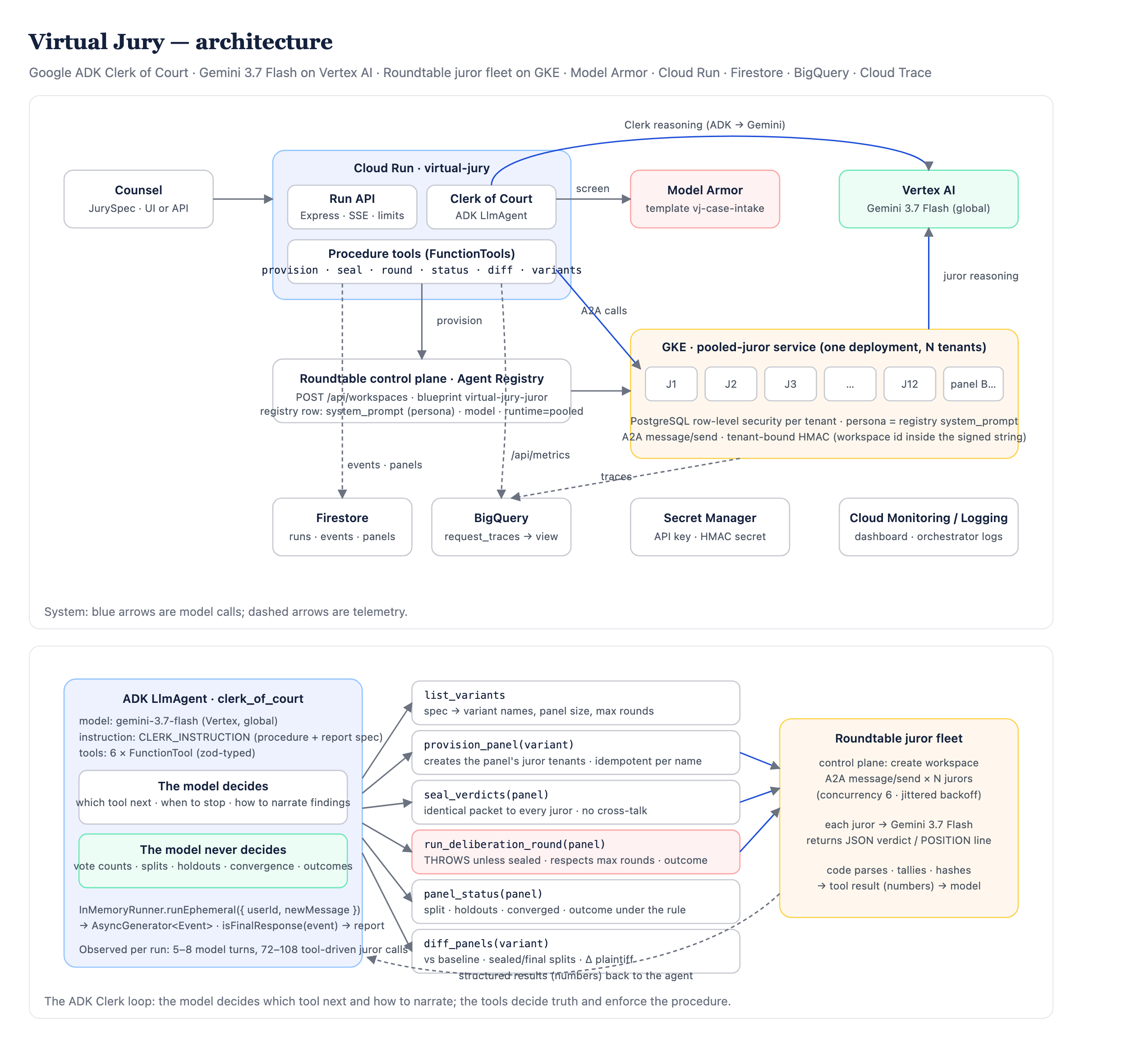
- Model Armor screens the packet. The Clerk of Court — a Google ADK agent — provisions one isolated juror workspace per seat on a pooled GKE fleet (a registry row, ~300 ms each), with a seeded persona.
- Every juror reads the identical packet and seals a verdict before any cross-talk. Then they deliberate: each hears an anonymized digest of the others and restates a position; code detects holdouts and convergence.
- Baseline and variants run as parallel panels. Three panels of twelve seal and deliberate in ~35 s.
- The Clerk writes a findings report: what carried the majority, where it breaks, variant effects, recommendations for counsel. Every count in it comes from a tool result.
How we built it
ADK LlmAgent + FunctionTools for the Clerk (Gemini 3.1 Pro on Vertex AI's global endpoint; the jurors run Gemini 3.7 Flash — two Gemini models, split by role). The tools
enforce the procedure in code — run_deliberation_round throws if verdicts aren't sealed; tallies and diffs are
computed, never narrated. Jurors are pooled Roundtable workspaces: one always-warm arthur-class service on GKE
serving N tenants with PostgreSQL row-level security, addressed over A2A with tenant-bound HMAC (the workspace id is
inside the signed string). Firestore holds runs/events/panels with transactionally sequenced events behind an SSE
stream; BigQuery holds every juror call as a traced span; Model Armor guards the gateway; Cloud Run hosts the API + UI.
Challenges
- Pooled domain services reject free-form
message/send; the tenant-bound HMAC path is arthur-class only — so jurors became chat-class agents on a plugin-free core image (which is the right shape anyway). - The fleet's least-privilege service account had never been granted Vertex or BigQuery roles; every juror call 403'd until it was. (Bonus: that restored tracing for the whole pooled fleet.)
- A2A calls are stateless — so the orchestrator owns all state and replays context; a run is a pure function of its inputs, which made reproducibility and idempotent re-provisioning natural.
- LLM juror populations converge fast in deliberation. Rather than hide it, we made sealing-first the design and report the sealed split as the primary signal.
Accomplishments
Three isolated 12-juror panels provisioned, sealed, and deliberated in 38 seconds. A Clerk-written report that identified the single load-bearing defense exhibit, quoted a juror's flip verbatim, and gave counsel three specific recommendations — every number traceable to a tool call. Model Armor blocking a live injection attempt in the case packet. 61 tests; procedure enforcement unit-tested without any pods.
What we learned
Isolation changes outcomes. The same seed produces the same twelve people, and the sealed distribution moves with the evidence in ways a single-context simulation cannot show. And: "the AI writes, code decides" survives contact with a multi-agent fleet only if the tools enforce the procedure — an instruction alone does not.
What's next
Calibration against closed cases with public outcomes, published scorecard-style. A packet editor that ingests real exhibits (with Model Armor in the path). Panel demographics controls. No damages modeling until it can be validated. Design-partner conversations with contingency plaintiff firms and jury consultants.
Built With
- a2a
- artifact-registry
- bigquery
- cloud-build
- cloud-firestore
- cloud-monitoring
- cloud-trace
- express.js
- gemini
- gemini-3.7-flash
- google-adk
- google-cloud-run
- google-genai-sdk
- google-kubernetes-engine
- model-armor
- node.js
- opentelemetry
- postgresql
- react
- roundtable
- secret-manager
- typescript
- vertex-ai

Log in or sign up for Devpost to join the conversation.