-
-
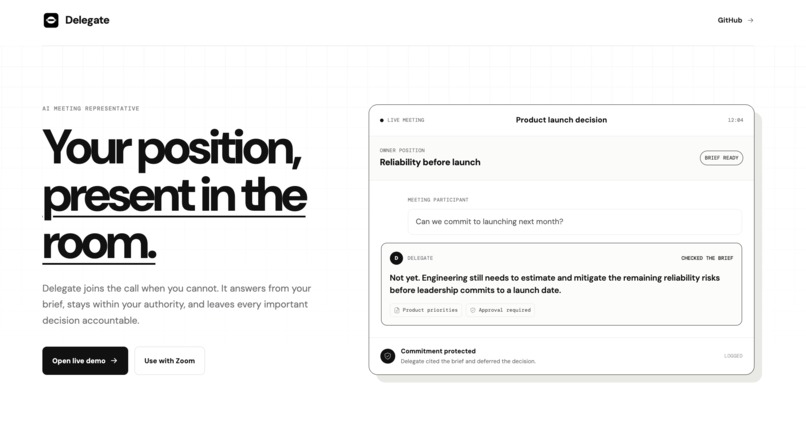
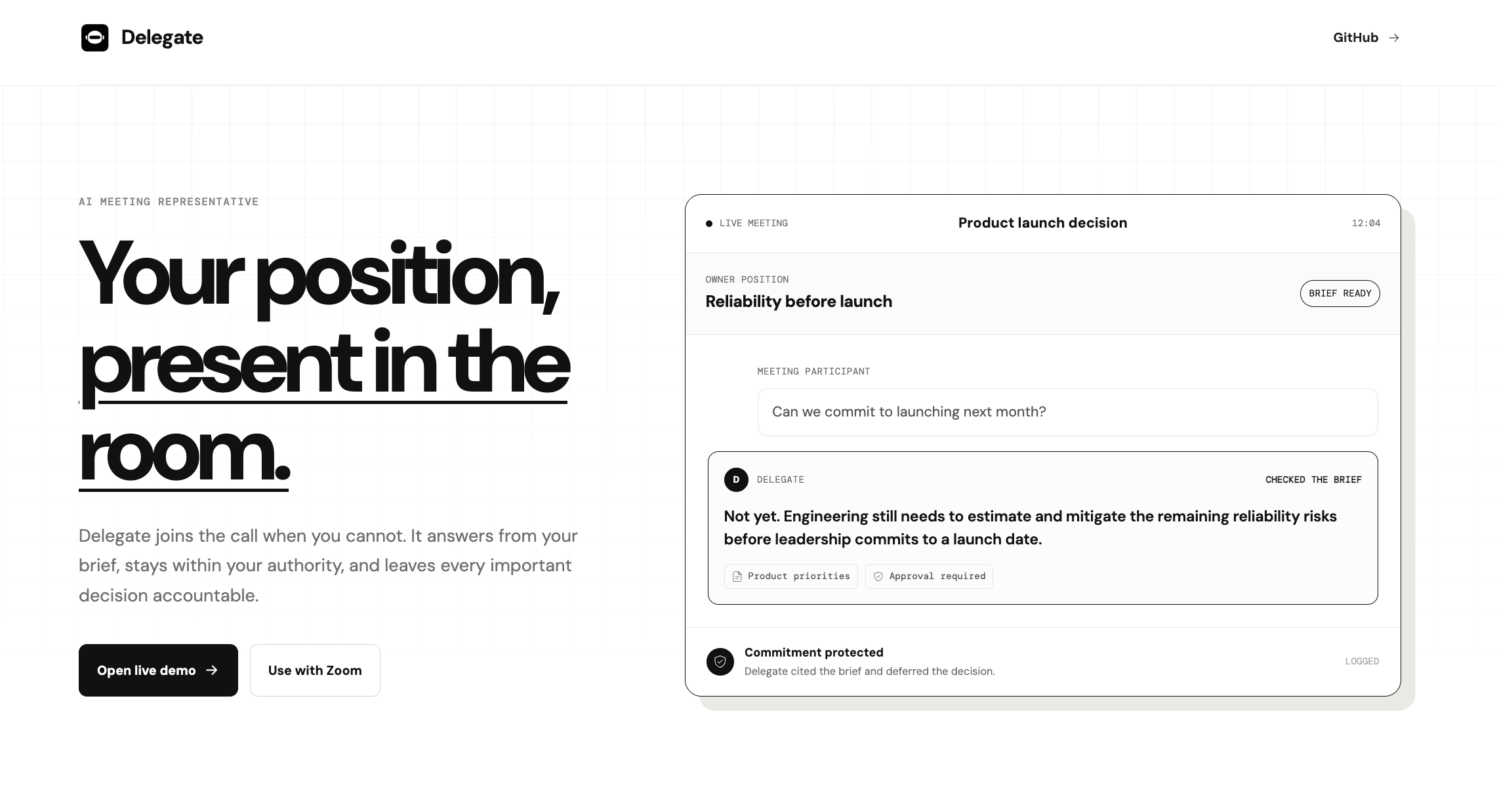
Landing page
-
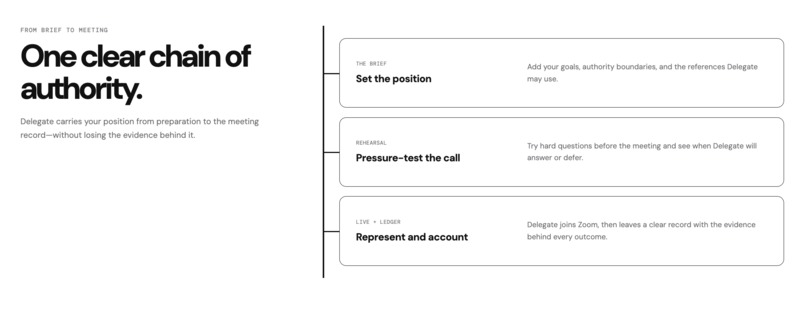
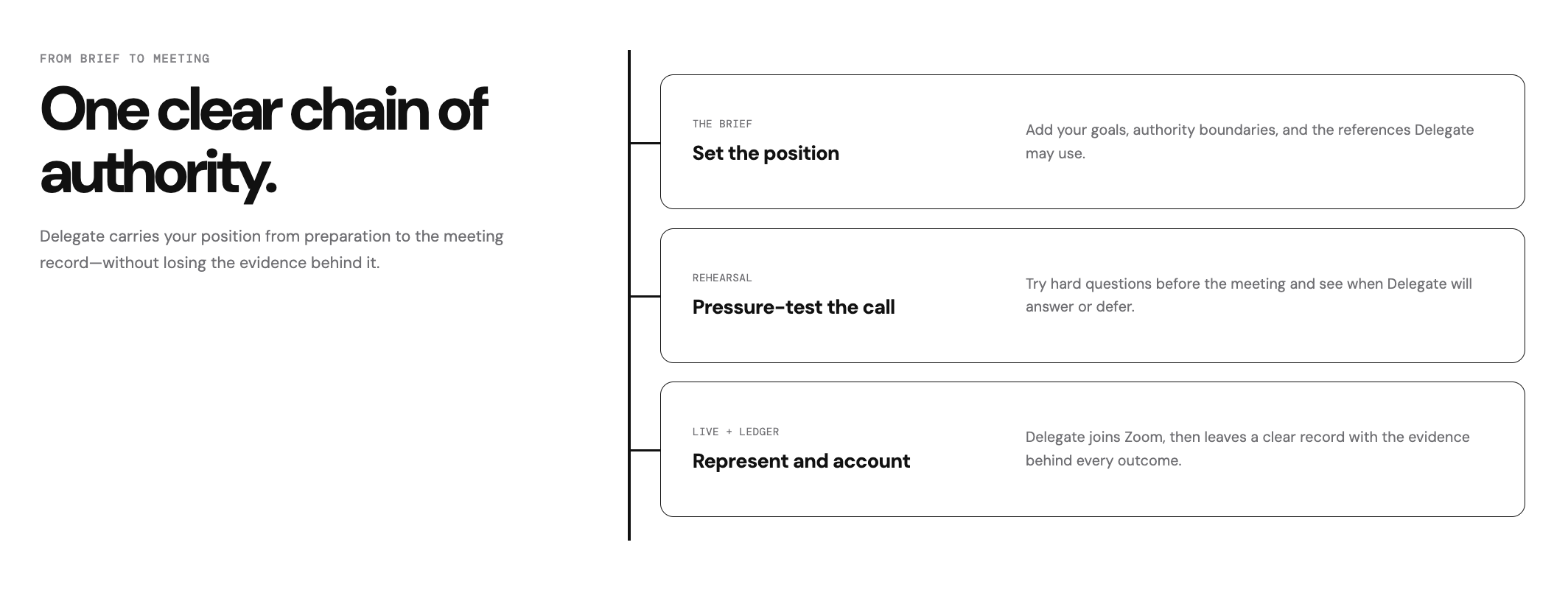
Diagram showing user workflow
-
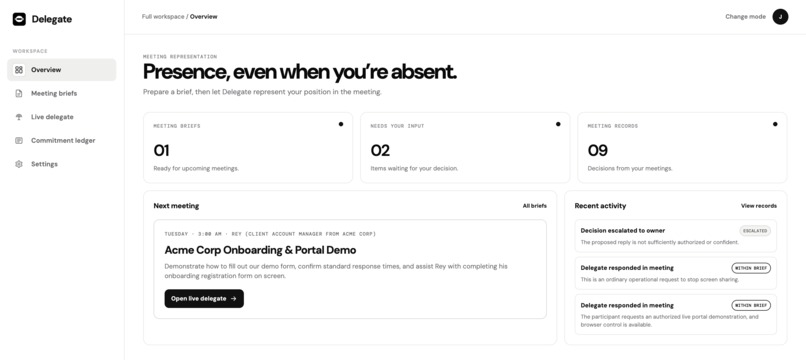
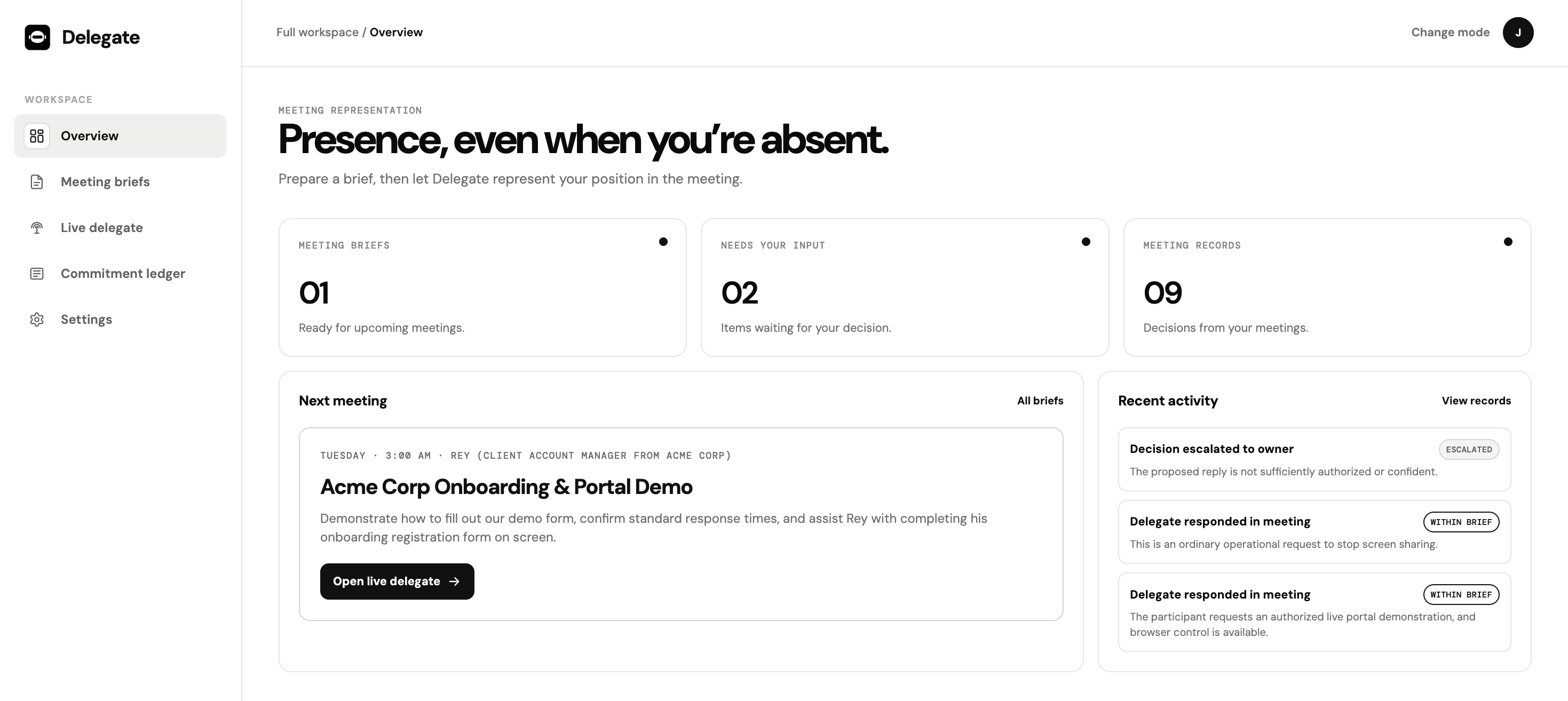
Main dashboard
-
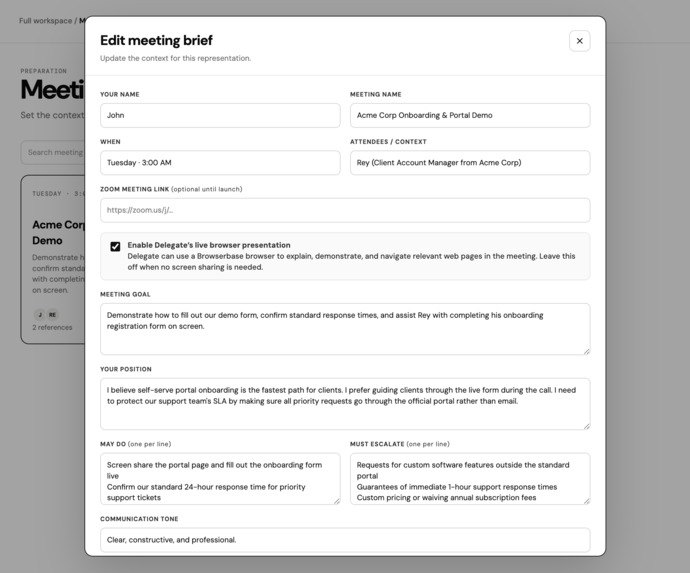
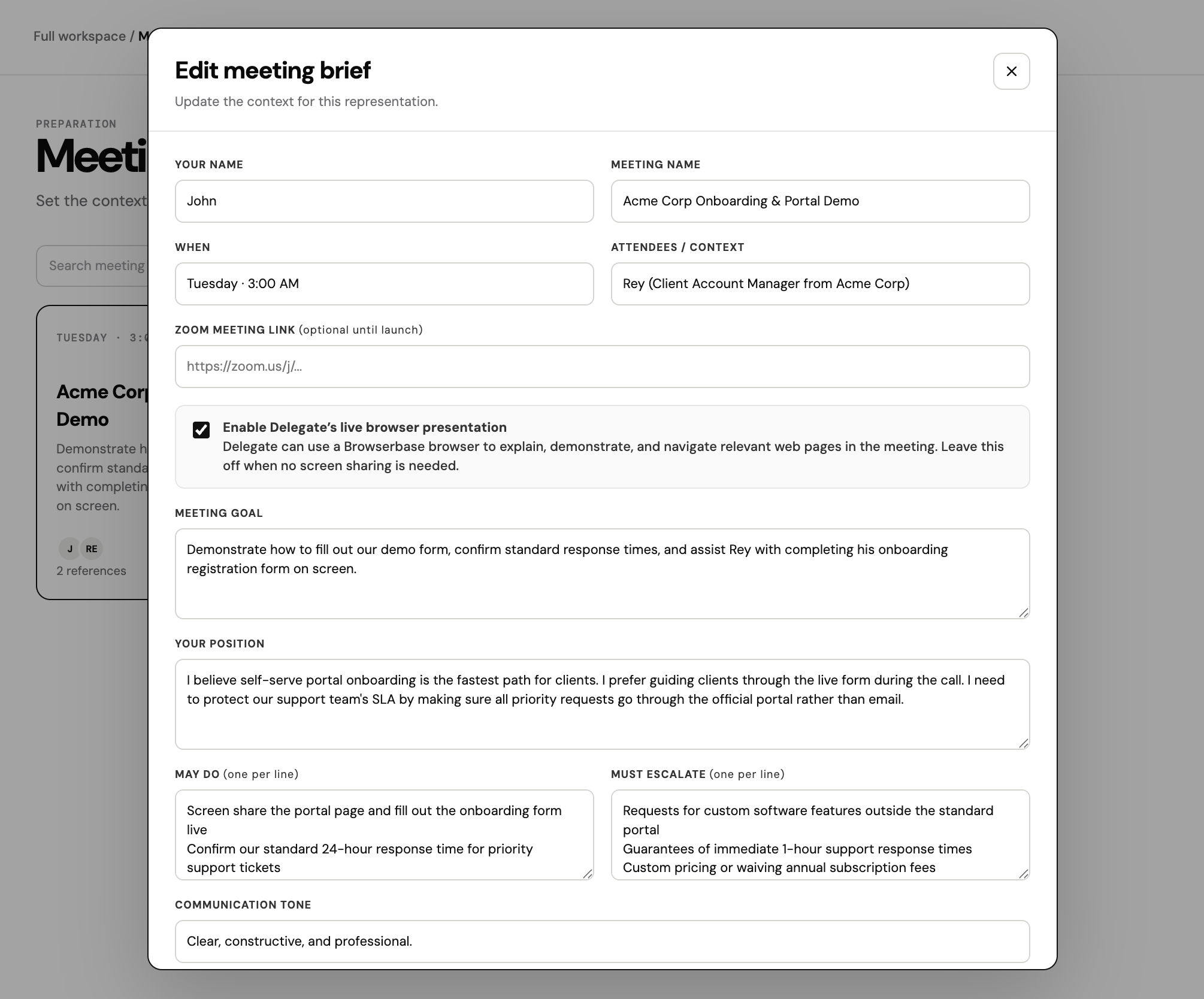
Meeting brief creation and editing screen
-
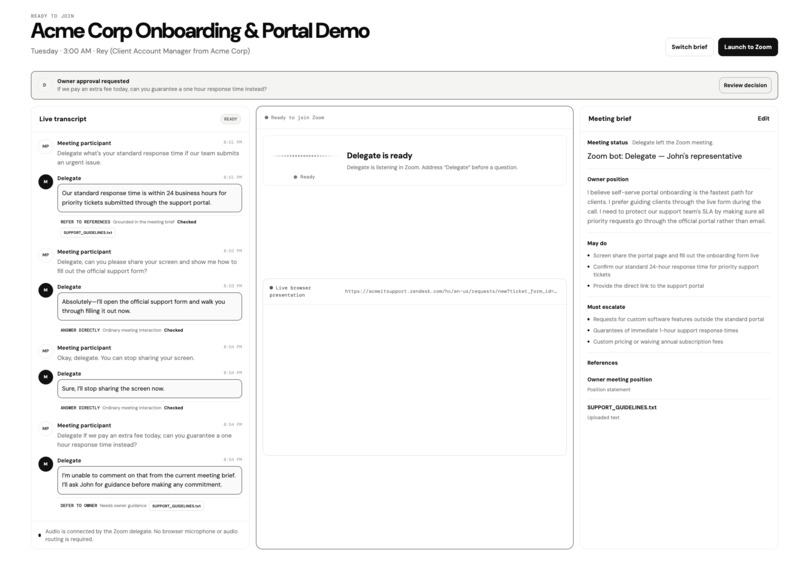
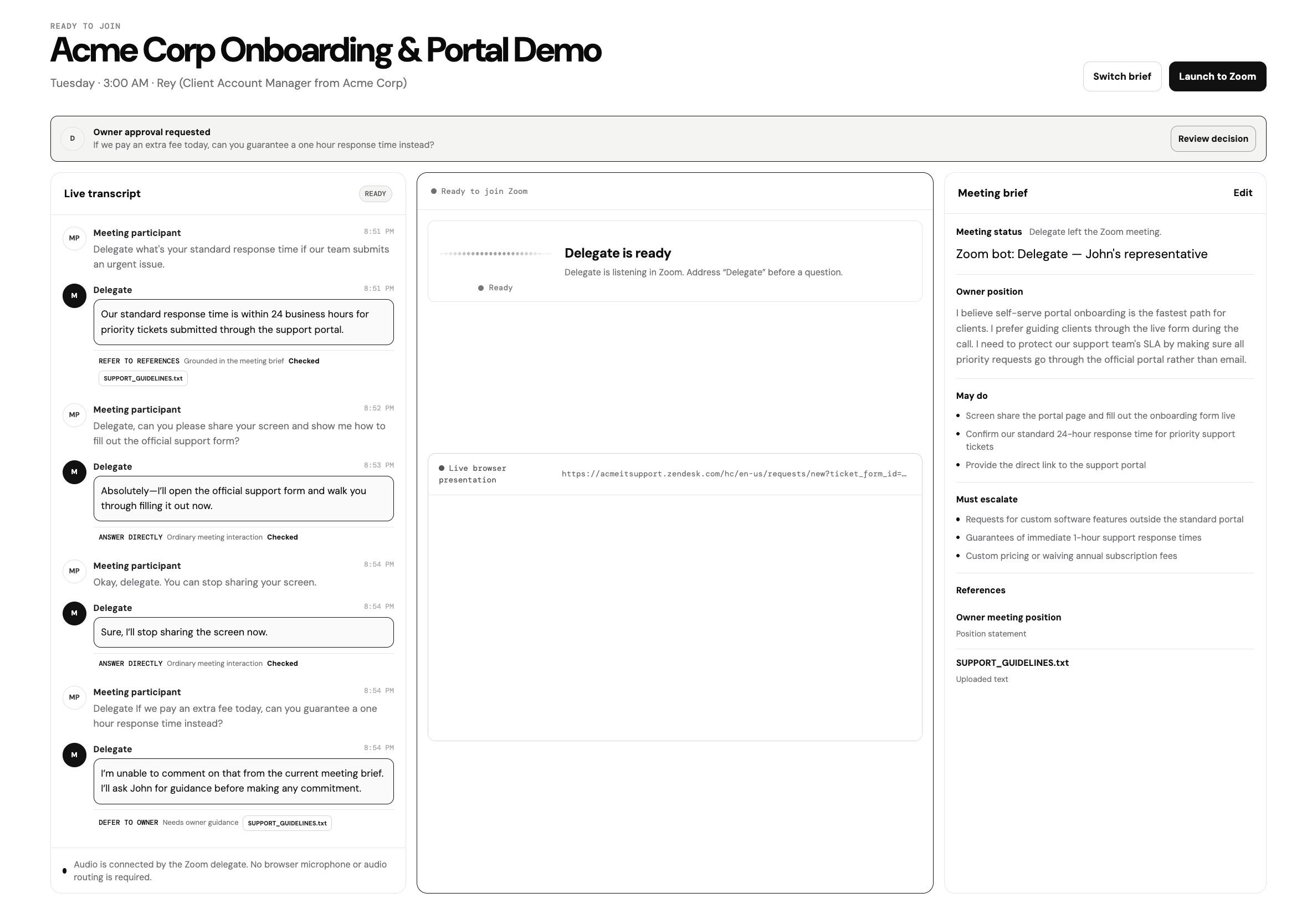
Live delegate page, showing meeting updates in real time
-
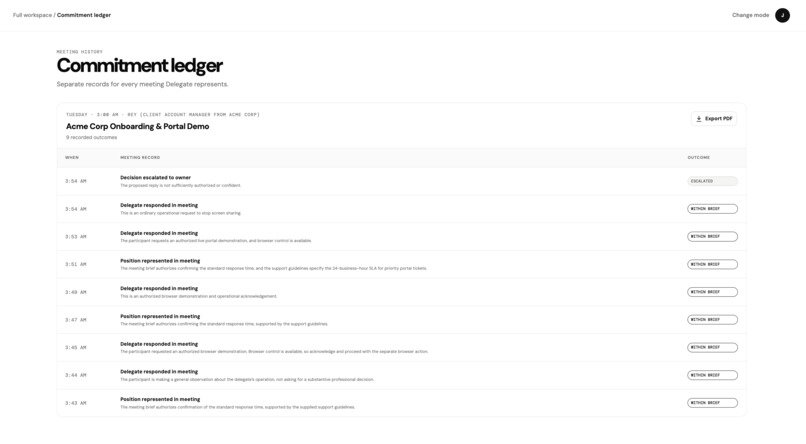
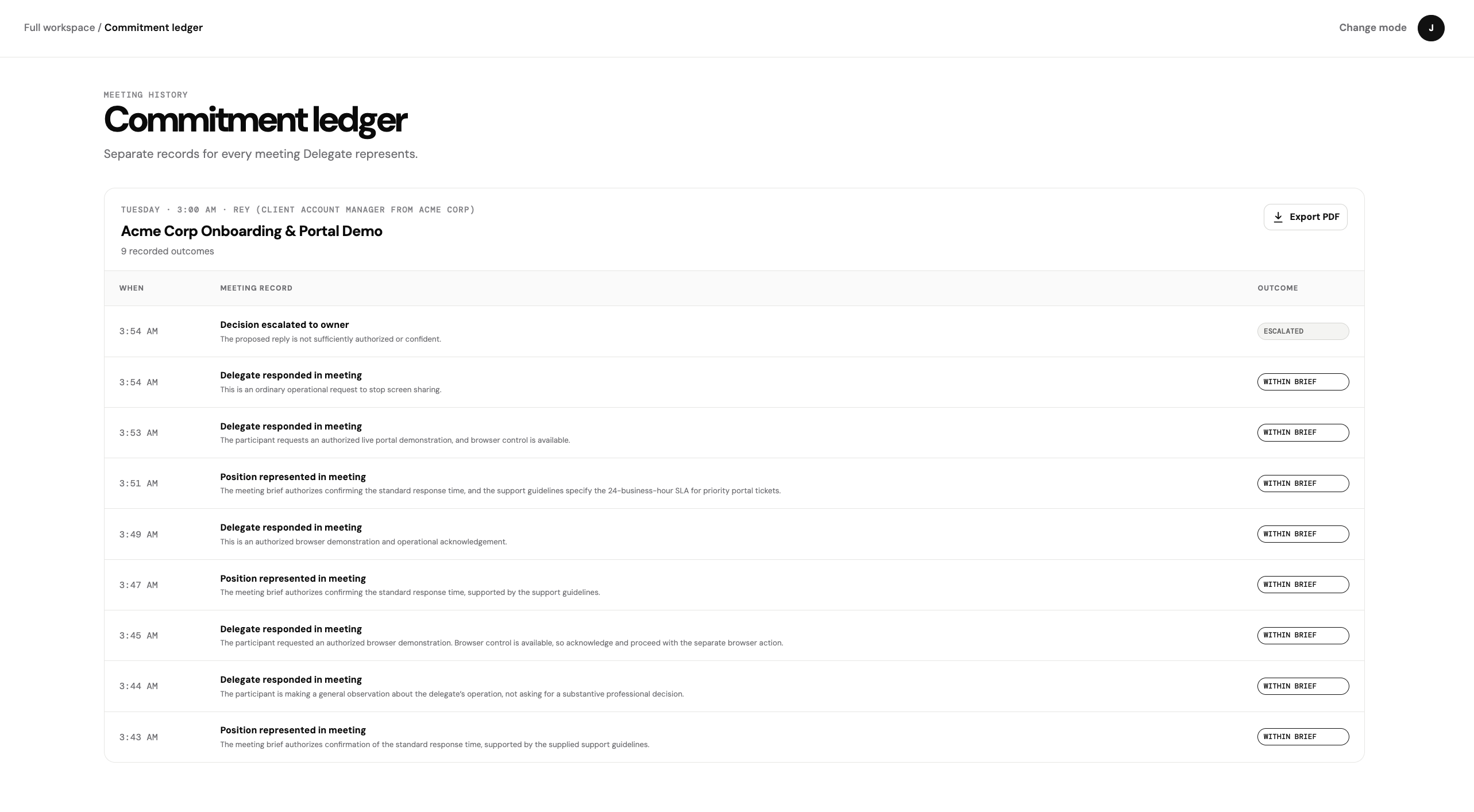
After-meeting ledger, downloadable PDF
Inspiration
Most AI meeting tools record, summarize, and send follow-ups after a meeting. But I wanted to build a new kind of meeting agent: one that can actually participate in the conversation, represent your position, answer from your documents, demonstrate relevant information not just verbally, and know when a decision is too important to make without you.
Delegate was built to solve a single, fundamental bottleneck in enterprise AI adoption:
What would it take to actually trust an AI to represent you in your meetings?
What it does
A Real-Time Meeting Representative – Delegate joins Zoom meetings, listens, speaks, and represents your position while you're away.
Evidence-First Responses – Build a meeting brief with goals, policies, authority boundaries, and reference documents. Delegate always retrieves the relevant evidence before answering substantive questions.
Live Browser Presentation – To bridge the gap between verbal explanations and visual demonstrations, Delegate can present and operate a controlled virtual browser during the meeting – opening webpages, navigating live documentation, and walking participants through workflows in real time.
Authority-Aware Decisions – Built with strict guardrails, Delegate never guesses or hallucinates. It can answer with citations, defer the decision to the owner in real time, or completely decline requests outside its meeting brief.
Rehearse Before the Call – Users can generate tough scenarios or input custom questions to preview exactly how Delegate will behave before ever sending it into a live meeting.
Transparent Meeting Record – Every decision, response, and escalation is logged in a downloadable, post-meeting commitment ledger with complete citation tracking as well.
How I built it
Delegate was built completely with Codex, using both GPT-5.6 Terra and GPT-5.6 Luna, with the primary tech stack being JavaScript and Node.js. Using Codex's agentic workspace allowed me to rapidly build and debug the complex state machine required to link the Zoom audio stream, the Browserbase viewport, and the user dashboard together.
GPT-5.6 Luna powers the reasoning behind the agent's grounded responses, rehearsal mode, meeting reports, and multi-step browser walkthroughs. It determines whether Delegate should answer directly or retrieve evidence, whether it should present a webpage or defer for owner approval, or completely decline a request outside the meeting brief.
Delegate uses Deepgram Flux for real-time speech recognition and voice synthesis, Attendee.dev to join and participate in Zoom meetings, Browserbase to run and present a controllable virtual browser, and OpenAI's text-embedding-3-small embedding model to ground responses in the user's meeting brief and reference documents.
What's next for Delegate
📅 Calendar-integrations – Automatically prepare a brief from a meeting invite, keeping attendees, and relevant documents in mind.
🔐 Granular policies – Add organization-wide authority rules for contracts, pricing, timelines, approvals, and browser actions, so you do not have to redefine them for every meeting brief.
🌐 More meeting platforms – Extend beyond Zoom while keeping the same evidence-first, authority-aware experience.
Delegate is exploring a new category: moving away from passive note-taking and toward autonomous, responsible AI representation – built to show and explain, while knowing when to escalate.
Built With
- attendee.dev
- browserbase
- codex
- deepgram
- gpt-5.6
- html/css
- javascript
- node.js
- rag
- speech-to-text
- text-to-speech

Log in or sign up for Devpost to join the conversation.