The problem
Software teams write architecture decisions down, then keep moving. Months later someone files a ticket that quietly undoes that decision. The ADR is still in Confluence. The new work lives in Jira. Nobody connects the two until the mismatch shows up in review, or in production.
That is decision amnesia. It is not that people ignore the record on purpose. The record is just not in front of them when they pick up the work.
What it does
Déjà Vu is a Forge app for software teams. It adds a Jira issue panel that compares the ticket you have open against decisions the team already recorded.
You do not launch a separate app. Open an issue you can edit, and the panel runs there.
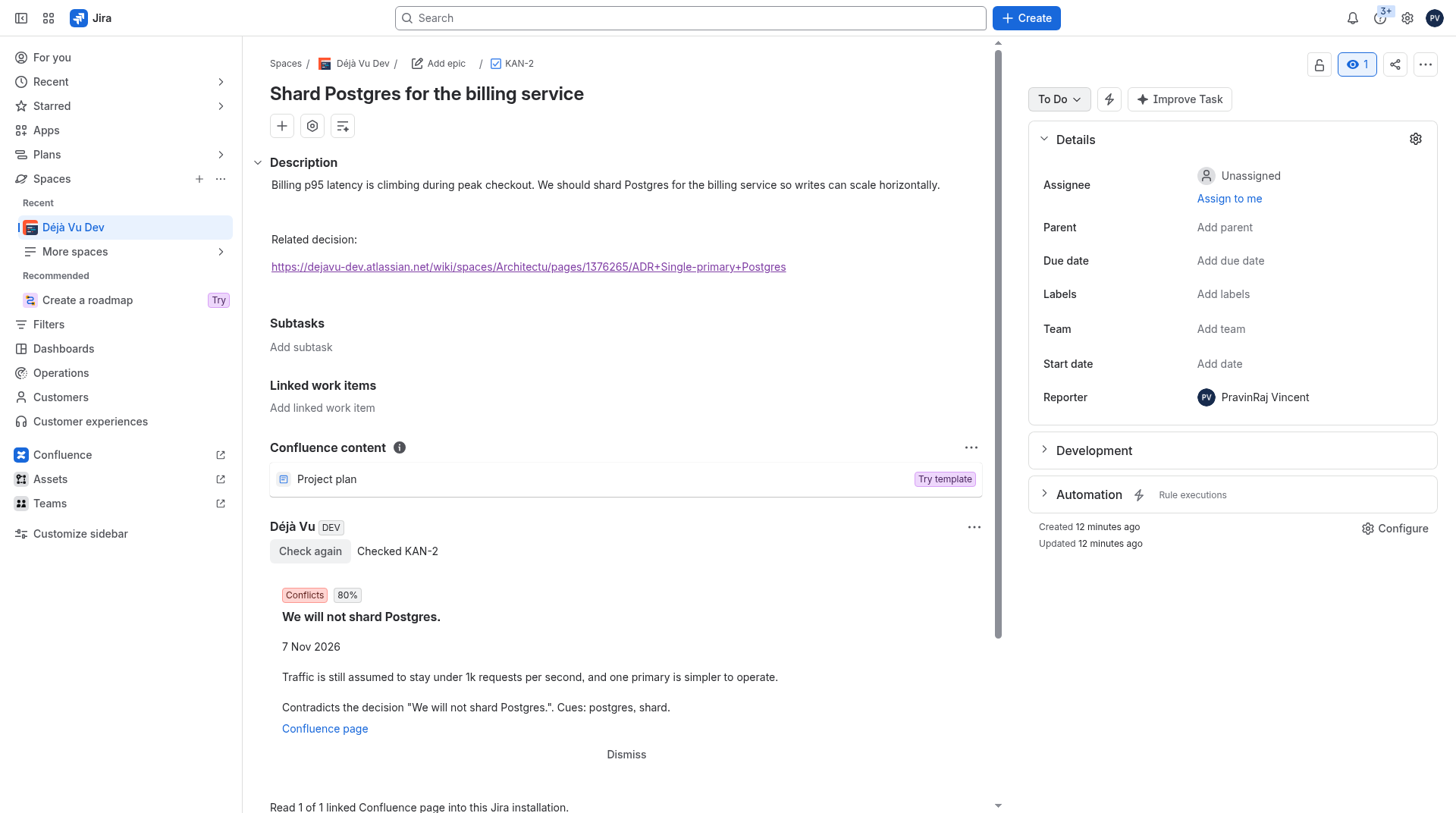
When a linked Confluence page contains an explicit decision, and the ticket contradicts, repeats, or reverses that decision, the panel shows a finding: the claim, when it was recorded, a short rationale excerpt, why this ticket conflicts, and a link back to the page. Check again re-runs the check. Dismiss hides a finding if the team has moved on.
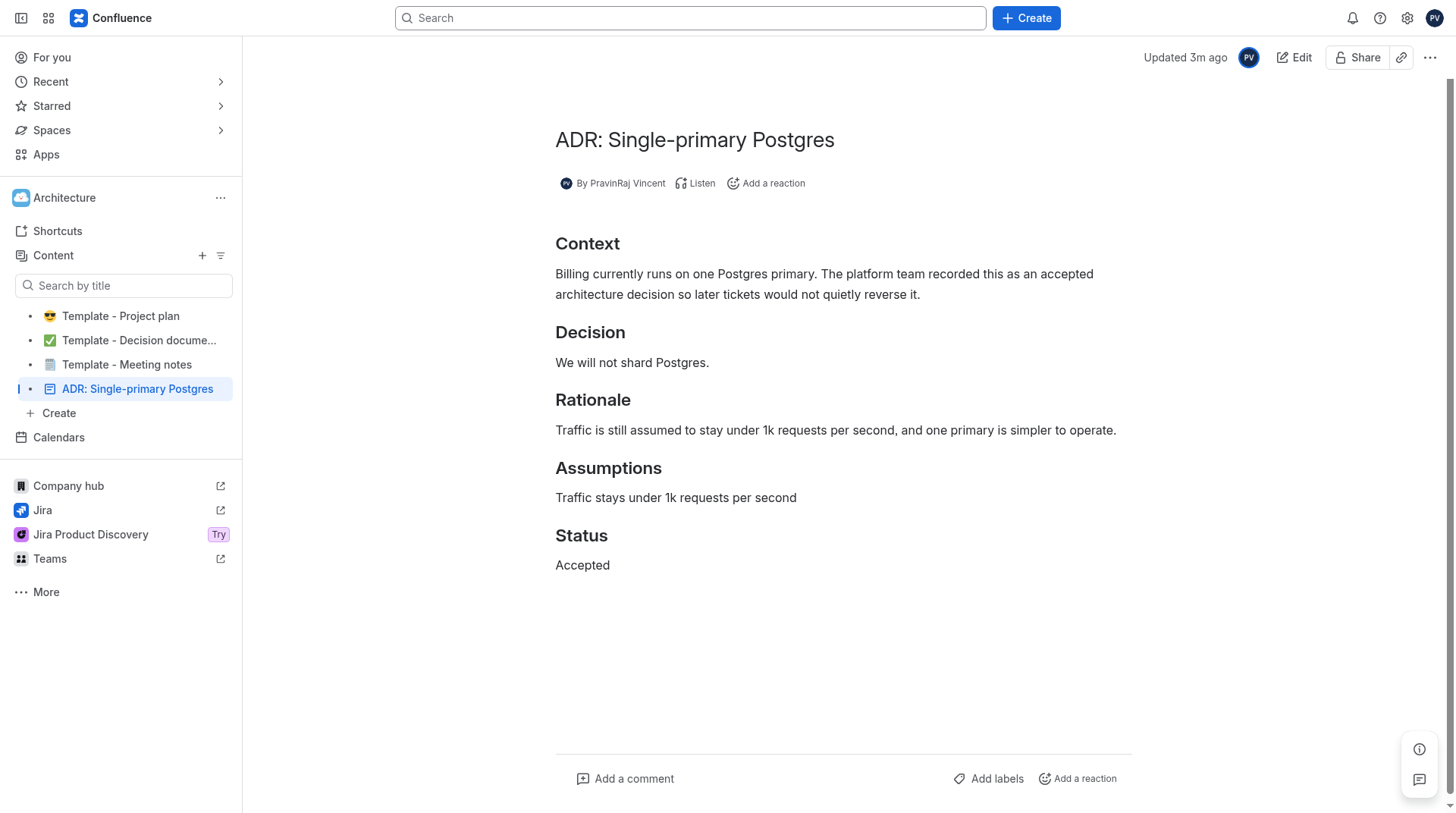
In the demo, the recorded decision is “We will not shard Postgres.” The ticket is “Shard Postgres for the billing service.” Déjà Vu flags that conflict before anyone starts the work.
It does not compare two Jira stories to each other to find duplicates. It compares a ticket to recorded decisions.
How I built it
The app is a native Forge issue panel with a resolver, Jira and Confluence event triggers, and Forge SQL.
A conservative extractor looks for an explicit decision: a Decision heading, a Decision: line, or a Confluence title that starts with ADR or Decision. Ordinary sentences are left alone, so everyday ticket chatter does not become a “decision.”
When you open an issue, the app reads the issue and any linked Confluence pages whose URLs match /wiki/spaces/.../pages/{id}. It stores those decision atoms in Forge SQL, then scores the issue against them with a deterministic engine (normalized claim overlap, negation, and reversal phrases). Findings at or above a 0.72 confidence threshold appear in the panel.
The engine and extractor are plain TypeScript. Unit tests run with Node and do not import Forge.
The app requests three read scopes: read:jira-work, read:confluence-content.summary, and read:page:confluence. It does not request write scopes. It does not use @forge/llm.
How this meets the technology requirement
Déjà Vu is built on Forge and integrates with Jira and Confluence. Jira hosts the issue panel and issue events. Confluence is where many teams keep ADRs; the app reads those pages when they are linked from the issue. Decision atoms and findings persist in Forge SQL on the installing site.
How to try it
Judges: install on a Cloud site that has both Jira and Confluence, and connect the app to both products. Then follow the walkthrough below. Full steps also live in JUDGES.md in the source.
- Open the installation link and install Déjà Vu on a Cloud site that has both Jira and Confluence. Install it onto both products.
- In Confluence, publish a page with this body:
Decision: We will not shard Postgres.
Rationale: Traffic is still assumed to stay under 1k requests per second, and one primary is simpler to operate.
- Copy the published page URL. It must include
/wiki/spaces/.../pages/and the page id. - In Jira, create an issue titled
Shard Postgres for the billing serviceand paste that URL into the description. - Open the issue and look at the Déjà Vu panel. Click Check again if needed. You should see a Conflicts finding for “We will not shard Postgres.”
If nothing appears, confirm the page is published, the URL shape is right, and the app is installed on both Jira and Confluence.
Inspiration
I kept seeing the same failure mode: the decision exists, the new work contradicts it, and the two artifacts never meet. Codegeist’s brief is about giving teams the context of what was already decided. This is a narrow, visible version of that problem.
Challenges I ran into
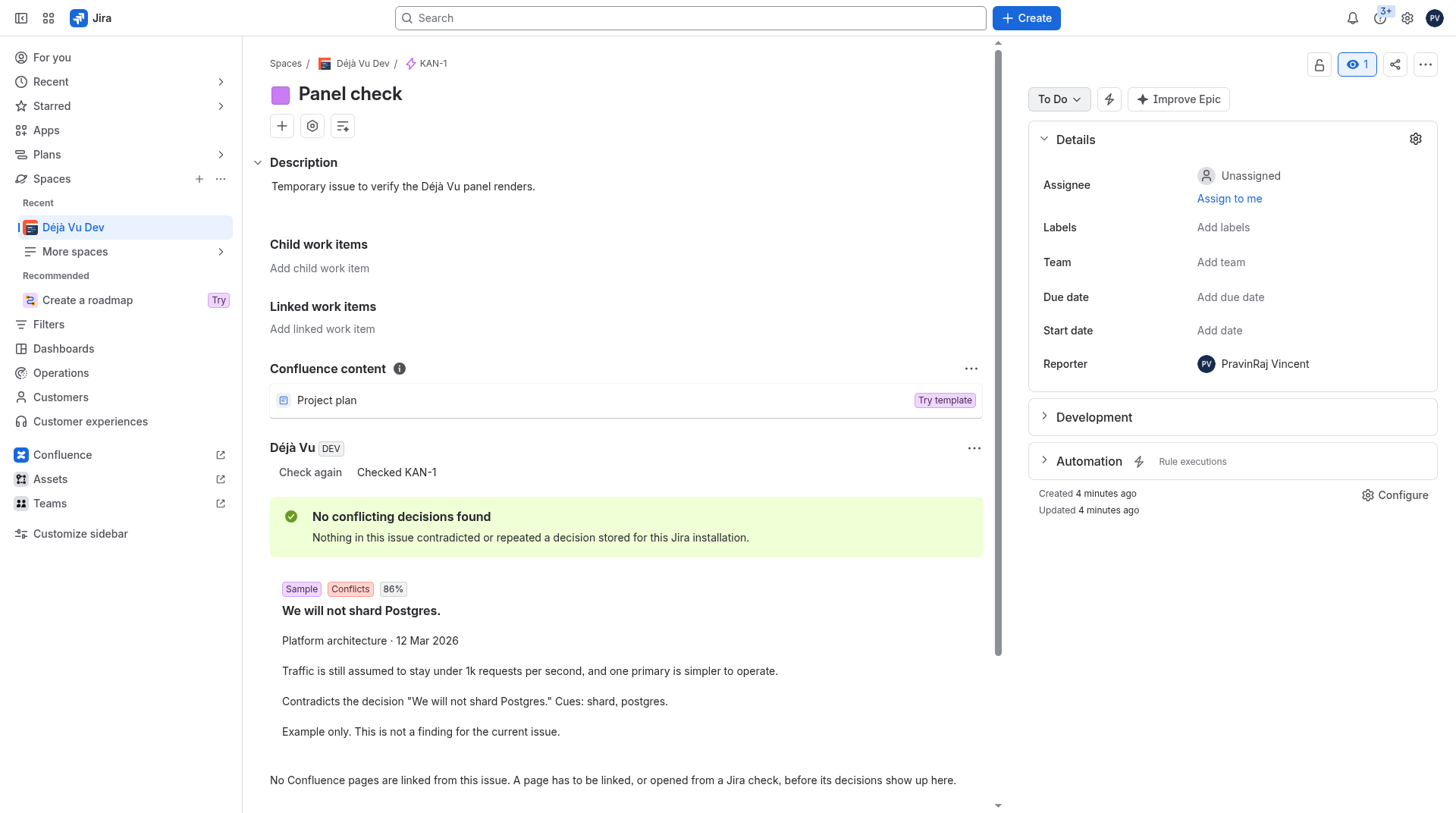
Confluence text is not automatically sitting next to a Jira issue. The panel has to project linked pages into the same check, and it can only do that when the URL is a real Confluence page link.
I also had to keep extraction strict. If every paragraph could become a decision, the panel would cry wolf. That means this version misses implied decisions, and that is intentional.
Accomplishments that I'm proud of
A judge can install the app, recreate one ADR and one ticket, and see a real conflict card, not a mocked screenshot. The demo video is a live walkthrough of that path. The contradiction engine is covered by unit tests and does not depend on a model.
What I learned
The useful product is not “more AI on the ticket.” It is putting the recorded decision back in front of the person about to undo it, in the place they already work.
What's next
Later work could widen extraction with a Rovo agent, expose tools over MCP, or read decisions from Teamwork Graph. Those pieces are not in this submission.
About the submitter
Pravinraj Vincent. Independent developer. Sunbury, Ohio. Solo / individual.
Built With
- atlassian-forge
- confluence-cloud
- forge-sql
- forge-ui-kit
- jira-cloud
- node.js
- typescript
