Inspiration
Our teammate Shivin's dad has struggled with Alzheimer's. The disease usually takes the newest memories first; the old places and the old faces tend to stay the longest. Families already know what helps on a good day: you sit together with the old photos and ask "do you remember this?" But a photo is flat. You can't turn around in it, and you can't sit back down at that table.
So we asked what it would take to give him the room back. Take the photos and phone clips his family already has, rebuild the place and the people in it in 3D, and let him sit inside it next to the people who love him, in a headset or just on a laptop. Then we tried it with him, and filmed it.
Then we saw the same thing works for everyone, with less at stake. Every group chat has a camera roll full of nights you weren't at. You get a 12-second clip, a blurry photo and "you had to be there." We wanted the next best thing to having been there: to actually stand in the room, turn around, and see who was sitting where.
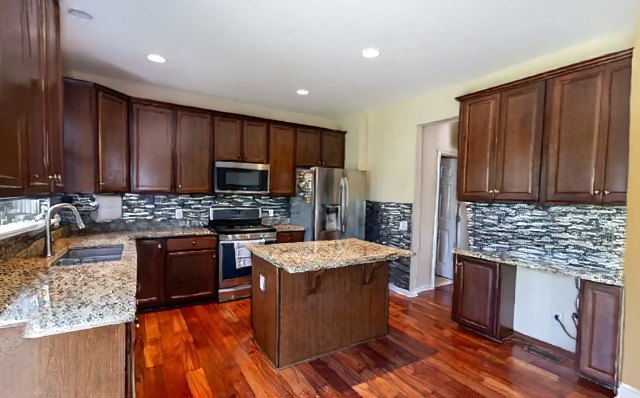
It goes further than a night out. Most of us have a home we can't go back to: the house you grew up in, sold years ago, still up on a real-estate site with its old listing photos. One of us rebuilt his family's old kitchen in Pennsylvania from four of those photos and walked around it again. And a phone clip can hold someone who isn't here any more: Video mode stands them back in the room where it was filmed, so you can see them where they were.
Two other things pushed us. World models have gotten good enough to imagine the part of a room behind the camera from a single photo, and a Meta Quest 3S is cheap enough to have one sitting on the table. Our host sponsor protects real content, which raised a question we couldn't drop: if the AI made up most of the room, shouldn't you be able to see which parts it made up?
What it does
Déjà View has two modes.
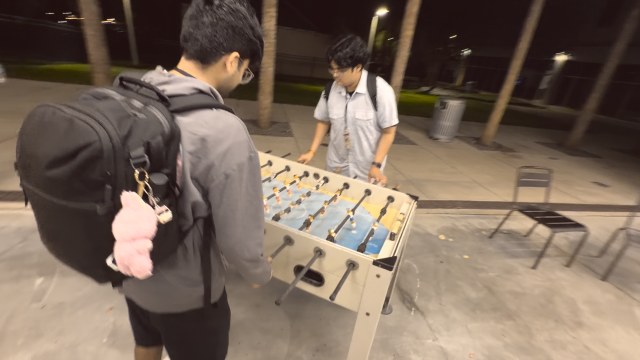
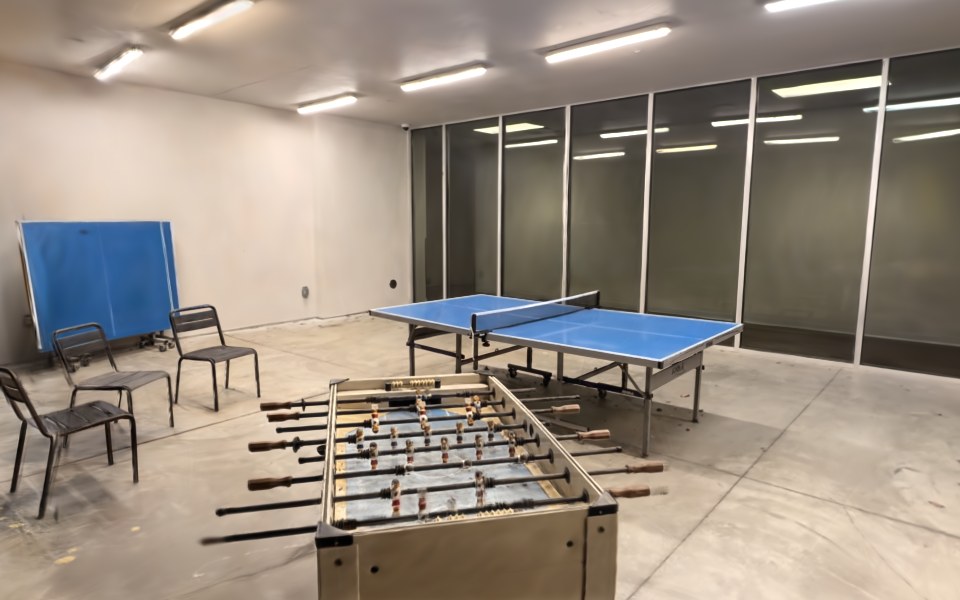
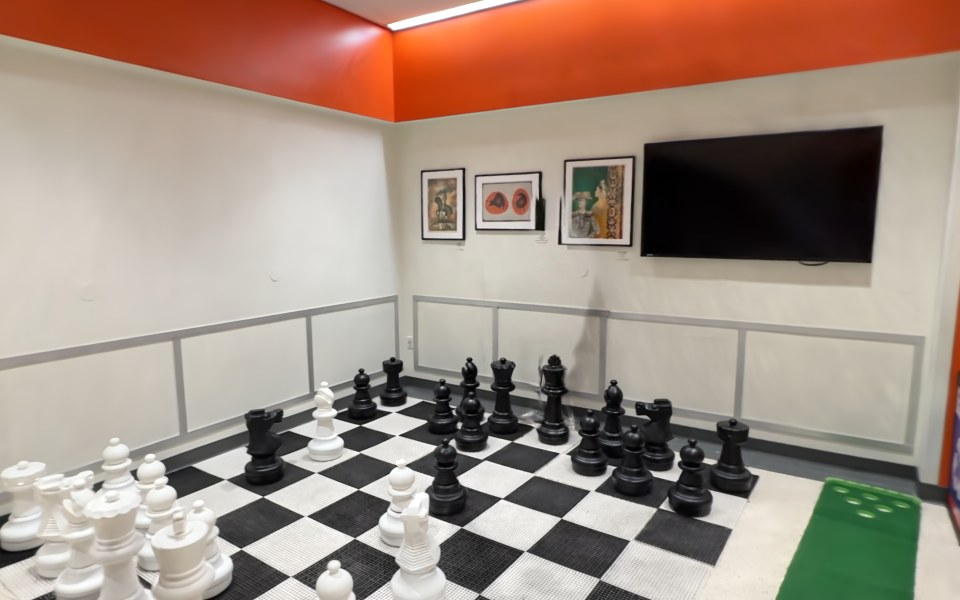
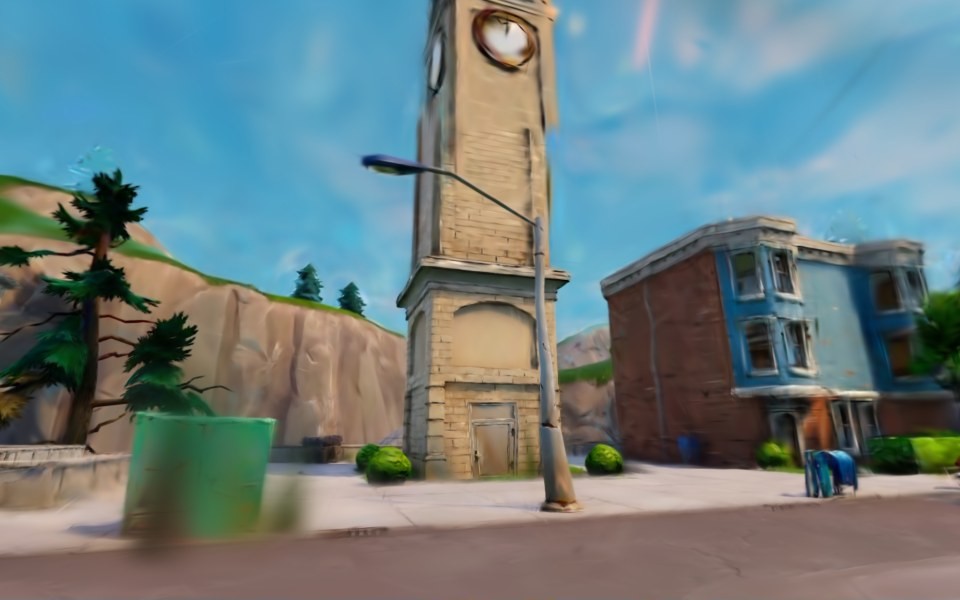
- Photo: walk around a real place from the photos you took there. We rebuilt the Infinity Hall Game Lawn, a giant chess room and a kitchen from phone photos and clips: each one is levelled, set to real scale with the floor at zero, and you can walk wherever the camera went. A single photo, a game screenshot or just a sentence also works: the model generates everything the camera missed. We built three worlds from single OG Tilted Towers screenshots, and only 14%, 21.7% and 22.9% of each world's million splats were actually in the screenshot. Old real-estate listing photos work too: the watermarks and logos are found and removed on their own, and our teammate's old family kitchen in Pennsylvania came back from four of them.
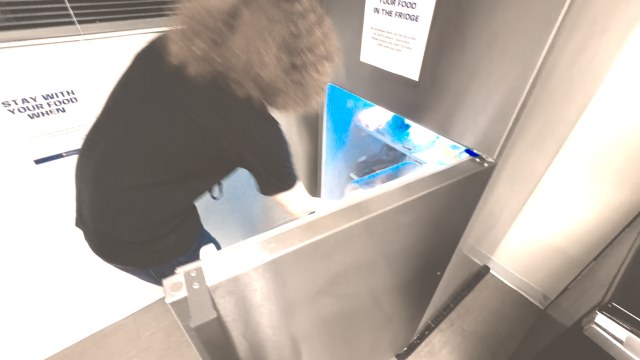
- Video: the people in a clip become full 3D people standing in the rebuilt room, moving in time with the footage and its sound. Walk all the way around your friends at the foosball table, pause mid-game and look at them from behind, or step back to where the phone was and see the original video line up with them. In the kitchen, Seb opens the fridge and carries the milk out, and the door and the jug move with him. At the giant chess board, both players stand there mid-game. That's 4D reconstruction from one phone clip: the room in 3D, and the people in it in 3D, moving through time. The video of Shivin's dad by the fire is one of these memories now, "Alzheimer's memory": two moments of it, played in one room, and you can sit beside them while they talk.
Then the room becomes social:
- Reality check: one toggle tints everything the AI imagined, so what the camera captured stays honest.
- Talk to the room: Gemini pins floating labels on the interesting things. Hold a button, ask "who won?", and the room answers out loud.
- Roblox: the same room becomes a life-size Roblox map. Friends without a headset join from a laptop and play tag with the person in VR, who sees them as ghosts. The Infinity Hall Game Lawn and the giant chess room are rebuilt by hand from their scans, at real size, with the real tables to play on, and the person in the headset can play the real ping pong table against someone on a laptop in Roblox.
- Notes that stay: leave a note in a room and it pops up in the headset as a sticky note where you left it, and stays for the next visitor.
- A visit, not a game: for someone who is forgetting, the same world becomes a place to sit with family. Put the old listing photos of the house and the birthday clips on one board, then walk in together: Dad in the headset or at the laptop, the kids beside him in Roblox, and the room answering "whose birthday was this?" out loud.
- Memories have keys: a family's kitchen is theirs. The owner can make a memory private, and then anyone else meets a closed door and has to sign in and knock. The owner sees the knock and lets them in, or doesn't. Even the guide keeps the family's secrets: it tells family about the people and the stories, and a stranger only about the room.
- It starts on the memory board: add a photo or clip with "Add a memory" in the DeepSpace app, and the card comes back with the world link and the Roblox link.
The sponsor chain: one memory, start to finish
Follow the fire video of Shivin's dad through Déjà View and every sponsor does one job:
- DeepSpace brings it in. The family adds the clip with "Add a memory", and DeepSpace hands it to our pipeline.
- HiPerGator and Vultr build it. Two GPUs working in parallel lift the people out of every frame into 3D and build the room around them. A photo becomes a walkable world in about 10 seconds, which is why a judge can make one live at the table.
- Gemini works with our other models to fill the gaps. It describes each scene, and the world model uses that description to imagine everything the camera never saw; then it labels what matters in the room and answers out loud when someone asks about it.
- Vobile keeps it honest. For someone whose memory is slipping, a made-up detail is worse than a gap. One toggle tints everything the AI imagined, so the family always knows what the camera really saw.
- Auth0 keeps it in the family. With Memory Keys a memory has an owner; a private one opens only for the people they let in, and the guide only tells family the family stories.
- Roblox brings everyone else. The rest of the family joins the same place from a laptop or phone at life size, and can play the real ping pong table against whoever is in the headset.
- Tiger Data remembers every visit. Who walked in, when, for how long and where they stood goes into a time-series record, so the family can see which places he goes back to most.
- deja-view.photo ties it together: one link that never changes, for the headset, Roblox and every phone.
Sponsor challenges: what each one does and where to see it
- DeepSpace: how a memory gets in. "Add a memory" in the DeepSpace app takes the photo or clip someone adds and hands it to our pipeline, which turns it into the world; the card comes back with the links to walk in.
- Gemini (MLH): works with our other models to fill the gaps: it writes the caption the world model imagines
everything outside the photo from. It also inspects our 3D reconstructions, pins labels on things in the room, greets you,
and answers spoken questions out loud. See it: in the headset or at
/view: the labels, then hold the button and ask "who won?". - HiPerGator and Vultr, in parallel: GPU work ran on both at once, on HiPerGator's GPUs and a rented Vultr cloud GPU,
with the same worker code on each. A warm worker turns a photo into a finished world in about 10 seconds. See it: the live build at the table and the GPU tile on
/host. - Vobile (reality check): one toggle tints every part of the world the AI imagined. See it: "Reality check" on
/host, in the headset. - Roblox: each real place is also a Roblox room built from the same scan: a block map of the place at life size (3.57 studs per metre) with proper collisions, and the Game Lawn rebuilt by hand from its measurements. The server also tells the game where the real ping-pong table, foosball table and chessboard are, so the games are played on the real furniture. Friends join from the Roblox app and play tag with the person in the headset, who sees them as ghosts. Nothing from a real place reaches Roblox unchecked: every texture is scanned for text, faces, logos and QR codes, a person approves that exact file (the approval is tied to its hash), and only then is it uploaded. See it: the Roblox app on a laptop or phone, next to the headset.
- Tiger Data: with
TIGER_DATA_URLset, every presence update (headset, Roblox and browser, up to 5 a second per world) is stored as one row per person in a TimescaleDB hypertable, with a one-second continuous aggregate and compression of older data; Roblox moments (tags, rounds, match results) go in a moments table next to it. The server answers replay questions from it: each visit to a memory (when, how long, who), everyone's path over a time range with the Roblox moments in it, and a heatmap of person-seconds per 0.5 m floor cell. See it: the JSON at/api/replay/status,/api/replay/<world>/sessions,/api/replay/<world>and/api/replay/<world>/heat, and the tables in the Tiger Cloud console. There is no replay page yet. - Auth0 (MLH): with
AUTH0_DOMAIN,AUTH0_CLIENT_IDandAUTH0_AUDIENCEset, anyone with the public link can still walk into a memory, but adding or rebuilding one, sending headset cues from/hostand changing a tab need a signed-in person. Nobody can delete a memory through the website at all. The pages use Auth0 Universal Login (authorization code with PKCE, no client secret), and the server checks the access token's RS256 signature against the tenant's key set, plus its issuer, audience and expiry, without an SDK. The host laptop itself, and scripts holding the API token or the event key, are not asked. See it: the "Sign in" button on/captureand/host(and on/tabwhen a change needs it);/api/auth/configsays whether sign-in is on.
Memory Keys is where Auth0 decides who gets to walk into whose memory, not just who can upload. The person a memory
belongs to claims it, and can make it private. A visitor to a private memory sees a closed door, signs in with
Auth0, and knocks; the owner gets the knock on /capture with the person's name and taps "Let in" or "Not now". A
guest gets a memory pass, an HttpOnly cookie signed by the server and checked against the guest list on every
request, so the world's files themselves (the splats, the photos, the 3D people) answer 403 to anyone who isn't
family, and taking someone off the list locks them out at once. The Gemini guide is told by the server, from the
verified token, whether it is talking to family or a visitor (the page can't claim to be family): family hear who is
in the photos and what happened that day, and a visitor about the room only. See it: make the kitchen private on
/capture, open /view?scene=old-house-kitchen on a phone, knock, and let yourself in from the laptop. The details
are in docs/memory-keys.md.
How we built it
The hub is a Bun + TypeScript server on a Mac. It stores scenes, runs jobs, pushes live updates over WebSocket,
serves video with HTTP range requests (the Quest needs them to seek), and is the only thing every other piece talks
to. Four of us built in parallel against one written contract (team/contracts.md) that specifies every endpoint,
unit and coordinate frame.
Photo worlds come from FlashWorld, a distilled Wan2.2-5B video diffusion model that decodes 3D Gaussians, running on UF's HiPerGator on an RTX PRO 6000 Blackwell. Generation takes 5 to 7.5 s. A warm worker keeps the model loaded and turns a photo into a finished world in about 9 to 11 s, compared with about 6 minutes just to load the model cold. We level each world, scale it, find the floor, put the spawn at the input camera, and trim its roughly 4 million splats to 1,000,000 (15 to 17 MB as SPZ). For many photos of one place there is an AnySplat path (3 s inference). With no warm worker, jobs fall back to a batch Slurm job, then the public FlashWorld Space, then the Mac.
Real places go through our own reconstruction pipeline on HiPerGator. We keep the sharpest frame in each window of a clip and mask people out, COLMAP 3.11 solves the cameras, and our own gsplat training loop (MCMC densification, a depth term, per-clip colour, pose refinement for video frames) trains the splats in about 12 minutes on one RTX PRO
- Then we measure the floor and the real scale on the splats themselves, put the floor at zero, crop to the room, and let you walk only where the camera actually went, so you never step into a part nobody photographed. The walk zone is found automatically: we render the world from a grid of spots at eye height in eight directions, keep the spots that look good, and build the fence and collider around them. The surprise was symmetric furniture: a ping-pong table looks the same from either end, and COLMAP put whole stretches of video on a mirrored copy of the room until we limited matching to nearby frames.
People in 3D: Multi-HMR 2 estimates every person's body in every frame. We track each person, nudge the bodies to match their outlines, and fit them to the Anny body model. The texture is then fitted to the footage itself, with the parts the camera never saw filled from the clothes' colours, and each person is exported as a skinned glTF (163 joints) whose animation is keyed to the video's clock. The viewer plays it with the video's current time, so the people stay in sync when you pause, seek or play. A last pass keeps people out of measured furniture: from one moving phone, a body's distance is its least certain coordinate, so a foosball player could end up inside the table. We push them back along the camera's ray until they clear it. On frames of the clip held out from fitting, the final people overlap the real outlines by 84 to 87% (IoU), up from 72%.
Video rooms run a five-pass pipeline. It samples frames to build an empty-room background plate (Big LaMa fills the spots nobody ever moved out of), runs Depth Anything V2 on every frame, unites a DeepLabV3 person mask with change-from-plate detection, aligns each frame's depth to the plate and smooths it over time, and packs RGB, depth and mask into one video with the original audio. The viewer draws that video as a relief mesh in a custom shader. It drops triangles that would stretch across depth jumps, adds a back sheet behind occluders, and composites the result with the splats so people stand in the room instead of floating in front of it. iPhone HDR clips are tone-mapped with our own LUTs, because the ffmpeg build we had couldn't do it.
The viewer is three.js + Spark for splat rendering + WebXR. It estimates the floor from the splats, builds a voxel collider so you can't walk through walls, and adds smooth locomotion, snap turn, a teleport arc, a comfort vignette, 72 Hz with a performance step-down on the Quest, and a desktop and phone fallback.
The social layer: a real place becomes a Roblox room generated from its own splats, at 3.57 studs per metre so the room is life size: a voxelizer turns the splats into greedy-merged, colour-quantised boxes (2,000 to 6,000 parts in under 2 s), and the Game Lawn and the giant chess room are rebuilt by hand from measurements taken from the splats (the walls found from a histogram of splat positions, the tables fitted to within 1% of their real size). Cross-play ping pong runs one physics model in both places: the headset flies the ball with a line-for-line port of the Roblox physics (gravity, drag, Magnus spin, 240 Hz steps), and the Roblox server accepts the headset's late hits by checking them against the ball's recent path, holding a point against the headset for 0.8 s. A presence relay moves everyone at 4 Hz in metres or studs, and the headset draws other people about 0.3 s in the past so nobody teleports. New notes reach the headset over a WebSocket within a couple of seconds. The reality check reprojects every splat into the input camera and checks it against depth: anything behind the camera, outside the frame or hidden behind something the camera saw is marked as imagined.
Testing: more than 930 TypeScript tests and more than 450 Python tests pass, plus opt-in headless-Chrome checks of the viewer and the guide, and a WebXR emulator for the headset code paths. We also built mock versions of the guide and DeepSpace services so every hop could be tested before the real ones existed.
AI tools used: Claude Code (Anthropic) for engineering help while we built it: code, tests and docs. Inside the product, Google Gemini writes the captions and labels and answers spoken questions, and the generative models listed in our credits fill in what the camera never saw.
Challenges we ran into
- Blackwell GPUs. The RTX PRO 6000 is sm_120, so we needed CUDA 12.8 PyTorch builds and had to compile gsplat for three GPU architectures on a cluster where nothing heavy may run on the login node.
- Two GPUs for an entire class. We had to be good citizens: one warm worker that exits after 20 idle minutes, atomic job claiming, and requeueing the jobs a killed worker left behind.
- Coordinate frames. OpenCV vs OpenGL axes, worlds with no real scale, a floor nobody told us about, and Roblox studs. The headset, Roblox and the map all have to agree on where you are to within 30 cm.
- The imagined parts drift. Ask for a Fortnite street and the parts behind you turn photoreal unless the prompt insists on the art style.
- Video in 3D is mostly edge cases. An arm in front of a torso, a blender in front of a cook, flickering depth. Each one made a rubber sheet until we handled it.
- Privacy that holds all the way down. Hiding a private memory's page isn't enough when its world is a set of plain files a viewer has to download. We gate the files themselves, with a pass the server signs and checks against the current guest list, and the guide's answers too, so a stranger can't learn a family's stories by asking.
- Networking at a hackathon. WebXR needs HTTPS, the Quest needs to reach the laptop, campus Wi-Fi can block
device-to-device traffic, and Roblox servers can't reach a LAN at all. We ended up with self-signed certificates,
adb reverseand a Cloudflare tunnel that watches itself.
Accomplishments that we're proud of
- A walkable world from one screenshot in about 10 seconds, with roughly 80% of it imagined, and a toggle that shows you exactly which 80%.
- Real places rebuilt from phone photos at real scale, and the people from a phone clip standing in them as full 3D people you can walk around, in sync with the video and its sound.
- One room, three ways in: a headset, a browser, Roblox.
- Private memories with a door you knock on, where the AI guide itself knows who it may tell what.
- More than 1,300 automated tests across TypeScript and Python, written during the event.
What we learned
- Camera trajectory matters as much as the model. An orbit trajectory left far fewer holes around the spawn than spinning in place (16.5% empty vs 25.4%).
- Keeping a model warm beats any amount of batch tuning when a person is waiting.
- Writing the contract first let four people build four very different things (a GPU pipeline, a Roblox game, a Gemini service and a DeepSpace app) that fit together.
- People believe a world more when it shows its seams.
What's next
- Memory visits for families living with dementia, designed with caregivers and memory-care staff instead of guessed at: a calm mode with no games and no labels, a family member's recorded voice in place of the guide's, and a way to keep each visit. We built one for Shivin's dad (it's in our video); the next step is to build it with caregivers and memory-care staff, not on our own.
- Live Video builds in under a minute, so the "now do it" moment works for clips too.
- More of the GPU work on Vultr, so we're not borrowing a class's GPUs.
- Several clips of one night stitched into one room.
- A permanent host instead of a laptop and a tunnel.
Credits
All of our own code was written during the event. It stands on open-source work, credited in full, with licences, at https://deja-view.photo/credits.html. The main pieces:
- Models: FlashWorld (imlixinyang) on Wan2.2-TI2V-5B (Wan-AI) for Photo mode; AnySplat (InternRobotics) with VGGT (Meta) for many-photo worlds; Depth Anything V2; DeepLabV3 (torchvision); Big LaMa (advimman/lama); Qwen-Image-Edit for painting what the photos never saw; Multi-HMR 2 and the Anny body model (NAVER) for the 3D people; SAM 2.1, Grounding DINO and TRELLIS for objects.
- Libraries and tools: three.js, Spark, three-mesh-bvh, gsplat (nerfstudio), spz (Niantic), COLMAP, PyTorch, OpenCV, Open3D, Hugging Face transformers and diffusers, ffmpeg, Bun, rojo, lune, iwer and Playwright.
- Media: the "Quest 3S with controllers" 3D model by OG_MATTER (CC BY 4.0); "Tilted Towers Tour | Fortnite OG S2" free-camera footage by woodinjake (the Tilted Towers and Brick House worlds); a public greyscale demo room. The Game Lawn, the giant chess board, the kitchen and the fire video are our own photos and clips.
- Services: UF HiPerGator, Vultr, Hugging Face, Google Gemini, Cloudflare Tunnel, DeepSpace, Roblox, Auth0 and Tiger Data.
Meta Quest, Roblox and Fortnite are trademarks of their owners; Déjà View is not affiliated with or endorsed by them.
Team
- Ojasva: server, viewer, GPU pipelines on HiPerGator, Roblox map voxelizer, presence and notes relays, reality check, Tiger Data replays, Auth0 sign-in, the deja-view.photo domain
- Shivin: the Roblox experience (room loader, room picker, VR ghost, tag rounds), automatic walk zones, listing photos to a home, the one-command video memory chain, and Memory Keys (private memories, knock-to-enter, the family-or-visitor guide)
- Brianna: the Gemini guide: captions, labels, narration, spoken answers
- Seb: the DeepSpace app ("Add a memory": a photo or clip into our pipeline), the Roblox games on the real furniture, the object maker and its censor gate for Roblox uploads, the Vultr GPU


Log in or sign up for Devpost to join the conversation.