-
-
-
-
-
-
-
-

logo

Inspiration
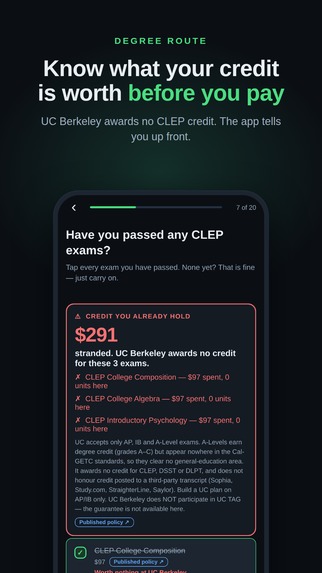
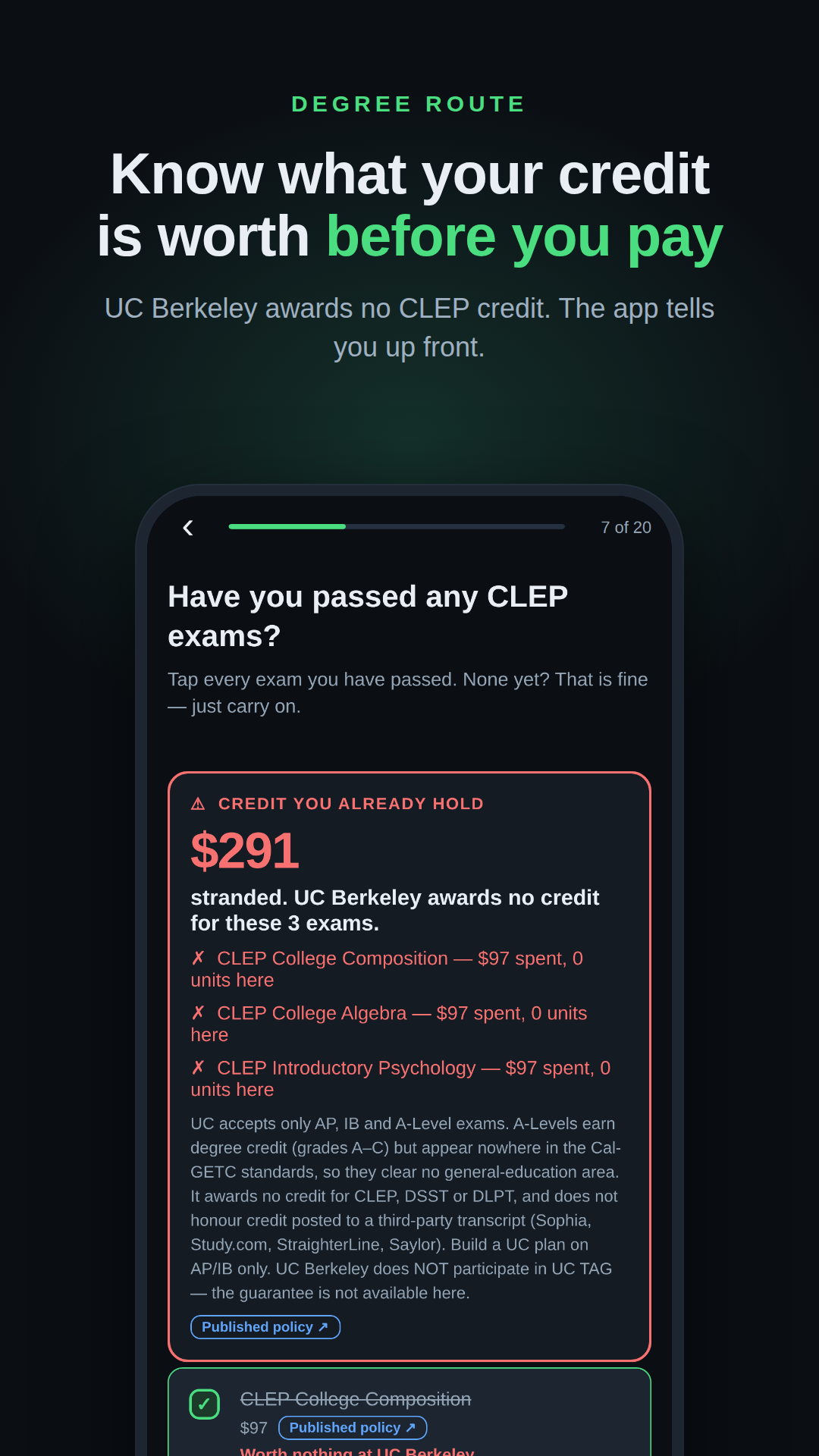
A friend sat three CLEP exams on the strength of a blog post that said they were "widely accepted". They were heading to a UC. The University of California awards no CLEP credit whatsoever — not reduced credit, not elective credit, none. Nobody had lied to them. The blog post was true somewhere else.
That is the whole problem in one sentence: transfer-credit advice is written nationally and enforced locally, and a student cannot tell which sentence applies to them until after they have paid.
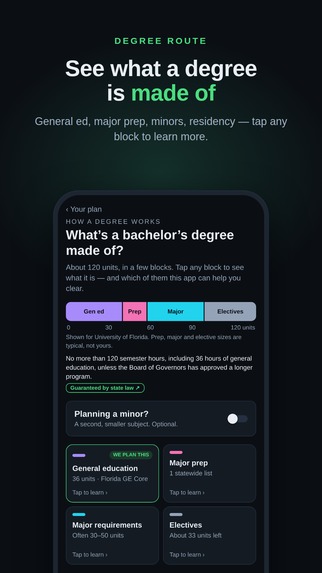
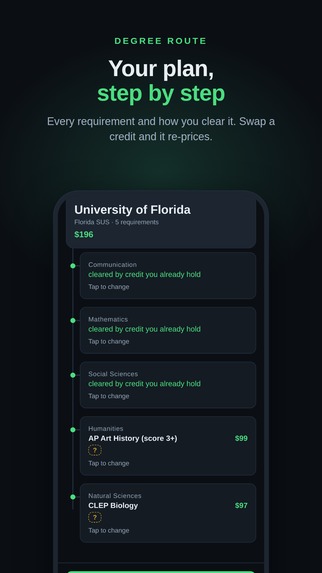
The number that decided it: the same three exams that are worth $0 at UC Berkeley clear three of the five general-education requirements at the University of Florida, dropping what that student still owes from $2,505 to $1,002. Same exams. Same scores. Same week.
What it does
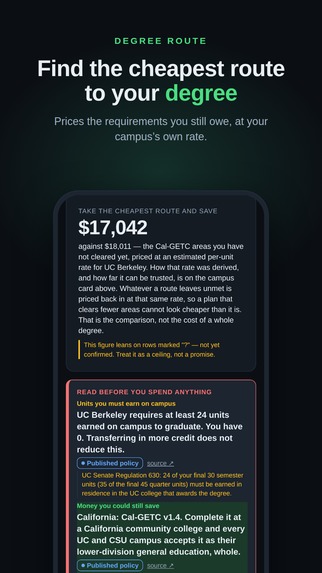
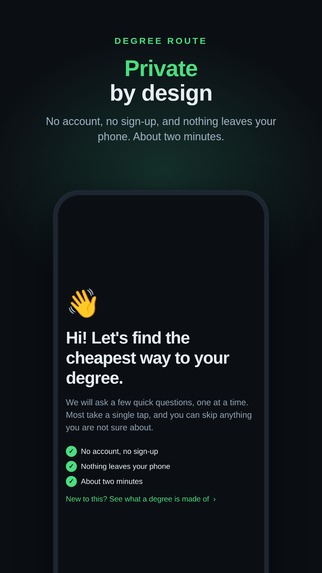
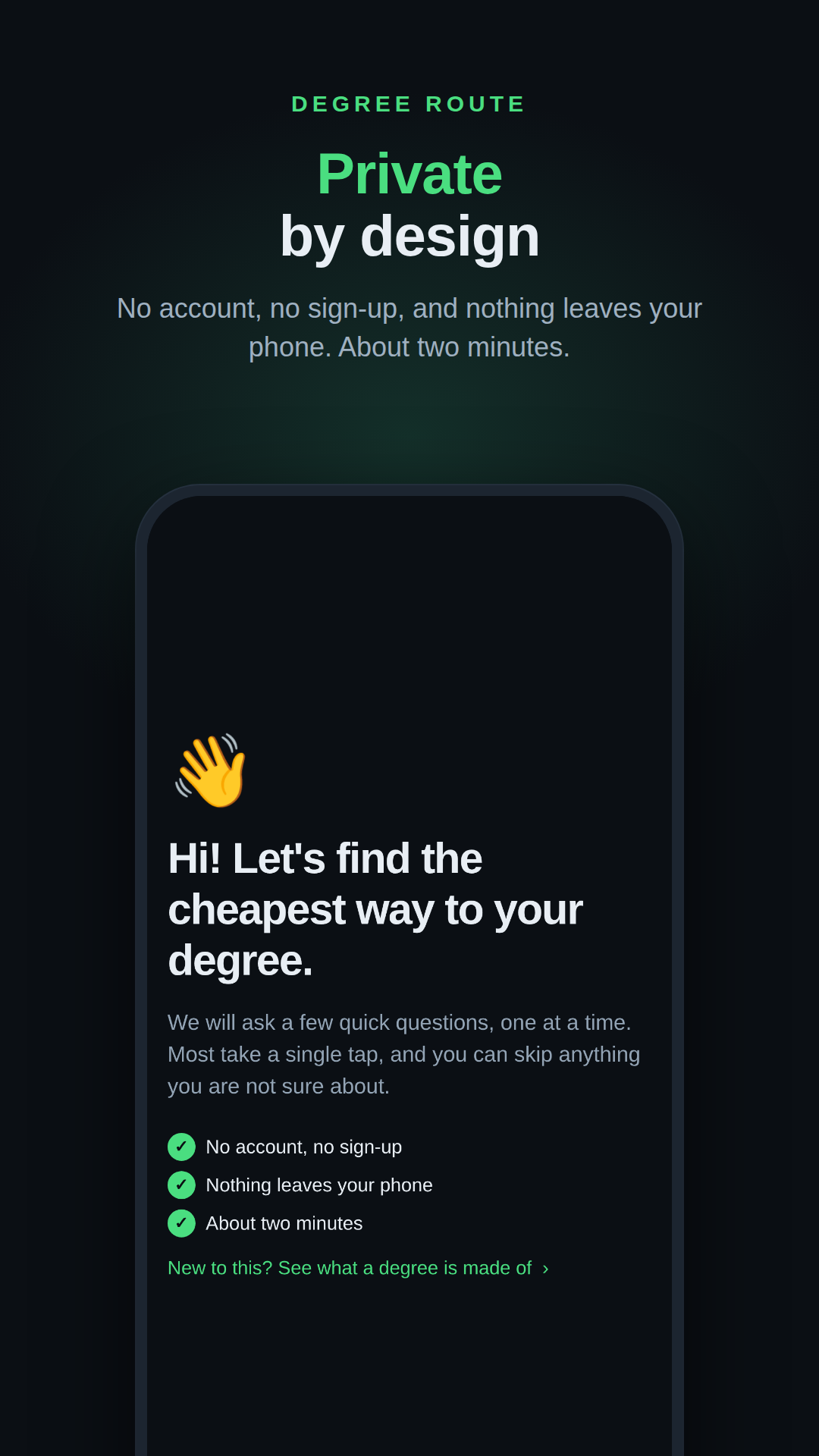
You answer a few quick questions, one per screen — year in school, rough field, what you can spend, whether you qualify for a fee waiver — pick a state and a campus, and say which credit you already hold. Degree Route then prices the requirements you still have to clear, at that campus's own per-unit rate, and shows three ways to clear them:
- Cheapest — the least money, however many terms it takes
- Fastest — exams instead of semesters
- Lowest risk — only credit backed by statute or a published campus policy
From a first-year at UT Austin with nothing banked:
| Do nothing | Cheapest route | Saving | |
|---|---|---|---|
| UT Austin (Texas Core, 42 SCH) | $12,600 | $875 | $11,725 |
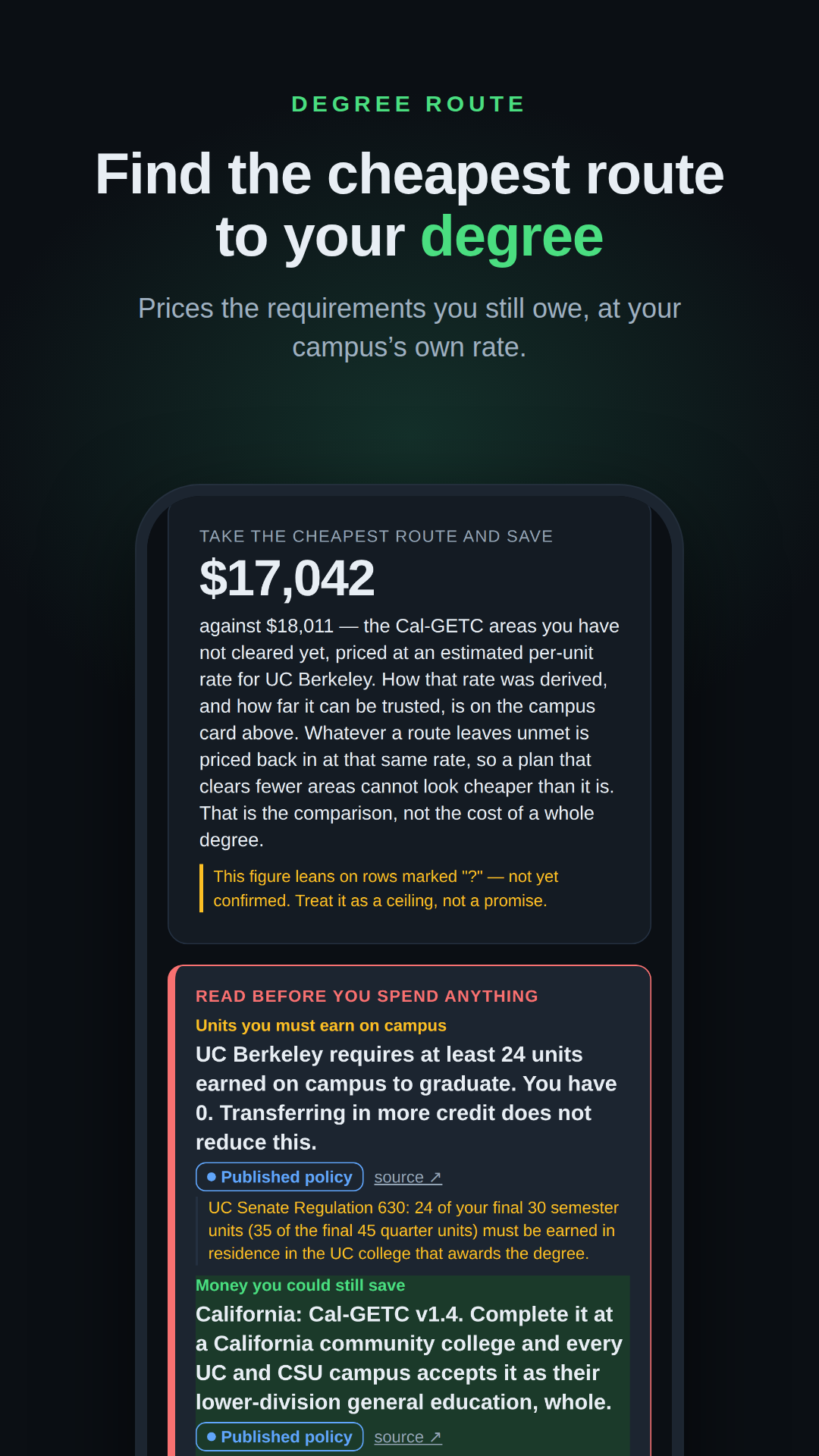
| UC Berkeley (Cal-GETC) | $17,825 | $969 | $16,856 |
| University of Florida (GE Core) | $2,505 | $487 | $2,018 |
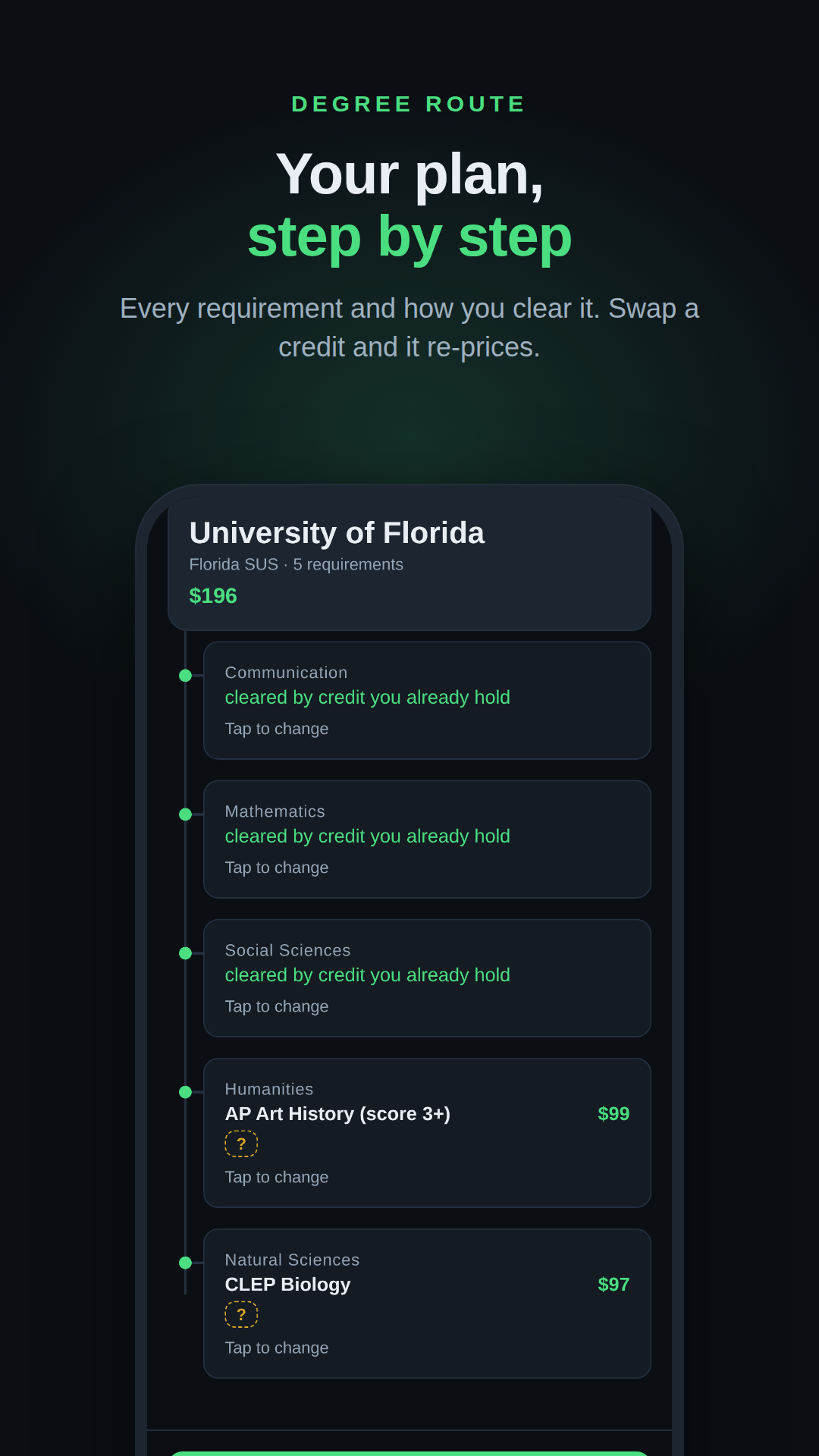
Then the part that matters more than the saving: every claim on screen carries its provenance — a source URL, the date it was last read, and a confidence level. Anything unconfirmed is badged in amber and excluded from the lowest-risk route by construction, not by convention.
The plan is a map, not a verdict. Tap any requirement to see every other credit that campus accepts for it, swap it, or say you are handling that one yourself — the engine re-plans and re-prices on the spot, and the plan persists on the device.
When you are ready, export an advisor packet: a printable page listing every row, every source, and — set apart at the top — the specific rows an advisor needs to confirm. There is a second version framed for a parent or guardian, with the same evidence and the same unconfirmed rows still marked. Softening those for a parent would be exactly the dishonesty the document exists to prevent.
How we built it
Expo SDK 57 / React Native 0.86 / React 19.2, TypeScript in strict mode, no any.
The core is a pure planning engine with no React in it — it takes a dataset and a student, and returns routes. That boundary is why it can be tested in Node with no renderer, and it is where the real correctness work lives: one credit can only be spent once (AP English Literature clears 1A or 3B, never both), an exam that clears two requirements is charged once, and a route's unmet requirements are priced back in so a plan that clears less can never look cheaper than it is.
The dataset is typed TypeScript modules rather than JSON, so a malformed row is a compile error. It currently holds 79 public campuses across three states, 25 requirement areas, 113 credit sources across eight credit families — AP, IB, Cambridge A Level (what Florida calls AICE), CLEP, DSST, DLPT, community-college courses and third-party providers — and over 5,000 acceptance rules. That is every family in Florida's credit-by-exam statute still being sat today, plus the two that are not exams at all.
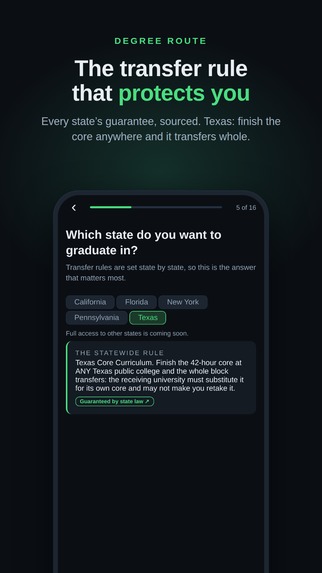
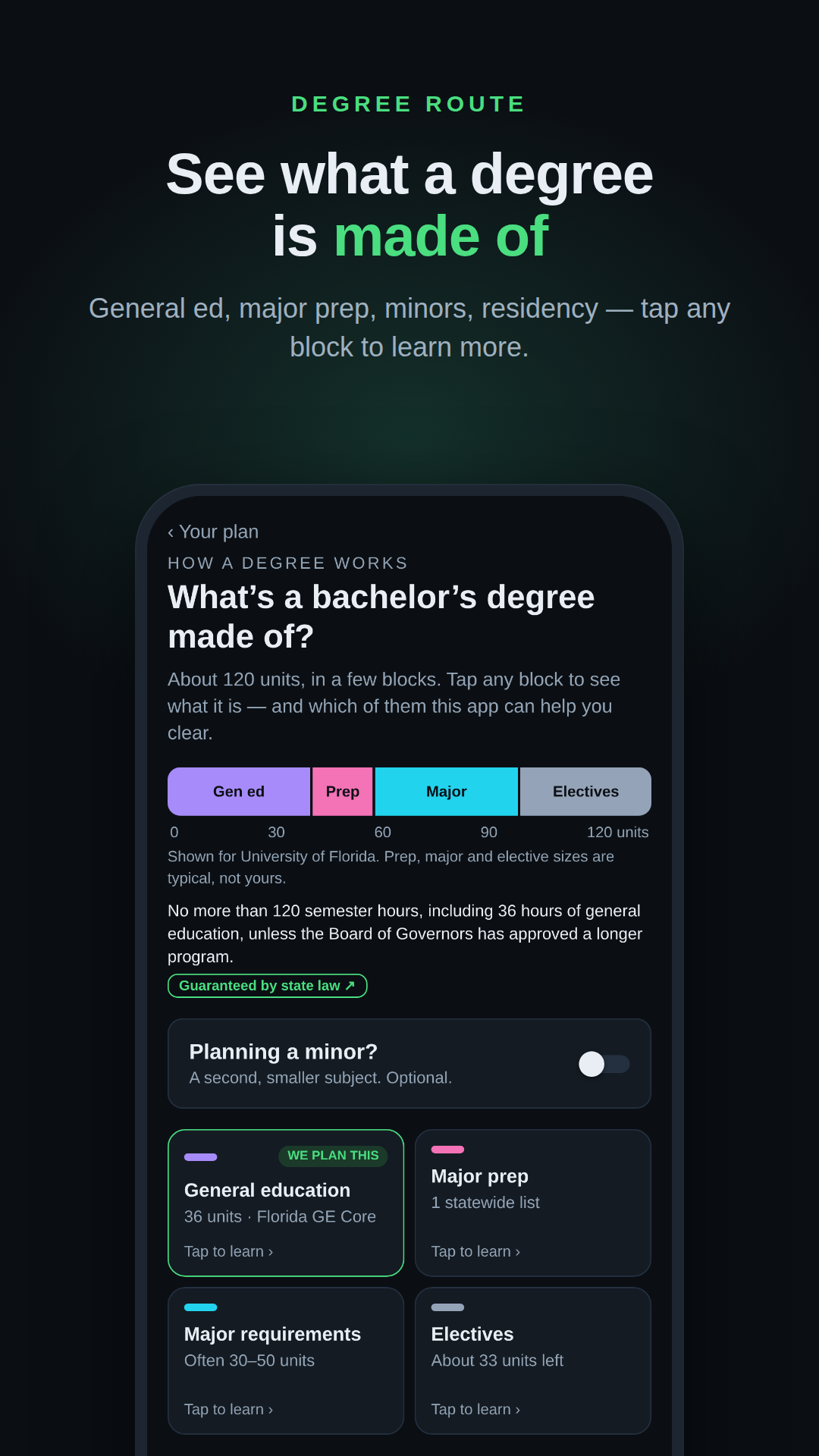
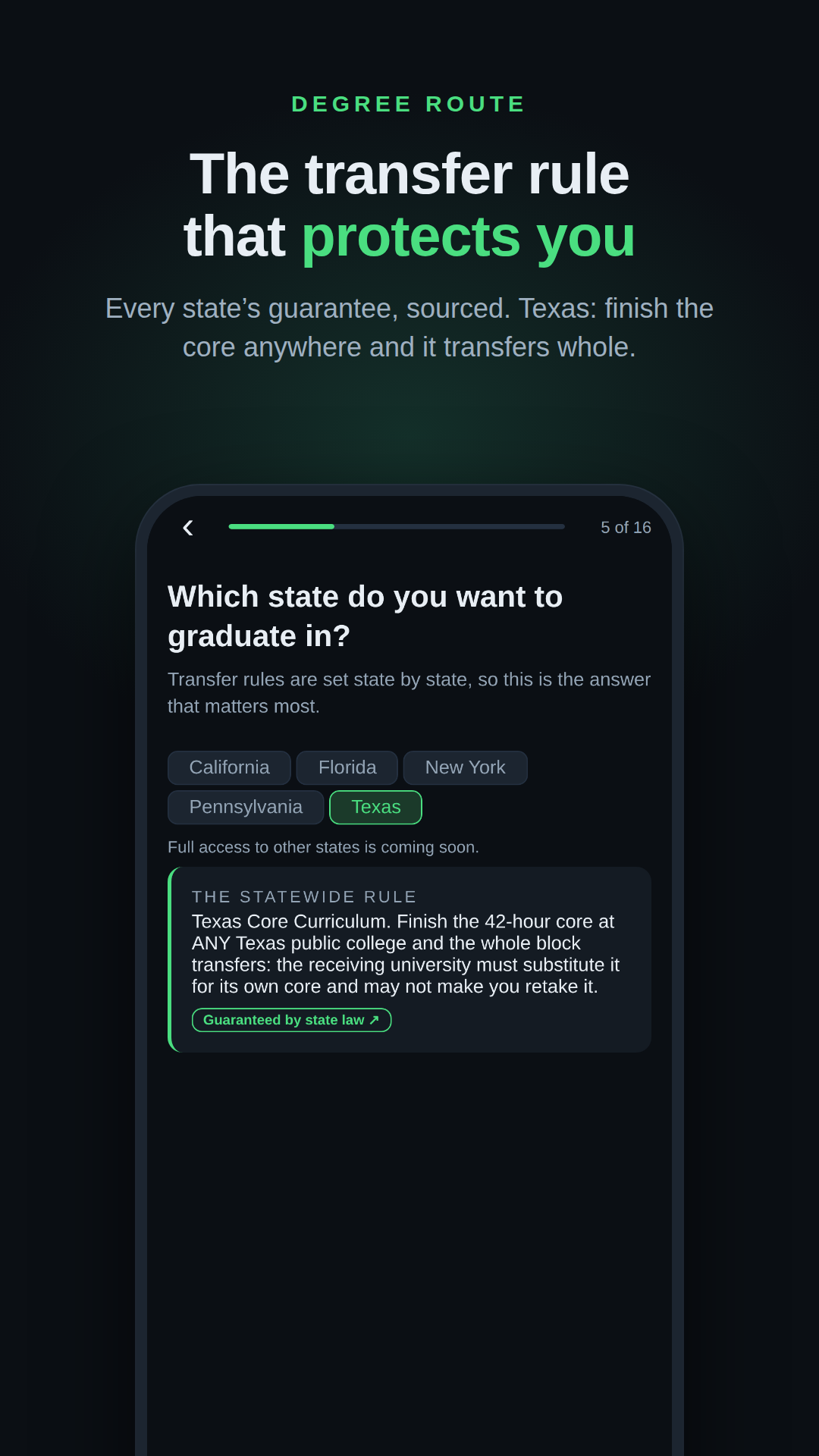
Coverage is deliberately two-tiered and the app never blurs them. Campus-level planning — the part that produces a number — is California, Texas and Florida. On top of that sits a statewide layer: 25 of the 51 US jurisdictions carry their actual statewide transfer rule (Ohio Transfer 36, the Illinois Articulation Initiative, the Michigan Transfer Agreement, Missouri's CORE 42, Arizona's AGEC…). That rule applies to every public campus in the state at once and is usually the most valuable thing a student can be told. The remaining 26 say honestly that we have not confirmed one.
RevenueCat powers the one-time advisor-packet unlock on both platforms:
react-native-purchases + react-native-purchases-ui (Paywalls and Customer
Center) on device, @revenuecat/purchases-js (Web Billing) on the web. Metro's
platform resolution picks the implementation, so nothing in the app knows which
one it got. With no key configured the app still runs end to end and the paywall
simply reports that purchases are unavailable — it does not crash and it does not
hide anything.
57 tests, and the ones worth naming are invariants rather than examples: no campus can be handed another state's requirements; every rule points at rows that exist, in the right framework; every campus in the country plans without producing a negative saving or spending a credit twice.
Challenges we ran into
Every interesting bug was a wrong number that looked right.
An early build showed the lowest-risk route as the biggest saver — "$0, saves
$9,933, clears 0 of 10" — because saving was computed as baseline − cost, which
credits a route for everything it never touched. An empty plan is the cheapest
plan. Savings now count only what a route actually clears.
The engine invented policy. For a campus/exam pair we held no rule for, it emitted "UC Berkeley counts this toward your degree" — a sentence no source supported. It now says "We have no record of how UC Berkeley treats this," which is less satisfying and true.
AP mappings were guessed and the guesses cost money: AP Biology clears 5B and
the 5C laboratory, so students were being sent to sit a lab they had already
satisfied. Fixing it meant satisfies_area: string had to become
satisfies_areas: string[], because "and" and "or" are genuinely different
things and a single field cannot hold both.
Going national surfaced the nastiest one. effectiveCost zeroed community-college
fees for any waiver-eligible student — correct in California, which has the
College Promise Grant, and wrong in Texas and Florida, which have no statewide
equivalent. It would have under-priced every route in those states, in the
student's favour: the direction a wrong number never gets caught, because
nobody complains that they saved too much. The waiver is now a property of the
jurisdiction.
And one that ate an afternoon: Metro inlines process.env.EXPO_PUBLIC_* at
transform time and caches the result, so changing the RevenueCat key and
rebuilding silently baked the stale one into the bundle. The key read as an empty
string through several rebuilds. build:web now passes --clear.
Accomplishments that we're proud of
The app tells you when it does not know. In Texas and Florida the lowest-risk route comes back empty, and says so: "We have not yet confirmed any credit for UT Austin against its own published policy, so there is nothing here we would stake your money on." We could have made those states look as strong as California by relaxing one confidence level. The whole product would have been worth less.
Going from one state to three cost two lines of engine change, because scoping is a data invariant rather than a filter — a requirement names the systems that require it, so a Texas campus cannot reach a Californian requirement even though both live in the same array. A test asserts it rather than trusting it.
And the thing we would ship even if nothing else survived: a student who has already spent $285 on the wrong exams is told so, on the first screen, before they are asked for anything.
What we learned
Statewide law is worth more than any campus's policy page, and no campus page will ever tell you about it — because it is not theirs to give. Texas Education Code §61.822 says a completed 42-hour core transfers as a block the receiving university must substitute. Florida §1007.23 has guaranteed AA holders university admission since 1972. Those two sentences are worth more to a student than every exam on their plan put together, and they surface above the routes now, not beneath them.
We also learned to read the limits as carefully as the promises. Florida guarantees admission to a state university — not the one you want. The app says that in the same breath as the guarantee.
What's next for Degree Route
- Read Florida's Rule 6A-10.024 equivalency table. One binding document that every public institution in the state must follow. Reading it flips every Florida AP and CLEP row from "needs confirming" to statute in a single pass, and turns Florida's empty lowest-risk route into the strongest demo in the app.
- Promote the statewide layer from
needs_checkto statute. All 25 rules are one document away each. Ohio Transfer 36, Illinois IAI, Michigan MTA and Missouri CORE 42 cover the largest student populations. - Campus pricing for those states, in the same order.
- Third-party credit providers (Sophia, Study.com, Saylor, StraighterLine,
TEEX, Modern States) are listed with price, who recommends them and — the
field that actually decides their worth — whose transcript the credit lands
on. UC publishes a refusal for all of them, so a UC-bound student is told
before they subscribe. See
docs/CREDIT-SOURCES.md. There are also some courses with ACE recommendations for transfering to colleges, but not implemented in the app yet. - Out-of-state coursework. A student who studied in one state and is heading to another is currently told to retake requirements they may already hold. The app can now show them both states and still cannot connect them — which got more pressing with three states in the dataset, not less.
- Community colleges as destinations, which matters most in Florida, where the statutory guarantee attaches to the Associate in Arts rather than to the university.
Built With
- android
- expo-router-free
- expo.io
- node.js
- playwright-core
- react
- react-native
- revenuecat
- typescript
- vercel

Log in or sign up for Devpost to join the conversation.