-
-
-
-
Liquid Glass Immersive UI
-
Mobile Betting UI
Inspiration
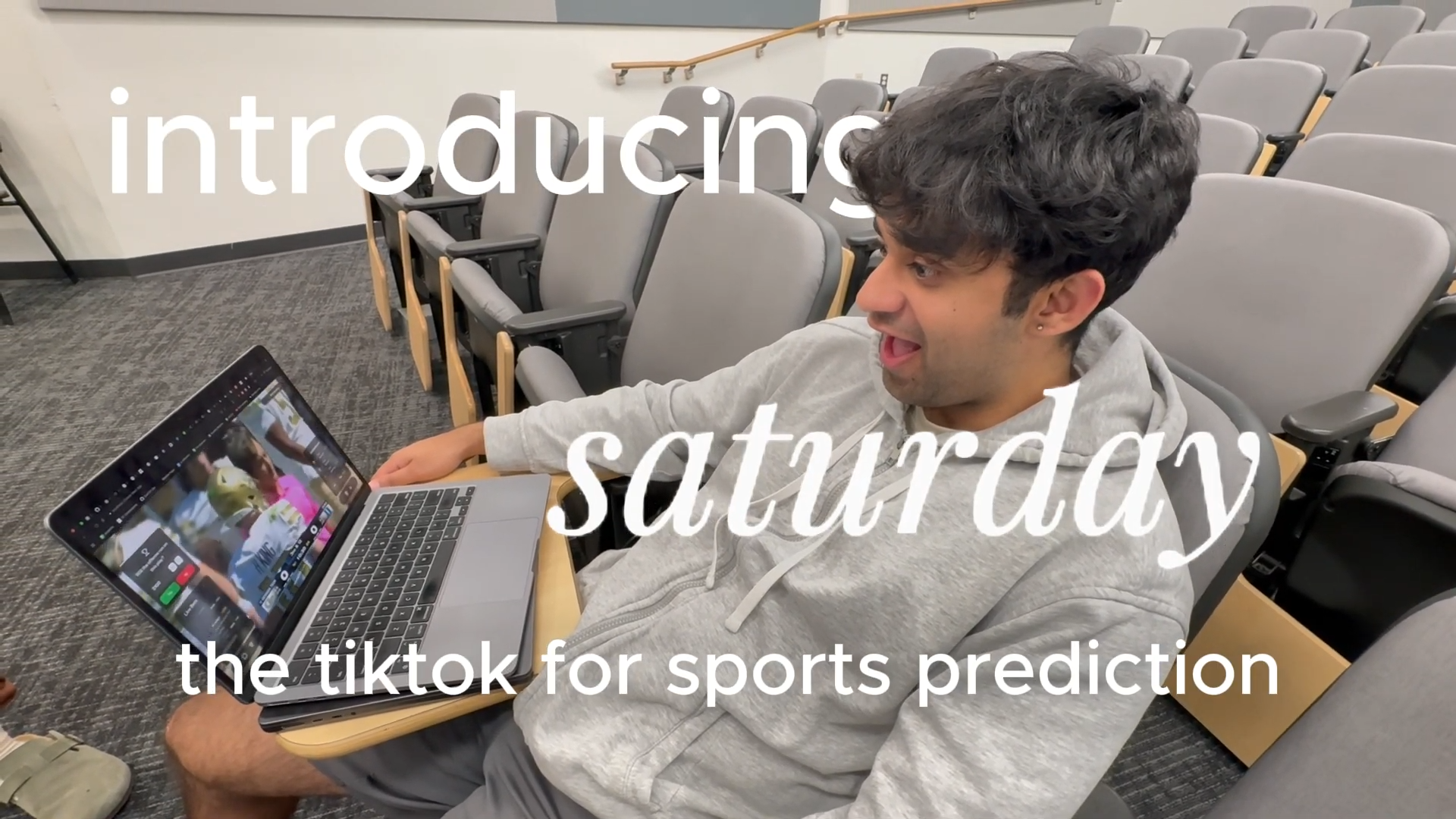
Most live prediction markets today feel disconnected from the actual action. Users have to constantly switch between the fast-moving game and separate predictive-market platforms, breaking the sense of immersion. Our team believed that prediction markets should be part of the excitement, not apart from it. We set out to build a platform where fans can stay fully engaged, where they can watch and predict all in one place, enhancing real-time sports engagement.
What it does
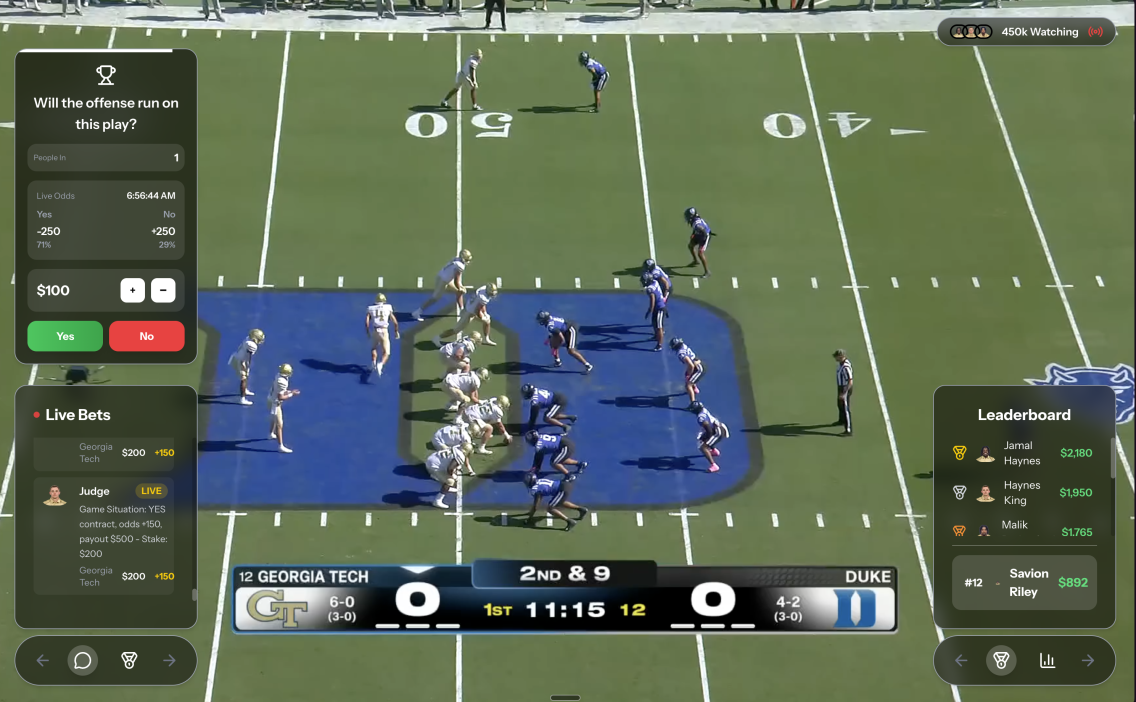
Our platform allows users to engage with live football and real-time prediction markets in one place. Users can switch easily between player stats, live game insights, and interactive chats with other fans through a clean interface that's simple to navigate through. At its core, the platform hosts built-in prediction markets that update odds with very low latency, allowing fans to place quick, in-the-moment micro-bets as plays unfold. Our AI Gemini agent continuously analyzes the live broadcast, interpreting frames in real time to understand game context and generate relevant predictions, such as whether the next play will be a run or a pass. Based on this analysis, another AI agent built off of Google's Agent Development Kit (ADK) automatically sets fair, balanced initial prices for all users. Designed with mobile users in mind, the experience stays smooth and engaging anywhere, whether you’re at the stadium, at home, or on the go.
How we built it
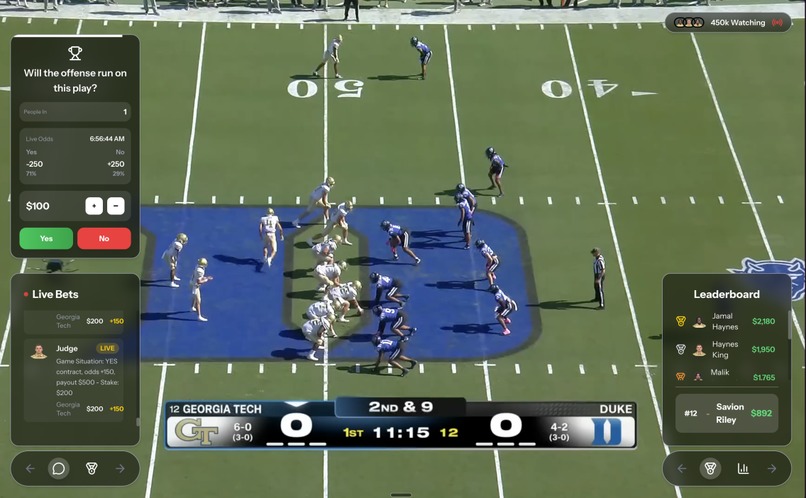
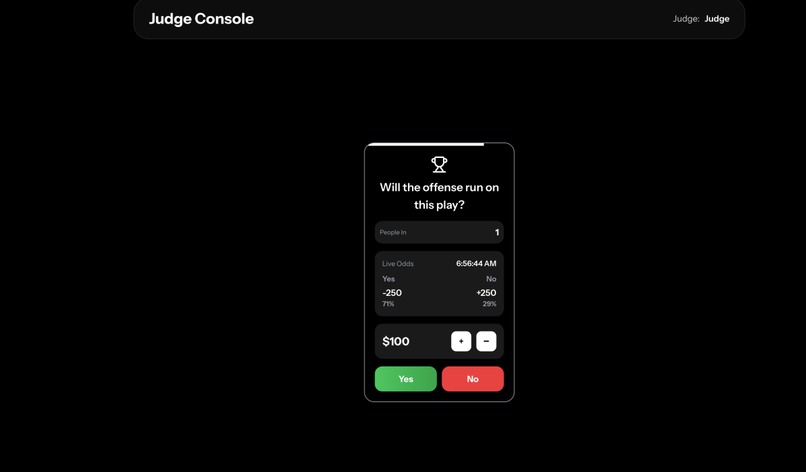
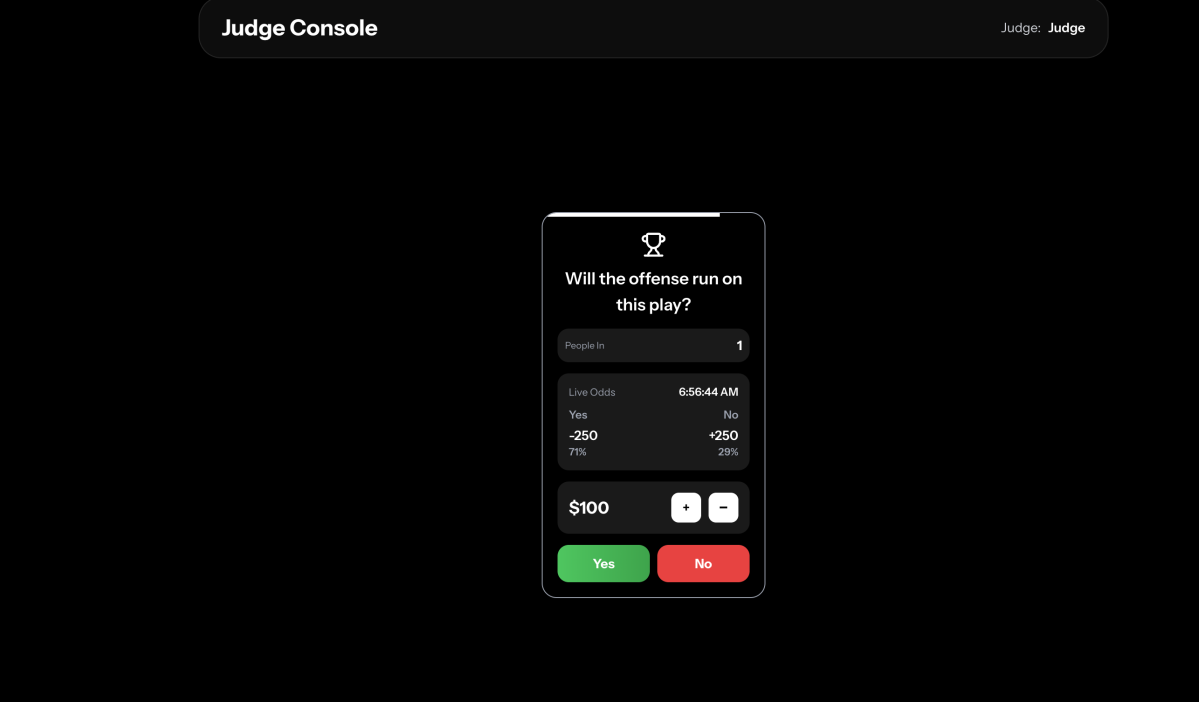
Our front end is a Next.js application that leans on Tailwind CSS, lucide-react, and Framer Motion to keep the experience lightweight and translucent for the game. This frontend was actually first designed utilizing Figma, in which one of our team members heavily prioritized the use of liquid glass pop-ups throughout the screen that allows the users to easily navigate through relevant information. The main overlay screen is a client-side route that holds timers, navigation systems, and prediction popups without leaving the single-page experience, so users stay immersed in the stream. Supporting pages such as the judge console reuse the same design system so everyone, from the AI desk to human adjudicators, sees a consistent control surface.
The overlay is directly over the live video feed: when no market is open it captures a frame every three seconds, encodes it, and calls our endpoint to form the next microbet prompt on the spot. Once a bet is looked upon, the same page spins up a MediaRecorder session on a down-sampled canvas, streams 3‑second clips back to /analyze-video, and keeps polling until Gemini confirms whether the market resolved, which lets us auto-close the popup and show whether the majority of the community was right (either Yes or No). Those interactions happen entirely on-device, so that users see the bets changing live without losing their view of the game.
Our backend is a Flask service with CORS enabled so every device can hit it in real time. We initialize Google’s Gemini client on Vertex AI to keep latency low, then expose our /analyze-picture and /analyze-video endpoints that accept inline blobs, enforce JSON schemas for down/distance/yard-line, and request structured responses from gemini-2.5-flash-lite. The same service handles bet resolution by comparing fresh clips against the original bet definition, normalizes rate-limit errors into client-friendly responses, and provides a text-only fallback endpoint for testing without media.
Behind that, we run a second-stage statistician built with Google’s ADK so every Gemini snapshot is validated by a deterministic schema, run through a compliance-focused prompt, and converted into a single “precision stat” yes/no contract pricing before the bet hits the market. This allows for initial users who first predict to not have an unfair advantage over other users. We had a helper method that nudges the implied probability based on down, distance, field position, and punt likelihood so we can quote transparent $1 binary contracts that stay within 5–95% odds.
All of those insights are then written to Supabase, streaming Postgres changes directly into the overlay and judge consoles. The schema seeds a bets table with RLS-friendly policies, indexes for judge/status queries, and realtime publication so every wager, resolution, and payout propagates instantly to the UI. This allows for quick updates on prices that remain relevant according to whichever option most users are willing to predict. Judges can accept or cancel bets from their console, while spectators watch the odds move in real time, completing the entire desired loop from live feed to AI interpretation, statistical sanity-check, market making, and cash-out.
Challenges we ran into
Prompt engineering was by far the hardest part of this project. Given that we used an LLM to process live game input, generate accurate game metrics based on the frame(s), and generate a relevant predictive question in a timely manner, we had to do a lot of prompt engineering to ensure that the JSON schemas from the Gemini model were actually concise. We had to do a lot of trial and error to work out the perfect response from the LLM while ensuring that token usage was not unsustainably large.
Accomplishments that we're proud of
We’re proud of how our team brought together design, AI, and real-time data engineering into one cohesive experience. Using Figma, we designed a clean, liquid-glass interface that keeps the live game visible while allowing users to navigate stats, predictions, and chats. Ultimately formed a distraction-free experience where fans can focus on both the game and their predictions.
On the backend, we're also really proud to have built a high-performance real-time database that instantly updates odds and market values as plays unfold using mathematical formulae. We also simplified our AI architecture from a four-stage pipeline to a faster two-stage system that pulls live feedback from the database.
What we learned
Throughout this project, we learned how challenging it is to build a real-time AI system that stays in sync with live ongoing events. We saw firsthand how important low latency, clean data flow, and tight integration between AI and database systems are for user experience. Working with Gemini taught us a lot about structuring prompts and handling real-time model feedback, especially real-time image interpretation.
What's next for Saturday
We look forward to make Saturday more applicable for other popular sports that hold fans all around the world that look for more engagement. As of right now, Saturday is largely revolved around American Football, however, if this shows a great impact on the viewing and engagement experience for users, it's a great opportunity to expand this to other popular sports like soccer or basketball.


Log in or sign up for Devpost to join the conversation.